-
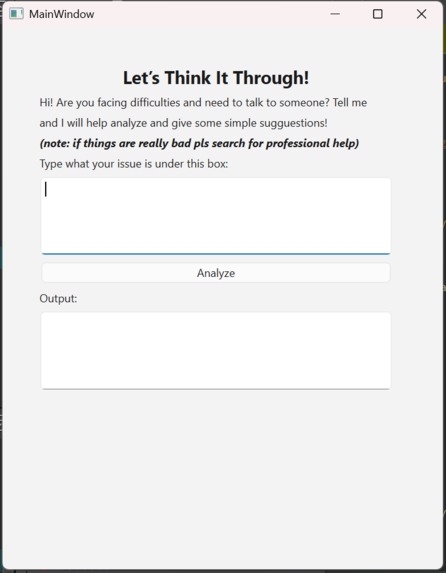
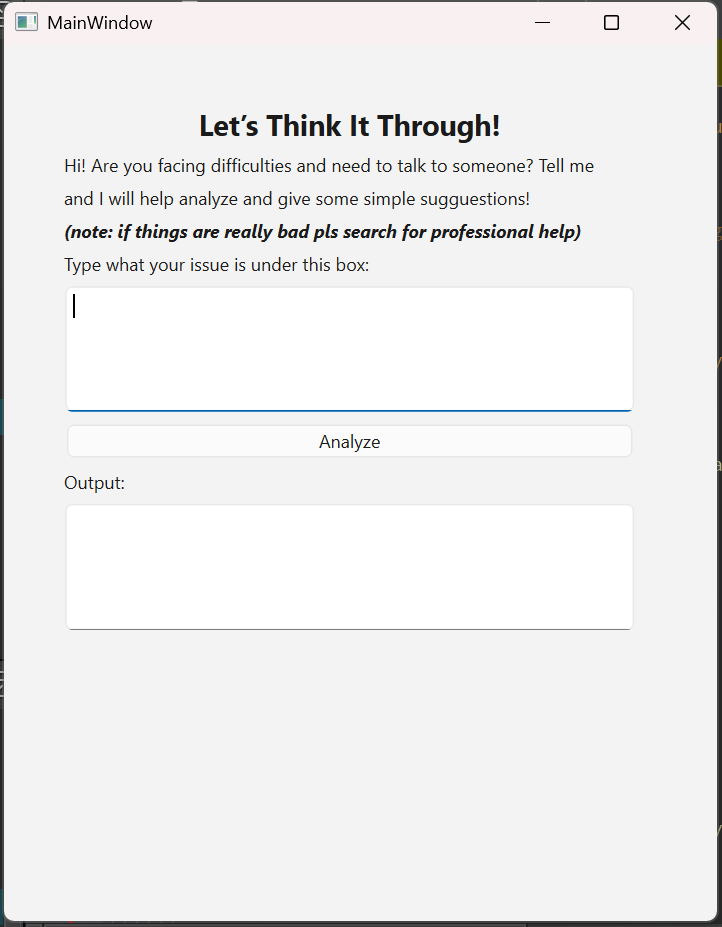
default page after the project runs
-
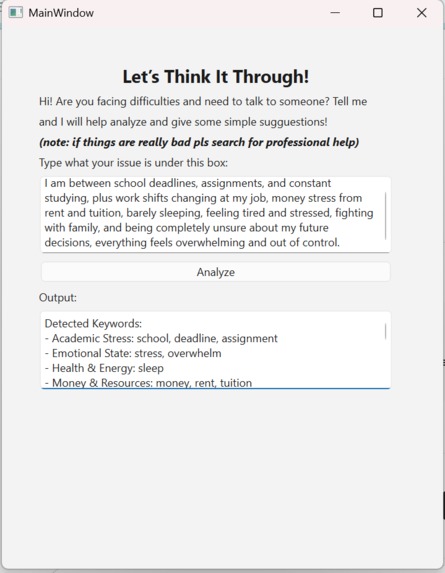
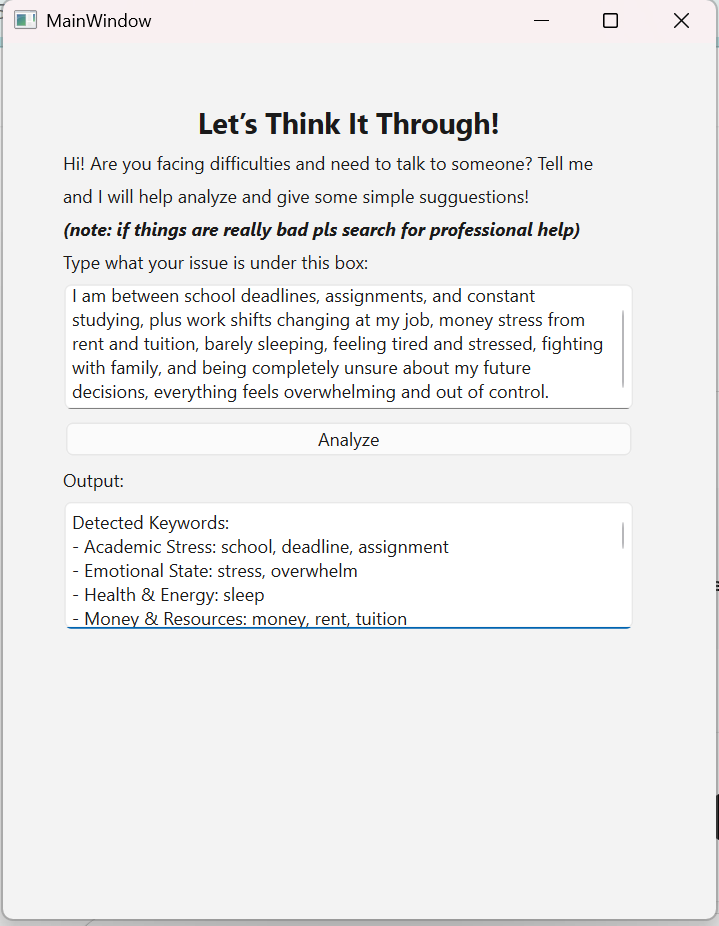
test run display
Inspiration
The idea came from observing how people often vent to friends when they are overwhelmed, but struggle to organize their thoughts. Many problems are a mix of controllable habits (sleep, schedule, stress management) and uncontrollable constraints (deadlines, exams, rent, bosses). When everything is blended together emotionally, it becomes hard to know where to start. Instead of building a chatbot that gives advice, this project focuses on clarifying the structure of the problem first. The output is meant to feel like a calm breakdown rather than a judgment or solution.
What it does
Lets_Think_It_Through is a lightweight desktop application that analyzes free-form text input and extracts key themes from it. It identifies topics such as academics, work, health, emotions, time pressure, and finances, and then separates what parts of the situation may be changeable from what is likely outside the user’s control. The app also suggests neutral areas to focus on (such as time management, rest, or communication) based on the detected themes. It does not provide direct advice or solutions, but instead helps users better understand the structure of their situation so they can decide what to do next.
How we built it
The project was built in C++ using the Qt framework as a fully offline desktop application. User input is processed through a rule-based text analysis pipeline that includes tokenization, normalization, keyword grouping, and domain classification. Each detected keyword group maps to higher-level domains, which are then used to determine controllability and suggested focus areas. The UI was designed with Qt Designer and connected to the logic using Qt’s signal–slot system. All analysis runs locally without any server, database, or AI dependency, keeping the system transparent and easy to reason about.
Challenges we ran into
One major challenge was handling ambiguity in natural language. Certain words, such as “work,” can mean different things depending on context, so additional logic was needed to reduce misclassification. Another challenge was designing normalization rules that improved keyword matching without accidentally removing meaningful distinctions. Debugging UI wiring and ensuring that signals, slots, and object names matched correctly in Qt also required careful attention. Balancing simplicity with coverage in a purely rule-based system was an ongoing design tradeoff.
Accomplishments that we're proud of
- Building a complete, functional desktop app solo within a short hackathon timeframe
- Creating a fully offline tool with no external dependencies
- Designing an analysis system that is transparent and interpretable rather than opaque
- Successfully separating emotional, practical, and contextual aspects of user input
What we learned
This project reinforced how small design choices in text processing can significantly affect outcomes. It also provided hands-on experience with Qt application structure, UI–logic separation, and rule-based language analysis. Most importantly, it highlighted the value of building tools that support reflection rather than trying to automate human decision-making.
What's next for Lets_Think_It_Through
Future improvements could include expanding keyword coverage, improving contextual reasoning, adding weighting to highlight dominant themes, and optionally supporting AI-assisted keyword expansion as a non-required enhancement. The project could also evolve to support journaling or progress tracking while remaining privacy-focused and offline-first.

Log in or sign up for Devpost to join the conversation.