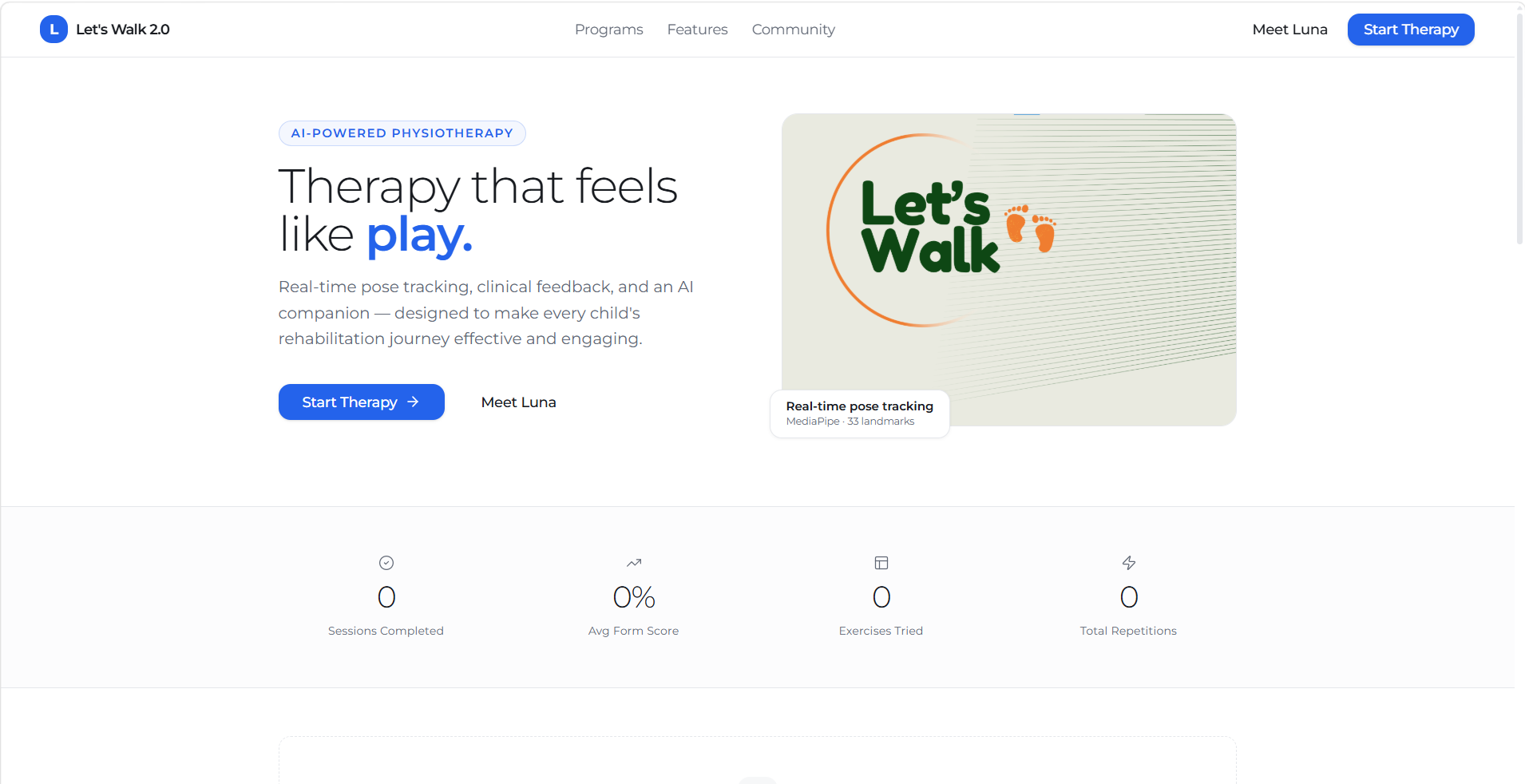
Inspiration Children with cerebral palsy have challenges with mobility often lack continuous, engaging rehabilitation support. Traditional physiotherapy can feel repetitive and discouraging. I was inspired to reimagine therapy as something playful, motivating, and clinically accurate — so families could access meaningful rehab anywhere. and not just for children with cerebral palsy but any one who wants an AI powered helper to work out from home.
What it does Let’s Walk 2.0 uses AI‑powered motion tracking with Google MediaPipe Pose to guide physiotherapy exercises. It calculates joint angles, applies medical rules, and gives real‑time feedback with visual overlays and an AI voice coach. Gamification adds badges, streak counters, and adaptive levels, while caregivers receive session reports with posture scores, crouch meters, and reach smoothness metrics.
How we built it We structured the pipeline into three layers: Detection: Captured 33 landmarks with MediaPipe Pose. Calculation: Computed joint angles using vector math. For example, the angle at a joint B between points A–B–C is found by comparing the slopes of AB and BC. Feedback: Applied physiotherapy rules (squat depth, posture warnings, rep counting) with green/red overlays and audio cues. Gamification & Clinical Modules: Added badges, streak counters, and modules for Sitting Stability, Crouch Gait, and Upper Limb Reach.
Challenges we ran into Balancing medical precision with user‑friendly design. Ensuring smooth real‑time tracking without lag. Designing gamification that motivates without distracting. Limiting integrations to camera‑only tracking since wearables weren’t available. Some high-level functions need more time to further refine and make more accurate
Accomplishments that we're proud of Built a functional AI physiotherapy app that transforms therapy into play. Implemented 15+ distinct clinical measurements across three modules. Created real‑time feedback overlays and automated rep counting. Designed gamification features that keep children engaged and motivated.
What we learned How to translate raw pose data into meaningful medical metrics. The power of gamification in improving therapy adherence. That AI guidance can make therapy more accessible across languages. How to structure a pipeline that balances clinical rigor with usability.
What's next for Let’s Walk Application Expand language support with translation APIs. Add more therapy modules for diverse conditions. Improve reporting with interactive dashboards. Explore AR mini‑games to make therapy even more immersive. Build caregiver community features for shared learning and support.
Built With
- 33-landmarks)-optional:-translation-apis-for-multilingual-chatbot-guidance-optional:-voice-feedback-plugin-for-ai-coach-other-technologies-lucide?react-(icon-set)-react-router-(navigation)-custom-hooks-(usetherapyprograms
- and-one?click-deployment)-cloud-services-medo?s-deployment-pipeline-(hosting-and-public-url-generation)-cloud?based-pdf-export-for-session-reports-databases-react-state-management-(hooks
- languages-natural-language-prompts-(to-scaffold-features-in-medo)-javascript/typescript-(for-custom-logic-and-ui-tweaks)-frameworks-react-(ui-components
- plugin-integration
- routing)-framer-motion-(animations-and-transitions)-tailwindcss-(styling-and-responsive-design)-platforms-medo-ai-(core-hackathon-platform-for-conversational-app-building
- usememo)-medo?s-built?in-data-handling-(no-external-db-required-for-prototype)-apis-google-mediapipe-pose-(real?time-motion-tracking

Log in or sign up for Devpost to join the conversation.