-
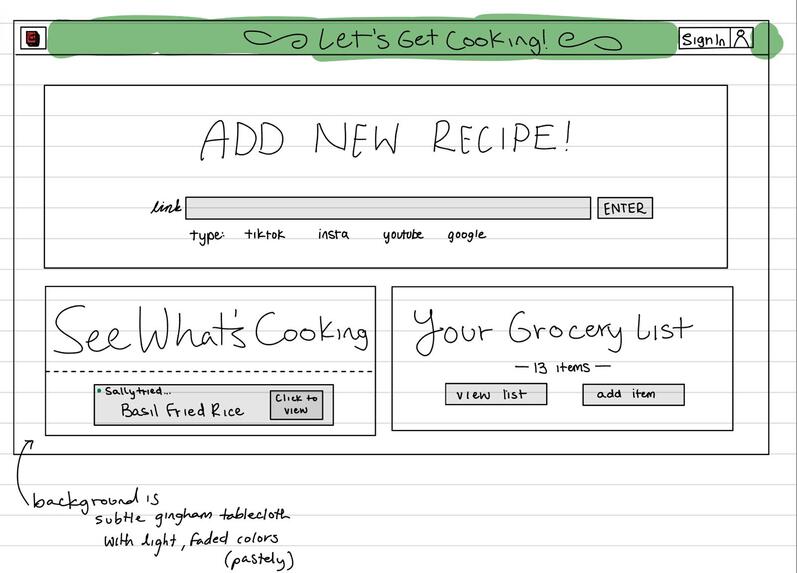
Mock-up of what we wanted the UI to look like.
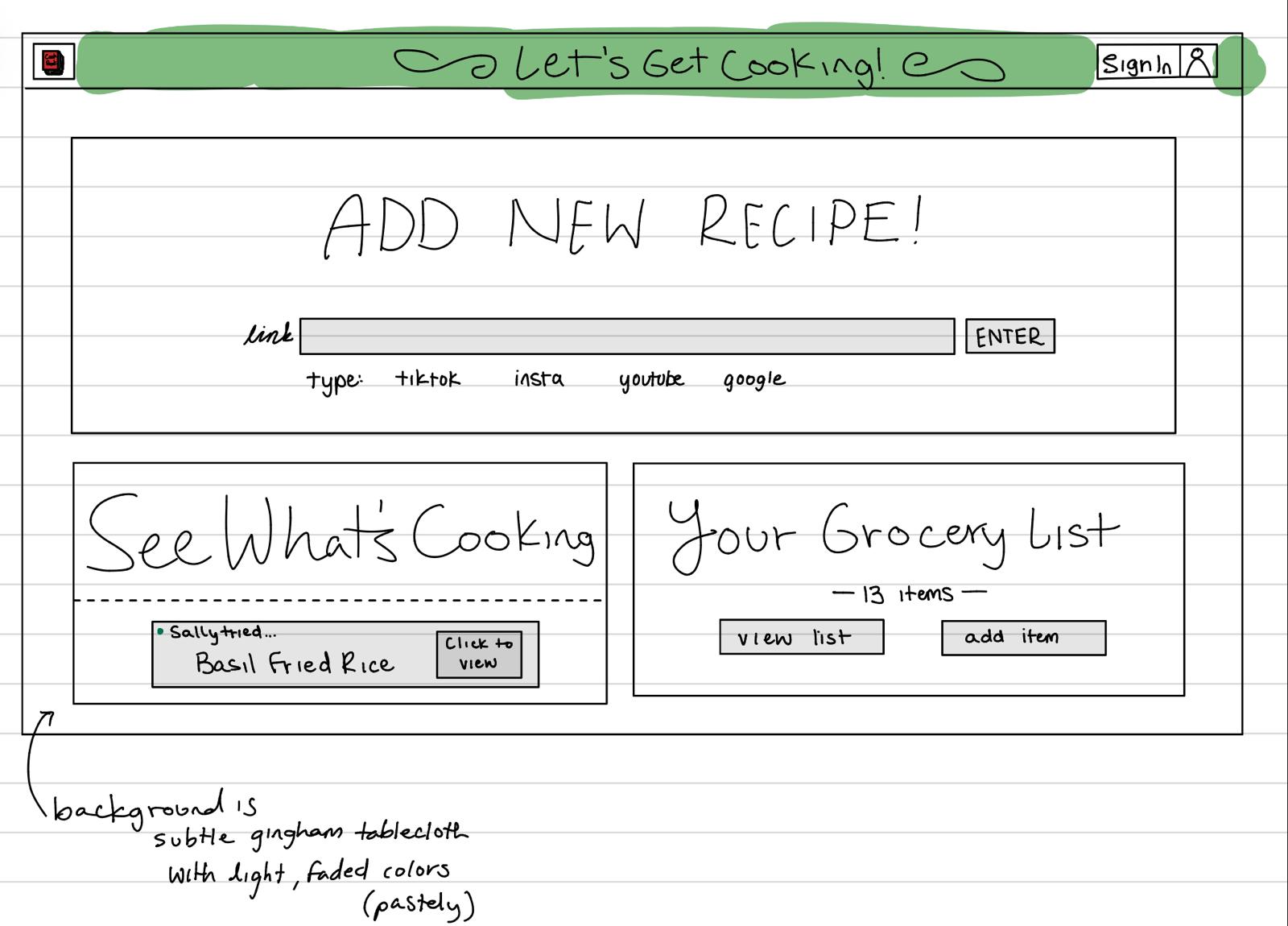
Let's Get Cooking
Inspiration
We've all experienced finding the perfect recipe on TikTok, Instagram, or a website, only to lose it when we're finally ready to cook. Even when we save recipes, they're often scattered across different platforms, making it difficult to find them again or follow along while cooking.
We wanted to create a solution that made cooking more accessible, organized, and personalized. That's how Let's Get Cooking was born: an AI-powered recipe organizer that brings recipe discovery, customization, and grocery shopping together in one place.
What It Does
Let's Get Cooking transforms recipe links from social media and websites into standardized, easy-to-follow recipes that users can save in their personal digital cookbooks.
Our application includes several key features:
- AI-Powered Recipe Importing: Paste a recipe link and let AI organize the ingredients, instructions, preparation time, and other important details into a consistent format.
- Personal Digital Cookbook: Save and organize recipes in an account-specific cookbook that persists across sessions.
- Sous-Chef AI: Chat with an AI cooking assistant to ask questions, make ingredient substitutions, adjust recipes, and create personalized variations without losing the original.
- Smart Grocery List: Add grocery items to a personalized list that saves across sessions. Check items off as you shop to automatically remove them.
Our goal was to simplify the entire cooking experience, from discovering a recipe to preparing the final meal.
How We Built It
We built Let's Get Cooking as a full-stack web application using React and Vite for the frontend and Python with FastAPI for the backend.
We integrated Google Gemini to power our recipe extraction and conversational Sous-Chef assistant. Gemini processes recipe information into structured data and generates updated recipes based on users' requests, such as substituting ingredients.
For authentication, we implemented Auth0, allowing users to securely log in and access their own personalized cookbooks and grocery lists. We used TigerData (PostgreSQL) to store recipes and grocery items, connecting our frontend and backend through REST API endpoints to create, retrieve, and delete data.
Throughout development, we divided responsibilities across frontend development, AI integration, authentication, and database management, bringing each component together into one cohesive application.
Challenges We Faced
One of our biggest challenges was integrating several different technologies into a functioning application within the limited timeframe of a hackathon.
Connecting Auth0 authentication to our FastAPI backend and TigerData database required us to manage access tokens, authenticate requests, and ensure that each user could only access their own saved data.
We also encountered challenges with AI integration, including API configuration, handling unsuccessful requests, and ensuring that AI-generated recipes followed a consistent structure.
Another interesting challenge involved managing recipe variations. Initially, when users asked Sous-Chef AI to substitute an ingredient, the updated recipe could overwrite the original in the interface. We worked on separating original recipes from AI-generated variations so users could experiment with substitutions while preserving their favorites.
Finally, implementing persistent grocery lists and cookbooks required us to coordinate frontend state with database operations so that changes would remain consistent across sessions.
What We Learned
Building Let's Get Cooking gave us hands-on experience developing a full-stack application from the ground up. We learned how to connect React, FastAPI, PostgreSQL, Auth0, and Gemini into a single application, while managing the challenges that arise when different technologies need to communicate.
We also gained experience designing REST APIs, working with authenticated database requests, managing React state, and debugging issues across the frontend and backend.
Beyond the technical skills, we learned the importance of teamwork, communication, and adaptability. With limited time, we had to divide responsibilities, troubleshoot unexpected problems, and continuously integrate our individual contributions.
What's Next
We see Let's Get Cooking as more than just a digital cookbook. In the future, we'd love to expand its functionality by automatically generating grocery lists from saved recipes, implementing recipe-pulling from social media, and a network to connect with friends and see what they are cooking.
Ultimately, our vision is to make Let's Get Cooking an all-in-one cooking companion that helps users spend less time searching for recipes and more time enjoying the process of cooking.
Built With
- auth0
- chatgpt
- fastapi
- figma
- geminiapi
- react
- tigerdata
- vite
