-
-
-
logo
-
example
-
example
-
example
-
example
-
example
-
example


Inspiration
Online scams are everywhere today. Fake shopping websites, phishing emails, and suspicious links appear constantly, and many people only realize the danger after they have already lost money.
After personally encountering several online shopping scams, my friends and I started asking a simple question:
What if people could instantly understand the risk before clicking a message or link?
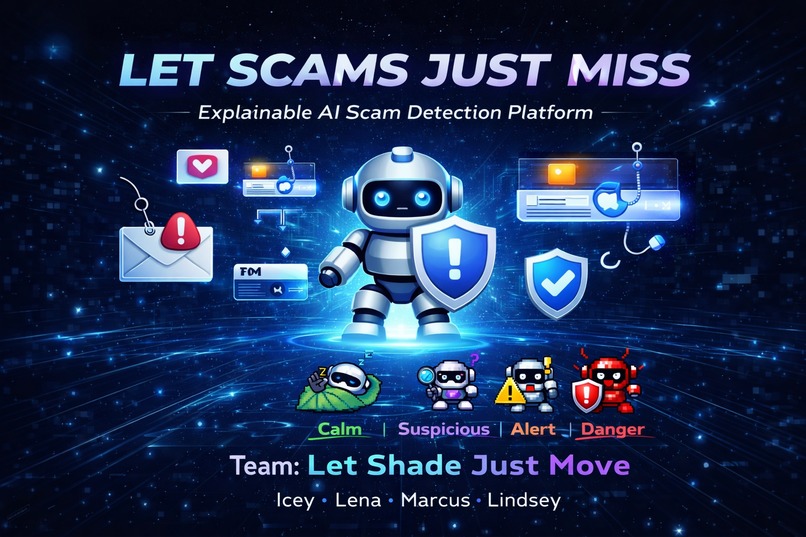
That question led us to build LSJM — Let Scams Just Miss, a tool designed to help users detect scams early, understand why something is risky, and stay safer online.
Instead of letting scams catch people off guard, we wanted to build something that helps users spot the warning signs before it’s too late.
What it does
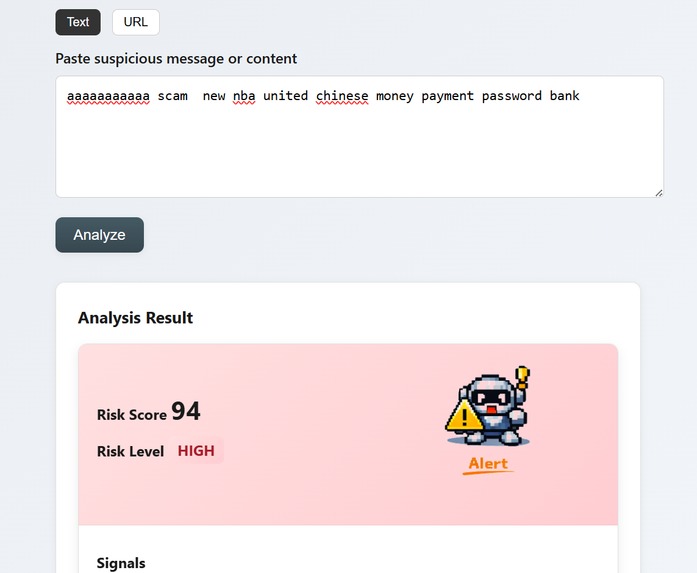
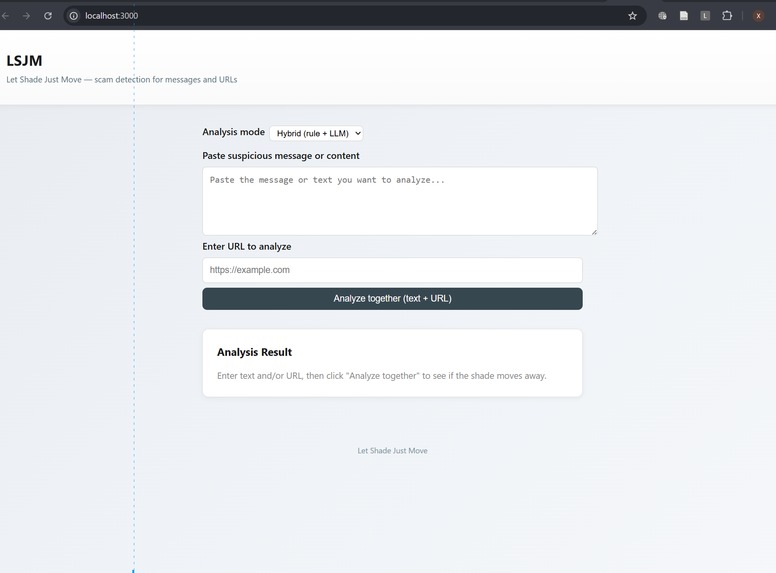
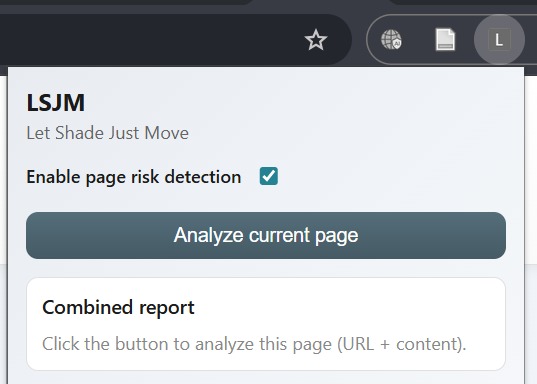
Let Scams Just Miss (LSJM) is an explainable AI platform with a web interface and browser extension that evaluates scam risks in messages and URLs.(Supports multiple languages)
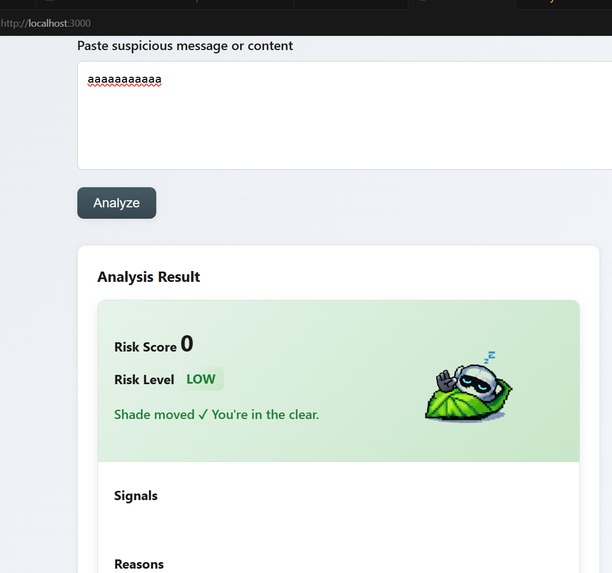
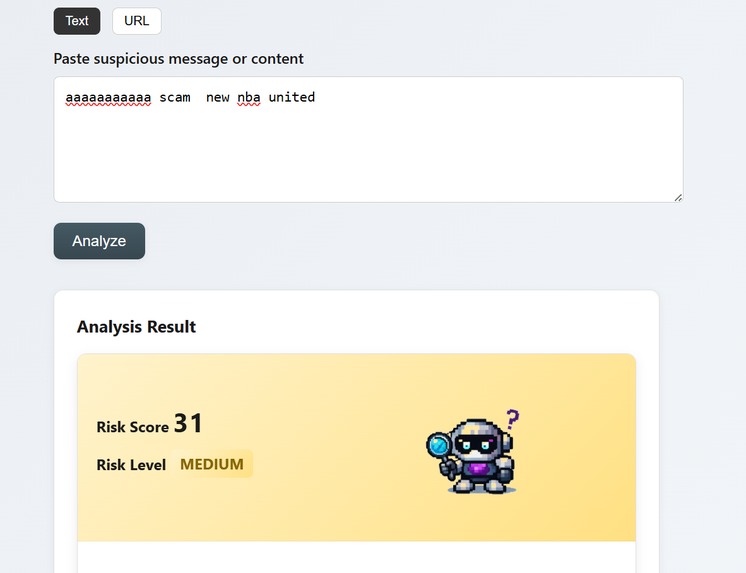
Instead of simply blocking content, LSJM analyzes the input and produces:
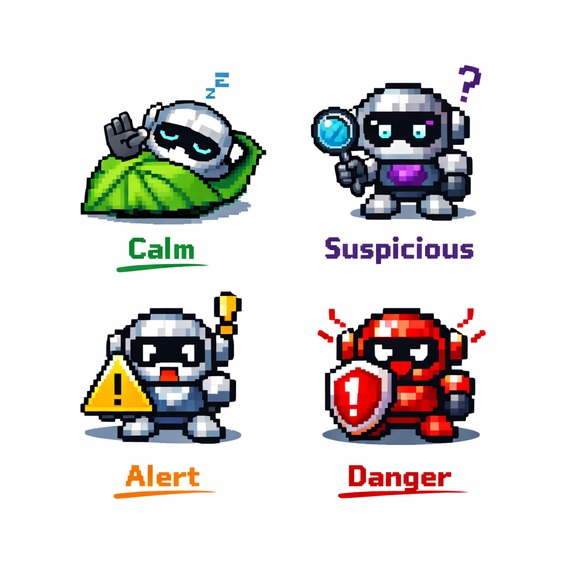
a risk score
detected suspicious signals
clear explanations
and recommended safety actions
This allows users not only to detect potential scams, but also to **understand why something is considered
How we built it
We built LSJM as a browser-based scam detection system with both a web interface and a browser extension, focusing on two major areas: text analysis and URL analysis.
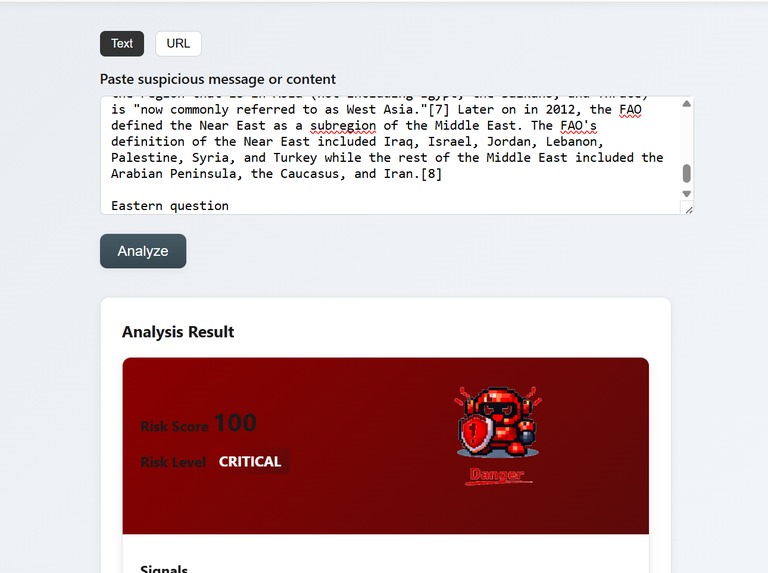
For text detection, we implemented a hybrid analysis pipeline that combines rule-based scam signals with LLM-assisted semantic analysis. The rule system detects known suspicious patterns and keywords commonly used in scam messages, while the LLM analyzes the semantic meaning, tone, and intent of the text. This hybrid approach allows the system to identify signals such as urgency, impersonation, or suspicious requests, and then generate clear explanations to help users understand why the message may be risky.
For URL detection, we collected phishing URL datasets from public sources such as PhishTank and studied commonly used indicators in phishing detection research. We extracted structural and lexical features, including URL length, the presence of special characters such as “@”, and other suspicious patterns. Based on these indicators, we designed a rule-based risk scoring framework that evaluates whether a URL resembles known phishing patterns.
To support efficient team collaboration during development, we used GitHub for version control and Jira for task management and project tracking, which helped us organize tasks, manage development progress, and coordinate teamwork effectively.
Challenges we ran into
Designing reliable detection mechanisms for both text content and URLs was the core challenge of this project.
For text analysis, relying solely on rules often leads to limited detection capability, while relying only on LLMs can reduce consistency and interpretability. To address this, we designed a hybrid system that combines rule-based signals with LLM semantic analysis, allowing the system to both detect known scam patterns and understand the underlying meaning of suspicious messages. This approach improves both accuracy and explainability, enabling the system to clearly show which signals triggered the risk detection.
For URL analysis, identifying phishing websites based purely on link structure is difficult because attackers continuously modify their strategies and URL formats. One of the challenges was determining which URL indicators are most meaningful for detection, and how to balance detection sensitivity with false positives.
As phishing techniques evolve, relying solely on manually designed rules and static indicators may become increasingly limited. In the future, we believe machine learning or neural network approaches could be introduced to model more complex URL patterns and improve the system’s robustness in real-world scenarios.
Accomplishments that we're proud of
One accomplishment we are particularly proud of is how quickly we were able to form a team, define a clear project direction, and build a working system within a short time frame.
By using Jira for project management and GitHub for version control, we established an organized development workflow that allowed our team to collaborate efficiently, track tasks clearly, and rapidly iterate on our ideas.
What we learned
Through this project, we learned that scam detection is far more complex than simply flagging suspicious keywords or links.
Effective detection requires combining multiple layers of analysis, including semantic understanding, feature engineering, dataset collection, and explainability design. We also learned the importance of building systems that not only detect risks but also help users understand the reasoning behind the warning, which is essential for building trust in AI-assisted security tools.
What's next for LET SCAMS JUST MISS
Scam techniques and phishing strategies continue to evolve rapidly. In the future, we plan to continue improving and maintaining LSJM by expanding our detection rules, improving the LLM analysis pipeline, and incorporating more advanced detection methods.
We also aim to further enhance the browser extension so it can provide real-time risk warnings and proactive protection, helping users identify suspicious messages and websites before they become victims of online scams.


Log in or sign up for Devpost to join the conversation.