-
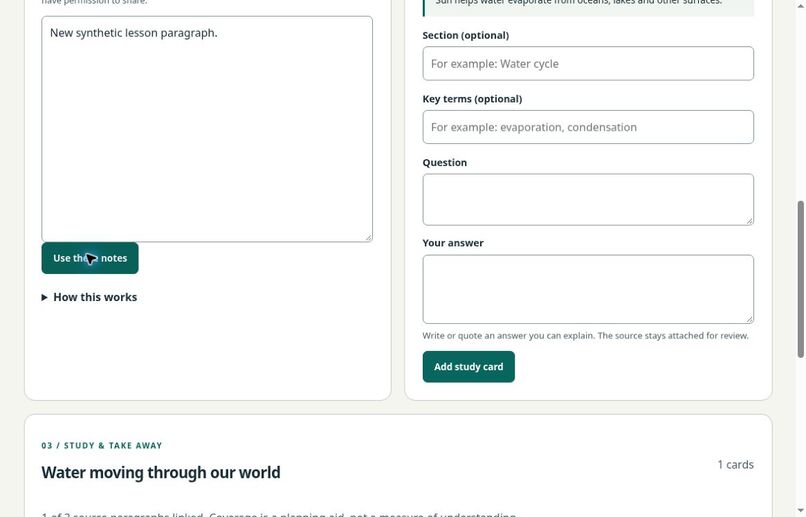
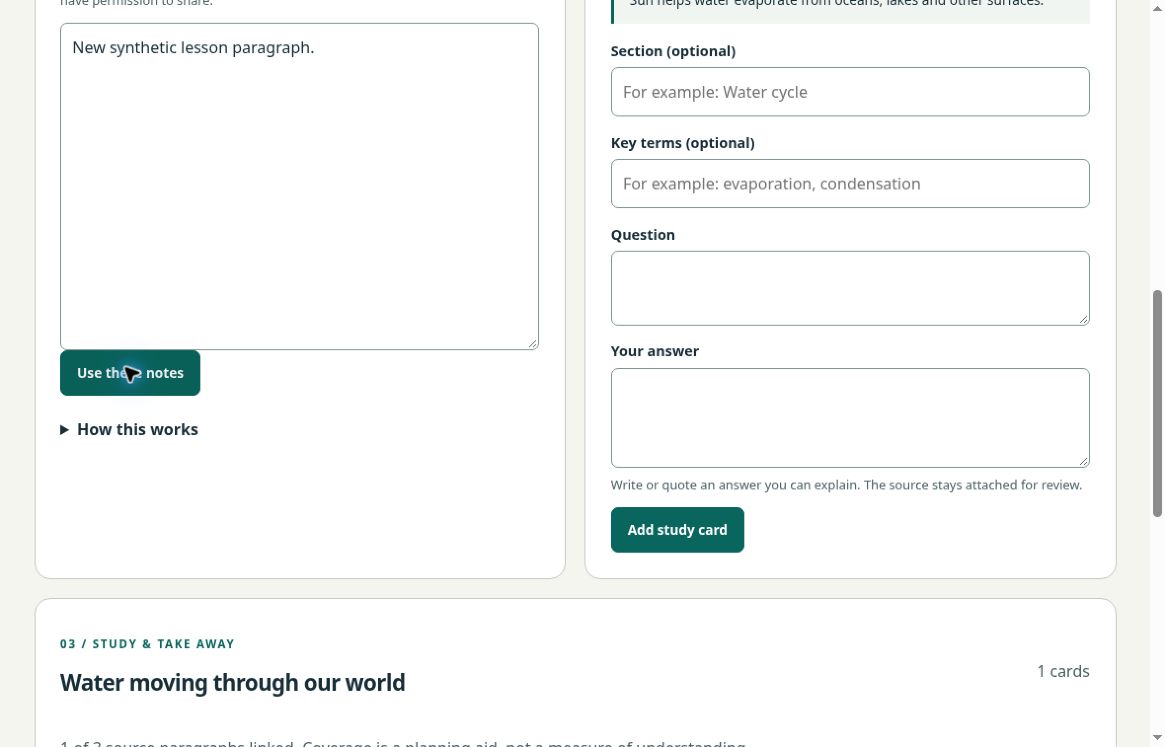
Actual managed-browser prototype during synthetic testing: notes draft, manual question and answer fields, and a study-card section.
Inspiration
Studying should not require a persistent connection or another account. A learner with useful notes still needs a way to organize them into readable questions, answers and source references that can travel together.
What it does
LessonLite turns personally selected notes into manually authored study cards. Choose a source paragraph, write a question and answer, and reveal the answer or original paragraph when reviewing. Adjust text size and contrast. Download a standalone HTML study pack or an editable JSON project to continue later.
The specific barrier is organizing reusable study material for intermittent-connectivity settings. The learner controls the content; LessonLite does not invent answers, grade learners or claim improved learning outcomes.
How it was built
A new independent browser-local application created on October 30, 2026 during the event. HTML, CSS and JavaScript handle paragraph parsing, manual cards, validated project imports and script-free HTML export. There are no runtime third-party dependencies, AI API calls, accounts or application network requests. The example water-cycle lesson is synthetic.
OpenAI assistance contributed to testing and documentation under direction. No commercial source, private research data or trained model weights were reused. The new application code is MIT licensed; that license does not grant rights to imported lesson notes.
Challenges and lessons
Source links must not silently change when notes are edited. Replacing applied notes therefore requires confirmation and clears associated cards. Notes and unfinished cards are drafts until applied or added. Saving an editable project does not silently mark those drafts as saved.
Another challenge was ensuring every accepted project could be saved and reopened. Import and export now use the same 3,000,000-byte ceiling. A final managed-browser regression imported a 100-card Unicode project and downloaded a byte-identical 1,158,226-byte saved copy.
Testing
49 Node tests passed, including schema and bounds checks, source indices, escaping, byte limits, script-free exports and draft-state logic. Bounded managed Chrome checks exercised manual cards, source disclosure, keyboard use, reading preferences, downloads, reimport, malformed imports and draft-protection regressions.
Direct file-mode acceptance, disconnected operation, print pagination, physical phones, other browsers, screen readers and OS-specific acceptance have not been completed. Offline support describes the design, not universal device certification.
Try it
Download the source folder and open index.html in a modern browser, or serve its four runtime files on an approved static host. Try the fictional water-cycle example, select a paragraph, write and add a card, reveal its source, then export a study pack and saved project.
Responsible use
There is no automatic persistence. Check Downloads and save before closing. Exported HTML contains the full notes and answer key, so review it before sharing. Use permission-cleared notes and avoid private learner records. Source coverage is a planning count, not a learning score. The tool does not verify factual correctness or replace an educator's judgment.

Log in or sign up for Devpost to join the conversation.