-
-
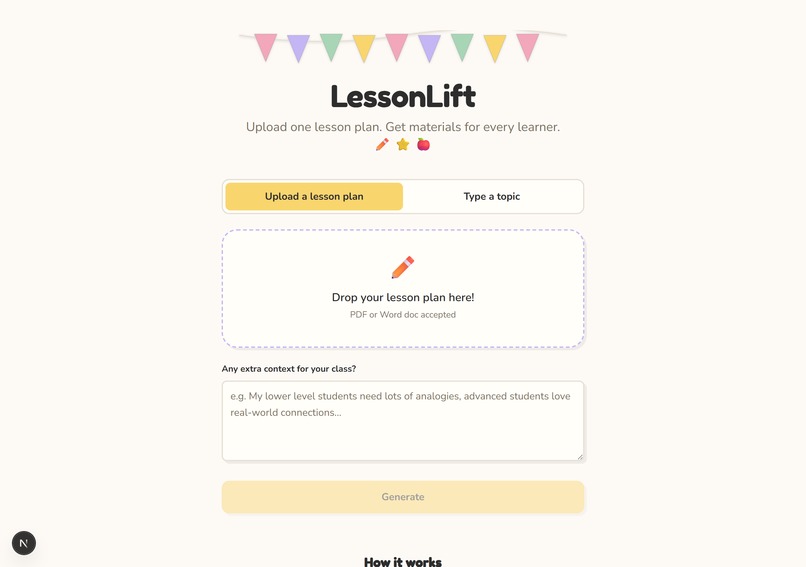
Home
-
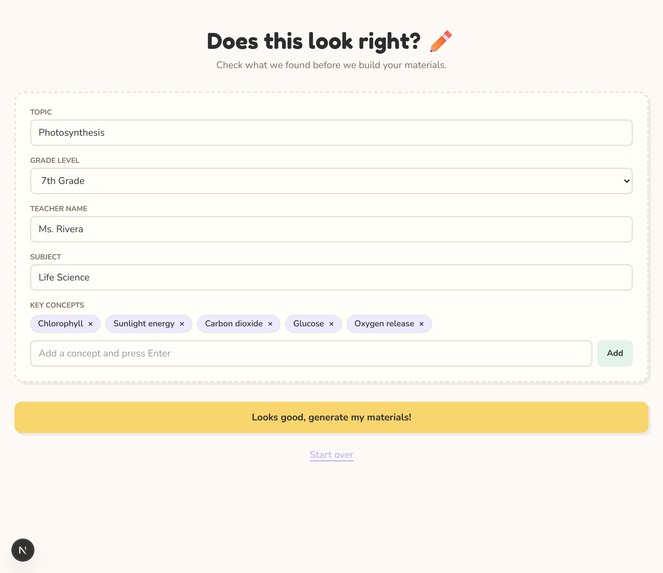
Review
-
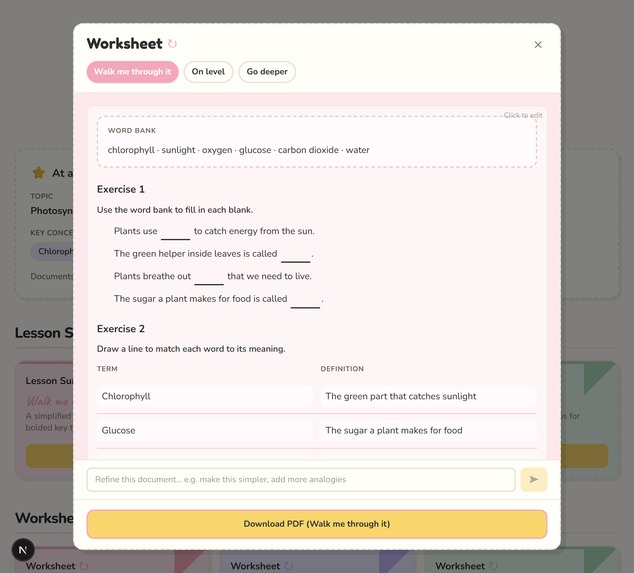
Preview Worksheet
-
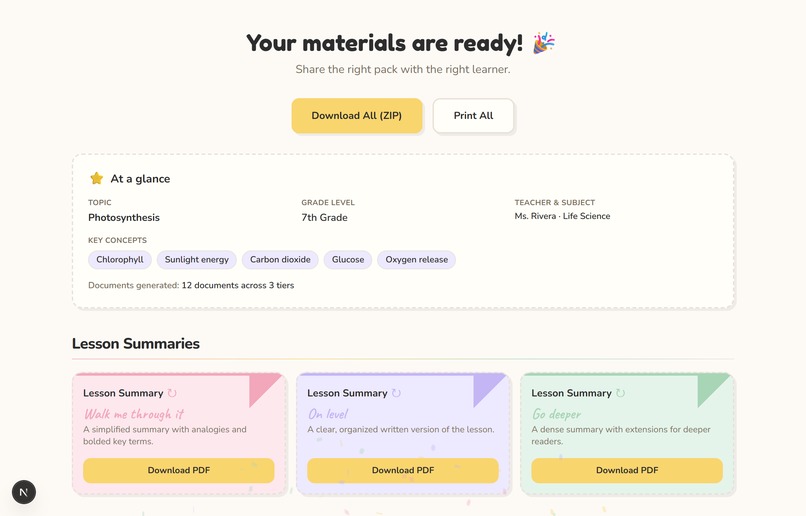
Results Header
-
Preview Summary
-
Results Grid
Inspiration
There are 5-7 literacy levels represented in each classroom. Each teacher is held accountable, often in silence, for meeting the needs of all of those levels. Doing that effectively requires a teacher to take one lesson and rewrite it in three different versions, one for the struggling student, one for the student working at grade level, and one for the advanced student, and then develop three different worksheets, practice sets and answer keys each day, meaning nine documents built by hand. We created LessonLift after watching a teacher spend 4 hours on a Sunday adapting one lesson into three different versions. The realization was that this was not an issue of teaching but rather an issue of processing. "Rewrite this information at three different cognitive levels while maintaining the same concepts" is a transformation that could be accomplished with a clearly defined data dependency graph, and is precisely the kind of problem computer science and modern-day artificial intelligence were designed to solve. We wanted to take this 4-hour process and compress it down to a 2-minute process.
What it does
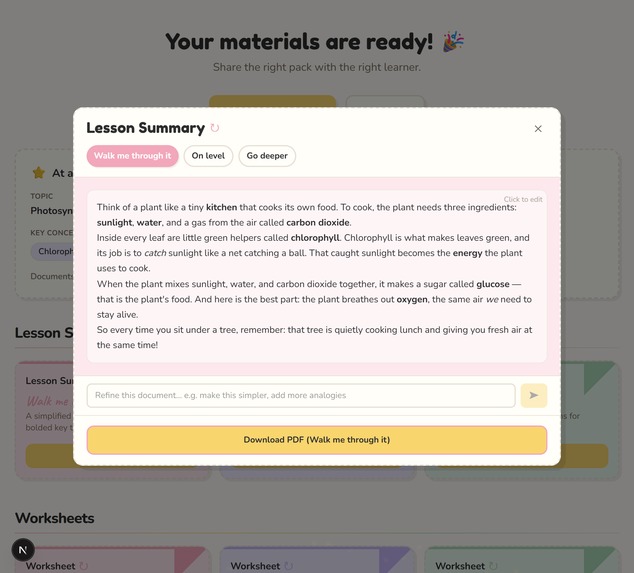
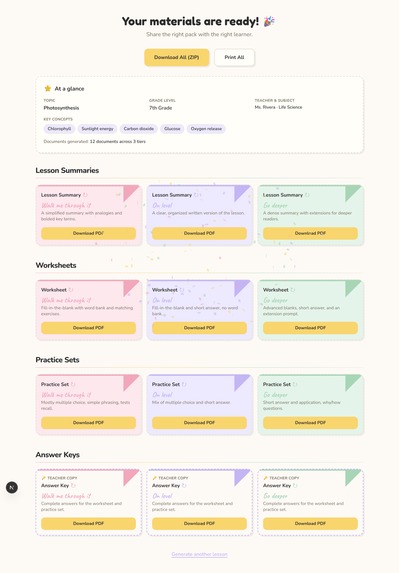
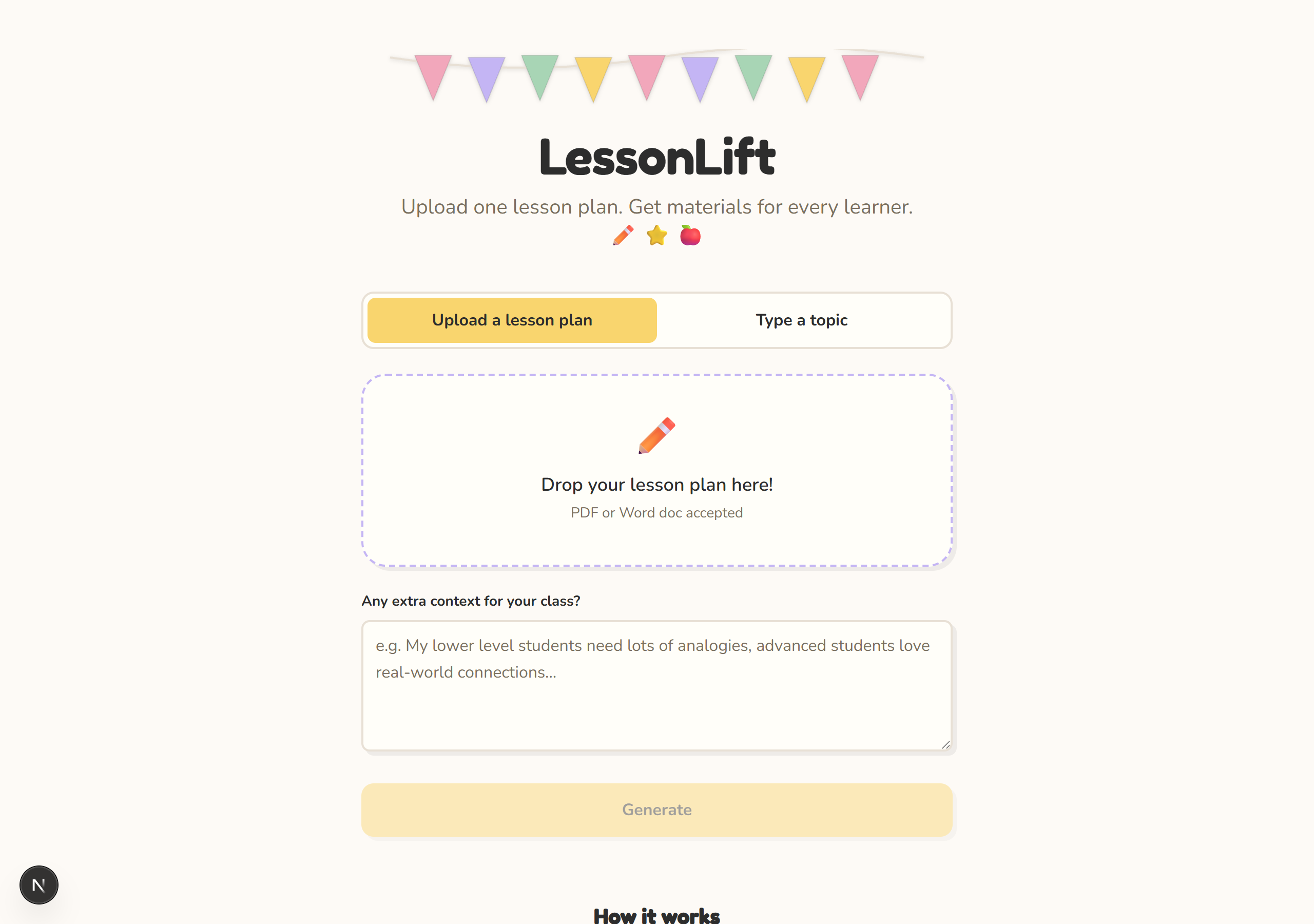
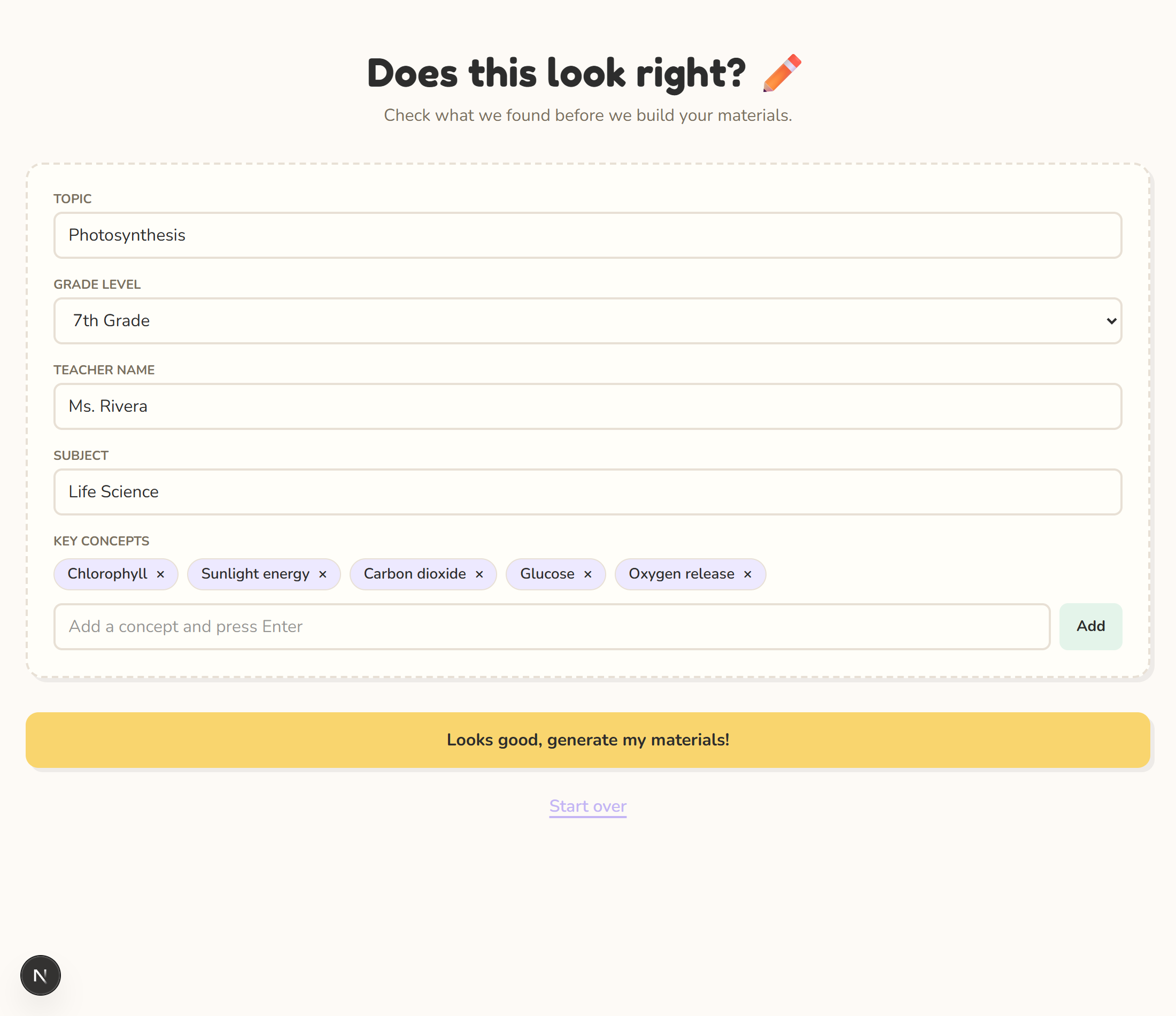
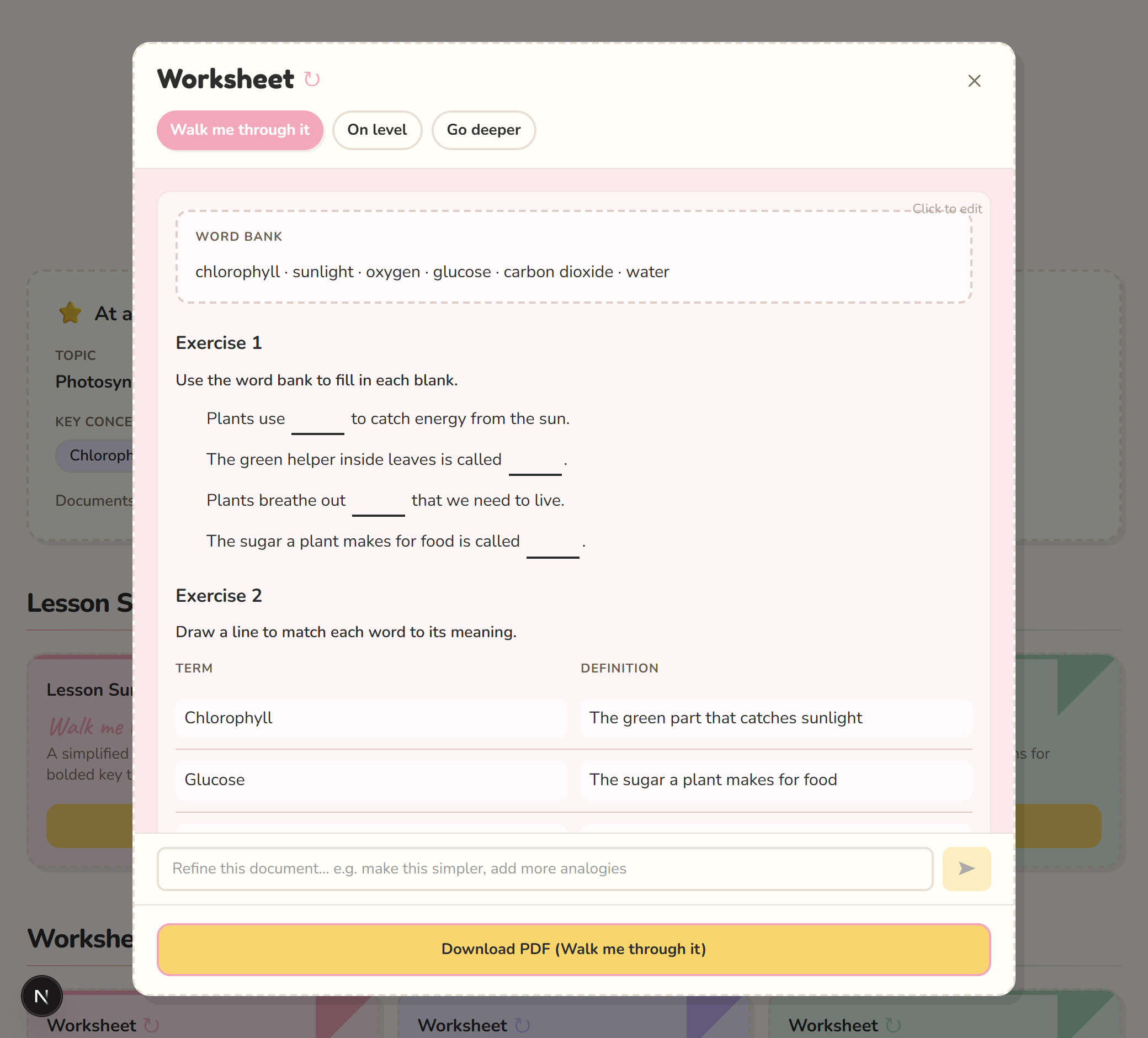
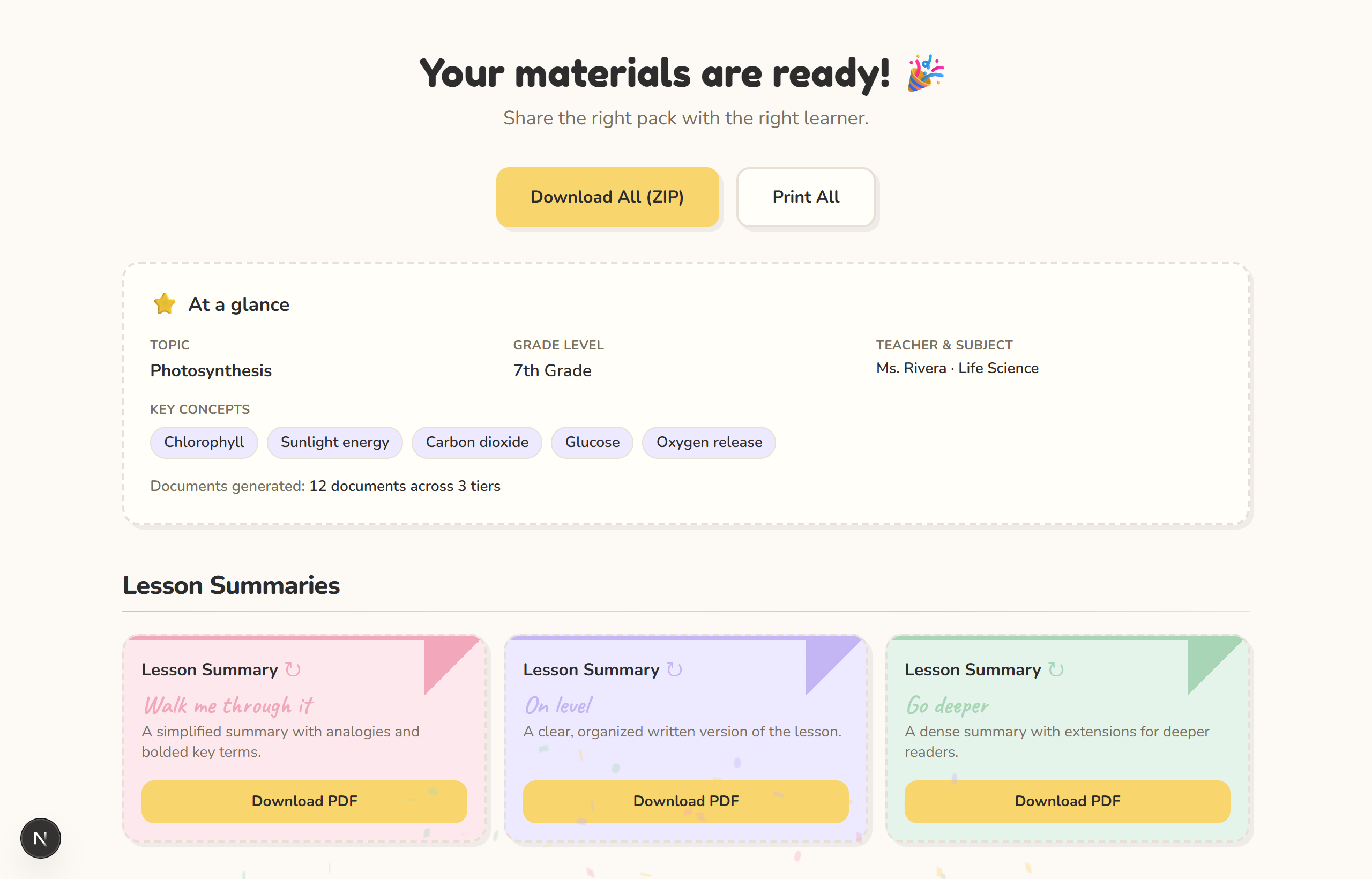
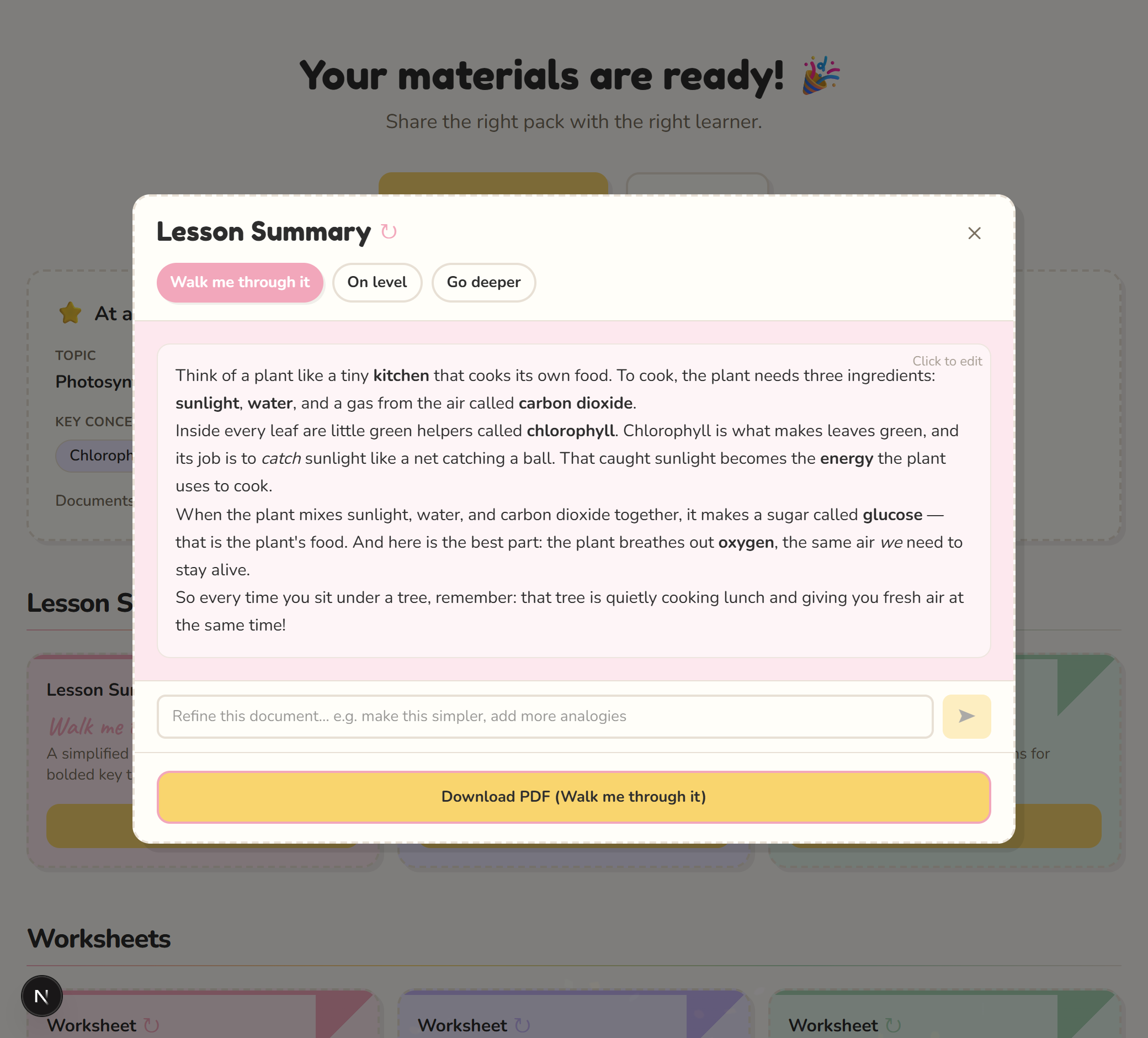
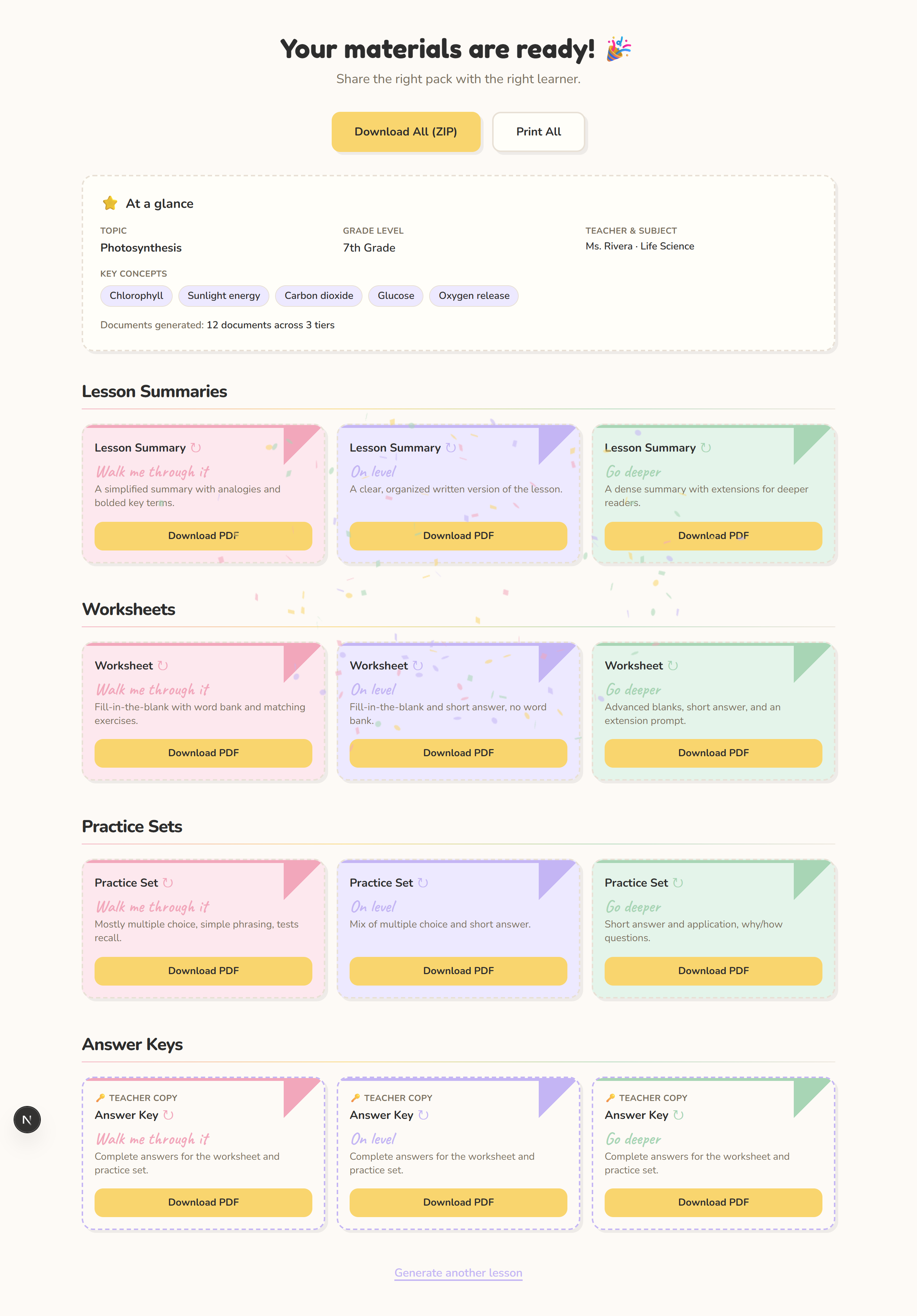
LessonLift provides a simple input method, a PDF or Word document of a lesson plan, or manually entering the topic and grade, to create 12 documents at 3 levels of difficulty for use in the classroom. The three levels of difficulty are not "just cosmetic." For example, Level A uses analogy and vocabulary support to reduce the cognitive load of a student who may have difficulty reading, but still reach an understanding of the underlying concept. Level C purposely builds toward reasoning and application by using a higher level of Bloom's cognitive learning. Each level covers the same concept, only the way the student accesses the information differs. After the teacher verifies the topic and key concepts, which are automatically extracted from the document, LessonLift generates preview copies, worksheets, practice sets, and answer keys for each of the 3 difficulty levels, allowing the teacher to preview documents prior to printing, quickly switch between difficulty levels, and make edits based on plain-text instructions. All documents are exported as formatted PDF files or zipped in an organized folder structure.
How we built it
The real engineering happens within the pipeline. When we attempted to issue a single AI request for all twelve documents, it failed: the output was bad, and the tests didn't actually test the summaries of the documents. So, in order to provide accurate summaries, worksheets and practice sets, we needed to begin creating a model of the deliverables using a directed acyclic graph, and begin creating our API calls based upon the data dependencies established within the outputs of the documents that would ultimately be used to create the various deliverables. In the case of generating a summary from a lesson, it would consist of the following: a Lesson would generate a Summary, a Summary would generate a Worksheet and/or a Practice Set, and a Worksheet and/or Practice Set would generate a Grounded Answer Key. The cognitive ladder is determined by hard constraints defined in the prompt, rather than by chance; therefore, cognitive ladders are calculated to spec. The Research Chat is a small agentic loop of its own, identifying the scope of a request, whether "Make This Easier" should generate one document or whether "Change the Grade Level" should generate all twelve documents. The Research Chat is developed using Next.js and the Anthropic API, with handwritten jsPDF layout logic providing the underpinnings of the user-friendly interface that the Research Chat utilizes.
Challenges we ran into
We encountered significant challenges while dealing with validation and reasoning-based issues. Validation of JSON at scale caused us to split one big call into four smaller but connected calls. Differentiating tiers by cognitive demand rather than just word count required us to reconstruct how Bloom's levels would define the prompts. Developing the answer keys necessitated returning the generated questions back to the system. Additionally, we discovered that training the model to accurately evaluate how much of an edit had taken place was a separate and very complex and impactful issue.
Accomplishments that we're proud of
We were able to compress a 4-hour manual task into 2 minutes while maintaining coherence: the worksheets test what the summaries taught, and the keys match the worksheets. We've been most proud of the parts that are invisible when they're functioning well, the dependency-driven pipeline and the scope-based refinement loop, and of putting together truly rigorous engineering within a package that feels warm enough for a teacher to actually want to use.
What we learned
We learned that modeling the data relationships, rather than just the end objects, and treating the 12 documents as a graph, produced the single largest quality improvement in terms of increasing the value created for the student. We also learned that all prompts are specifications, that human checkpoints prior to a costly AI step are a feature, not friction, and that the limitation in education is not creating the resources, but translating those resources for every student in the room, which, in its nth form, is a computer science problem.
What's next for LessonLift
Aligning all documents to NGSS and Common Core standards automatically, implementing an additional means of differentiation by providing bilingual generation of documents, and providing accessible formatting will turn a one-time document generator into an adaptive teaching tool.
Built With
- canvas-confetti
- jspdf
- jszip
- mammoth
- next.js
- node.js
- pdf-parse
- react
- react-markdown
- tailwindcss
- typescript
- vercel

Log in or sign up for Devpost to join the conversation.