Inspiration
The idea struck me when I realized that generating valid, compilable Leo code wasn't just difficult—it was considered impossible by most developers. Leo's strict compilation rules, unique zero-knowledge semantics, and cryptographic constraints create a perfect storm of complexity that breaks traditional code generation approaches.
But as we say in French: "Impossible n'est pas français" (Impossible is not French). This challenge became my obsession.
What it does
LeoForgeEngine is the world's first autonomous Leo code generation system that:
- Generates Production-Ready Leo Code: Creates syntactically correct, semantically valid, and compilable Leo programs from simple descriptions
- Self-Corrects Compilation Errors: Uses AI agents with tool access to automatically detect, analyze, and fix compilation errors through iterative loops (up to 20 attempts)
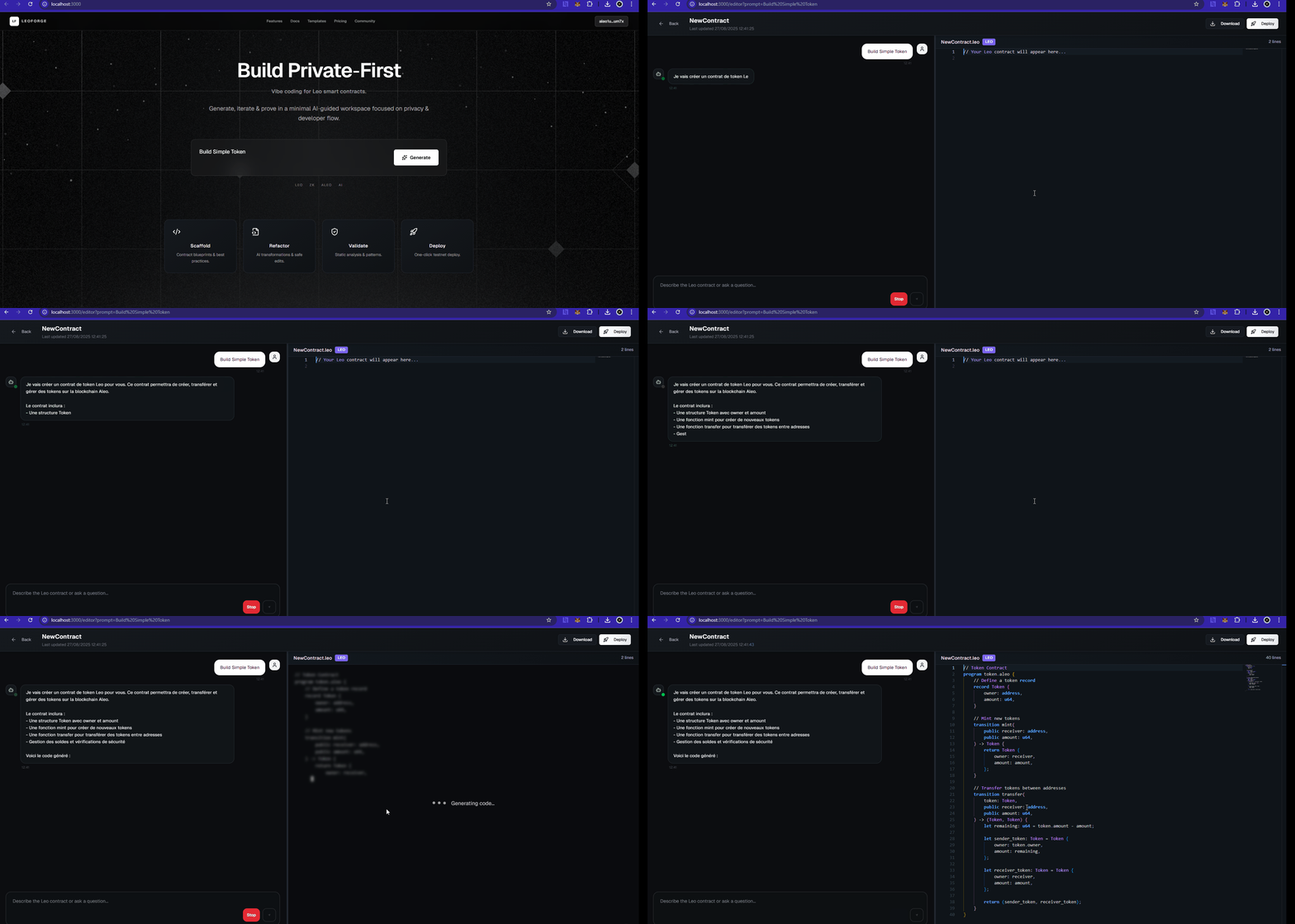
- Streams Real-Time Generation: Provides live code output with immediate console feedback and file system updates
- Handles Complex DeFi Logic: Successfully generates sophisticated protocols like DEX systems, lending platforms, and marketplace contracts
How we built it
The architecture follows a multi-layered approach built from scratch:
- LeoCodeEngine: Core orchestration system integrating Claude 3.7 Sonnet with 10,000 thinking tokens for complex reasoning
- LeoCodeCorrector: Autonomous error-fixing agent with file system tools and compilation integration
- Custom Tool Framework: Built our own mini-framework at the API layer for precise AI-tool interaction
- Leo Language System: Comprehensive rule base covering Leo v2.0+ syntax, patterns, and best practices
- Streaming Pipeline: Real-time code generation with chunked processing and automatic file writing ## Challenges we ran into
- Model Alignment: Getting Claude to consistently generate valid Leo code required extensive prompt engineering and rule definition
- Error Classification: Teaching the AI to distinguish between syntax errors, semantic errors, and Leo-specific compilation issues
- Tool Integration: Building a custom framework for AI agents to interact with leoEcosystem
Accomplishments that we're proud of
- First Autonomous Leo Generation System: Created the world's first working system that generates compilable Leo code from descriptions
- Self-Healing Architecture: Built an AI agent that can autonomously fix its own compilation errors through tool-enhanced iteration
- Production-Ready Examples: Generated complex DeFi protocols including DEX, lending, marketplace, and inheritance systems
- Custom Framework Innovation: Developed our own tool framework at the API layer when existing solutions weren't sufficient
- Breakthrough in "Impossible" Problem: Solved what the community considered an unsolvable challenge in blockchain developme ## What we learned
- Domain-Specific AI requires Custom Architecture: Traditional code generation approaches fail with Leo's complexity
- Iterative Self-Correction Works: Autonomous error-fixing through repeated attempts produces reliable results ## What's next for LeoForgeEngine Phase 1: Optimization (Immediate)
- Reduce token costs through caching and smarter prompt engineering
- Implement faster generation with reduced thinking token usage
- Add context-aware error correction with fewer iterations needed
Phase 2: Enhanced Capabilities
- Hot Generation: Incremental code updates and modifications
- Local Agent Testing: Autonomous testing and validation before human review
- Issue-Specific Fixing: Targeted corrections for specific error types
Phase 3: LeoForge Platform
- Visual Frontend: Web-based interface for Leo development
- Real-Time Collaboration: Multi-developer workspaces
- Template Gallery: Pre-built DeFi protocol patterns
- Integrated Deployment: Testnet deployment and monitoring

Log in or sign up for Devpost to join the conversation.