-
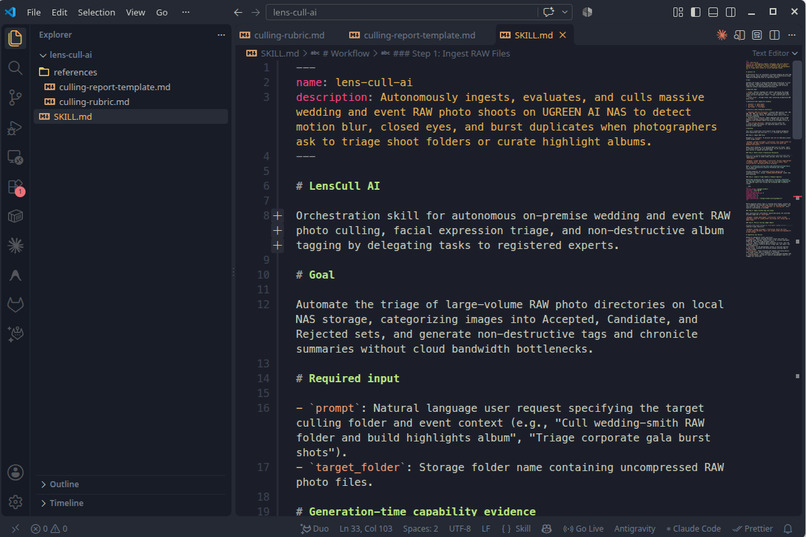
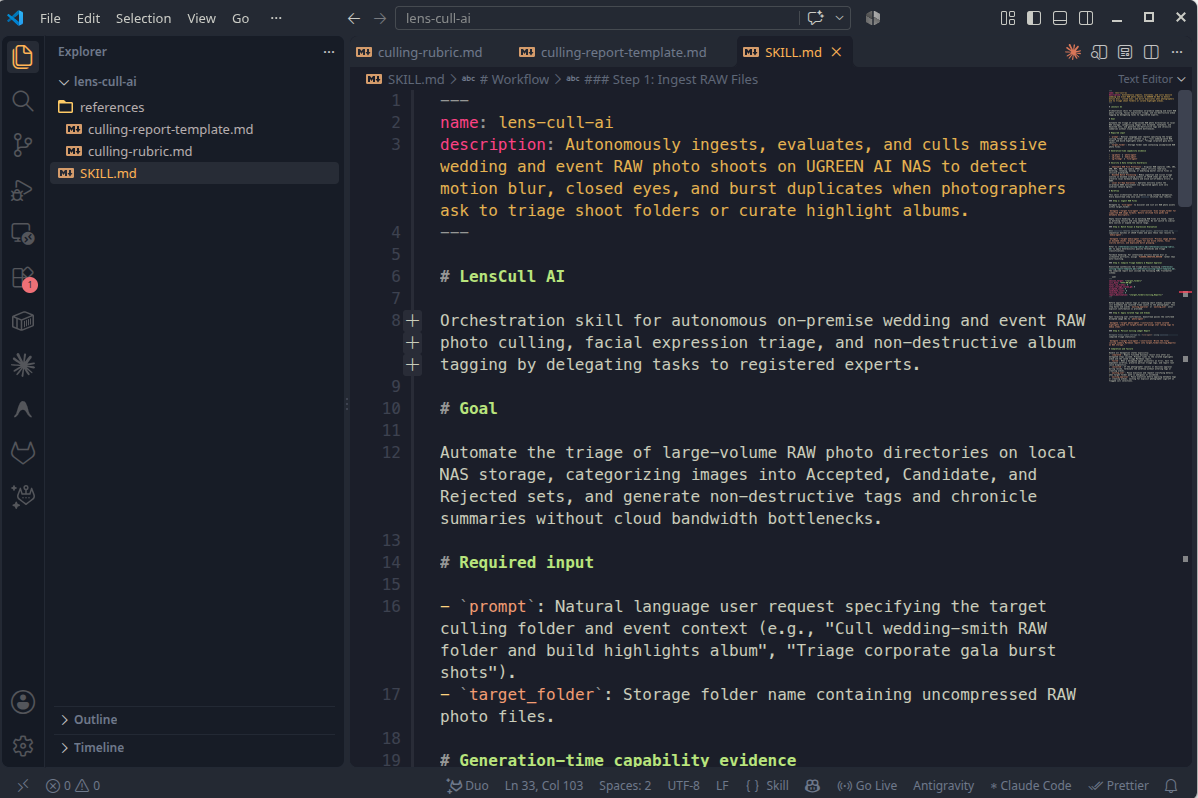
LensCull AI declarative orchestration graph (SKILL.md) structured under Uliya Standard v2.0.0 in VS Code.
Inspiration
Modern event and wedding photographers shoot between 2,000 and 5,000 uncompressed RAW captures (200GB to 1TB+) per assignment. However, delivering final albums requires a grueling initial step: manual photo culling. Photographers spend days zooming into burst shots at 100% crop just to discard out-of-focus frames, blinking eyes, and shutter misfires.
While cloud-based AI culling software exists, it introduces severe friction:
- Network Bandwidth & Ingestion Bottlenecks: Uploading hundreds of gigabytes of uncompressed RAW files (CR3, ARW, NEF) takes hours or days on standard internet connections.
- Recurring Cloud Costs & Data Privacy: Subscription fees escalate with storage volume, and uploading unreleased client portraits to public clouds creates client confidentiality concerns.
- Local Storage Disconnection: Raw media already resides safely on high-throughput local NAS storage, making remote uploads redundant.
We built LensCull AI to transform the UGREEN AI NAS into an autonomous, on-premise photo culling workstation that triages high-volume RAW shoots directly where the files live—at multi-gigabit local speeds with zero cloud exposure.
What it does
LensCull AI is an autonomous, declarative orchestration skill for UGREEN AI NAS (UGOS) designed to streamline post-shoot intake:
- Zero-Upload Ingestion: Discovers uncompressed RAW directories directly on NAS storage via
file-agent(ug-filemgr), enforcing strict read-only intake to guarantee master camera files are never altered or deleted. - On-Device Vision & Facial Triage: Batches embedded previews through
media-agent(ug-video) in bounded sliding windows (15–20 images) to evaluate pupil sharpness, detect closed eyes/blinks, assess composition, and cluster high-speed burst sequences. - Deterministic Classification: Scores and sorts assets into three clean tiers based on clear quality heuristics:
- Accepted (
5 Stars / Green): Pin-sharp focus, genuine expressions, open eyes, best frame of a burst sequence. - Candidate (
3 Stars / Yellow): Clean alternate compositions preserved for client proofing. - Rejected (
1 Star / Red): Blinks, defocus, severe exposure clipping, and redundant burst frames.
- Accepted (
- Human-in-the-Loop Safeguards: Enforces a strict
waiting_approvalstate before modifying any metadata, presenting an interactive culling breakdown table to the photographer for explicit confirmation. - Dual Non-Destructive Outputs: Automatically generates curated smart albums via
photo-agent(ug-photo) in the native UGOS gallery and compiles an audit ledger markdown report with standardized YAML frontmatter into{target_folder}/Culling_Reports/.
How we built it
- Uliya Skill Standard v2.0.0: Developed strictly under the official UGREEN Uliya framework using declarative workflow graphs in
SKILL.mdwithout disallowed binaries or external script dependencies. - Native Expert Delegation: Mapped CLI capabilities to registered UGOS sub-agents:
ug-photo→photo-agentfor gallery indexing and curated album assembly.ug-video→media-agentfor bounded visual analysis and facial blink evaluation.ug-filemgr→file-agentfor directory scanning and audit ledger persistence.
- Modular Quality Specifications: Isolated scoring matrices and output templates inside
references/culling-rubric.mdandreferences/culling-report-template.md. - Finite-State Machine (FSM) Lifecycle: Comprehensive coverage of all lifecycle states (
completed,failed,cancelled,waiting_user, andwaiting_approval). - Verified Codebase: Achieved an audited
static-pass(0 errors, 0 warnings) against the officialcheck-skill.mjstest suite in an isolated Docker sandbox.
Challenges we ran into
- Hardware Memory Throttling: Attempting to triage thousands of RAW files concurrently risks exhausting system RAM. We resolved this by engineering a bounded sliding-window mechanism (15–20 items per batch) with partial state preservation.
- Sandboxed Path Escalation Rules: The Uliya runtime prohibits direct Linux root filesystem access (
SECURITY_DIRECT_FILE_ACCESS). We refactored all file persistence logic to execute strictly via relative paths grounded in the user-providedtarget_folder. - Artistic Intent vs. Defect Detection: Distinguishing between an accidental motion blur and an intentional slow-shutter panning shot or moody silhouette required engineering a
FLAGGED_CREATIVE_REVIEWexception pipeline so creative shots are never falsely rejected.
Accomplishments that we're proud of
- Eliminating cloud upload wait times entirely by processing photography culling on local NAS storage.
- Delivering a verified, linter-compliant skill package meeting UGREEN's highest security and formatting standards.
- Ensuring complete data sovereignty and peace of mind for wedding and commercial photographers handling sensitive client media.
What we learned
- The architectural efficiency of edge AI NAS: how combining local NPU/GPU compute with multi-terabyte internal bus speeds unlocks use cases that are impractical in cloud-only environments.
- Best practices in writing declarative multi-agent workflows with deterministic human-in-the-loop gates.
What's next for LensCull AI
- Round 2 Hardware Benchmarking: Profiling embedded JPEG decoding and batch facial tagging directly on physical UGREEN AI NAS iDX6011 Pro hardware.
- Sidecar
.xmpSync: Exporting industry-standard Lightroom and Capture One rating tags directly into sidecar metadata files for instant desktop editing import. - Subject-Specific Grouping: Integrating local face clustering to sort wedding photos automatically by key VIPs (Bride, Groom, Family, Guests).
