-
-
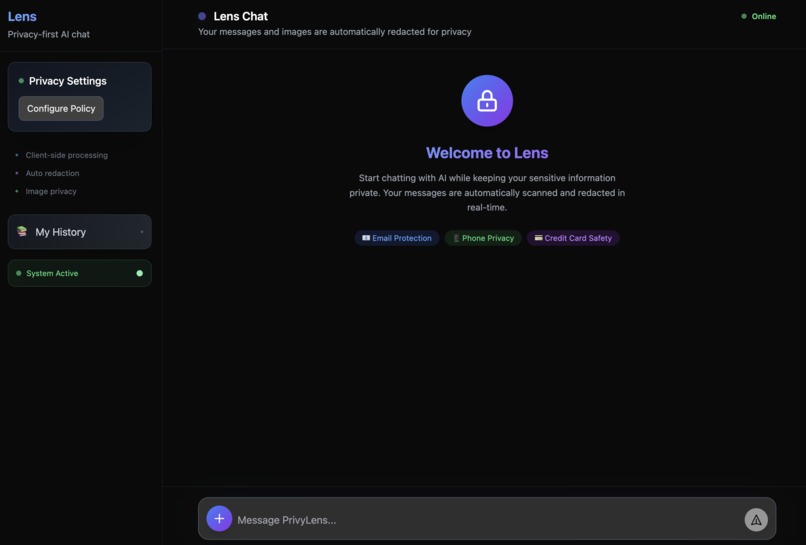
Chat Interface
-
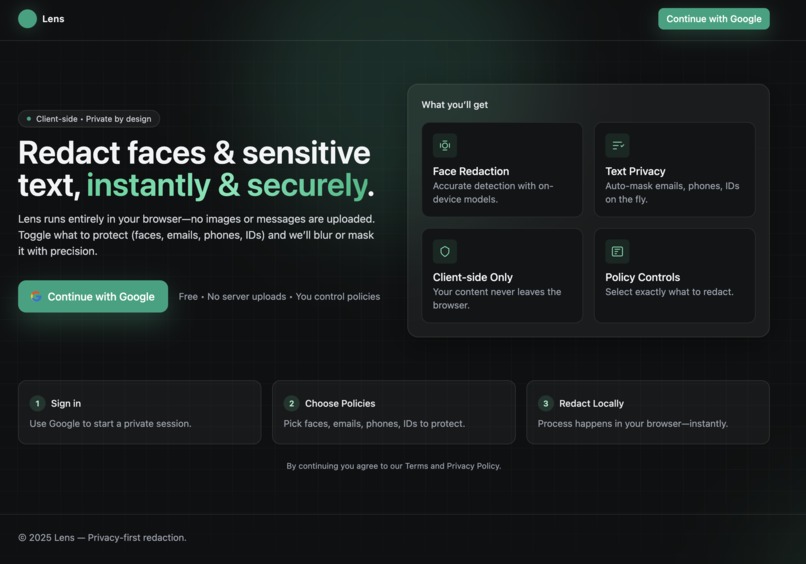
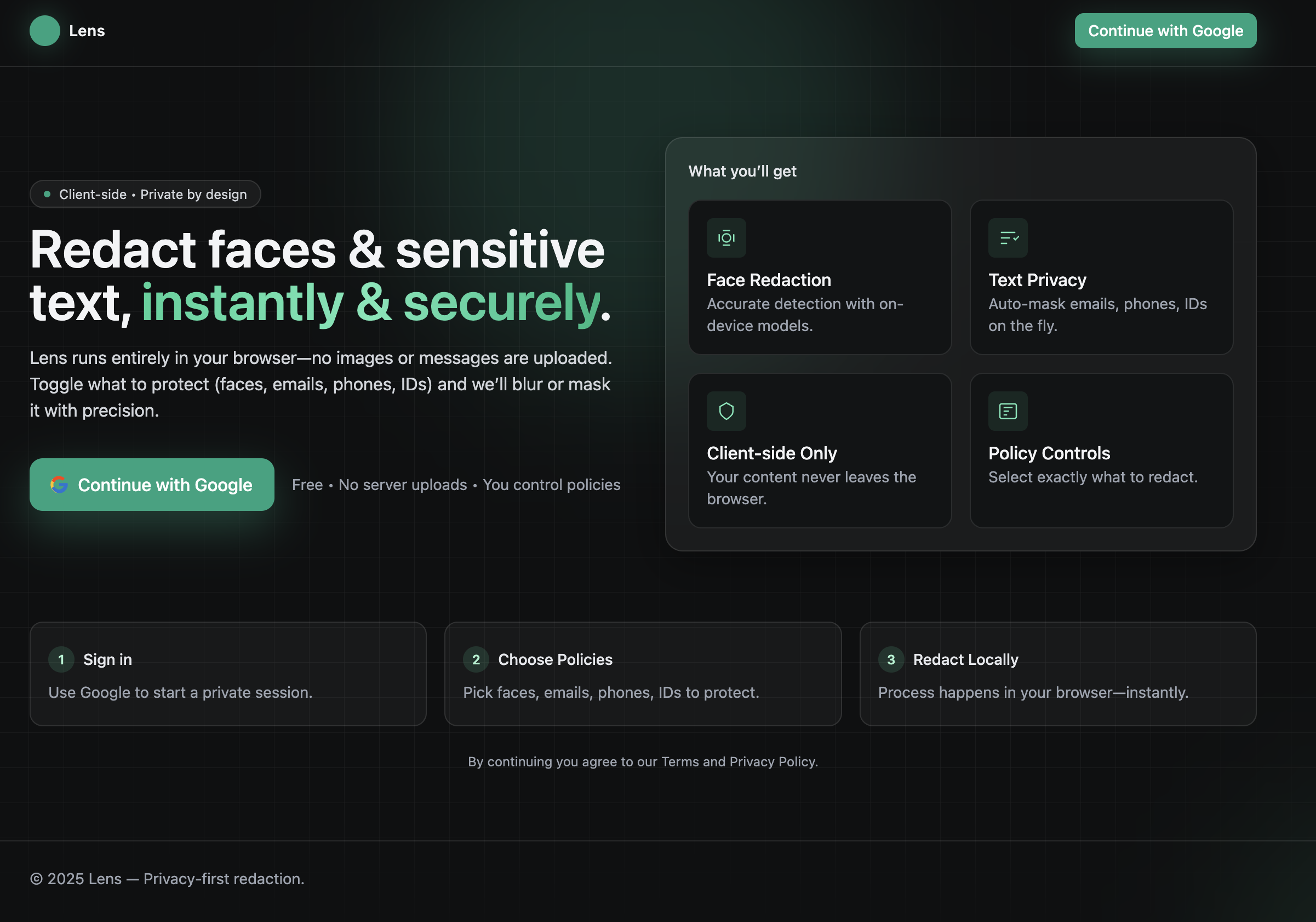
Landing Page
-
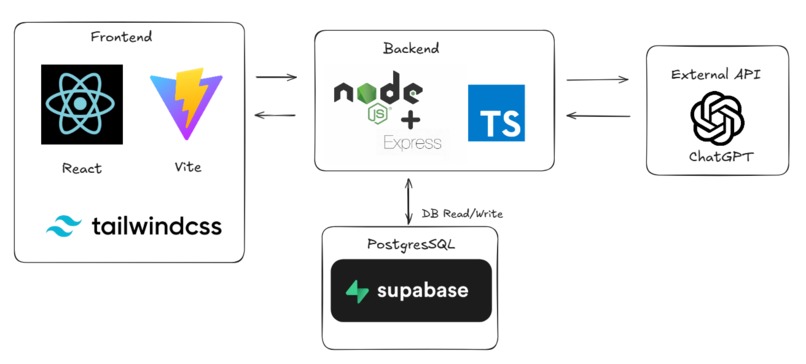
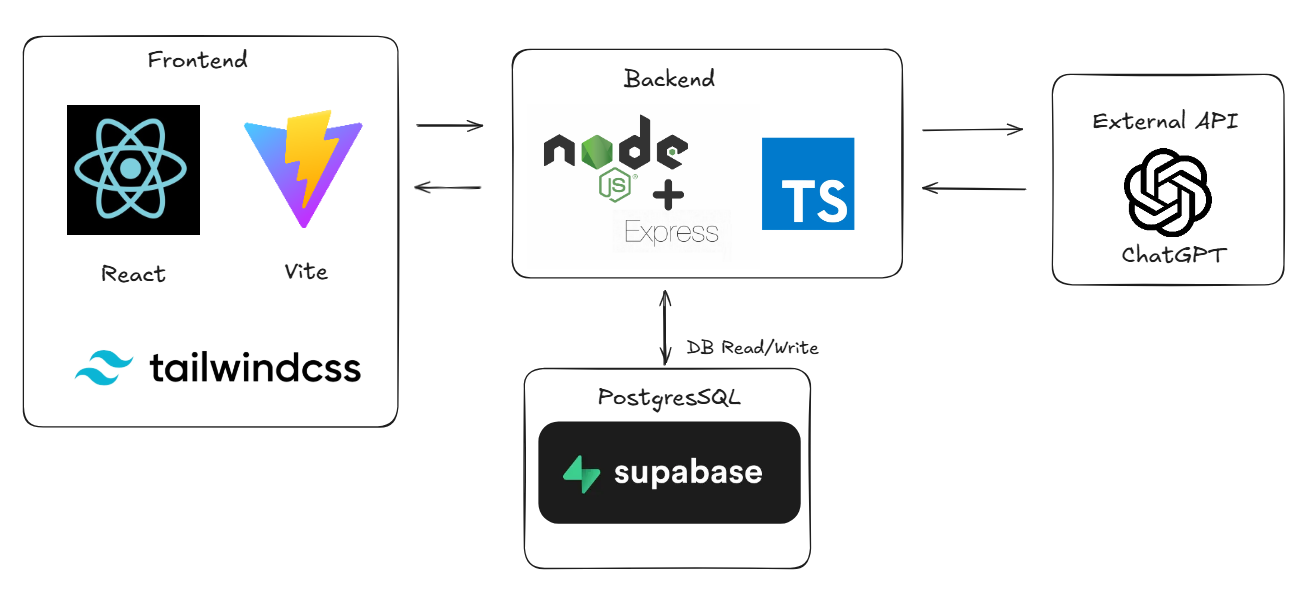
Tech Stack
Lens — Privacy-First Conversational AI
A secure, redaction-by-default chat interface that detects and masks sensitive text and blurs identifiable regions in images before anything reaches an external LLM.
Inspiration
Modern AI apps make it far too easy to leak private data—names, emails, locations, or even faces in photos—into third-party models and logs. We wanted a chat experience that treats privacy as a first-class feature, not an afterthought.
What it does
- Text Redaction
Automatically detects PII (names, locations, organizations, emails, phone numbers, credit cards) and replaces them with placeholders. - Image Redaction
Detects faces client-side and applies precise pixelation/blur for irreversible anonymization. - Policy-Driven Controls
Users choose what to redact; policies are enforced on both client and server. - Secure Processing
Ensures no raw sensitive data is ever sent to external APIs. Inputs are validated as redacted before LLM calls. - Privacy-Aware Chat UI
ChatGPT-style interface with streaming responses that only sees masked text and blurred imagery. - Zero-Knowledge Auditing
Logs events (what was redacted) without storing the original sensitive content.
Key Features
- Hybrid text engine: transformer-based NER + regex rules for robust PII detection.
- Real-time face blurring: TinyFaceDetector-powered detection with configurable thresholds.
- Local-first design: on-device inference paths minimize data exposure.
- Policy presets: granular toggles for PII types (emails, phones, orgs, etc.).
- Auditability: cryptographic integrity for privacy event trails.
How we built it
On-Device Processing Architecture
- Client-side NER and face detection first; only sanitized payloads can cross the boundary.
- Server validates redaction again before proxying to the OpenAI API.
Frontend
- React + TypeScript (Vite)
- Tailwind CSS for styling and a clean, responsive chat experience
Backend
- Node.js + Express API
- TypeScript with strict types
- Multer for image uploads, sharp for image ops when needed
- Server-Sent Events (SSE) for LLM streaming
Data & Infra
- Supabase (Postgres + real-time) for auth, policy storage, audit metadata (never the raw PII)
Code Quality & Testing
- ESLint + Prettier
- Vitest for unit tests
Assets & Implementation Notes
- TinyFaceDetector weights (≈416 KB) loaded at runtime for client-side detection
- Canvas-based image processing on the web; server uses sharp when applicable
- Inline SVGs for icons; CSS-only effects for visuals (no external image assets)
- Tailwind design system for predictable spacing, color, type
Challenges we ran into
- Balancing accuracy vs. latency for face detection on varied devices (tuning input size/thresholds).
- PII detection edge cases (overlapping spans, partial matches, false positives/negatives) and safe placeholder merging.
- Strict privacy guarantees across boundaries (ensuring masked-only requests reach the LLM).
- Cross-environment dependencies (keeping Node-only libs like
tfjs-node/sharpout of the browser bundle). - Consistent dataset handling when precomputing masks/landmarks for model experiments.
Accomplishments that we're proud of
- A fully redaction-first chat flow where sensitive content is never exposed upstream.
- Multi-layer validation (client and server) for defense-in-depth.
- Smooth, real-time UX that still honors strict privacy policies.
- A reusable redaction-image and redaction-text package for other apps.
What we learned
- Privacy-by-design means reshaping architecture (not just adding a filter).
- Combining ML (NER) with deterministic rules (regex) delivers better coverage than either alone.
- Small vision models (e.g., TinyFaceDetector) can be fast and good enough for anonymization with the right thresholds.
- Strong type systems and clear boundaries reduce accidental data exposure.
What's next for Lens
- Broader visual redaction: license plates, screens, IDs, documents (OCR-aware masking).
- Stronger on-device NER: more compact multilingual models and custom PII domains.
- Policy packs & org controls: team-wide presets, audit exports, DLP integrations.
- Mobile & Edge: PWA and edge-compute variants for ultra-low latency, offline safety.
- Developer SDK: drop-in redaction middleware for any AI pipeline.
APIs Used
- OpenAI API — GPT with SSE streaming (only after server-side redaction validation).
- Supabase API — Auth, policy storage, audit metadata; never stores original sensitive content.
Tech Stack
Frontend
- React + TypeScript
- Vite
- Tailwind CSS
Backend
- Node.js + Express
- TypeScript (strict)
- Multer (uploads), Sharp (image processing)
- pnpm workspaces
Testing / Quality
- Vitest, ESLint, Prettier
Libraries
AI/ML
- @xenova/transformers — in-browser BERT-style NER via WASM/WebGL, no external API needed.
- face-api.js / TinyFaceDetector — lightweight CNN for real-time face detection (e.g., 416px input, ~0.4 threshold).
PrivyLens packages
- @privylens/redaction-text — regex-based detectors, span merging, placeholder policies.
- @privylens/redaction-image — Canvas/Sharp image ops; pixelation & blur with normalized boxes.
Setup (optional quick start)
# Running the repo
1) download node js

2) cd into tiktok/privylens

3) npm install -g pnpm

// install pnpm globally

4) pnpm install

5) pnpm dev

- website would be on localhost:3000

# Models (client)
# Load TinyFaceDetector weights from CDN or place in /public/models

# Environment
# SUPABASE_*, OPENAI_API_KEY set in server env; client never sees raw PII
Built With
- express.js
- face.api
- multer
- openai
- react
- react-router
- supabase
- tailwind
- vite
- xenova/transformers


Log in or sign up for Devpost to join the conversation.