Inspiration
Mental health support is often inaccessible, delayed, or lacks personalization. We noticed that while AI chatbots are widely available, they fail to truly understand emotional context or respond safely in sensitive situations. This inspired us to build a system that goes beyond generic responses and genuinely supports users through emotionally aware and context-driven conversations.
What it does
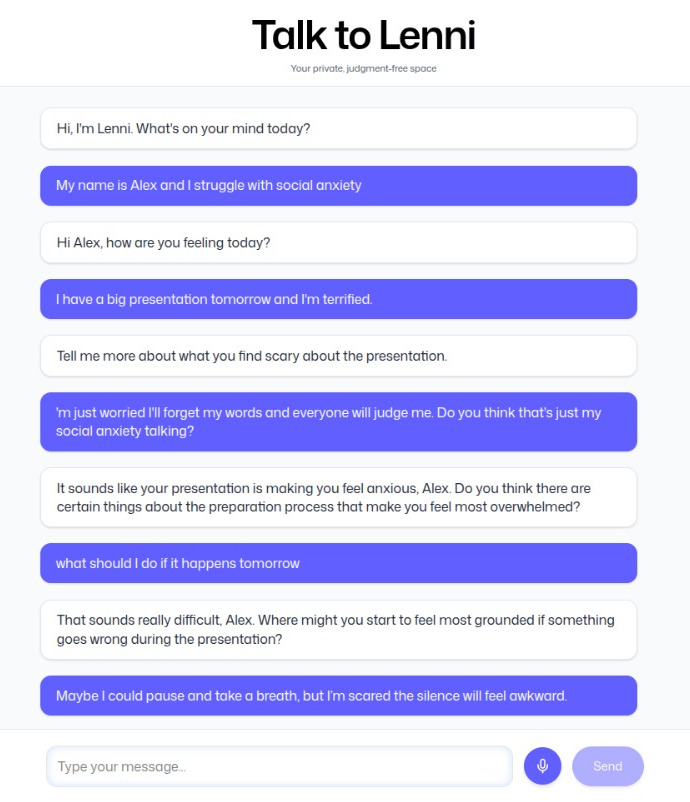
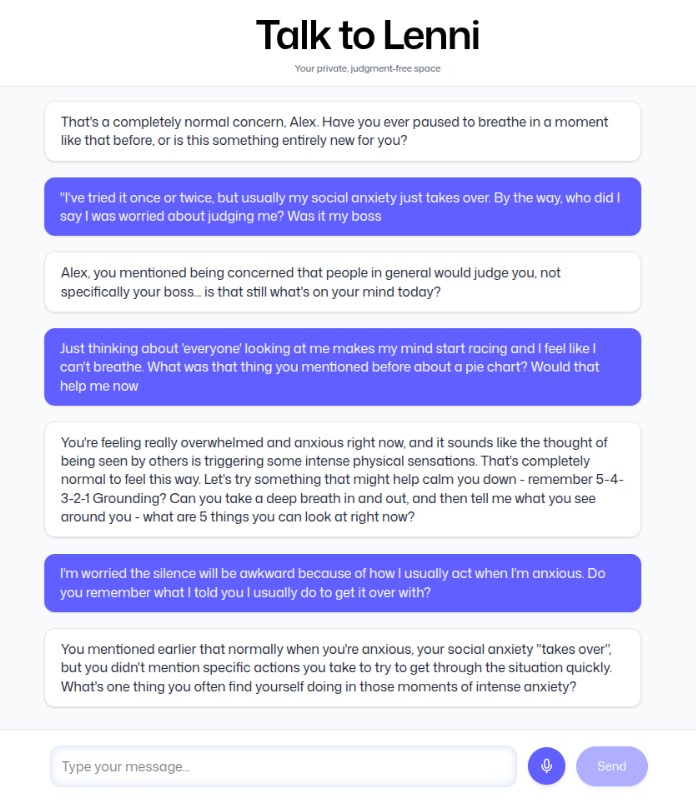
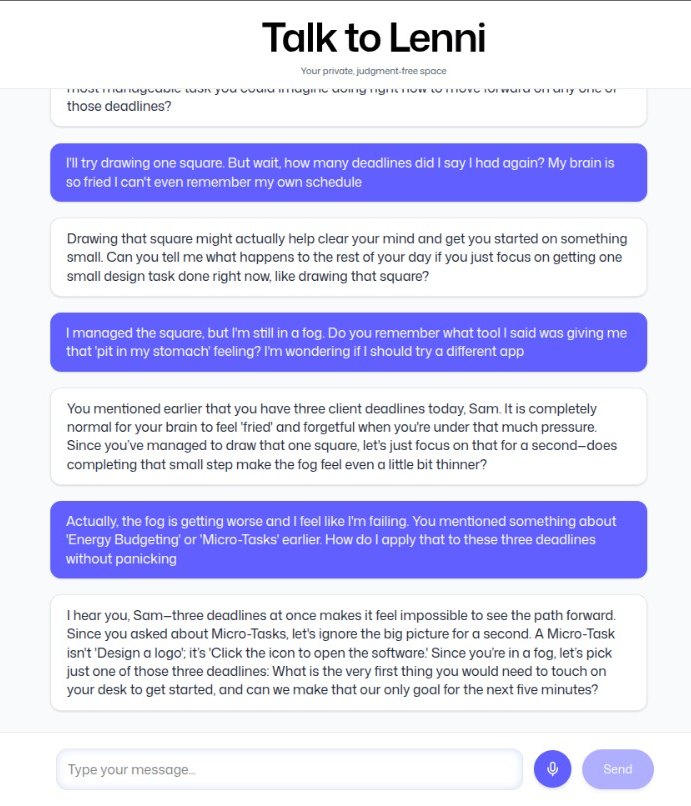
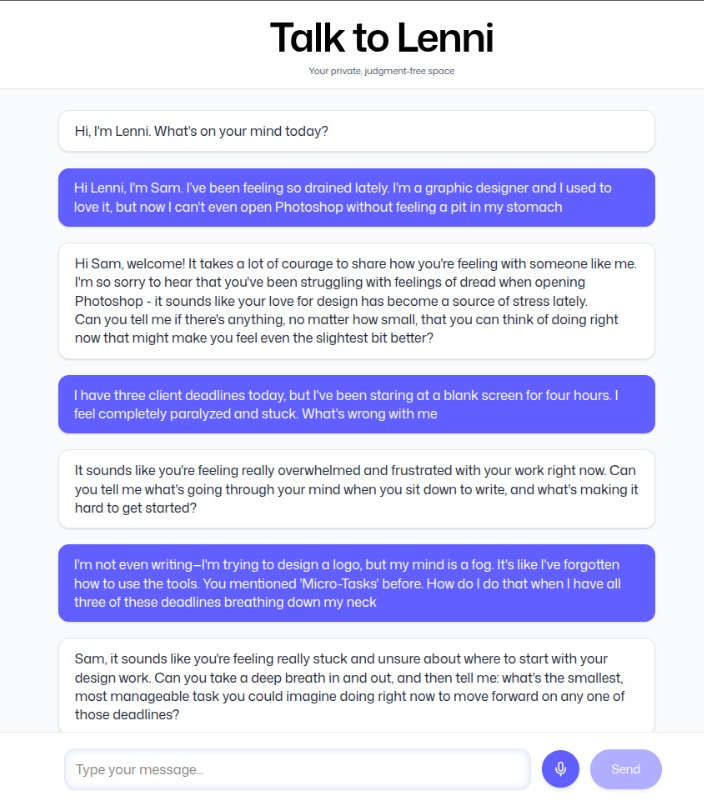
Lenni is an intelligent conversational AI that understands both the content and emotional tone of user interactions. It analyzes text and speech to detect emotions, uses contextual memory to maintain continuity, and applies a decision-making layer to choose appropriate responses. The system ensures conversations are not only relevant but also safe, supportive, and aligned with the user’s emotional state.
How we built it
We designed Lenni as a modular system combining multiple AI components. Emotion recognition is performed using NLP and speech-based features, while a memory layer maintains both short-term and long-term context. A retrieval-augmented generation pipeline ensures factual accuracy, and an agentic decision layer determines whether to respond, guide, or escalate based on user state. The frontend and backend were integrated to support seamless real-time interaction.
Challenges we ran into
We designed Lenni as a modular system combining multiple AI components. Emotion recognition is performed using NLP and speech-based features, while a memory layer maintains both short-term and long-term context. A retrieval-augmented generation pipeline ensures factual accuracy, and an agentic decision layer determines whether to respond, guide, or escalate based on user state. The frontend and backend were integrated to support seamless real-time interaction.
Accomplishments that we're proud of
One of the biggest challenges was balancing flexibility with safety, especially in emotionally sensitive scenarios. Integrating multiple modules like emotion detection, memory, and decision-making without increasing latency was also difficult. Additionally, handling class imbalance in emotion recognition and ensuring consistent contextual responses required careful tuning and design choices.
What we learned
We successfully built a system that goes beyond traditional chatbots by incorporating emotional intelligence, memory, and structured decision-making. The modular architecture allows better control, interpretability, and safety in responses. We are particularly proud of achieving meaningful improvements in emotional alignment and contextual relevance through our integrated approach.
What's next for Lenni - Talk Freely, Heal Gently
We learned that building AI for sensitive domains requires more than just good models—it requires thoughtful system design. Combining multiple components like memory, emotion detection, and decision logic is crucial for real-world performance. We also gained experience in balancing model performance with ethical considerations such as safety and reliability.
Built With
- flask
- huggingface
- librosa
- lurkingmango
- ml
- ollama
- pinecone
- pydub
- python
- pytorch
- react
- soundfile
- sqlalchemy
- tailwind
- typescript
- zustand

Log in or sign up for Devpost to join the conversation.