-
-
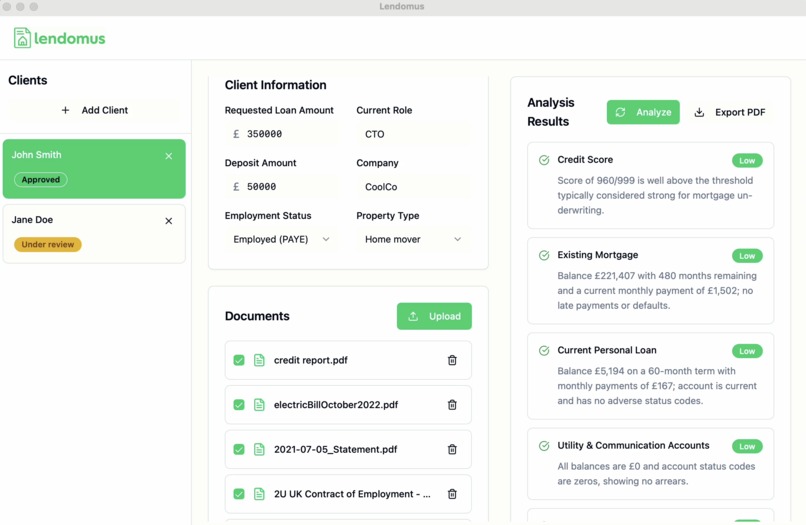
Product in action after completing analysis for a client
-
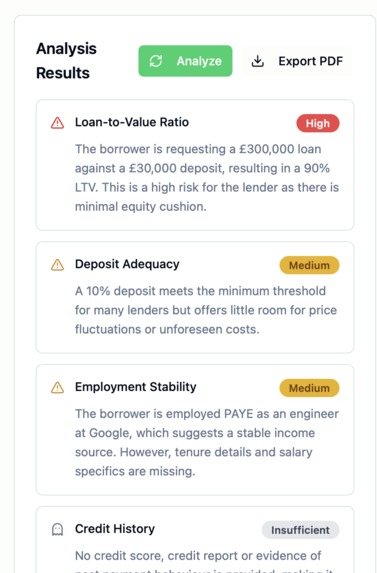
Categorisation of analysis outcome
Inspiration
Raghvi, working at a payments fintech, saw how messy document verification can be with unstructured formats, cross-checks across contexts, and long, manual reviews. LLMs are a natural fit for this, able to reason across multiple documents and flag inconsistencies. Eleonora has built enterprise admin software before, so she knows how to make complex tools usable and efficient. Through our own house-buying experience and conversations with brokers, we learned that document checks often take hours to days, with inconsistent follow-ups between brokers. Some even turn away clients because they can’t handle the workload. Existing tools are built for banks or anti-money laundering, and most cloud solutions can’t be used due to strict privacy rules. That’s why we built Lendomus - to help brokers handle more clients, review documents consistently, and connect borrowers to lenders faster.
What it does
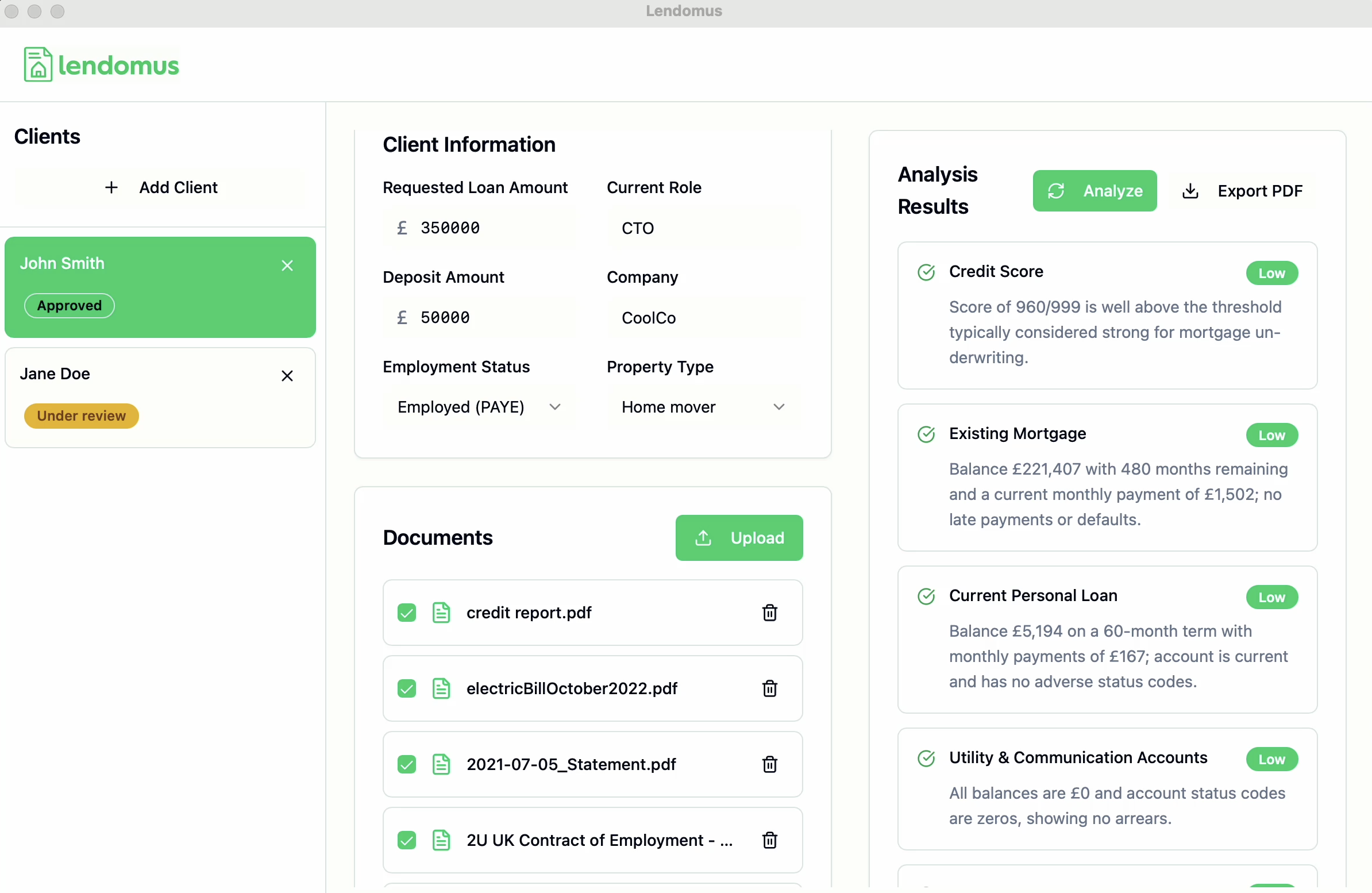
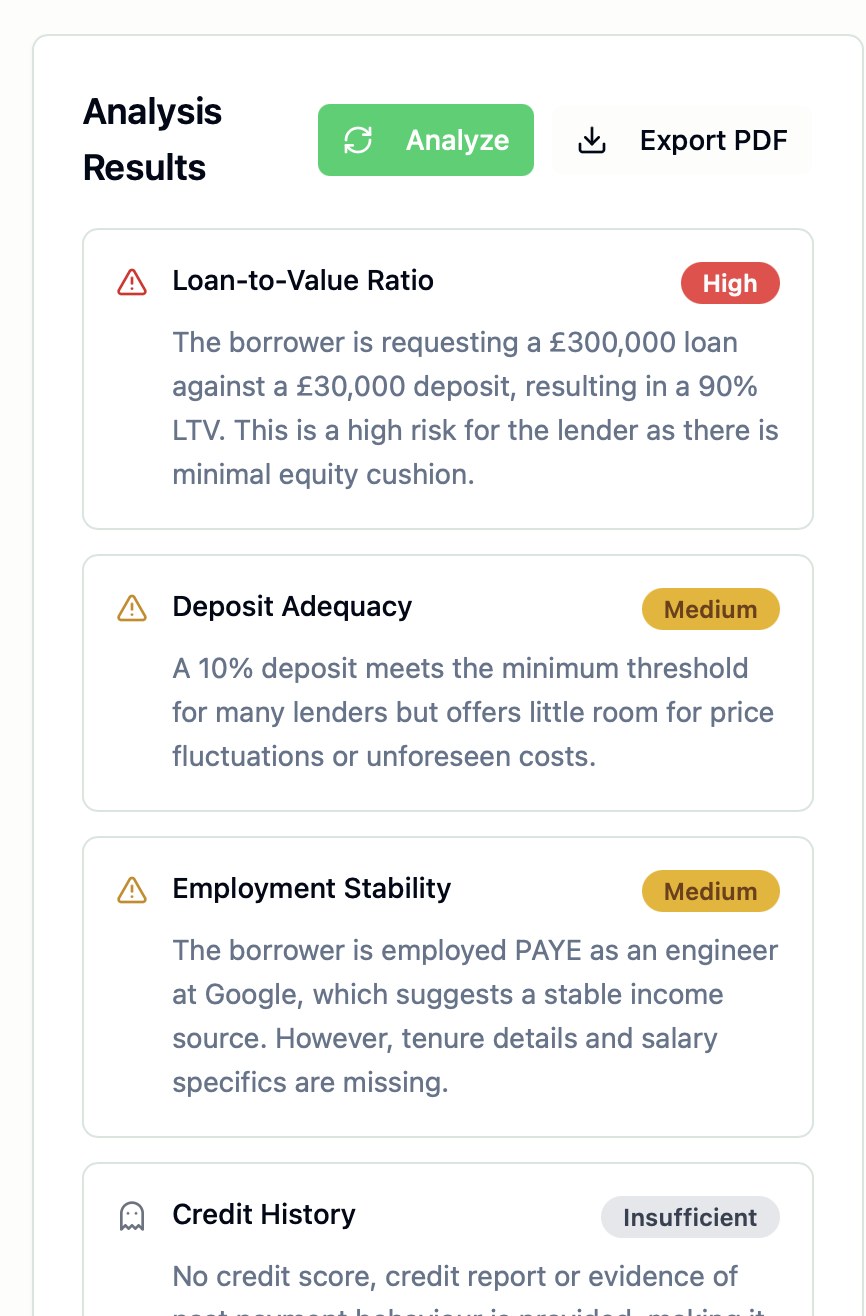
Lendomus is a desktop application that runs gpt-oss reasoning models locally to check borrower documentation. Brokers enter client context (loan amount, employment status, property type) and upload documents like credit reports and bank statements. Lendomus then parses, structures, and analyses them, produces a categorised risk breakdown, highlights missing or inconsistent docs, and generates actionable insights. Brokers can manage multiple clients, re-run analyses, and export clear PDF reports with both summaries and detailed breakdowns.
How we built it
We built Lendomus using a Tauri and Rust backend for speed, and a React, TypeScript and Tailwind frontend for a clean, modern interface. This wraps a gpt-oss-20b model, running locally with Ollama on the broker’s computer. We prototyped UI screens with Lovable, and coded the backend and reasoning pipeline ourselves with the help of Cursor. Our pipeline involves uploading documents and context, extracting content from the documents, structuring analysis context based on these, feeding it into gpt-oss to reason through mortgage suitability, outputting the results as structured analysis, and then generating a downloadable PDF.
Challenges we ran into
While building Lendomus, we faced a few challenges. Firstly, mortgage applications can include dozens of large files, which can be too much context for LLMs to handle. We solved this by chunking documents and analysing them individually before synthesising an overarching assessment. Secondly, re-running the analysis with additional documents took a long time. To avoid recomputing everything when only one file changes, we cached prior analyses and only re-ran the relevant parts. Finally, most brokers are not technical, so we focused on simple flows and minimal setup.
Accomplishments that we're proud of
We are proud of having built something that is easy to use for people who currently largely use manual processes, and have no technical knowledge. Everything runs locally and the interface feels simple and modern despite the complexity under the hood. Secondly, we built a full end-to-end product in just a few weeks - from data processing and multi-step AI analysis to a polished desktop UI and PDF export. This was Raghvi’s first time taking a project all the way through the engineering stack, and our first virtual hackathon together, during which we collaborated seamlessly to combine our fintech and enterprise software experience.
What we learned
Through this process, we learnt how to apply document processing techniques: chunking large, messy mortgage docs, caching results, and re-analysing only what changes. We also learnt how to balance AI power with usability, designing workflows that brokers can adopt without technical knowledge.
What's next for Lendomus
We plan to extend what we’ve built by adding support for more document formats (e.g. JPEGs, documents with password), more client context fields (e.g. DOB, salary, property conditions), and 2-person mortgage applications. We also want to build the ability to connect Lendomus to the broker CRM to recommend best lenders for each applicant, based on the brokers’ negotiated rates. Eventually, we will be able to expand the same workflow into insurance, visa, and compliance document checking.
Built With
- cursor
- gpt-oss:20b
- lovable
- ollama
- react
- rust
- tauri
- typescript


Log in or sign up for Devpost to join the conversation.