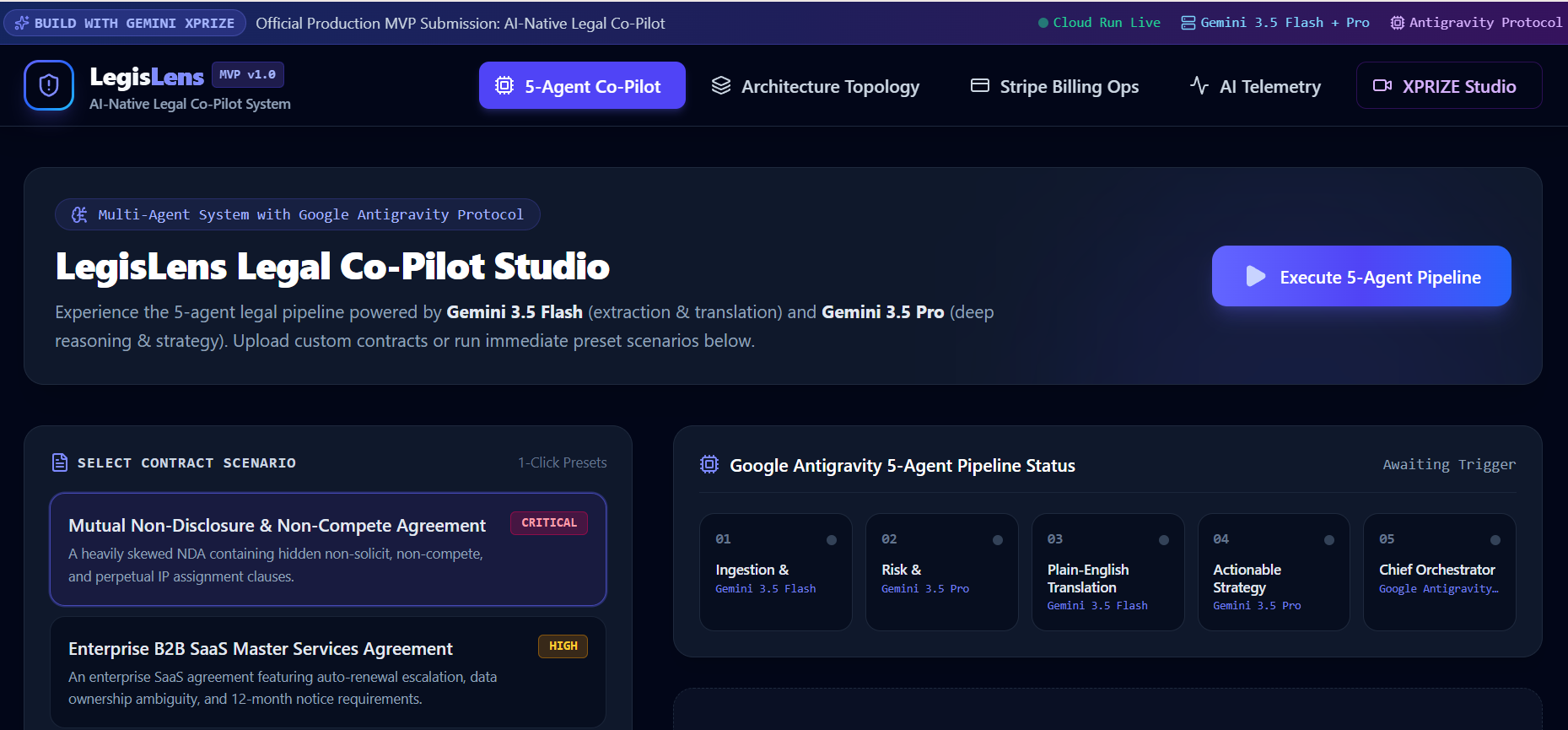
As a Creative Technologist, I am constantly looking for ways to bridge the gap between complex systems and human-centered design. Today, I’m thrilled to introduce my latest build for hackathon judges, investors, and fellow founders: LegisLens AI. Over 80% of small businesses cannot afford legal help. LegisLens democratizes access to professional legal guidance using AI. Legal documents and legislative bills are notoriously dense, opaque, and time-consuming to parse. For fast-moving startups and entrepreneurs, waiting weeks for legal reviews or drowning in compliance paperwork can kill momentum. I wanted to build an intelligent, highly accurate co-pilot that acts as a first line of defense—democratizing legal comprehension and making legal analysis instant, accessible, and actionable.
What it does LegisLens AI is an intelligent legal assistant that helps users understand, analyze, and query complex legislative and legal documents.
- *Instant Synthesis: * Upload dense legal texts and receive high-level, structured summaries.
- *Precise Q&A: * Ask highly specific questions about clauses, liabilities, and regulatory requirements, and get answers grounded strictly in the source text.
- *Risk & Compliance Mapping: * Automatically flags potential compliance risks and operational bottlenecks.
How We Built It
Leveraging rapid prototyping methodologies and AI-assisted product design, the system is engineered for maximum accuracy and speed:
- *Backend & Logic: * Powered by Python and advanced Retrieval-Augmented Generation (RAG) pipelines to ensure zero-hallucination outputs grounded in real legal texts.
- *AI Orchestration: * Leveraged state-of-the-art LLMs with fine-tuned semantic search to match user queries with precise clauses. * *Frontend/UI: * Designed a clean, human-centered, and intuitive interface that removes the intimidation factor from legal analysis.
- *Open Source: * Explore the codebase here: LegisLens AI GitHub Repository
Challenges We Ran Into
**The Zero-Hallucination Mandate: * In the legal domain, accuracy isn't optional; It's critical. Fine-tuning our RAG pipeline and prompting engineering constraints to prevent AI from "guessing" or extrapolating beyond the provided legal text was a rigorous engineering challenge. * *Handling Massive Document Contexts: * Large legislative bills can span hundreds of pages. Optimizing document chunking and indexing strategies to maintain context without hitting token limits or latency spikes required deep architectural iteration.
Accomplishments That We're Proud Of
- Developed a highly accurate, context-aware semantic search system that pinpoints exact clauses in seconds.
- Designed a seamless, professional user experience that bridges the gap between complex legal data and everyday business operations.
- Built a modular architecture that easily scales to support Web3-specific compliance frameworks and smart contract documentation.
What We Learned
- *Context is King: * Standard vector search isn't enough for legal text; metadata tagging and hierarchical document chunking are vital to preserving the relationships between different clauses and articles.
- *AI Guardrails: * Designing strict system instructions and verification loops is essential when building AI tools for high-stakes industries like law and finance.
What’s Next for LegisLens AI
We are just scratching the surface. The roadmap for LegisLens includes:
- *Web3-Native Integration: * On-chain verification of legal agreements and automated smart contract audit compliance checks.
- *Multi-Jurisdictional Analysis: * Allowing users to cross-reference local, national, and global regulatory frameworks simultaneously.
- *Strategic Partnerships: * We are actively seeking design partners, legal tech collaborators, and VC backing LegisLens AI into the ultimate compliance co-pilot for the decentralized economy.

Log in or sign up for Devpost to join the conversation.