Inspiration
My friend and I are both longtime VR players. We work in VR, play in VR, and spend time in VR communities every day. Because of that, we see firsthand what players enjoy, what frustrates them, and what makes them keep coming back.
We had always talked about making our own game, but we never really knew where to start. Then I saw the new Meta glasses announced and started thinking about where VR could be heading.
That sparked a simple idea: What if we made a VR fighting game where you didn’t need controllers?
We wanted to build something that felt natural, physical, powerful, and fun. Something where the player wasn’t just controlling a fighter they actually felt like the fighter.
That idea became Dojo Showdown VR.
What it does
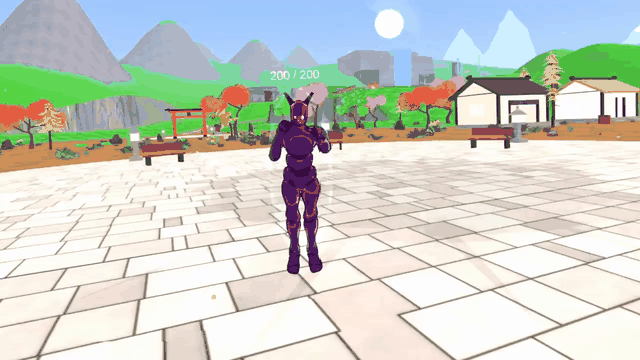
Dojo Showdown is an anime-inspired VR fighting game focused on immersive, physical combat.
Players can fight using their hands, body movements, and gestures without needing traditional VR controllers.
The goal is to let players:
- Punch and block naturally
- Use hand gestures to activate special abilities
- Fight opponents in stylized anime-inspired arenas
- Knock enemies across the environment
- Interact with destructible objects
- Move freely around the fighting space
- See their own full VR body, including moving arms and legs
- Feel like they are actually inside an anime battle
Controllers can still be supported, but hands-free gameplay is one of the main features we wanted to explore.
How we built it
We began building Dojo Showdown in Unity.
Since neither of us started as traditional game developers, a lot of the process has involved learning as we build.
We started by creating a basic combat environment and experimenting with:
- Hand tracking
- VR interaction
- Character rigs
- Full-body avatars
- Inverse kinematics
- Physics-based combat
- Special abilities
- Destructible environments
- Anime-inspired visual effects
- Quest optimization
We also approached development from the perspective of VR players. Instead of only asking what was technically possible, we constantly asked ourselves whether something actually felt good inside the headset.
Challenges we ran into
One of our biggest challenges has been making controller-free combat feel responsive.
Hand tracking is very different from controller tracking, especially when players are moving quickly, throwing punches, blocking, or putting their hands close together.
Another challenge has been creating a believable full body using limited tracking information. The headset knows where your head is and hand tracking knows where your hands are, but the game still has to estimate where your shoulders, elbows, torso, hips, legs, and feet should be.
Performance has also been incredibly important.
We want Dojo Showdown VR to run well on standalone Meta Quest hardware, so we have to balance visual quality, physics, effects, destructible environments, avatars, and combat without hurting performance.
And because we are learning while building, sometimes something works perfectly one day and completely breaks the next.
But solving those problems has become part of what makes the project exciting.
Accomplishments that we're proud of
One of the biggest accomplishments is simply taking the idea out of our heads and actually building it.
For years we talked about making a game someday. Now we can actually put on a headset and play something we created.
We are especially proud of experimenting with hands-free fighting, gesture-based abilities, full-body avatars, environmental destruction, and anime-inspired combat.
Seeing a character respond to your real movements or watching an attack send something flying across the arena makes the countless hours of experimenting worth it.
We are also proud that this started as two VR players asking, "Why doesn't someone make this?"
Instead of waiting for someone else, we decided to try.
What we learned
The biggest thing we learned is that you do not have to know everything before you start.
We definitely didn't.
Game development has involved a lot of experimenting, failing, researching, rebuilding, and trying again.
We have also learned how different VR development is from traditional games.
Something that looks great on a monitor might feel completely wrong once you put on a headset.
Comfort, scale, responsiveness, physical interaction, performance, and immersion all become incredibly important.
Most importantly, we learned how valuable the VR community is.
Players constantly talk about what they want, what they dislike, and what they wish developers would try. Listening to those conversations has helped shape the direction of Legends Beyond VR from the beginning.
What's next for Dojo Showdown VR
We are still very early in development, and there is a lot we want to build.
Next, we plan to continue improving:
- Hands-free combat
- Gesture-based powers
- Full-body movement
- Enemy AI
- Physics interactions
- Destructible arenas
- Additional characters
- New abilities
- Different fighting styles
- More anime-inspired environments
- Multiplayer combat
We also want the community involved as much as possible.
We want players to test the game, tell us what feels good, tell us what doesn't, suggest abilities, suggest arenas, and help shape what Legends Beyond VR eventually becomes.
This project started as two friends who love VR wondering what would happen if your own hands became the controller.
Now we want to find out just how far we can take that idea.

Log in or sign up for Devpost to join the conversation.