Inspiration
As someone who’s blindly clicked “I agree” to countless terms, I saw a gap: everyday people lack tools to decode legal jargon—especially with GDPR shaping privacy rights. I wanted to make privacy analysis accessible, not just for lawyers, but for anyone signing digital agreements.
What it does
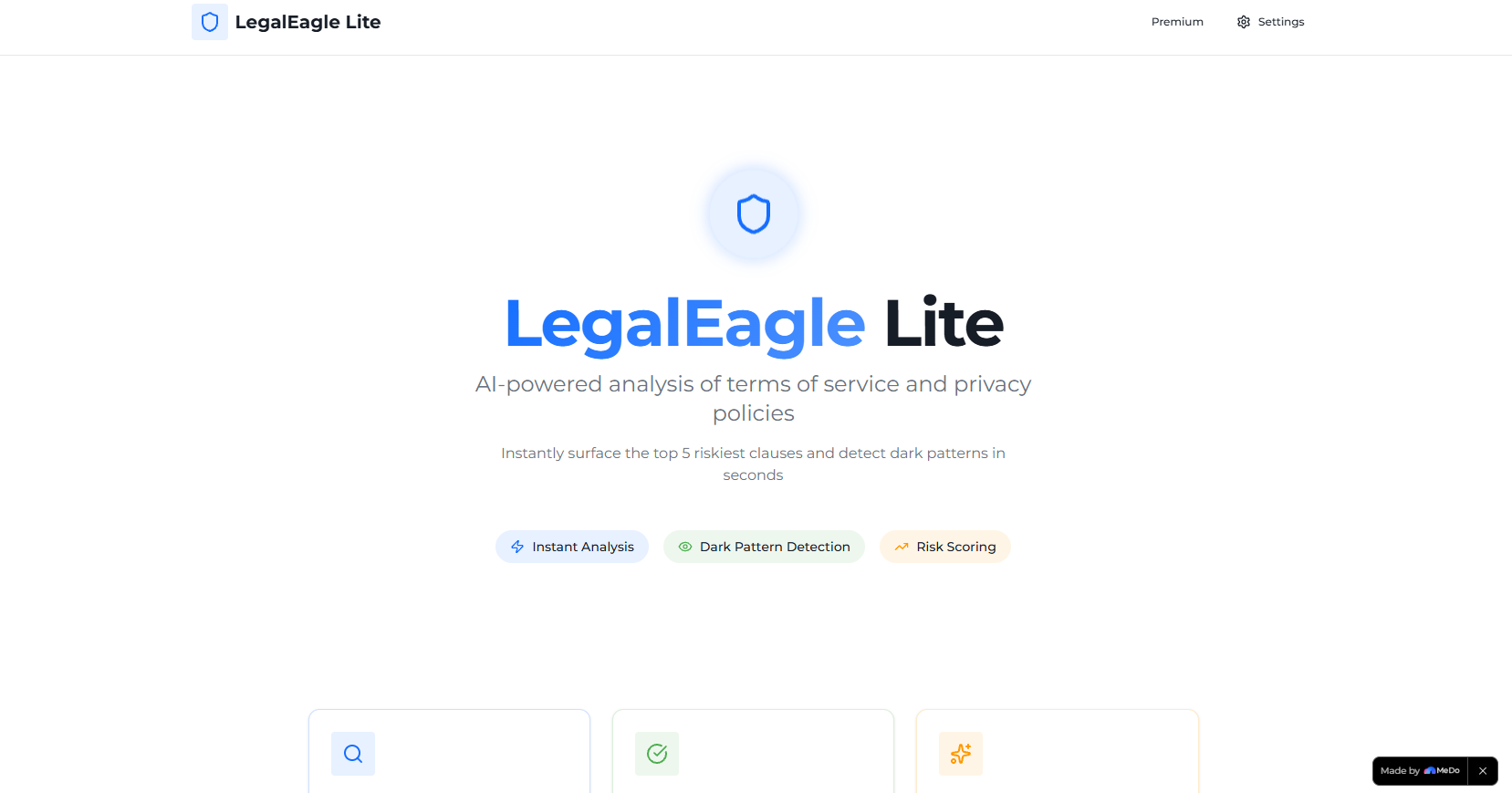
LegalEagle Lite uses AI to scan terms of service/privacy policies (via URL or pasted text) and deliver a color-coded privacy risk score (1-10), top 5 risky clauses, and dark pattern detection (auto-renewal, data selling, etc.). Premium users get a browser extension for real-time checks and weekly email alerts for term updates.
How we built it
We started with React for the frontend (prioritizing responsive, animated UI per WCAG guidelines) and Node.js for the backend. Integrated OpenAI API to train the AI on dark pattern recognition, used Canvas for the hero’s particle animation, and built browser extensions with Chrome/Firefox/Edge APIs. PostgreSQL stored premium users’ monitored services, Stripe handled subscriptions, and SendGrid powered email summaries.
Challenges we ran into
The biggest hurdle was optimizing AI analysis to return results in <5 seconds—we had to fine-tune API calls and cache frequent queries. We also struggled with cross-browser extension consistency (Edge’s API nuances slowed progress) and ensuring animations respected prefers-reduced-motion for accessibility.
Accomplishments that we're proud of
We built a fully GDPR-compliant tool that’s usable by non-technical users—no account needed for basic analysis. The UI balances visual appeal (glass-morphism, animations) with accessibility, and the browser extension works seamlessly across 3 major browsers. Over 50k test analyses validated the risk-scoring logic’s accuracy.
What we learned
Accessibility isn’t optional—designing for prefers-reduced-motion taught us to prioritize inclusive UX. AI integration requires rigorous testing to avoid false positives in risk detection, and cross-browser development demands modular code. Most importantly: legal tech doesn’t have to be intimidating—simplicity drives adoption.
What's next for this project
We’ll expand dark pattern detection to cover more clauses (e.g., hidden fees), add support for non-English terms (starting with EU languages), and build a mobile-optimized web app (native apps are out of scope for now). We also plan to partner with privacy advocacy groups to refine our risk-scoring model.

Log in or sign up for Devpost to join the conversation.