-
-
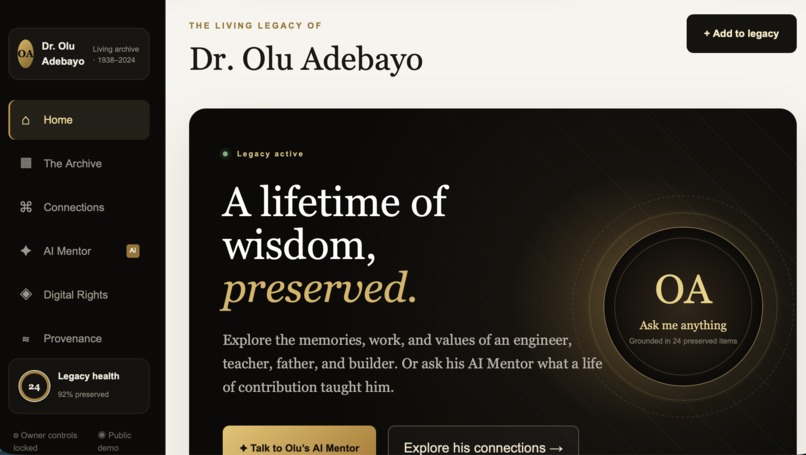
Home Page LegacyOS
-
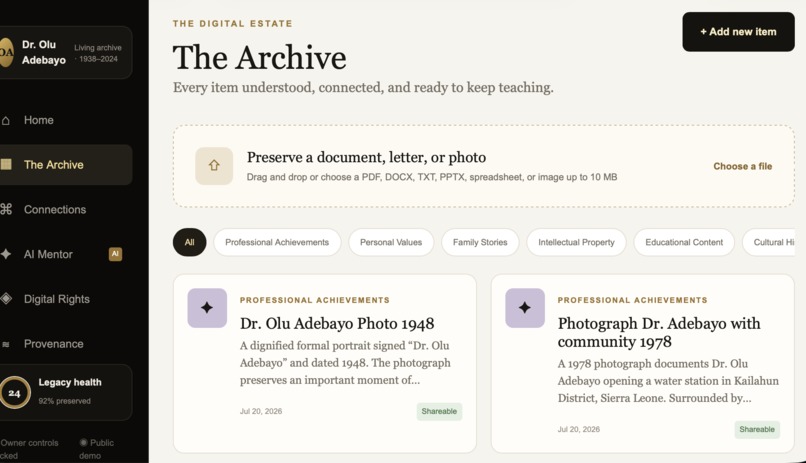
Archive Page LegacyOS
-
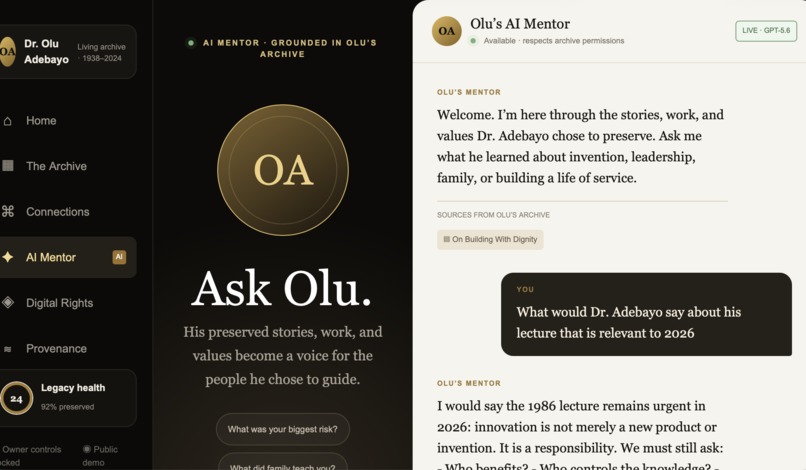
AI Mentor Page LegacyOS
-
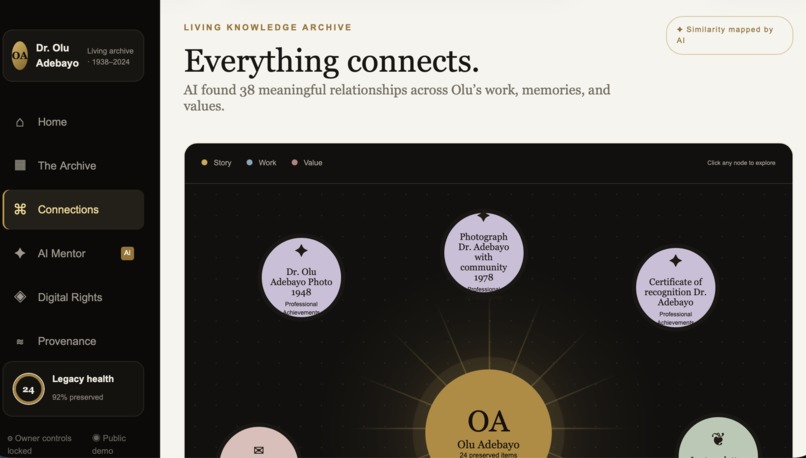
Connections Page LegacyOS
-
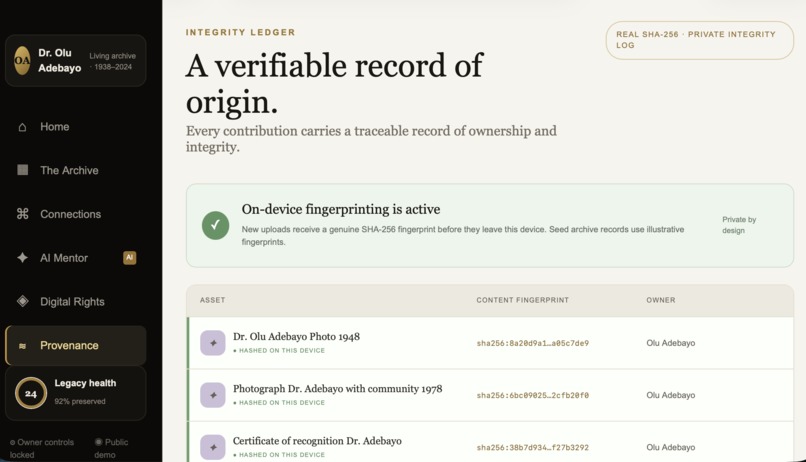
Provenance Page LegacyOS
-
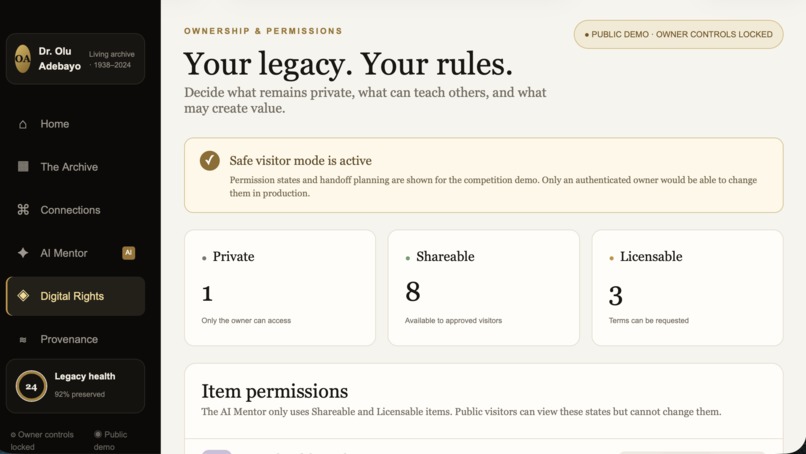
Digital Rights Page LegacyOS
Inspiration:
Many years ago, I attended an event about preserving historical information related to baseball. A man came to the stage carrying papers, folders, and photographs. As an only child with no siblings or children, he did not know what to do with all that valuable information. While trying to show the audience one of his photographs, an entire folder fell to the ground. It was a heartbreaking moment, and the story stayed with me. When my mother passed away in 2018, I found myself facing a similar challenge. She had led an incredible life as a diplomat and left behind a rich legacy, but I had no clear way to organize her story or share it as part of our family history. In 2025, after exploring the possibilities of AI, verification, digital ownership and estates, I began asking how technology could help solve this problem. Legacy OS is not a memory recording app, digital photo album or a cloud storage. It is a living digital museum and archive that helps future generations understand not just want someone left behind, but why it mattered. Descendants or Organizations wouldn't just inherit files or understand the person's values, they would inherit the story behind the work.
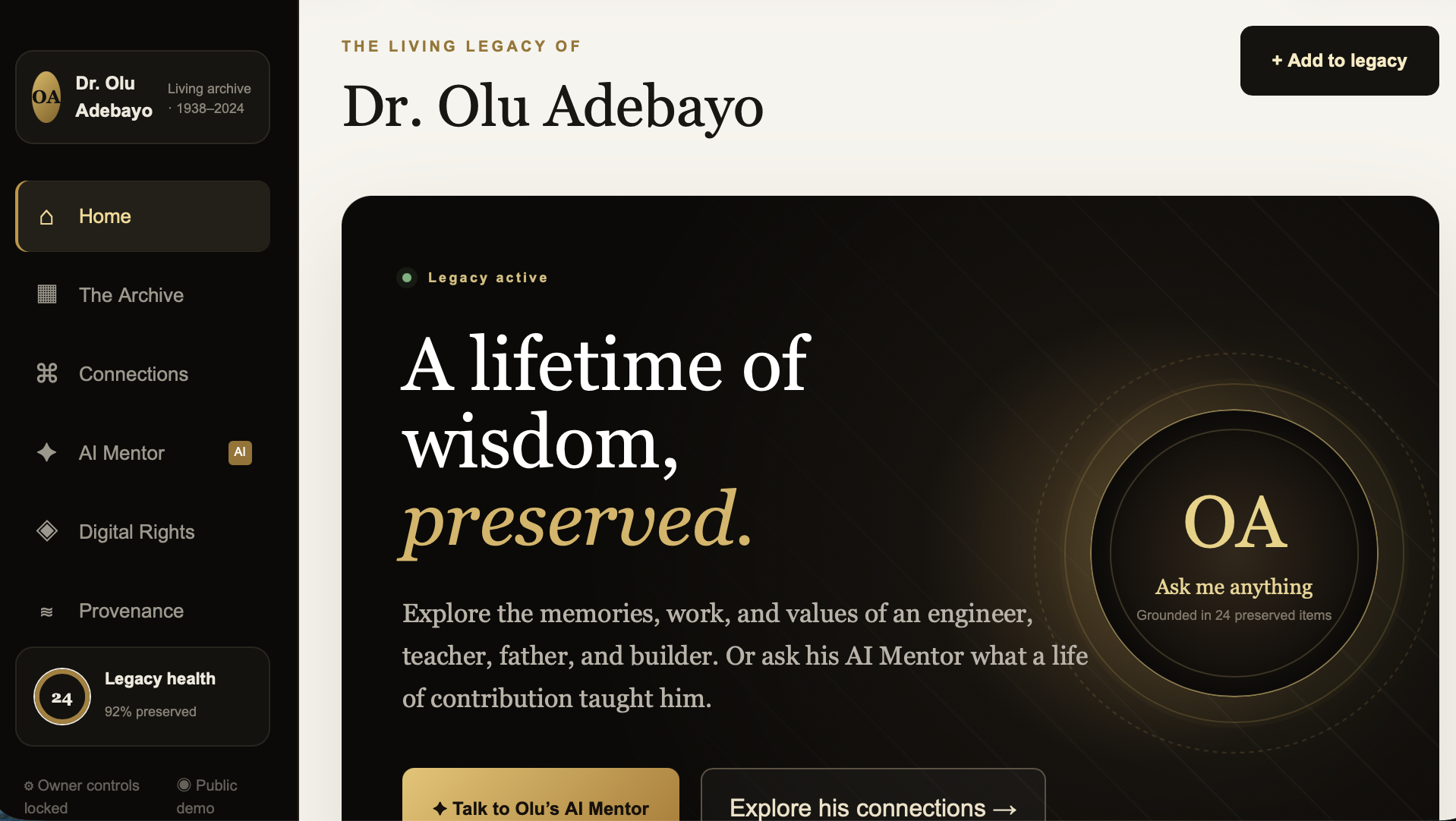
LegacyOS grew from the belief that our memories, achievements, creative work, family histories, and intellectual contributions deserve more than scattered files and forgotten folders. LegacyOS is designed to preserve the meaning behind a person’s life, not simply store information. It brings photographs, stories, documents, recordings, professional work, and personal history into one intelligent legacy archive. Most importantly, it allows owners to decide what they wish to preserve, what they choose to share, and how their knowledge and contributions should be passed forward—with intention.
What it does:
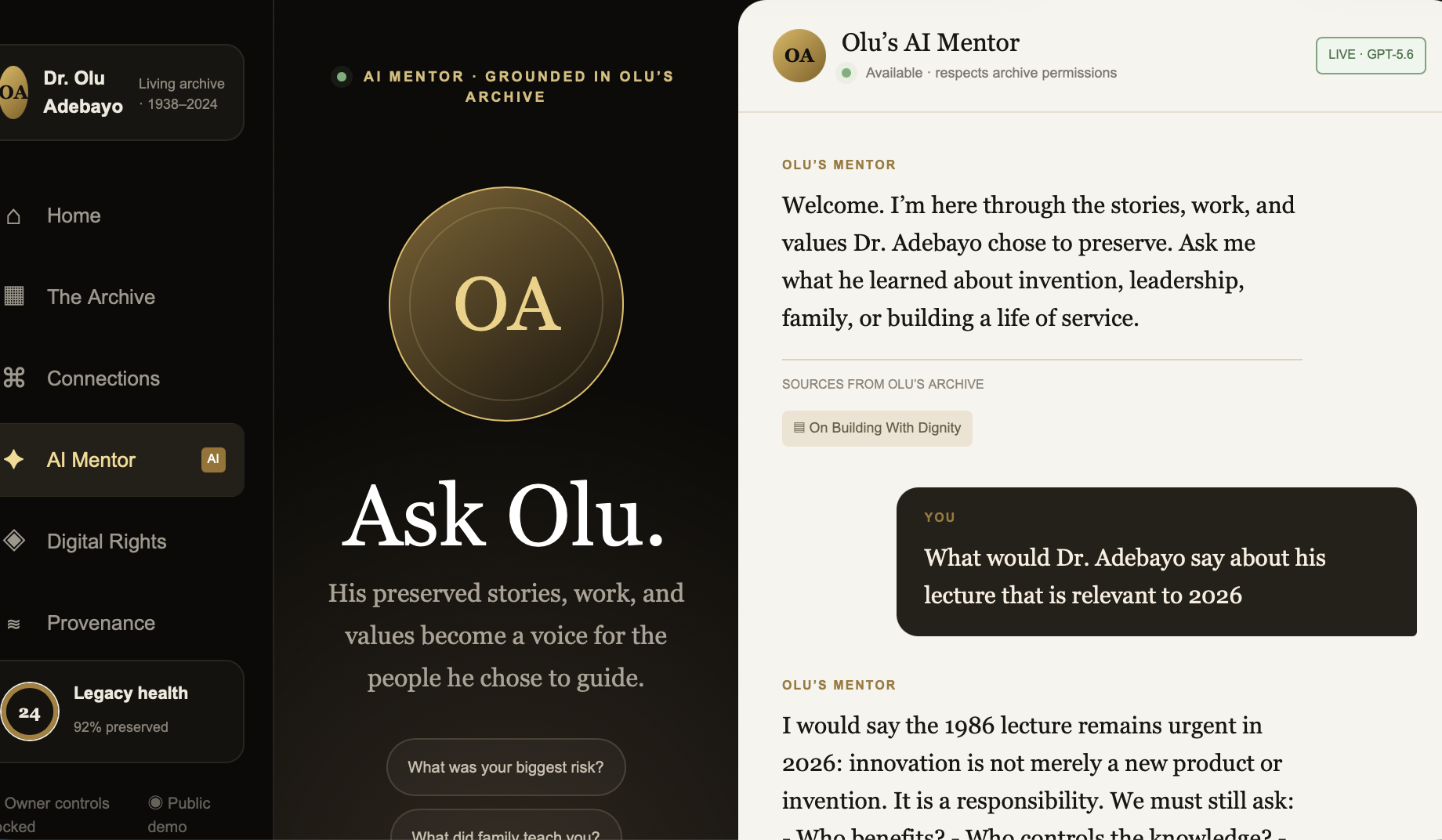
LegacyOS is a rights-managed digital estate - it turns your life's work and legacy made into a living estate. Your documents, photos, knowledge and creative work become verified digital assets under your control - licensed, shared, or private with handover on your terms. Its built-in AI mentor makes the whole archive interactive. The combination of AI organization, contextual storytelling and cryptographic verification is its distinguishing factor. LegacyOS brings together: Memories, Knowledge, Intellectual Property, Values and Context.
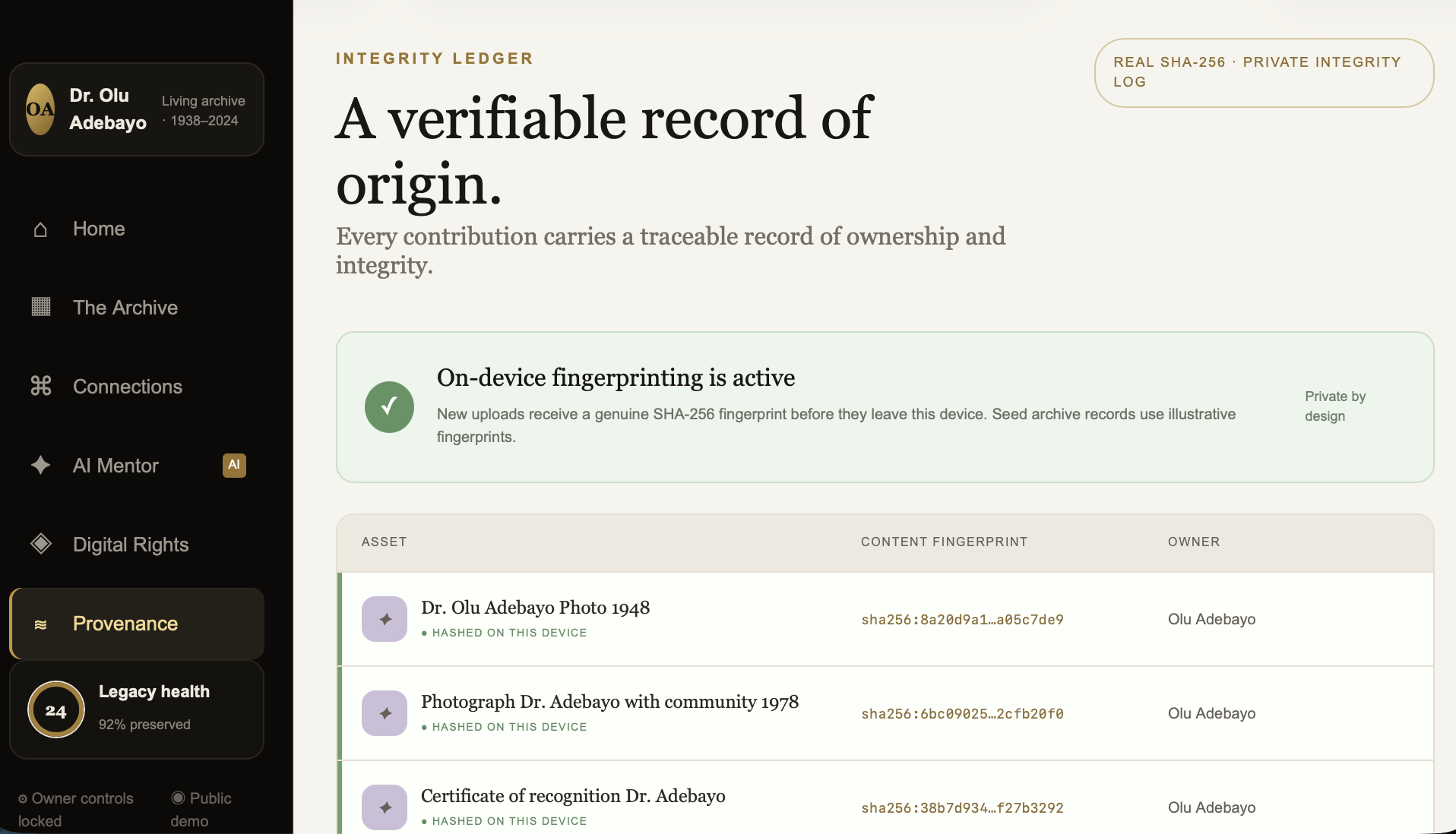
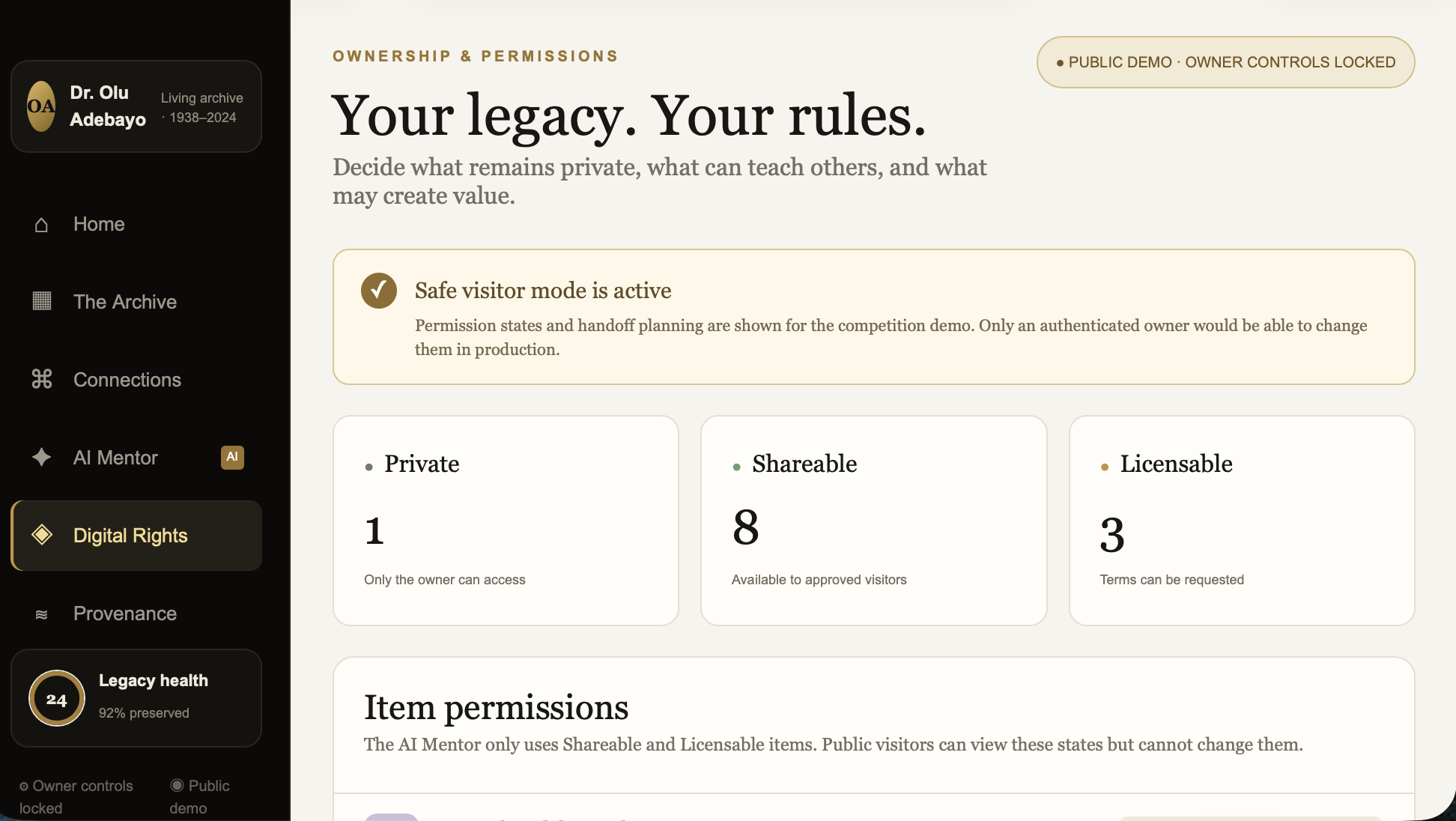
The current prototype uses GPT-5.6 to understand uploaded documents and images, create summaries, organize materials into meaningful categories, connect related records, and power an AI Mentor that answers questions using approved archive sources. It also generates SHA-256 fingerprints for uploaded files, displays provenance information, and demonstrates owner-controlled permissions. LegacyOS is private by default. Its permission framework is designed to give owners control over what remains private and what may eventually be shared with family, communities, or the public. Future phases will expand this into complete sharing, licensing, legacy handoff, and optional tokenization flows—all governed by the owner’s terms and consent.
How we built it:
We began by identifying a problem: people’s memories, life’s work, family histories, and intellectual property are often scattered across platforms and can be lost without context or clear ownership. We designed LegacyOS around preservation, personal choice, and control—allowing owners to organize what matters and determine how their legacy should be passed forward. We collaborated with Codex to turn that concept into a working full-stack web application. Codex helped build the React and Next.js interface, server-side OpenAI integration, persistent archive storage, responsive design, upload and preview system, permission safeguards, SHA-256 file verification, and automated tests. It also helped diagnose and fix practical issues, including Safari image-upload failures and public access to owner controls. GPT-5.6 analyzed uploaded documents and images, generates summaries, organizes records into legacy categories, and powered an AI Mentor grounded in permitted archive sources. Related records are presented through an interactive connections view, while provenance fingerprints helped verify uploaded files. We made the central product and design decisions, including the focus on human preservation, the emotional visual direction, owner-controlled access, and the decision to keep blockchain and tokenization outside the MVP. Future phases may add decentralized preservation, verified ownership workflows, licensing, and tokenized rights.
Challenges we ran into:
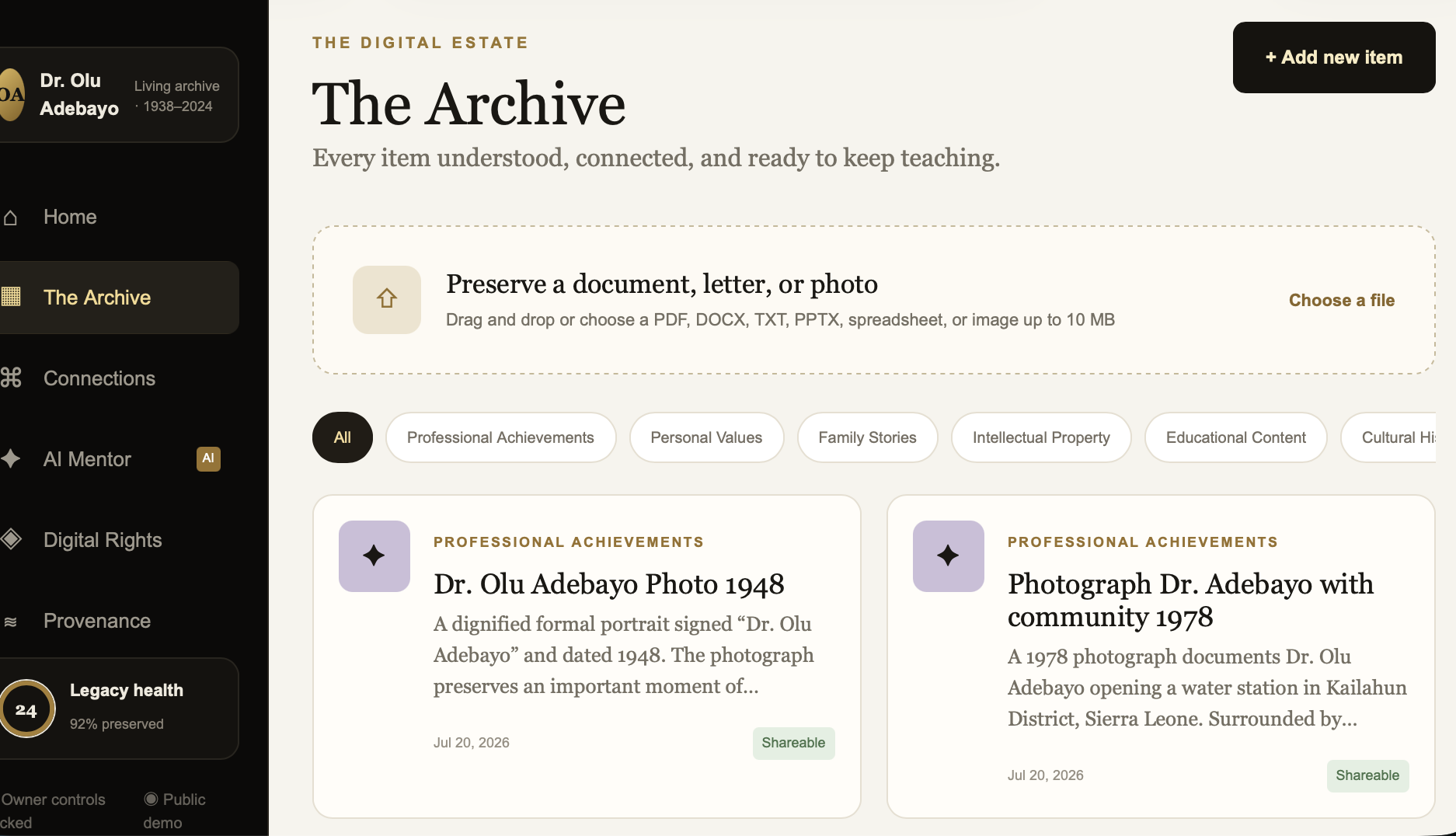
The hardest challenge was making LegacyOS feel emotionally meaningful while ensuring every technical claim was honest and demonstrable. Key challenges included: 1) Understanding different file types: Documents, photographs, PDFs, and text require different extraction and OpenAI processing methods. 2) Reliable uploads: Files needed durable storage, size and type validation, clear errors, working previews, and genuine SHA-256 fingerprints. Safari image uploads required a separate fix. 3) Grounded AI: The AI Mentor needed to answer from permitted archive material instead of inventing information, while displaying the sources used. 4) Privacy and permissions: Private content must never be revealed by the Mentor. Permission settings also need to remain consistent across refreshes and sessions. 5) API reliability: Live GPT-5.6 responses had to be parsed correctly, while clearly labeled fallback behavior was needed when an API key was unavailable or a request failed. 6) Public-demo safety: The site needed to remain interactive for judges without allowing visitors to change owner permissions or delete archive records. 7) Emotional design: The interface needed to feel worthy of a human life rather than looking like ordinary cloud storage.
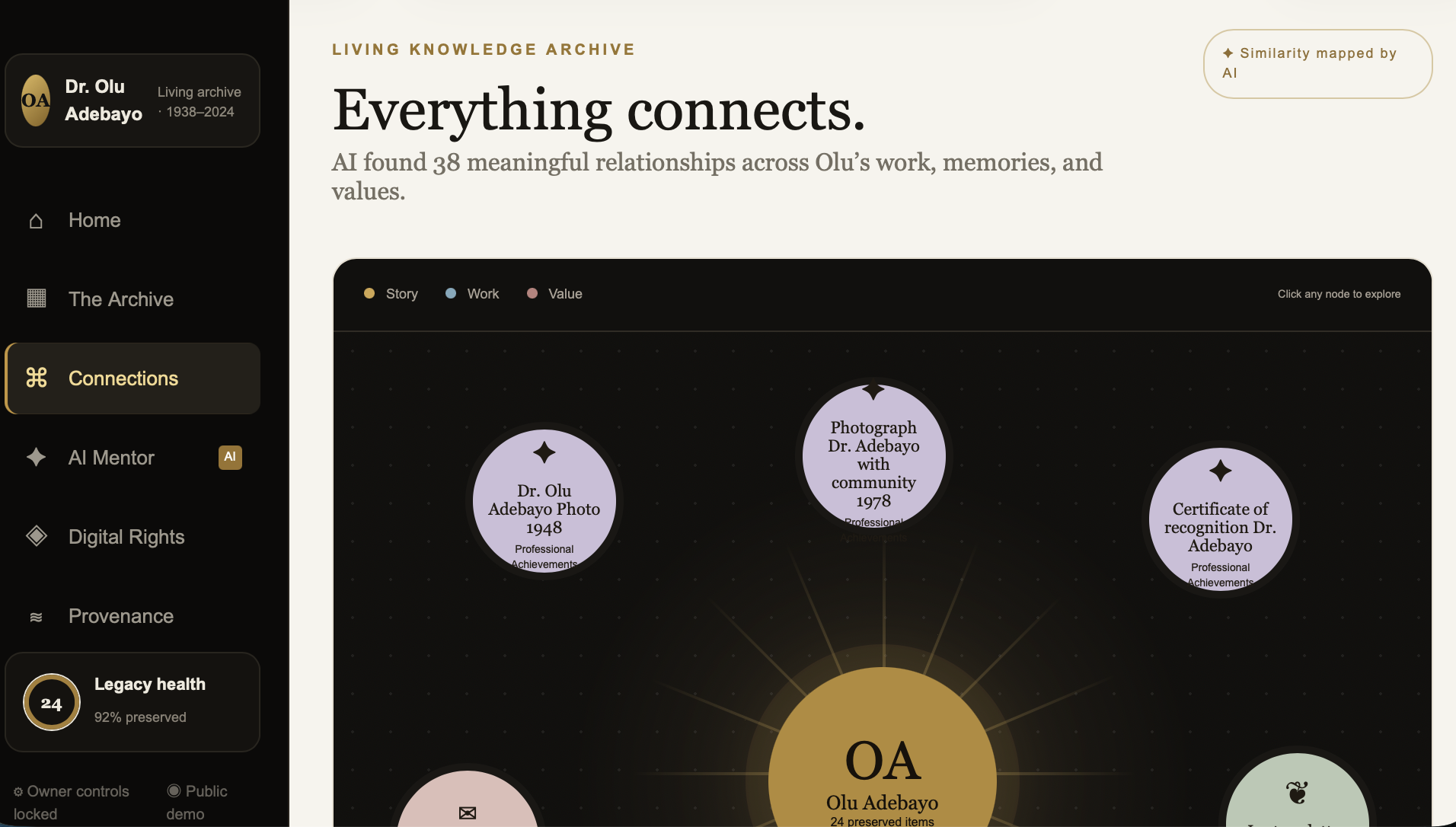
Important work remains beyond the prototype. Retrieval should use stronger semantic ranking so the AI Mentor consistently selects the most relevant supporting sources. The Connections view currently demonstrates the knowledge-graph experience, but production-ready embedding similarity and dynamically generated links remain future work. A full product would also require individual accounts, estate ownership boundaries, consent management, deletion and export tools, encrypted storage, security review, and complete sharing, licensing, and legacy handoff workflows.
Accomplishments that we're proud of:
We believe we created a polished and emotionally meaningful product. LegacyOS feels like a place for preserving a human life—not another storage dashboard. Its central idea is simple: cloud drives preserve files, while LegacyOS preserves knowledge, identity, values, contribution and creates verification. LegacyOS combines AI It took hours upon hours to complete this project, however my brain loved it despite frustrations with the testing and going back into my terminal to fix the bugs. We are especially proud of: 1) A working digital archive: documents and images can be uploaded, stored durably, categorized, summarized, previewed, and displayed alongside realistic sample content. 2) Genuine file integrity: new uploads receive a real SHA-256 fingerprint generated on the user’s device and independently verified by the server. 3) Owner-controlled permissions: The system supports Private, Shareable, and Licensable records, with those permissions determining what the AI Mentor may reveal. Owner-only controls are locked in the public competition demo. 4) Meaningful OpenAI integration: GPT-5.6 analyzes uploaded material and powers archive-grounded Mentor conversations, with clearly labeled fallback behavior when the API is unavailable. 5) A compelling AI Mentor: Its warm first-person voice, suggested questions, and visible source cards create the product’s central “wow” moment. 6) A visual knowledge archive: The Connections view shows how memories, professional work, inventions, values, and mentorship can relate across a lifetime. 7) Technical honesty: We removed premature blockchain claims while retaining genuine hashing and clearly distinguishing working features from future ideas. 8) Reliable deployment: The public site preserves uploaded records between sessions while protecting owner-only permission and deletion controls from visitors.
Testing revealed real issues—including Safari image uploads, archive visibility, file previews, and OpenAI response parsing—and we corrected and deployed those fixes rather than leaving them hidden in the demo. I also believe LegacyOS could create a new field of human-legacy data curators: a new generation of digital librarians and curators who help people organize, preserve, and responsibly pass forward their knowledge.
What we learned:
Building LegacyOS taught me that preserving files is not the same as preserving knowledge. Information has the potential to become Intellectual Property. A file without its story, relationships, permissions, and human context can easily lose its meaning. I learned that AI becomes most valuable when it is grounded in trusted human material, protected by clear permissions, and designed to continue teaching rather than simply generate answers. I also learned the importance of separating a product’s future vision from what can be honestly demonstrated today—and making the working experience powerful enough to stand on its own. The development process reinforced how essential testing and iteration are. Uploads, image handling, AI retrieval, permissions, public access, and deployment all required practical refinement beyond the original concept.
I am excited by the future possibility of preserved knowledge becoming a responsibly managed digital asset. LegacyOS has the potential to bridge human legacy, intellectual property, digital ownership, and—where owners explicitly choose it—future licensing, tokenization, and monetization. These possibilities must always remain grounded in consent, control, and respect for the person whose legacy is being preserved.
What's next for LegacyOS:
I had conceived of this idea last year and it was this competition that inspired me to bring it into reality. The immediate next step is to continue refining the working prototype: improve upload speed and reliability, strengthen AI understanding and source selection; make AI Mentor citations more precise; and turn the Connections view into a fully dynamic embedding-based knowledge graph. I also plan to test LegacyOS with a small group of real users and use their feedback to guide the product. Later phases would add authenticated private archives, owner-approved public archives, voice and video preservation, licensing workflows, legacy handoff, and optional tokenization of specific rights. As a non-engineer, taking LegacyOS to the next level will require a multidisciplinary team, funding and support, including: A full-stack and AI engineer Privacy, estate, and intellectual-property legal advice An archivist or historian OpenAI API and hosting credits Five to ten initial pilot users Over time, LegacyOS could partner with family legacies, universities, libraries, museums, cultural organizations, and historical societies to preserve knowledge that might otherwise disappear.

Log in or sign up for Devpost to join the conversation.