-
-
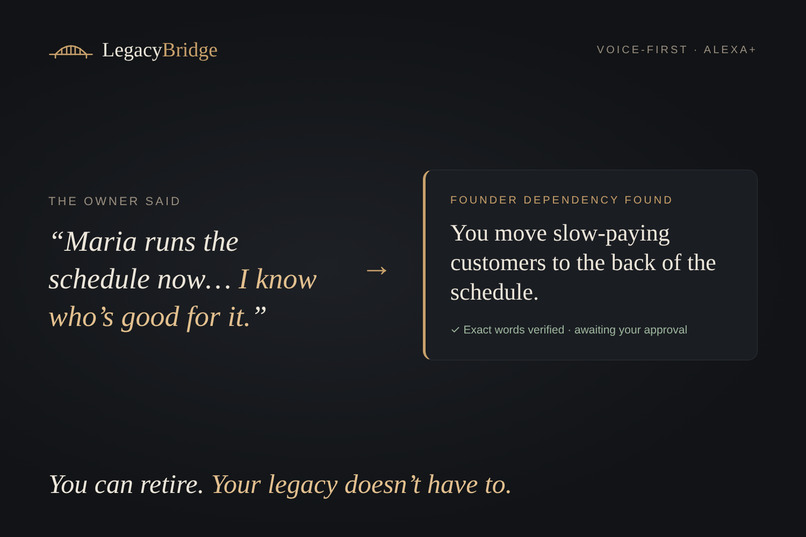
The owner thinks scheduling is handed off. LegacyBridge hears what isn't.
-
You can retire. Your legacy doesn't have to.
-
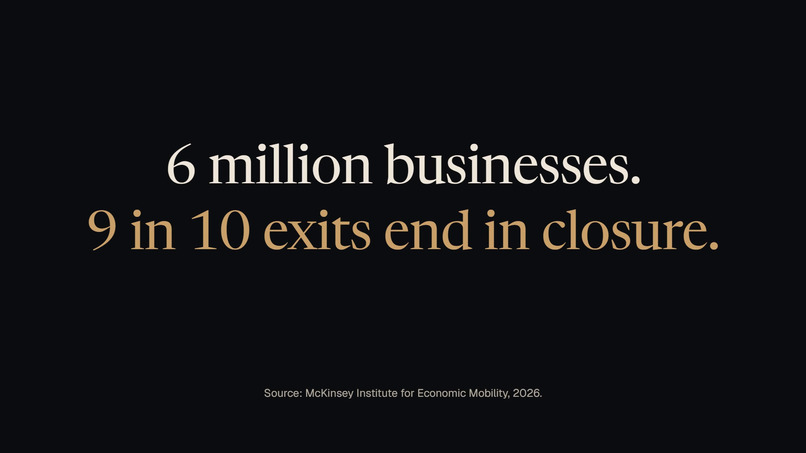
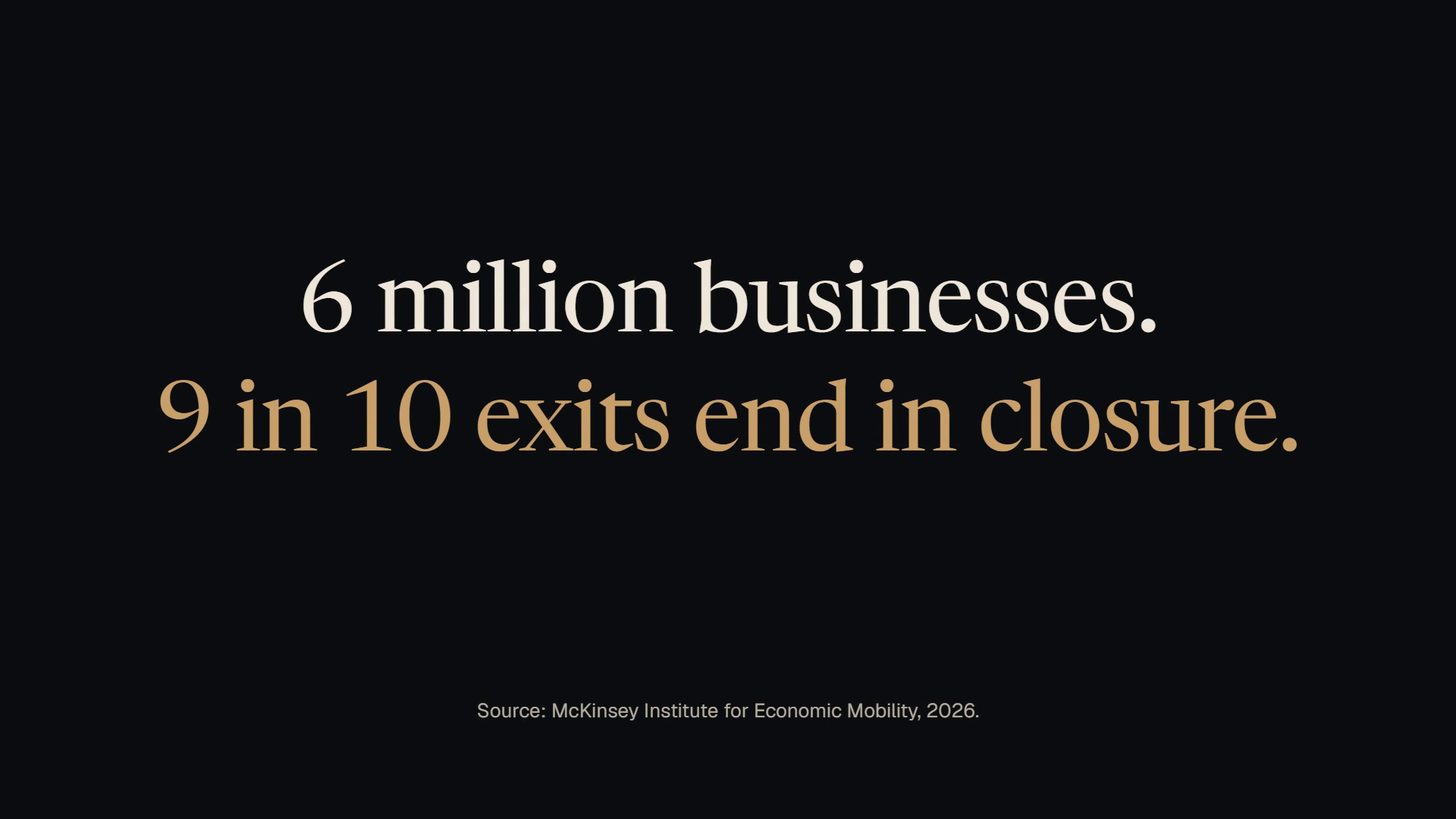
6 million businesses face an ownership transition by 2035. 9 in 10 exits end in closure.
-
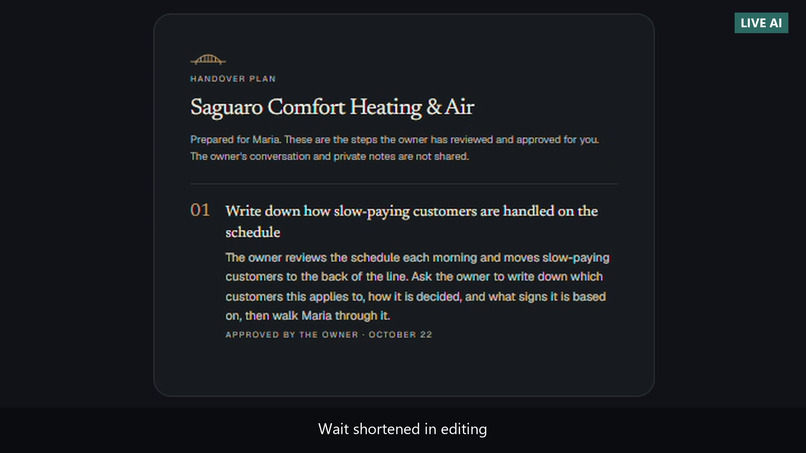
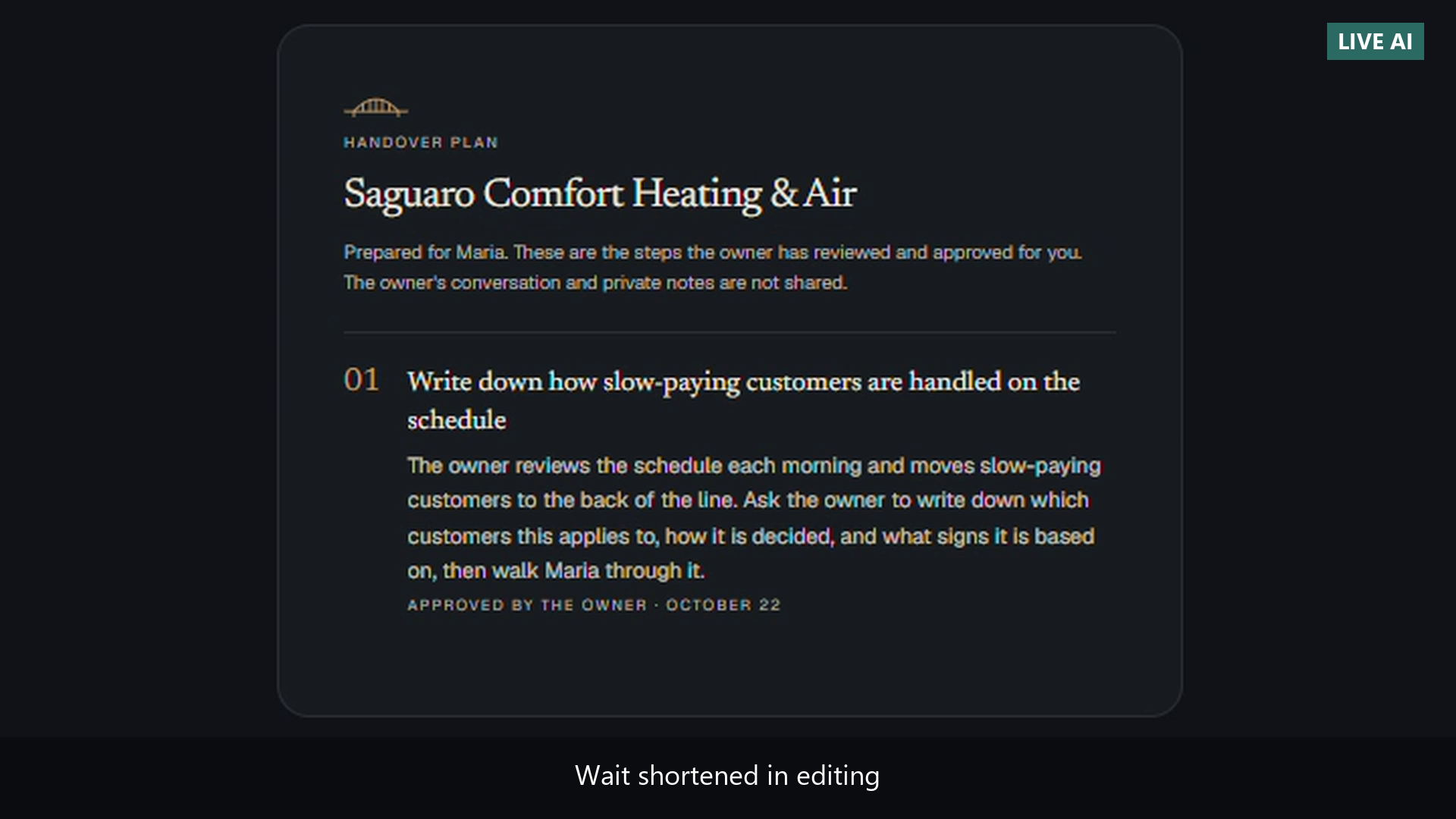
The successor sees only the steps the owner approved. Never the conversation, never the private notes.
-
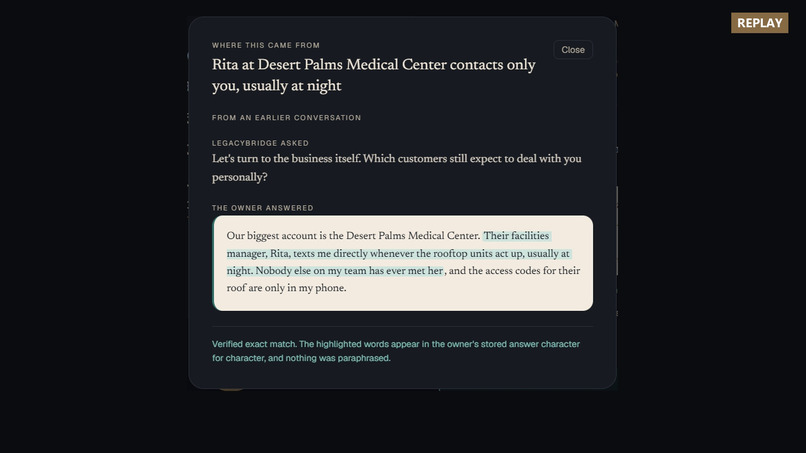
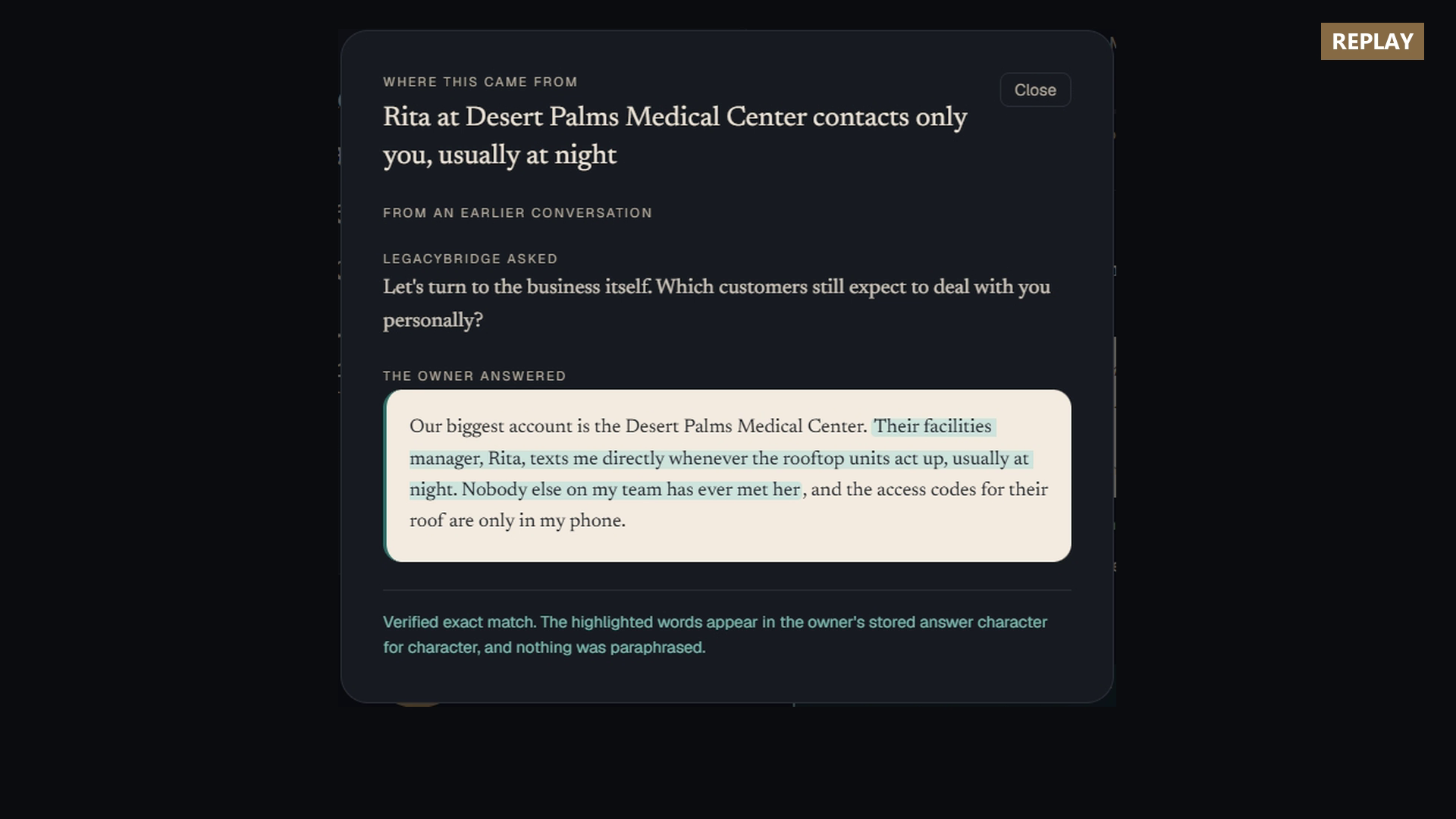
Every finding is traced to the owner's exact words, verified character for character.
-
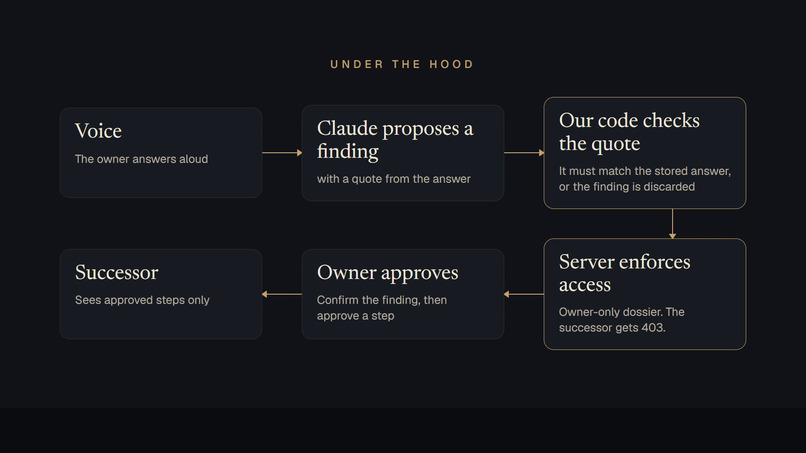
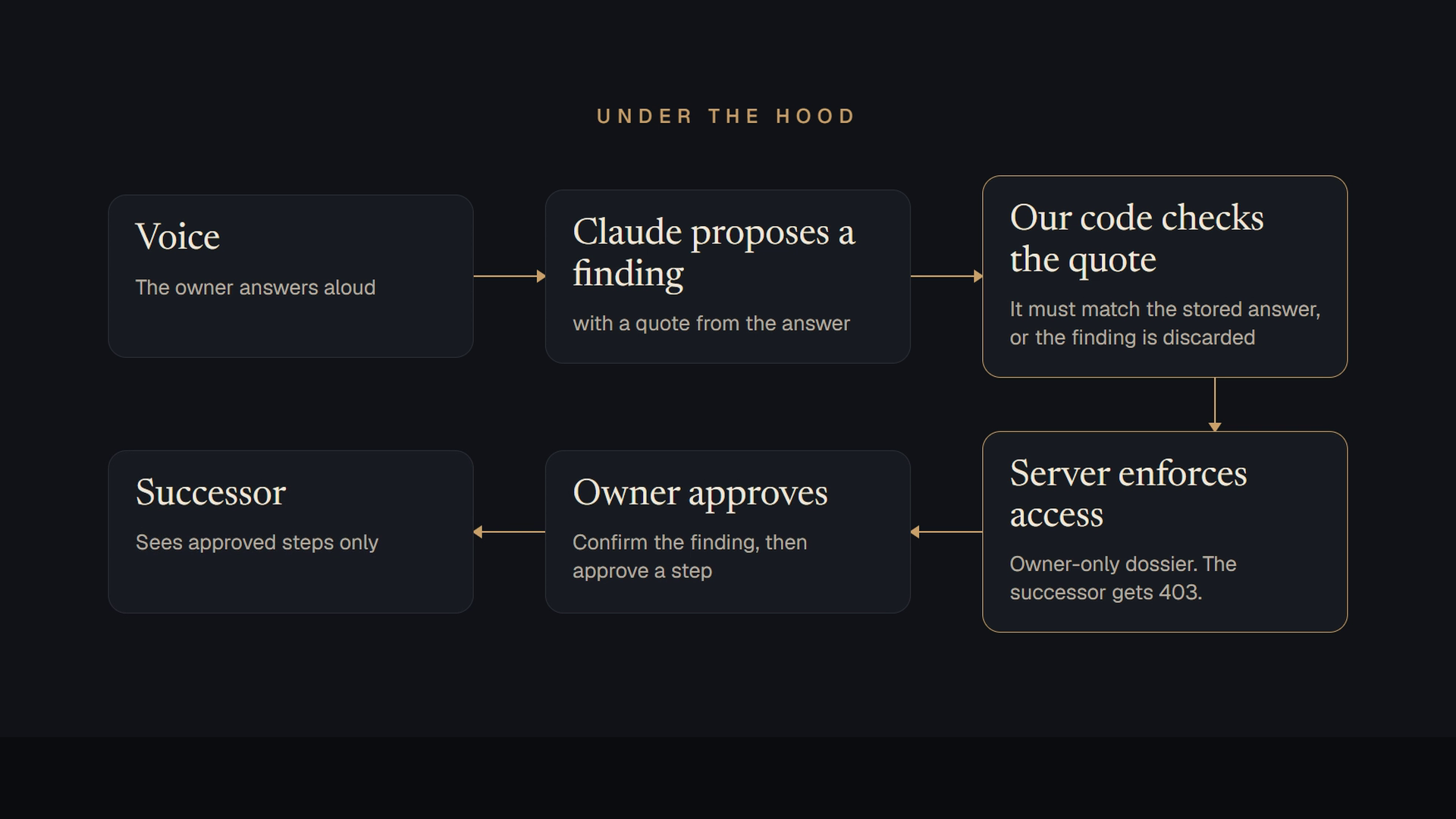
Claude proposes; our code verifies the quote; the server enforces access; the owner approves.
-
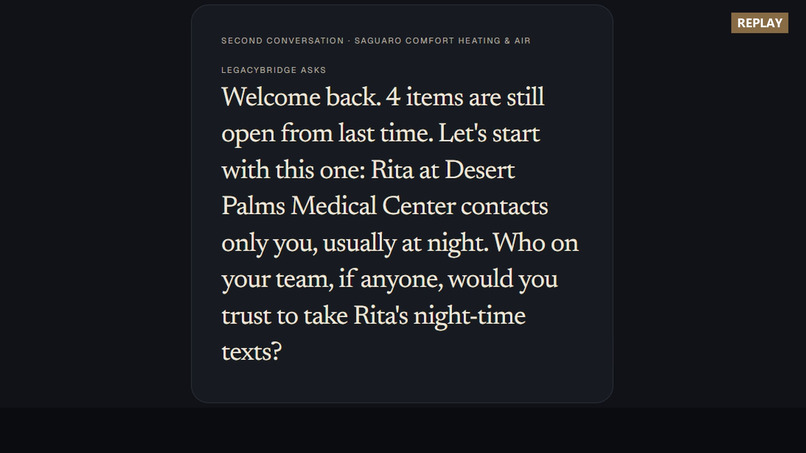
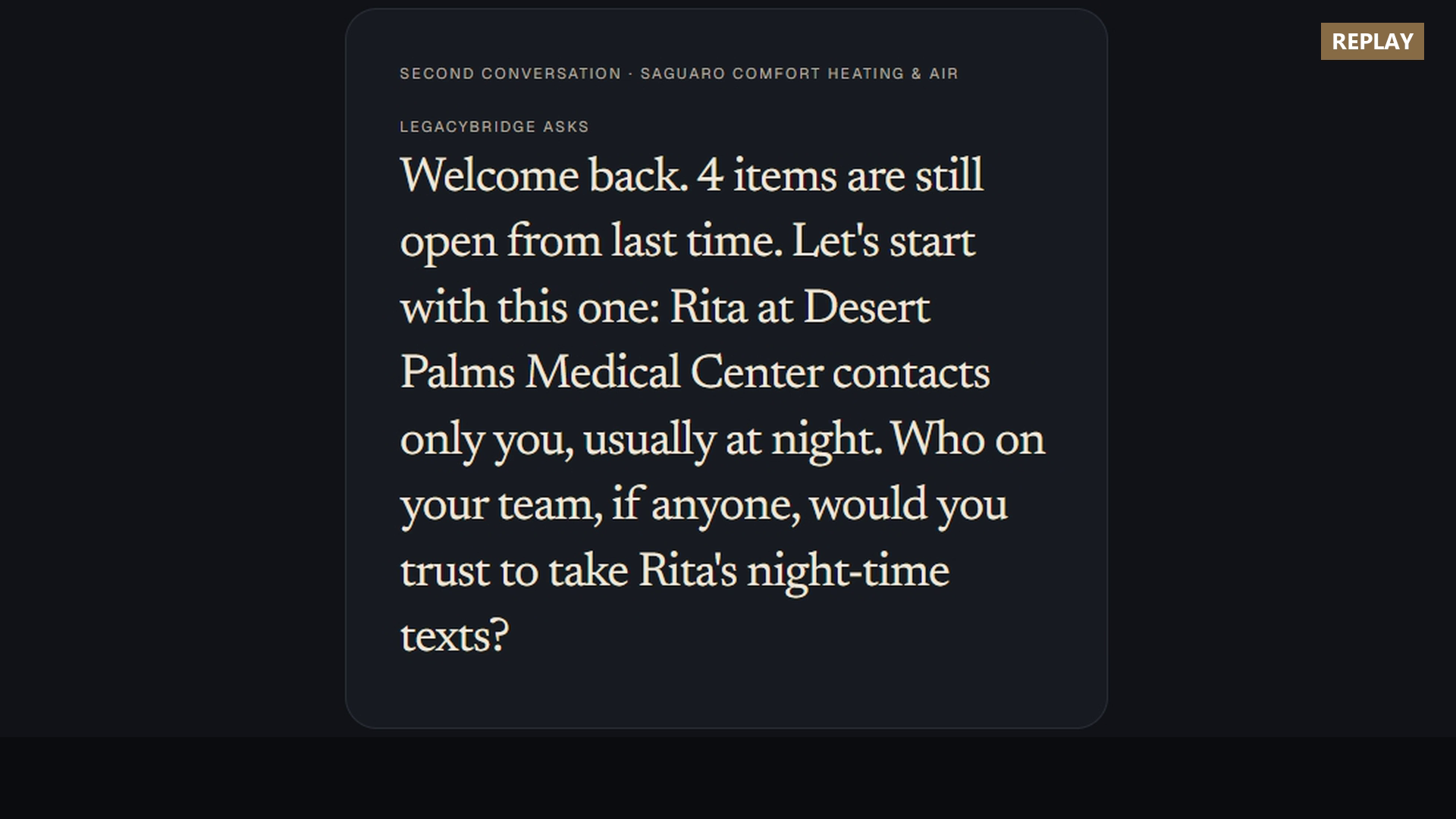
Days later, it remembers what's still unresolved.
Inspiration
A business can survive without its founder. Can it survive without everything the founder knows?
Over thirty years, an owner builds more than a company. They build relationships, make thousands of judgment calls, and learn things that never reach an operating manual. When they step back, much of that knowledge leaves with them.
By 2035, about 6 million American small and mid-size businesses will face an ownership transition, worth up to $5 trillion. Yet 92% of small-business exits end in closure; only 5% are sold and 3% are handed to new owners (McKinsey Institute for Economic Mobility, The Great Ownership Transfer, 2026).
Many owners have no family successor and no one ready to step in, so they keep working because the business can't run without them. A portfolio can be inherited. The know-how that runs a business can't. Financial statements show what a business earns; they don't show which decisions still depend on one person. And the people around the owner often assume a plan exists: in one 2026 survey, 59% of potential successors believed a succession plan was in place, while only 35% of owners said they had one (Revenued).
The hardest part is that owners often don't know either. Experience becomes automatic. An owner can sincerely believe a task has been handed off while still quietly making the key call every morning.
So we asked: what if a voice assistant could hear the knowledge an owner doesn't realize they still hold, and help them pass it on, on their own terms?
Why voice: owners won't write a manual. They will talk. Decades of judgment come out in conversation, in passing remarks the owner doesn't realize matter.
What it does
LegacyBridge is a voice-first succession advisor for owner-led businesses. It holds a natural conversation with the owner, finds what the business still depends on them for, keeps the owner's exact words as evidence, and hands a successor only what the owner approves.
The moment that makes it different
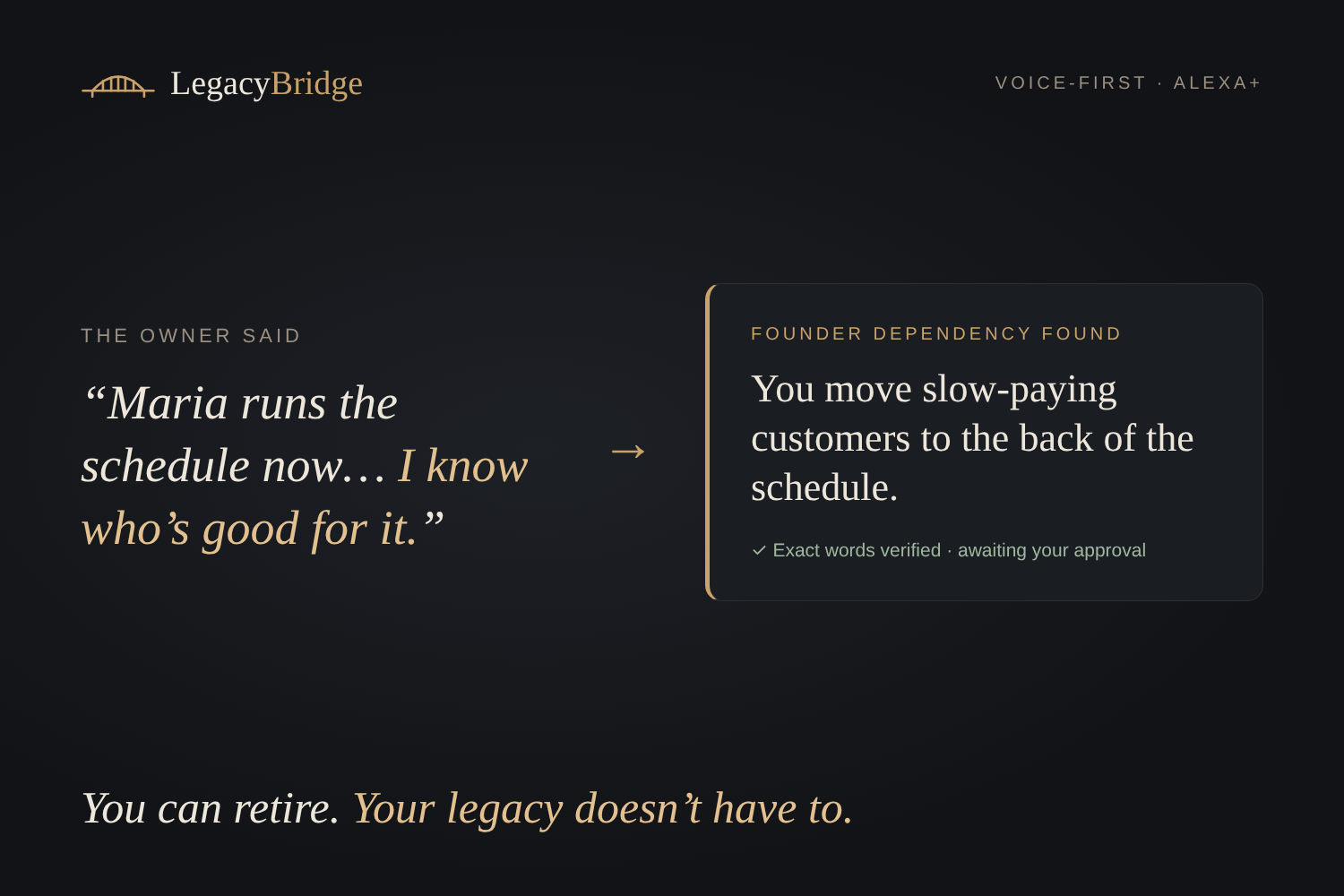
Our demo follows Saguaro Comfort Heating & Air, a fictional HVAC company. The owner says: "Maria runs the schedule now, honestly. I just look it over each morning and move anyone who's slow to pay to the back of the line. I know who's good for it."
A questionnaire would record "scheduling: delegated" and move on. LegacyBridge hears the dependency hiding in the last sentence: deciding which customers get served first still lives only in the owner's head. It quotes his exact words as evidence, drafts a handover step, and asks the follow-up a good advisor would ask: "When you look over Maria's schedule each morning, how do you decide who counts as slow to pay?"
That was live, unscripted analysis. In our tests the same answer surfaced the same dependency, quote and draft handover step in every run.
From conversation to continuity
- It starts with the owner. The first questions are about the owner's next chapter and the decisions they want to keep. Those notes stay private to the owner.
- Listen and discover. Adaptive follow-up questions surface customer relationships, pricing judgment, exceptions, supplier ties and financial controls that depend on the owner.
- Verify. Every finding carries the owner's exact words, checked character by character against the stored conversation. A quote that can't be matched is set aside, never shown as evidence.
- Approve. Each finding becomes a draft handover step. The owner confirms the finding, then approves the step. Nothing reaches the successor without both.
- Hand over. The successor sees approved steps only: never the conversation, never the private notes.
- Remember. A later conversation opens with what is still unresolved, with the earlier evidence one click away.
How we built it
Next.js, TypeScript, Tailwind CSS, Supabase (PostgreSQL), Anthropic Claude, the Model Context Protocol, and the browser Web Speech API, deployed on Vercel.
Voice-first, designed for Alexa+
The conversation is built for voice: one question at a time, read aloud, answered aloud, short turns, and a transcript the owner can review before sending. Voice input and output use the browser's speech services, with a typed fallback.
Alexa+ integration: LegacyBridge includes a self-hosted MCP server (Streamable HTTP, protocol 2025-11-25) that exposes the owner's tools: start a conversation, submit an answer, read the dossier, confirm a finding, approve a step, and read the successor's approved steps. It runs on the same engine as the web experience, with the same access rules, spending caps and quote checks. It is an MCP server ready for the Alexa+ MCP Toolkit, verified with MCP Inspector against production. The voice experience at /demo is a simulation; this is not an official Amazon Alexa integration, and we have not tested it on an Alexa+ device.
Evidence you can inspect
Claude proposes findings with a supporting quote. Our code, not the model, locates that quote in the stored conversation and computes its position. If the words aren't there, the finding is rejected. Stored conversations can't be edited, so evidence can't drift from what was said.
Human approval and access control
AI proposes; the owner decides. Approval requires a confirmed finding and an owner identity. Successors are refused the owner's dossier and conversation (a real request returns 403). In the full app, Supabase authentication and PostgreSQL row-level security enforce the same boundaries.
A demo judges can use
The demo needs no account. Prepared replies replay analysis recorded from a live session, so the walkthrough is reliable, and every replay is labeled. Live analysis of your own answers runs under per-demo, per-visitor and daily caps.
Challenges we ran into
Making AI findings trustworthy. A confident summary isn't an accurate one. We moved verification out of the prompt and into code and the database, so a finding without a matching quote simply can't be saved.
Hearing what the owner doesn't say. The best findings hide in passing remarks. Tuning follow-ups to probe the remark, not restate the answer, took many iterations.
Testing beyond localhost. Local database tests passed while hosted Supabase exposed table privileges our local setup didn't reproduce. We fixed the permissions and now run access checks against the hosted database.
A public AI demo without runaway cost. We separated the fictional demo from real data, signed demo sessions, and capped live model usage at three levels.
Accomplishments that we're proud of
- A working workflow, not a mockup: conversation, finding, evidence, approval, successor handover, and memory across sessions.
- Live analysis that consistently catches a dependency the owner didn't flag.
- Every finding traceable to the owner's exact words.
- An MCP server ready for the Alexa+ MCP Toolkit, verified with MCP Inspector.
- 181 unit tests, 74 database access checks, 33 production smoke checks and 15 MCP flow checks passing.
- A calm, voice-first interface that makes a heavy subject feel approachable.
What we learned
The most useful AI doesn't always give the answer. Sometimes it asks the question that changes how someone sees their own business.
Trust can't be added with interface copy. It has to be built into the system: verified evidence, permissions, persistent context and human approval.
Who it's for and how it makes money
The owner gets the value, but succession advisers, exit planners, business brokers and acquisition firms are the natural buyers: they already work with owners who are preparing to step back. The planned model is a fixed-fee succession-readiness assessment for an individual owner, and a subscription for advisers who run LegacyBridge with every client. We don't plan to take transaction fees.
What's next for LegacyBridge
- Successor readiness. Interview the successor, surface where owner and successor expectations differ, and build the successor's handover plan.
- The right person, not just the highest bidder. Many capable people have the skills, values and drive to run a thriving business, but not the cash to buy one outright. LegacyBridge would match owners with operators who share their values, and help both sides understand options such as seller financing, where the new operator pays the owner over time from the business's earnings, so the owner can retire comfortably and the business carries on. Education and preparation only; the deal itself is made with qualified advisers.
- Legacy intentions. For owners without heirs, help them put into words what they want their business and wealth to stand for, and prepare a brief for their estate attorney or philanthropic adviser.
- Alexa+ on device. Take the MCP server through the Alexa+ MCP Toolkit so owners can hold these conversations at home, at their own pace.
LegacyBridge provides decision support, not legal, tax, valuation, lending or investment advice.
About the demo video
The owner's spoken answer in the video was recorded live and analyzed live; the owner's voice was re-voiced with ElevenLabs Voice Changer, and the narrator voice is generated with ElevenLabs. Shots marked REPLAY replay analysis recorded from an earlier live session. Saguaro Comfort Heating & Air and everyone in it are fictional.
LegacyBridge
You can retire. Your legacy doesn't have to.
Built With
- anthropic
- claude
- css
- elevenlabs
- model-context-protocol
- next.js
- playwright
- postgresql
- react
- supabase
- tailwind
- typescript
- vercel
- vitest
- web-speech-api

Log in or sign up for Devpost to join the conversation.