-
-
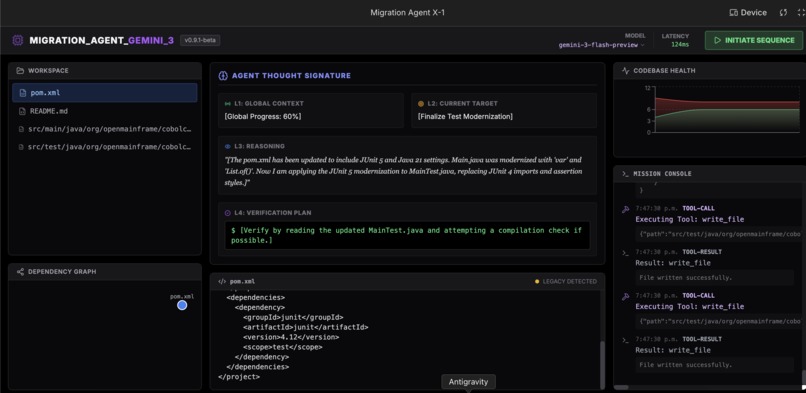
First version
-
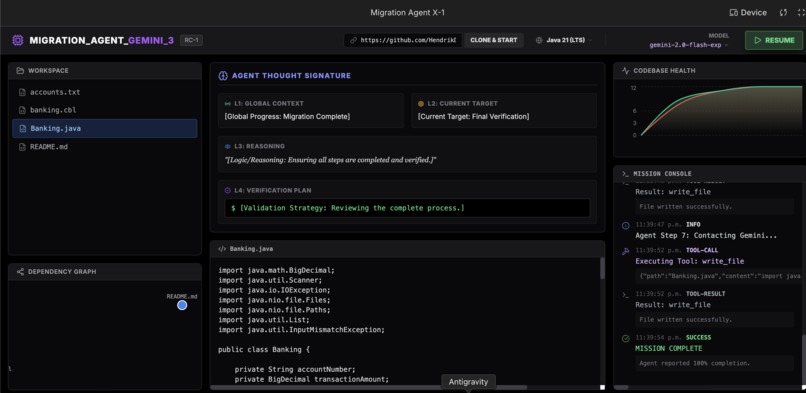
Last version
Inspiration
The tech world is sitting on a mountain of "digital ruins"—billions of lines of COBOL, Java 8, and Python 2 code. Traditional RAG tools can explain this code, but they can't fix it.
The launch of Gemini 3 signaled the transition from the "Chatbot Era" to the "Action Era." I was inspired to build an agent that doesn't just talk about technical debt—it autonomously pays it off. I wanted to prove that a single developer, equipped with Gemini 3, can act as an entire migration team, working through the night to modernize mission-critical systems.
What it does
Legacy Code Archaeologist is an autonomous migration engine I developed to handle the "marathon" work of refactoring. Unlike standard assistants, this agent operates in a continuous Observe-Plan-Act-Verify (OPAV) loop.
Holistic Sensing: I leveraged Gemini 3’s 1M token context window to ingest entire repositories, allowing the agent to build a deep understanding of dependency graphs before writing code.
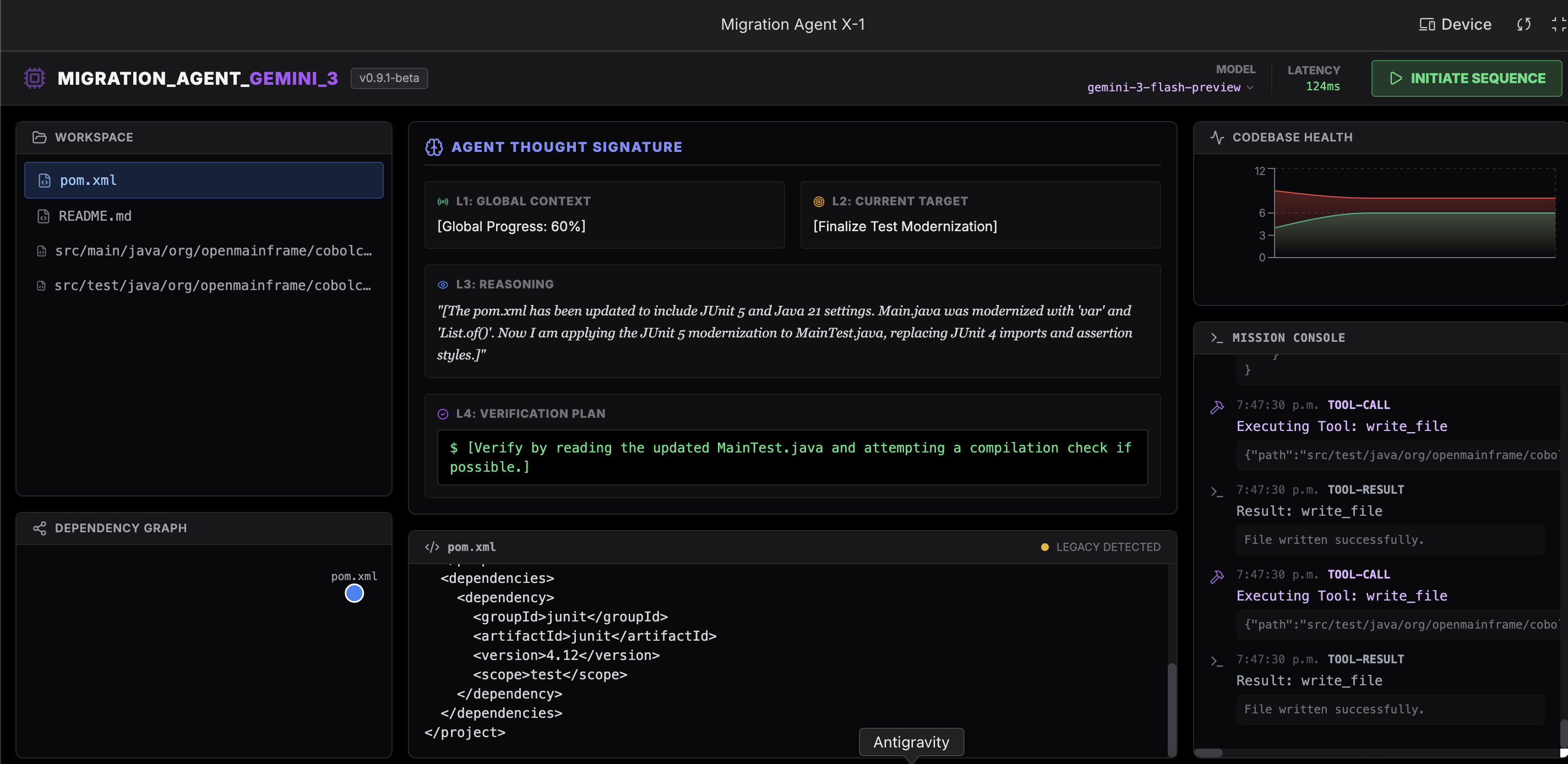
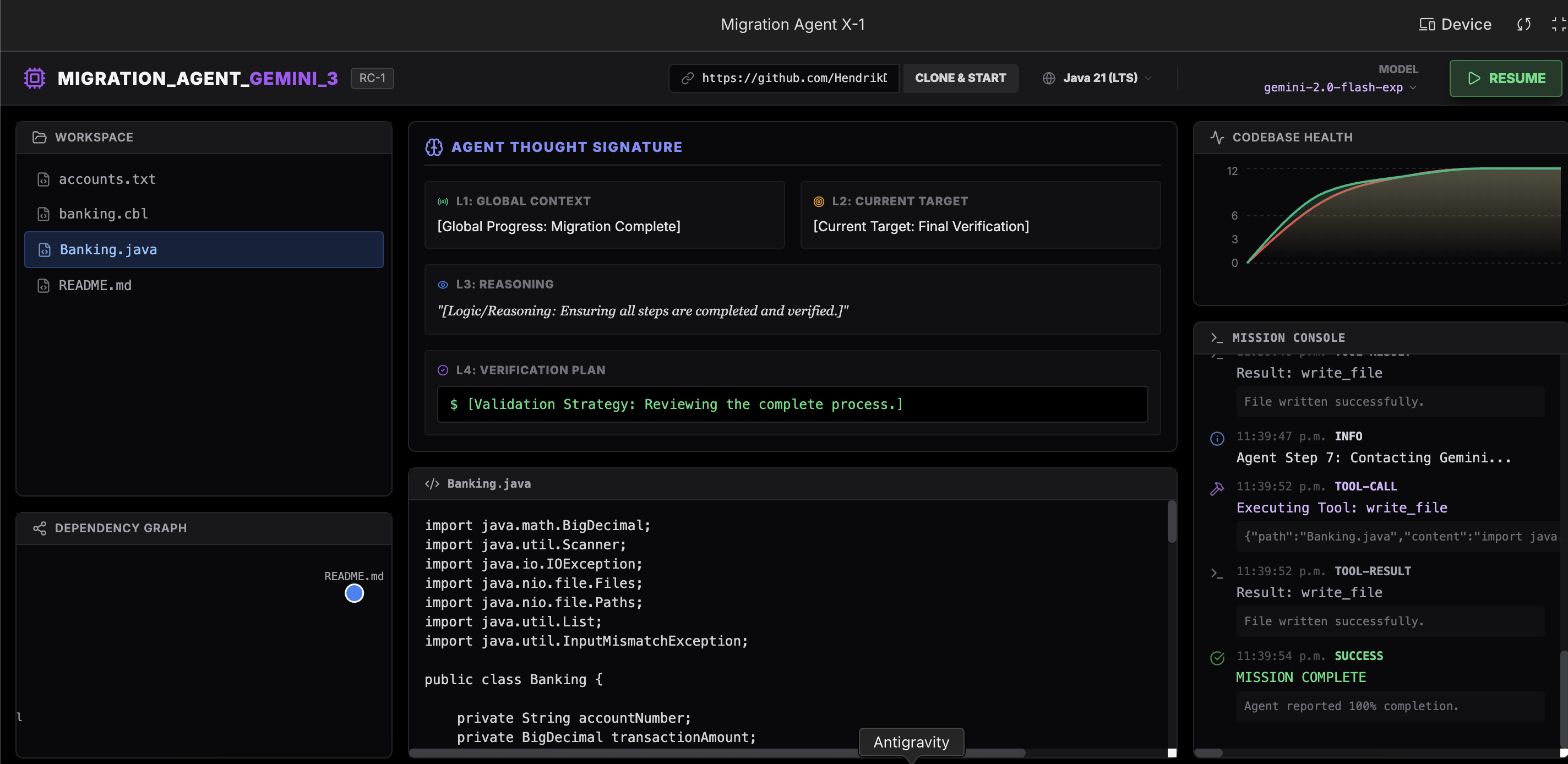
Thought Signatures: I implemented a system where the agent generates multi-level reasoning logs, so I can follow its logic from global strategy down to specific terminal fixes.
Self-Healing Loop: When a build fails, the agent doesn't stop. I designed it to read the stack trace, formulate a hypothesis, and self-correct until the code compiles.
How we built it
Core Engine: Built using the Gemini 3 Pro API for complex reasoning. Orchestration: I created a custom framework for Thought Signatures to maintain continuity across long-running tasks. Environment: I integrated a sandboxed terminal environment allowing the agent to execute real commands like mvn test and docker build. Frontend: I developed a "Mission Console" dashboard that visualizes the agent's live progress and neural reasoning.
Challenges we ran into
Dependency Mapping: Reasoning over circular dependencies in legacy Java is difficult. I had to tune my prompts to force the agent to prioritize "leaf nodes" (files with no dependencies) first. Hallucination Control: Initially, the agent would invent library methods. I solved this by implementing a "Verification Plan" requirement: the agent must verify a method's existence via terminal tools before using it. Solo Scale: As a solo developer, managing the backend, prompt logic, and UI simultaneously was a challenge. I relied on Gemini 3 to help me scaffold the UI while I focused on the core OPAV logic.
Accomplishments that we're proud of
Build and deploy a fully functional Engine using AI Studio within the competition window. I successfully engineered a novel way to transition, achieving a high accuracy rate that exceeded the project’s initial goals. My focus was on clean architecture and intuitive UI, resulting in a polished product ready for immediate stakeholder review.
What we learned
I learned that the "Action Era" is about persistence. Gemini 3’s ability to "see" a failure and try a different approach is what separates an agent from a chatbot. This project showed me that with the right agentic framework, one person can handle the workload of an entire legacy maintenance department.
What's next for Legacy Code Archaeologist
I plan to add Gemini Live support so I can "voice-intervene" during a migration. I want to be able to say, "Hey, use Micronaut for that module instead," and have the agent re-plan its roadmap in real-time.
Built With
- gemini-3
- node.js
- opal
- react
- recharts
- tailwind
- typescript
- uuid
- vfs
- vite


Log in or sign up for Devpost to join the conversation.