-
-
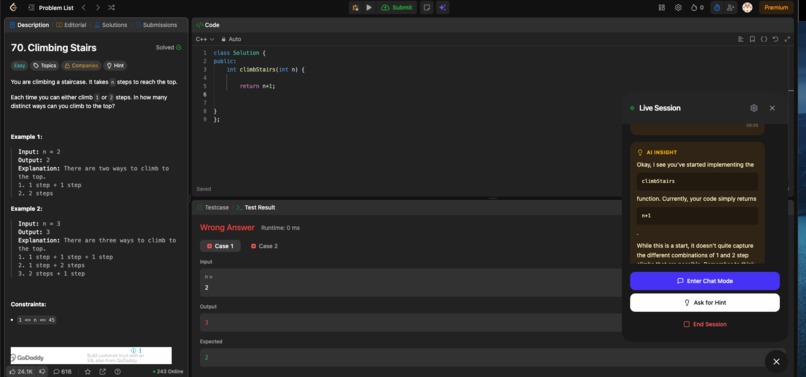
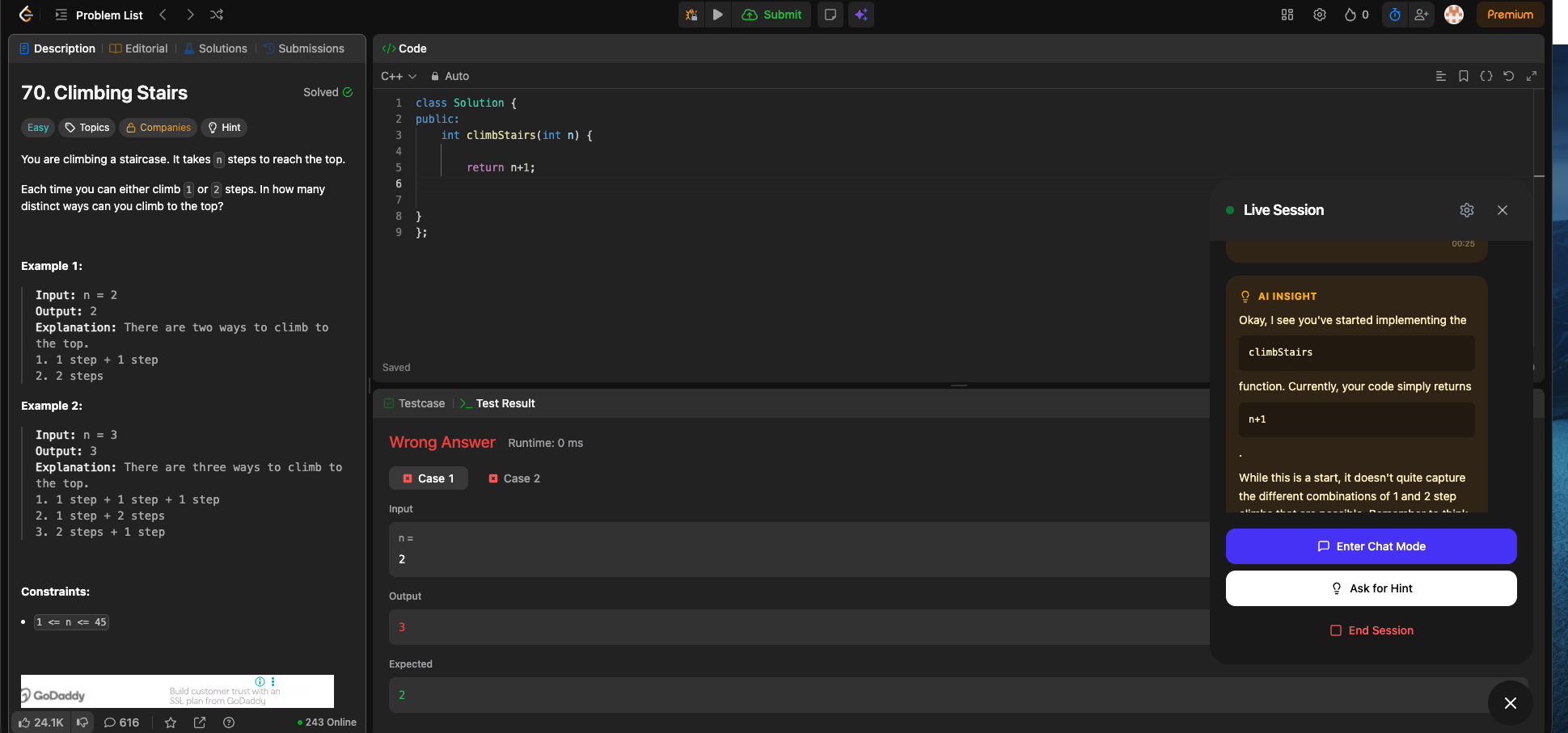
Hint Generation in action
-
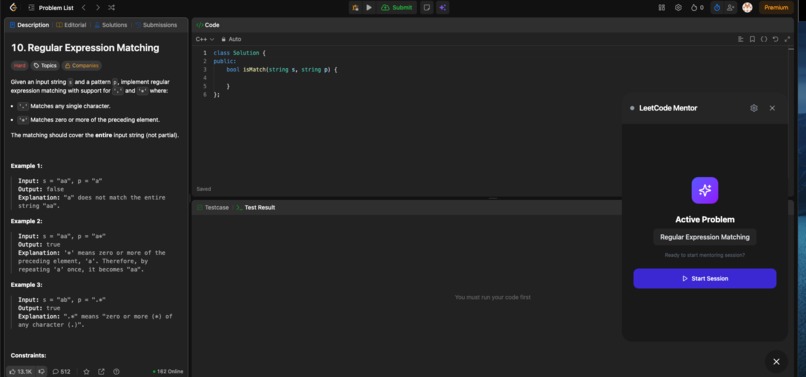
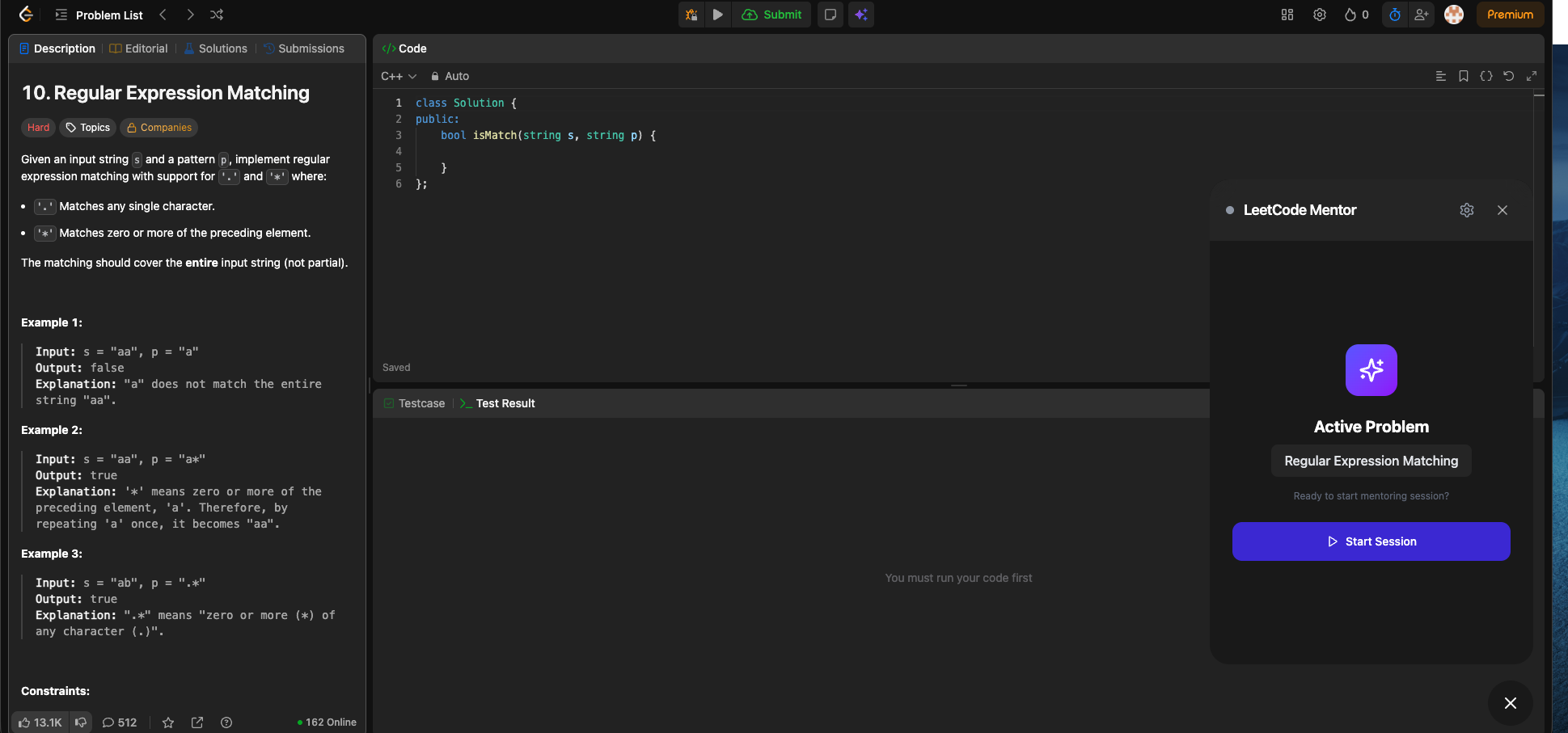
Home View
-
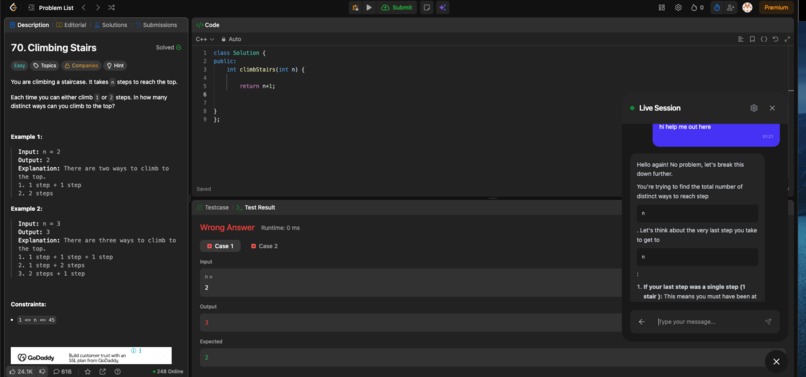
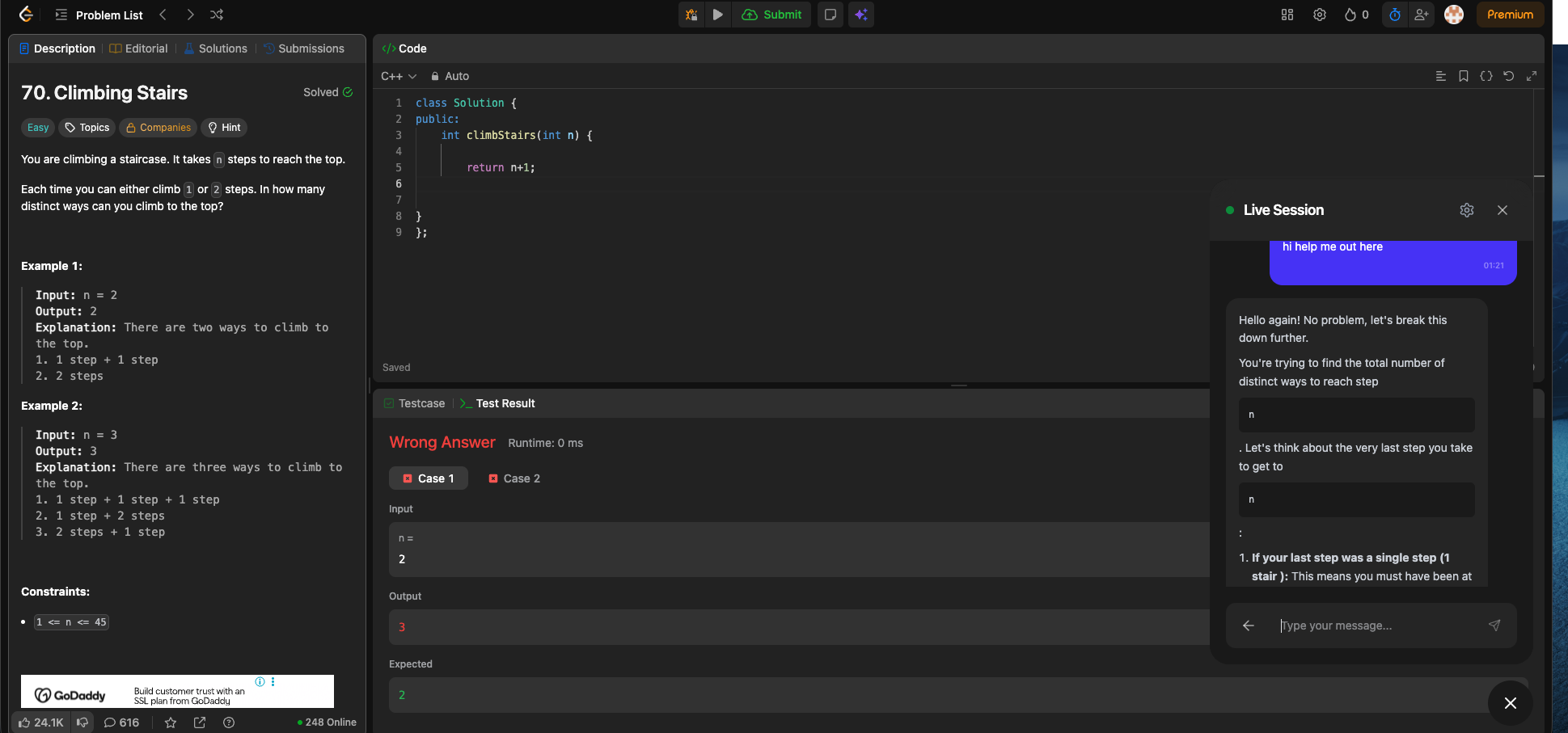
Chat Mode
-
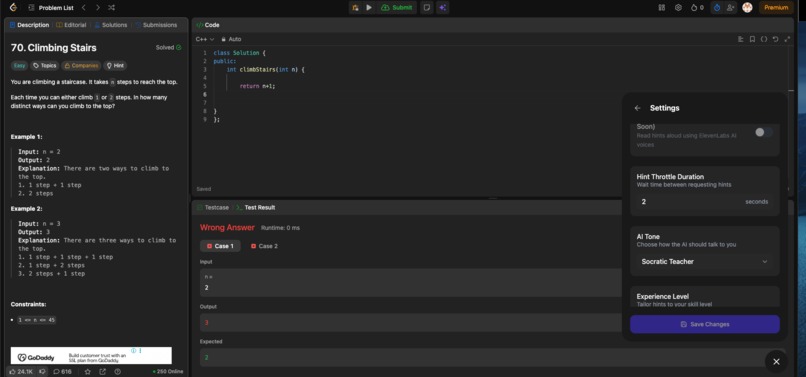
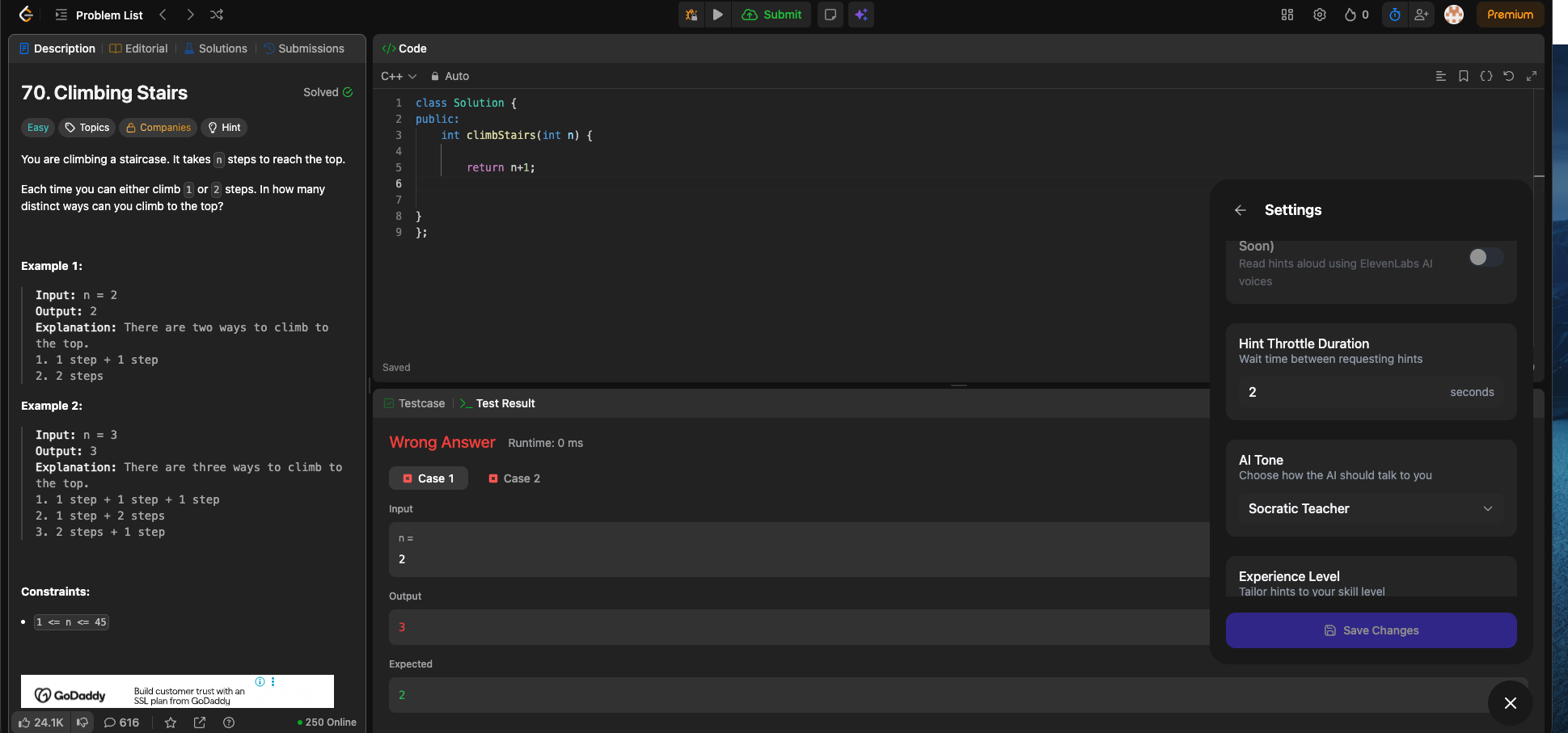
Settings View
💡 Inspiration
We've all been there: staring at a LeetCode problem for 45 minutes, completely stuck, until we finally crack and check the solution or paste the problem into ChatGPT. The result? instant relief, but zero learning. You get the "what" but miss the "how."
We wanted to fix this broken loop. We asked ourselves: What if you had a Senior Staff Engineer sitting next to you? They wouldn't just grab your keyboard and type the answer. They would look at your code, point out a flaw in your logic, or ask a guiding question to help you unblock yourself. That is the experience we built LeetCode Mentor to replicate—bringing the power of pair programming to solitary practice.
🚀 What it does
LeetCode Mentor is an intelligent browser extension that transforms LeetCode into an interactive learning environment.
- Real-time AI Observation: It watches your keystrokes and code changes live as you type.
- Socratic Guidance: Instead of giving answers, it provides subtle, context-aware nudges. If you have an off-by-one error, it hints at checking your loop bounds. If you miss a base case, it gently reminds you.
- Struggle Detection: It analyzes behavioral patterns—like rapid tab switching or repeated failed test runs—to detect when you are frustrated and proactively offers help.
- Adaptive Personas: Choose your mentor's personality! From a "Supportive Guide" who cheers you on to a "Rude Senior Engineer" who ruthlessly (but helpfully) critiques your inefficiency.
- Deep Chat Integration: Stuck on a specific concept? Open the chat mode to have a deep, multi-turn conversation about your specific code implementation without ever leaving the page.
⚙️ How we built it
We engineered a sophisticated Event-Driven Microservices Architecture to ensure low latency and high scalability.
- Frontend: Built with React and Vite, injected directly into the LeetCode page via a Chrome Extension using Shadow DOM for complete style isolation. It captures user events (typing, test runs, tab switches) and streams them via WebSockets.
- Event Streaming: We use Confluent Kafka as our central nervous system. Every user interaction is an event that flows through our pipeline, decoupling event ingestion from heavy AI processing.
- Pattern Recognition: A specialized Python service consumes the Kafka stream, maintaining a sliding window of user activity. It calculates "diffs" on the fly to distinguish between minor typos and significant logic changes.
- AI Engine: We leverage Google Vertex AI (Gemini Models) for the intelligence layer. Our Hint Generator service constructs dynamic prompts including the user's code history, error logs, and current approach to generate pedagogically sound advice.
- Backend: Powered by FastAPI, handling the WebSocket connections and orchestrating the flow between the user and the Kafka ecosystem.
🚧 Challenges we ran into
- DOM Injection Nightmares: LeetCode uses the Monaco Editor (same as VS Code), which is complex. Intercepting keystrokes without breaking their editor or causing lag required deep reverse-engineering of their internal events.
- Real-time Latency: Chaining a WebSocket → Kafka Producer → Consumer → Vertex AI → Producer → WebSocket created a long round-trip. We had to optimize our Kafka consumer groups and batching settings to ensure the "typing to hint" latency felt instantaneous.
- State Management: Tracking "sessions" across a stateless architecture was tricky. We had to implement a distributed state store concept within our Python services to remember what the user tried 5 minutes ago so the AI wouldn't repeat itself.
🏆 Accomplishments that we're proud of
- Seamless Integration: The UI looks native. It feels like a premium feature LeetCode built themselves, not a hacky add-on.
- The "Rude" Persona: It sounds silly, but tuning the AI to be "sarcastic but helpful" was a blast and actually makes the learning process more engaging and less monotonous.
- Architecture Quality: We didn't just write a script; we built a production-grade system. Using Kafka and Microservices for a hackathon project was overkill, but it proves the system can scale to thousands of concurrent users.
- Smart Diffing: Implementing a custom diffing algorithm that ignores whitespace changes but alerts on logic shifts was a huge win for reducing API costs and noise.
🧠 What we learned
- Prompt Engineering is Engineering: It requires version control, testing, and iteration just like code. Small changes in the system prompt yielded massive differences in the utility of the hints.
- Event-Driven Complexity: While powerful, debugging distributed events is hard. You can't just set a breakpoint. We learned the importance of comprehensive logging and correlation IDs to trace a request through the system.
- User Psychology: Users don't always want help when they struggle. Timing is everything. We learned to rely on explicit "Hint Requests" more than auto-interventions to avoid being annoying (like "Clippy").
🔮 What's next for LeetCode Mentor Extension
- Voice Mode: Real-time voice conversation with your AI mentor for a true pair-programming feel.
- Extend to other coding websites: Support for other popular coding platforms like GFG, HackerRank, InterviewBit, etc.
- Mock Interview Mode: A specialized mode where the AI acts as an interviewer, asking you to explain your thought process out loud before writing a single line of code.
Built With
- confluent
- docker
- fastapi
- gcp
- langgraph
- python
- react
- tailwind
- vertex
- websockets


Log in or sign up for Devpost to join the conversation.