-
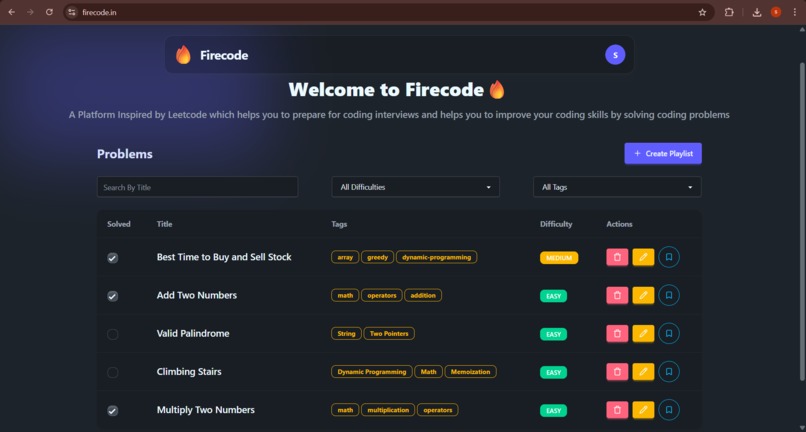
firecode.in problem page

Firecode.in — Building a Real-World Coding Platform
Inspiration
The idea for Firecode came from a simple problem I personally faced while learning DSA and competitive programming. Most platforms allow you to read problems, but the gap between writing code and understanding why it works or fails is often frustrating for beginners. I wanted to build a platform where users could write, run, and submit code in real time, see clear feedback, and track their progress — just like a real coding environment, not a static practice site.
What I Built
Firecode is a LeetCode-style full-stack coding platform where users can:
- Practice coding problems
- Run and submit code with real-time execution
- Track submissions and progress
- Access role-based dashboards for users and admins
It is a production-ready application, deployed and accessible to real users.
How I Built It
Frontend
I built the frontend using React and TypeScript, focusing on a clean and responsive UI.
Key aspects included:
- Component-driven architecture
- Role-based routing and protected pages
- State management using Zustand
- Responsive design with Tailwind CSS and DaisyUI
Backend
The backend was built using Node.js and Express, where I:
- Designed REST APIs for users, problems, and submissions
- Implemented JWT-based authentication and role-based access control
- Integrated the Judge0 API to execute user code securely in real time
- Used Zod for request validation and centralized error handling
Database
I used PostgreSQL with Prisma ORM to:
- Design relational schemas for users, problems, submissions, and playlists
- Optimize queries and maintain data consistency
- Track submission history and user progress effectively
Deployment
- Frontend deployed on Vercel
- Backend deployed on Render
- Environment-based configuration for development and production
Challenges I Faced
One of the biggest challenges was integrating real-time code execution reliably. Handling multiple submissions, managing execution results, and ensuring proper error feedback required careful API design and error handling.
Another challenge was designing scalable data models for submissions and playlists without overcomplicating the schema. I had to balance flexibility with performance.
Managing authentication, authorization, and role-based dashboards across frontend and backend also required careful coordination to keep the system secure and maintainable.
What I Learned
Building Firecode taught me how real-world full-stack applications are designed and shipped. I learned:
- How frontend and backend systems interact in production
- How to design scalable REST APIs and database schemas
- The importance of validation, error handling, and clean architecture
- How to deploy and maintain a production-ready application
Most importantly, it helped me think beyond features and focus on reliability, scalability, and user experience — the same mindset required in real engineering teams.
Firecode is more than a project for me; it represents my transition from building demos to building real, usable products.
Built With
- daisyui
- express.js
- javascript
- node.js
- postgresql
- react
- tailwind
- zod
- zustand

