-
-
Cover
-
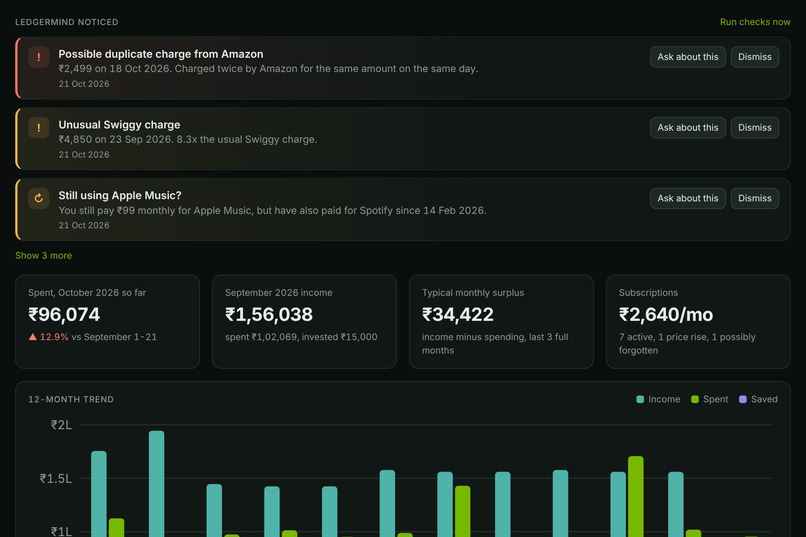
Overview
-
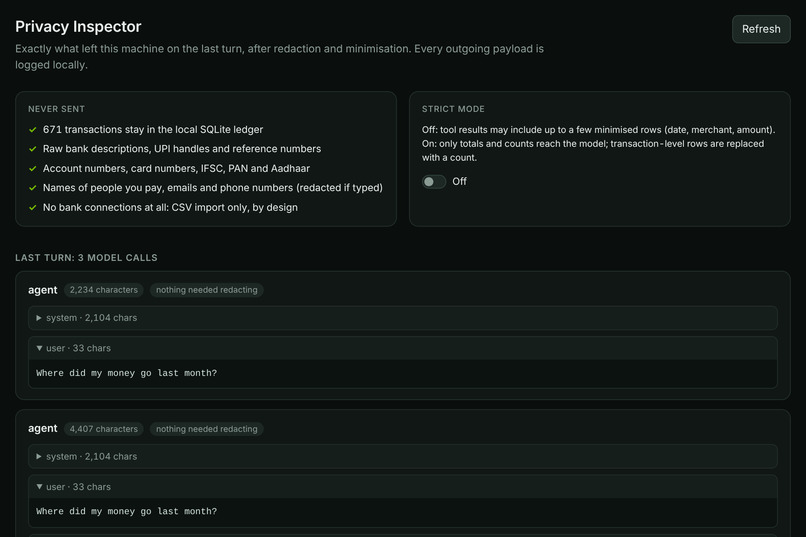
Privacy
-
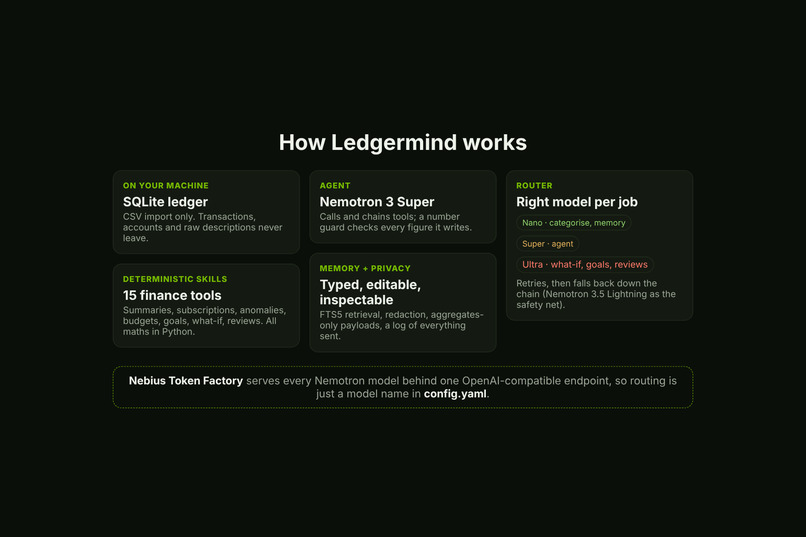
Architecture
-
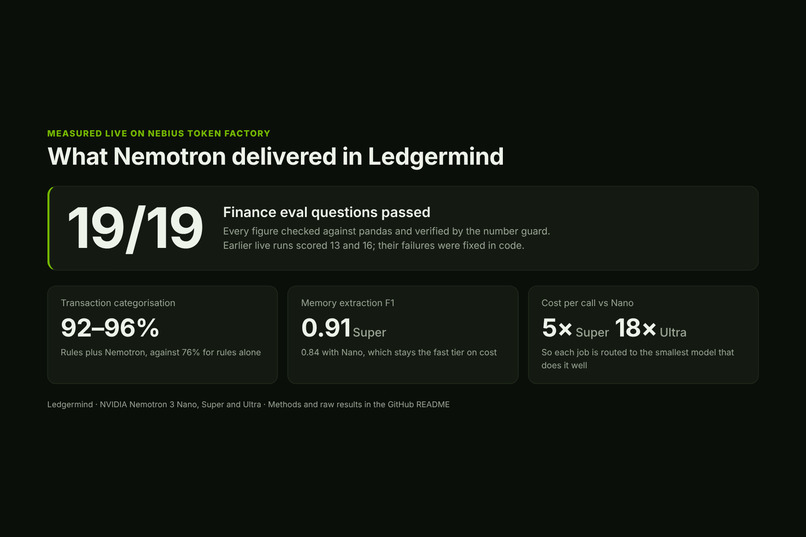
Results
Inspiration
Most people's financial lives are scattered across bank apps, UPI histories, spreadsheets and half-remembered goals. Existing finance apps either want your raw transaction data on someone else's servers, or they forget everything between sessions. We wanted an assistant that behaves like the old family munim, the trusted accountant who remembers your budget, your habits and your goals, and who works only for you.
Open models made that realistic. With NVIDIA Nemotron served through Nebius Token Factory, we could build an always-on assistant with real reasoning, without locking the user into a closed platform.
What it does
Ledgermind is a private AI finance assistant with persistent memory.
- Ingests your expenses and income from [CSV / bank export / manual entry].
- Remembers your budgets, goals, recurring bills and past conversations across sessions.
- Answers questions in plain language, such as "Why was March so expensive?" or "Can I afford a laptop this month?"
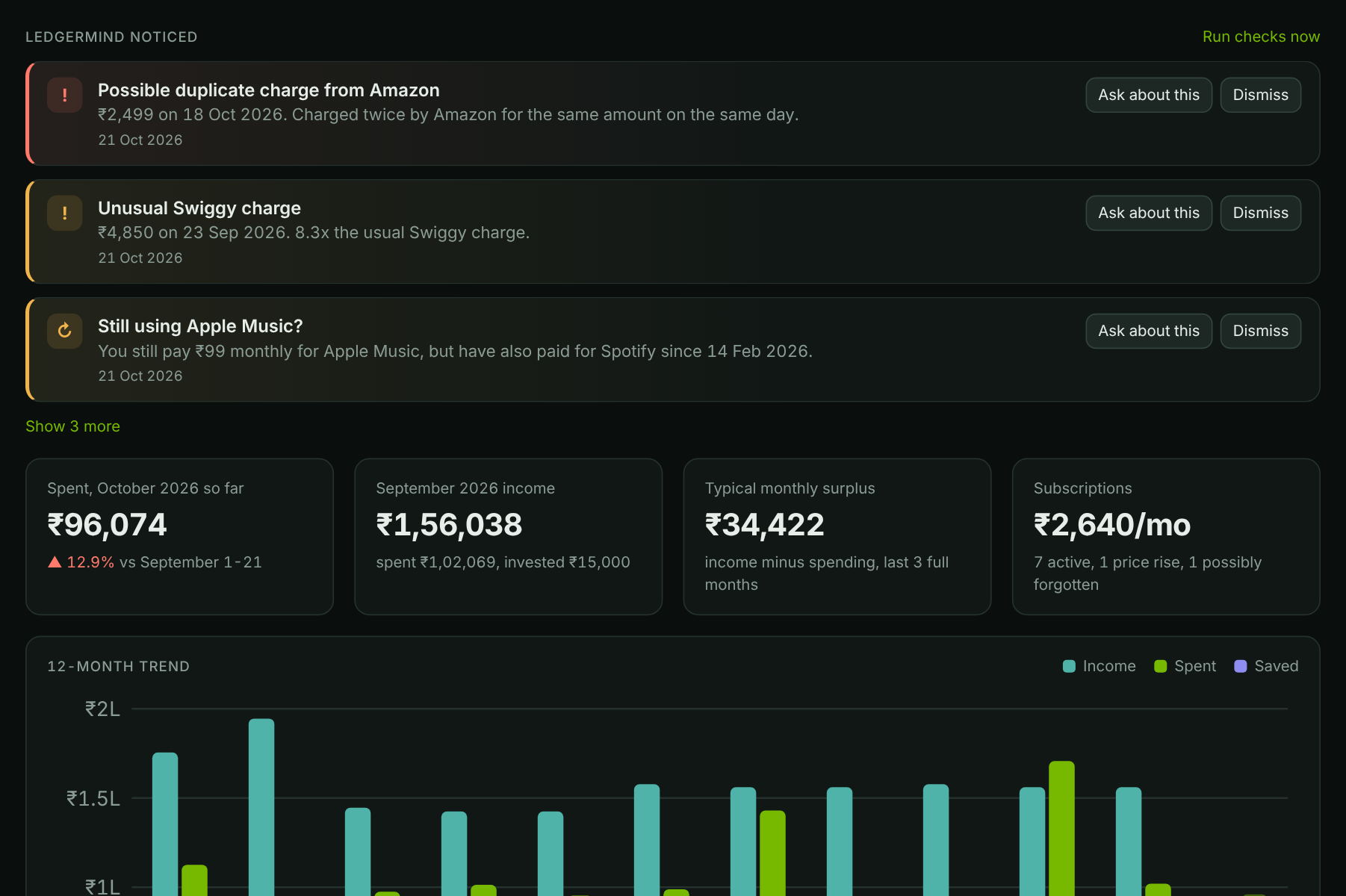
- Spots patterns: overspending categories, forgotten subscriptions, unusual transactions.
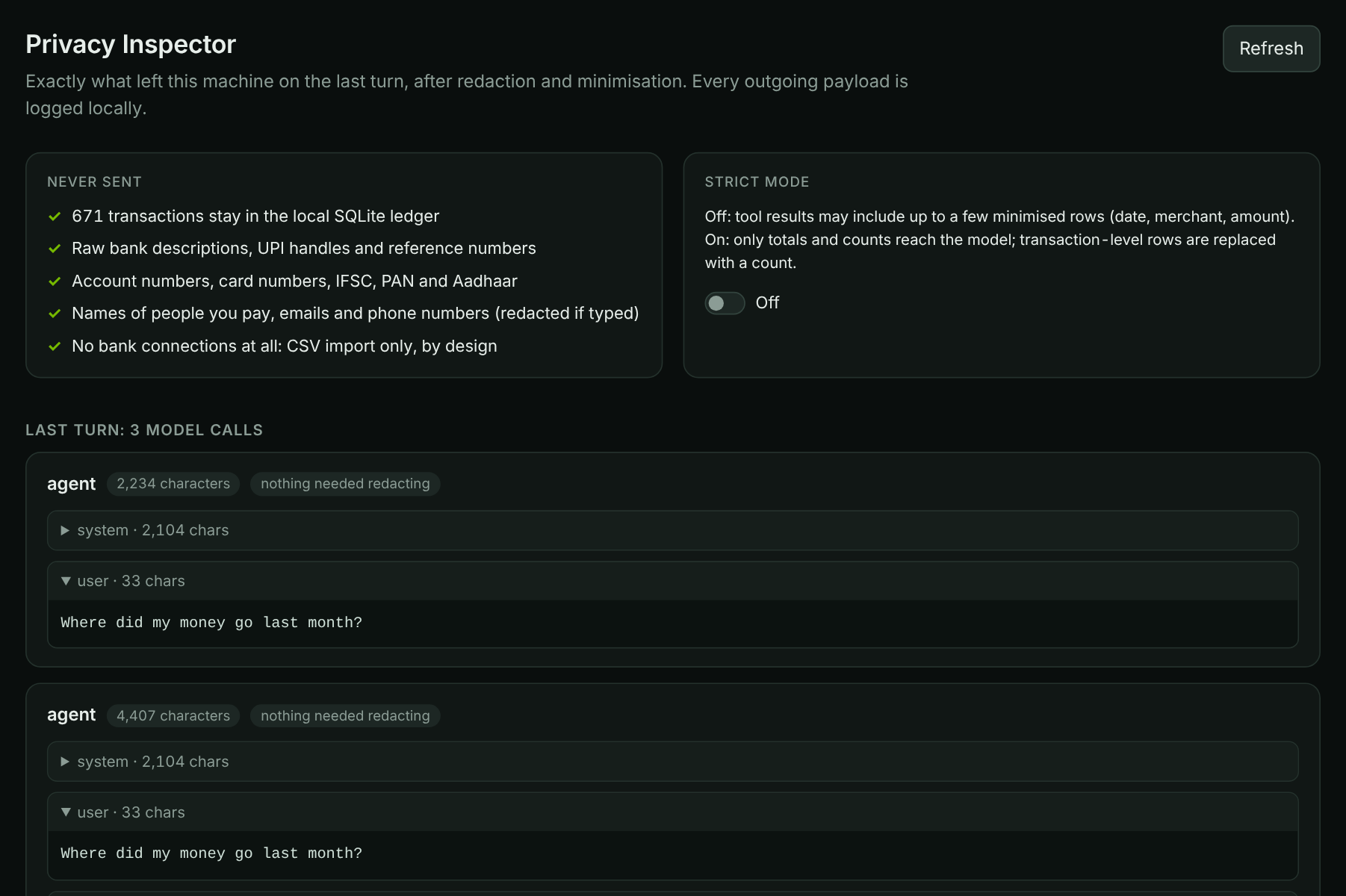
- Stays private: you choose what data and tools it can access. [Describe your actual privacy setup.]
Investment-related output is educational only and is not financial advice.
How we built it
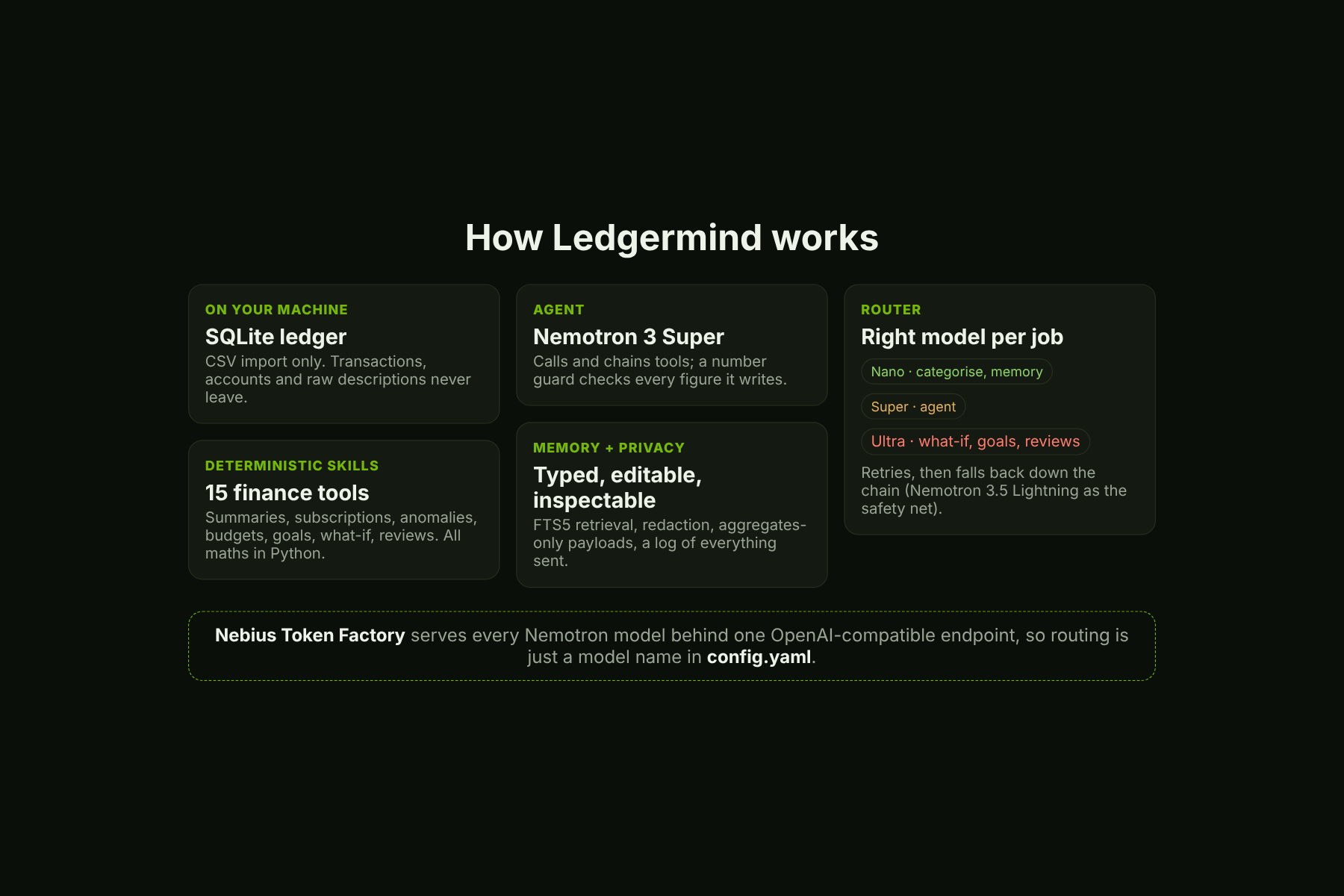
- Models: Nemotron 3 Ultra handles multi-step reasoning, such as budget analysis and planning. Nemotron [Nano / Super] handles fast, frequent calls such as categorizing transactions and routine queries. This split keeps the app responsive and stretches credits.
- Inference: Nebius Token Factory serves all model calls. [Mention latency, throughput or cost benefits you actually observed.]
- Memory: [Describe your design, e.g. a structured store for budgets and goals plus a retrieval layer over past conversations.]
- Skills and tools: [List the reusable skills, e.g. categorize, forecast, summarize, anomaly check.]
- Deployment: [Nebius Serverless Endpoints / Jobs / other, if used.]
- Stack: Python, [framework], [database], [frontend].
For forecasting, we use a simple projection of month-end spend. If $s_t$ is the spend so far on day $t$ of a month with $T$ days, the projected total is
$$\hat{S} = s_t \cdot \frac{T}{t}$$
and the assistant flags a category when $\hat{S} > B$, where $B$ is the budget for that category. [Replace or extend this with your actual method.]
Challenges we ran into
- Making memory useful rather than noisy. Storing everything is easy, but deciding what is worth remembering and retrieving is hard. [Explain what you did.]
- Numbers vs. language models. LLMs are unreliable at arithmetic, so we [compute totals in code and let the model explain the results].
- Messy transaction data. Merchant names and formats vary wildly. [Explain how you handled it.]
- Privacy vs. capability. Giving the assistant more access makes it more helpful, so we had to draw clear boundaries around [what it can see and do].
- Time. [Describe what you cut or simplified within the hackathon window.]
Accomplishments we're proud of
- [A working end-to-end flow from raw data to a useful answer.]
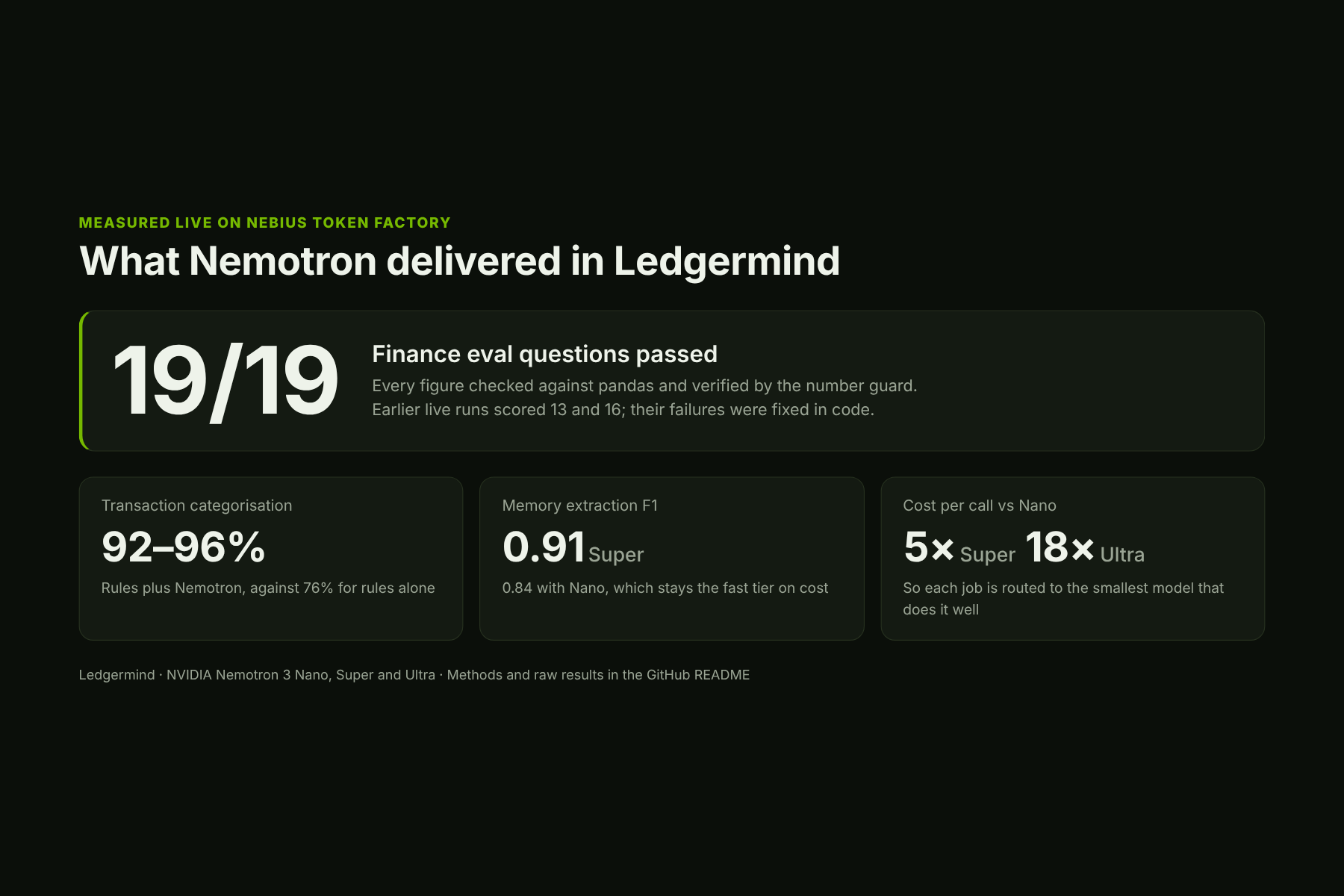
- [A specific, honest metric, e.g. categorization accuracy on N transactions.]
- [Anything that surprised you.]
What we learned
- How to route work between larger and smaller Nemotron models to balance quality, speed and cost.
- Designing persistent memory for an agent, and where it helps and where it hurts.
- Why deterministic code should own the math while the model owns the reasoning and explanation.
- [Your own lessons from using Nebius Token Factory.]
What's next
- [Bank and UPI statement connectors]
- [Proactive alerts and monthly summaries]
- [Multilingual support for Hindi and Bengali]
- [Stronger on-device or self-hosted privacy options]

Log in or sign up for Devpost to join the conversation.