-
-
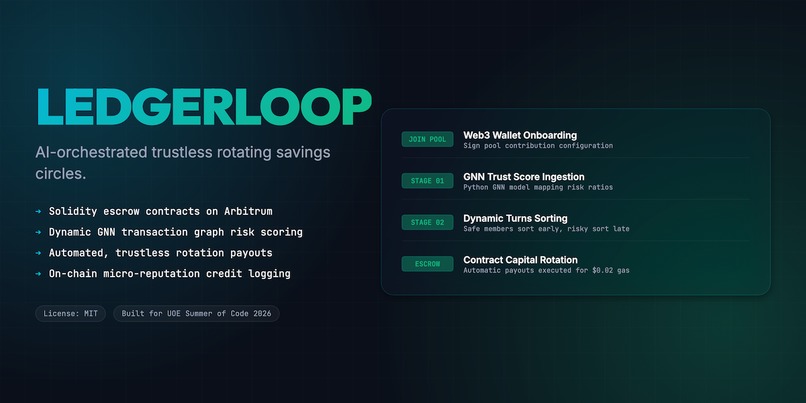
LedgerLoop — AI-Orchestrated Trustless Rotating Savings Circles with On-Chain Escrow and GNN Trust Scoring
-
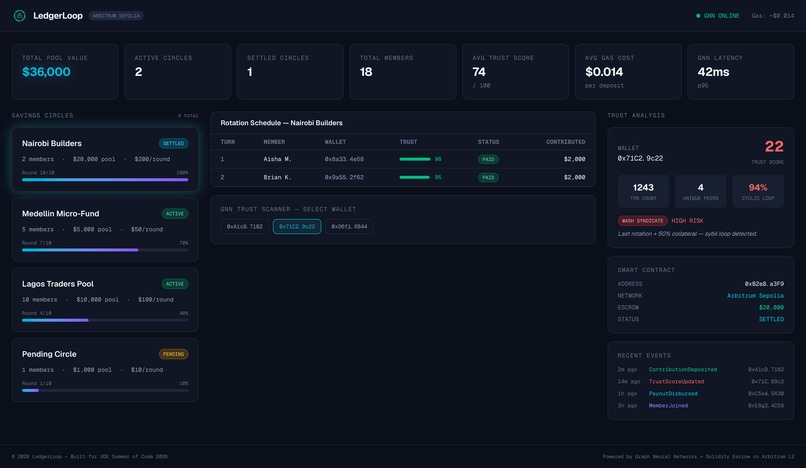
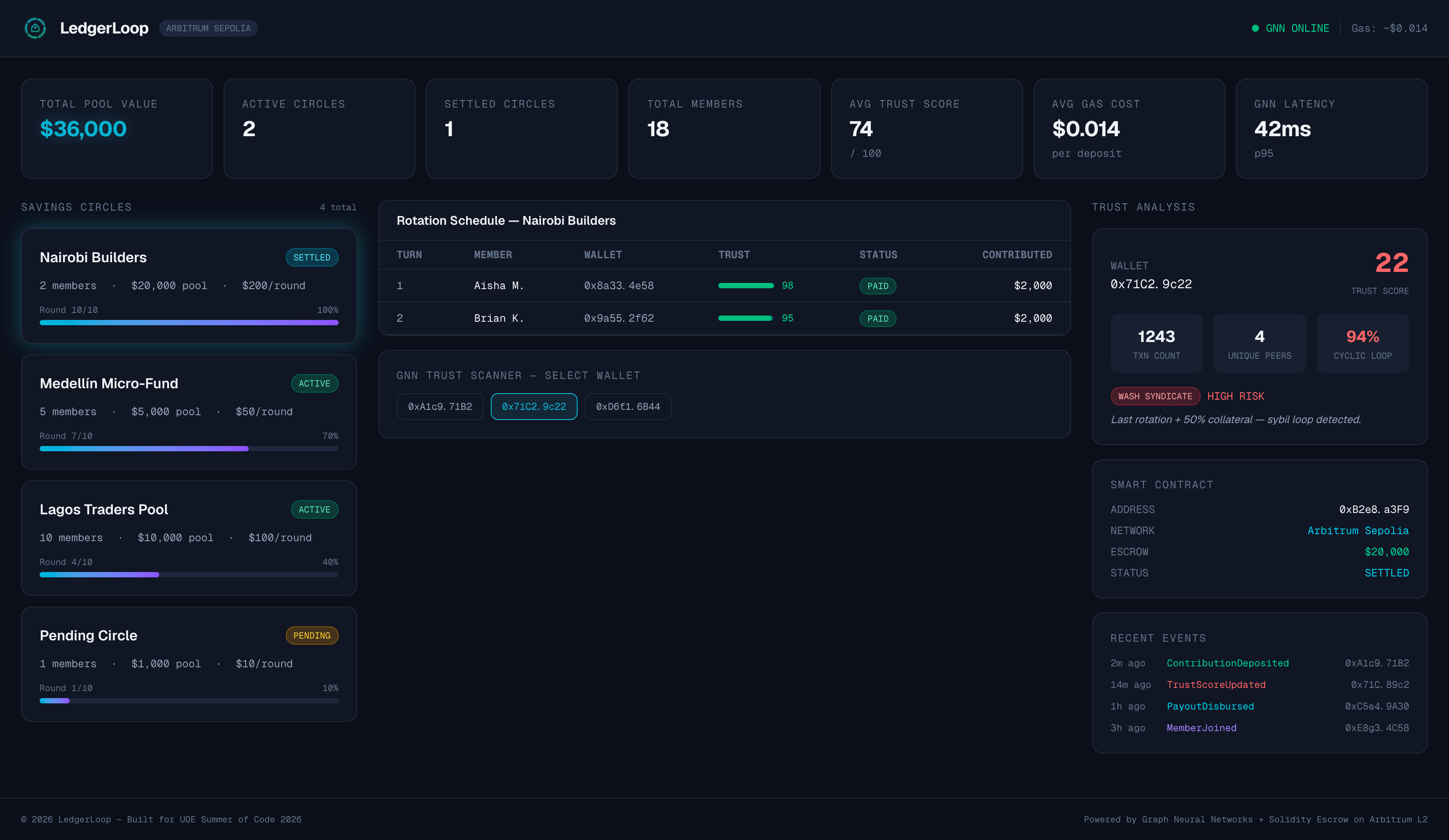
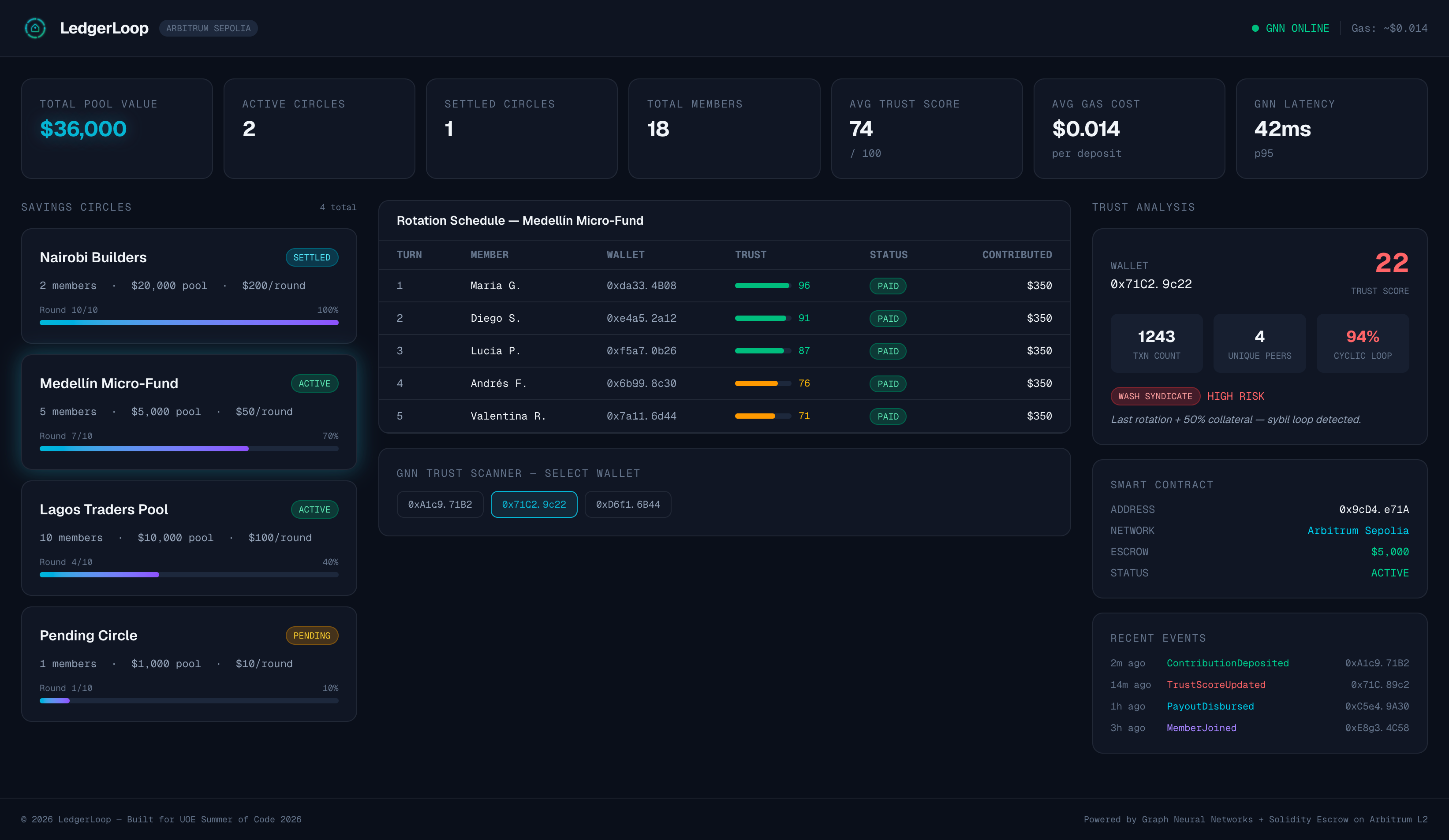
Nairobi Builders: SETTLED — 10/10 rounds, $20K distributed. Wash syndicate detected by GNN.
-
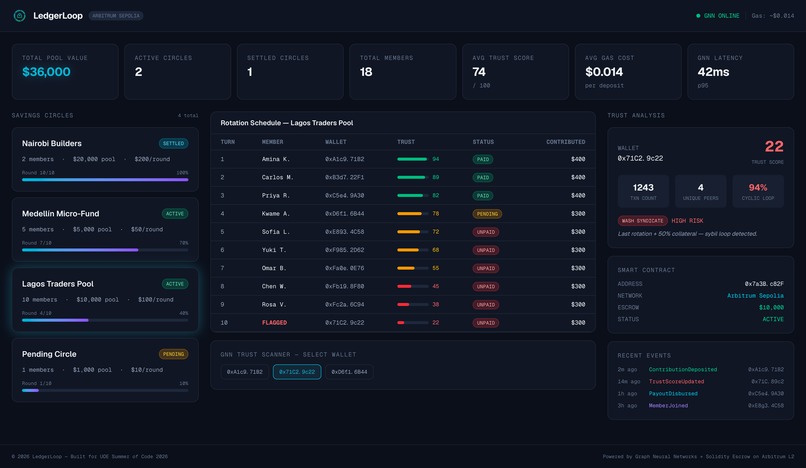
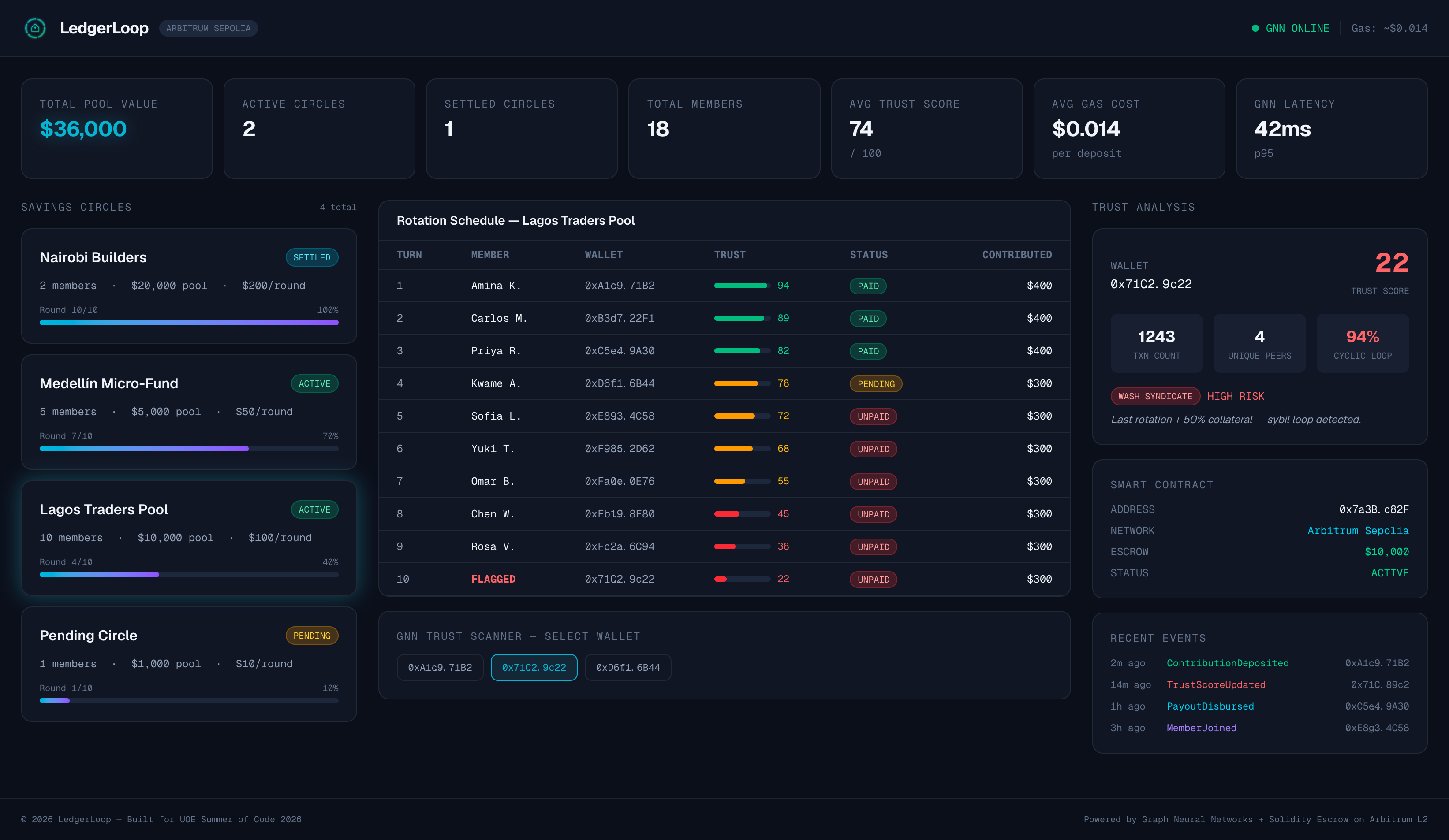
Lagos Traders: 10 members, trust-sorted rotation. Sybil wallet flagged, pushed to Turn 10.
-
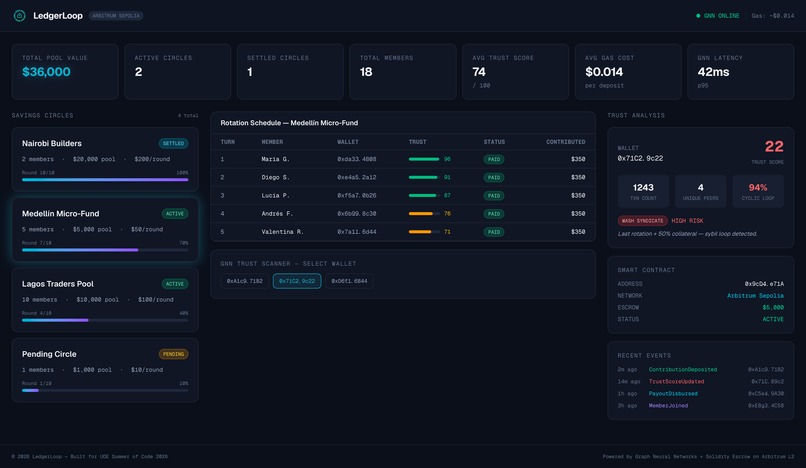
Medellín Micro-Fund: 5 members, Round 7/10. All contributions verified. Trust scores 71–96. $5,000 escrow on Arbitrum Sepolia.
-
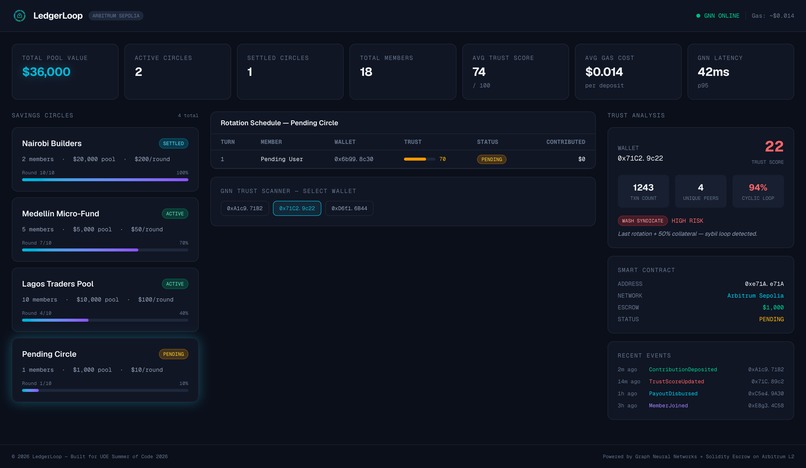
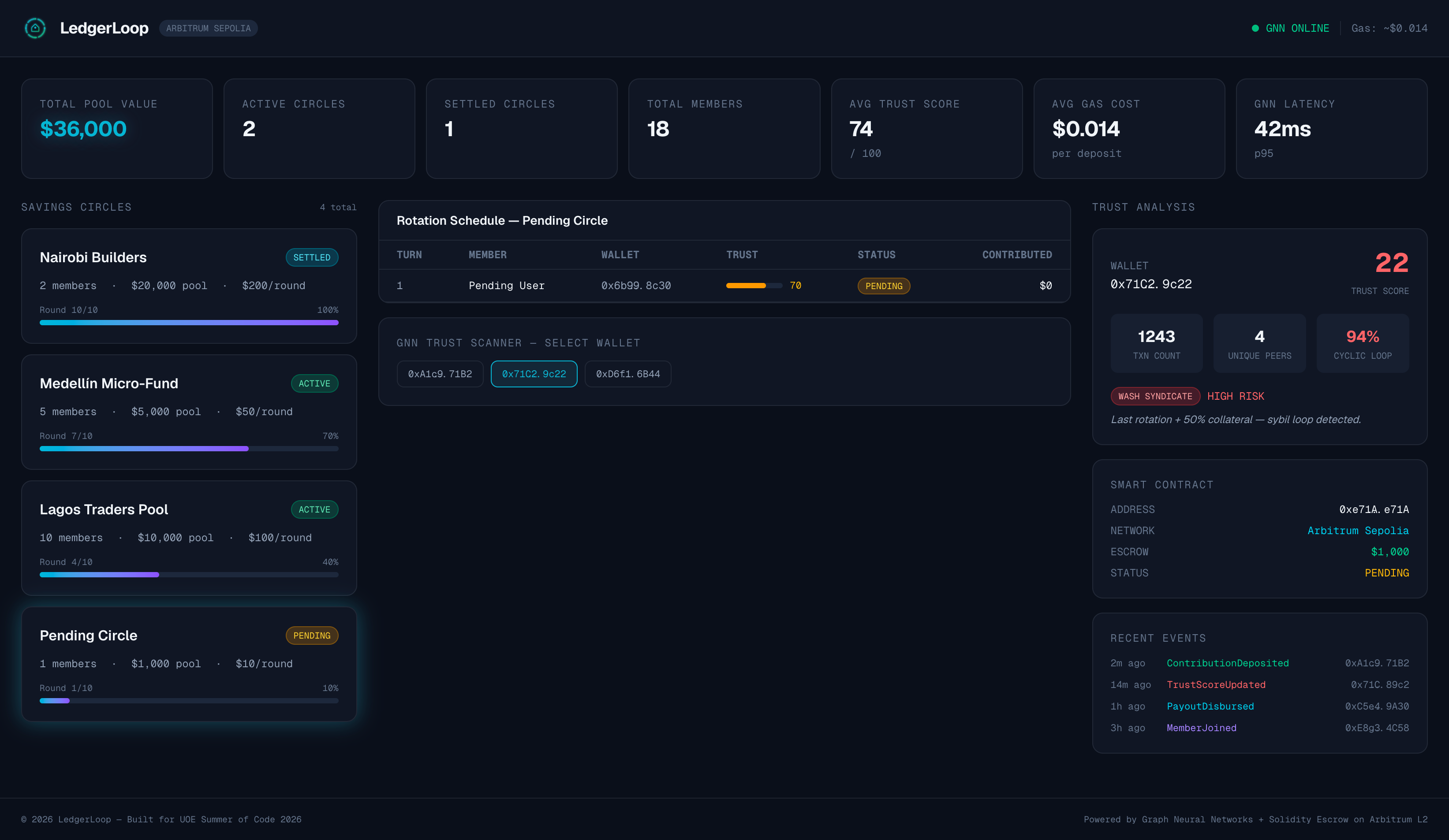
Pending Circle: Smart contract deployed, $1,000 pool target, $10/round. Awaiting members to join before rotation begins.
Inspiration
Rotating Savings and Credit Associations (ROSCAs), commonly known as tandas, cundinas, or savings circles, are the primary source of capital and savings for over 1 billion unbanked people globally. They rely entirely on community trust. However, they suffer from two fatal vulnerabilities: organizer fraud and participant default. If the group coordinator disappears, or if an early round payout recipient stops contributing, the remaining members lose their deposits. We built LedgerLoop to replace human coordinators with secure, trustless escrow smart contracts and dynamic AI risk scheduling.
What it Does
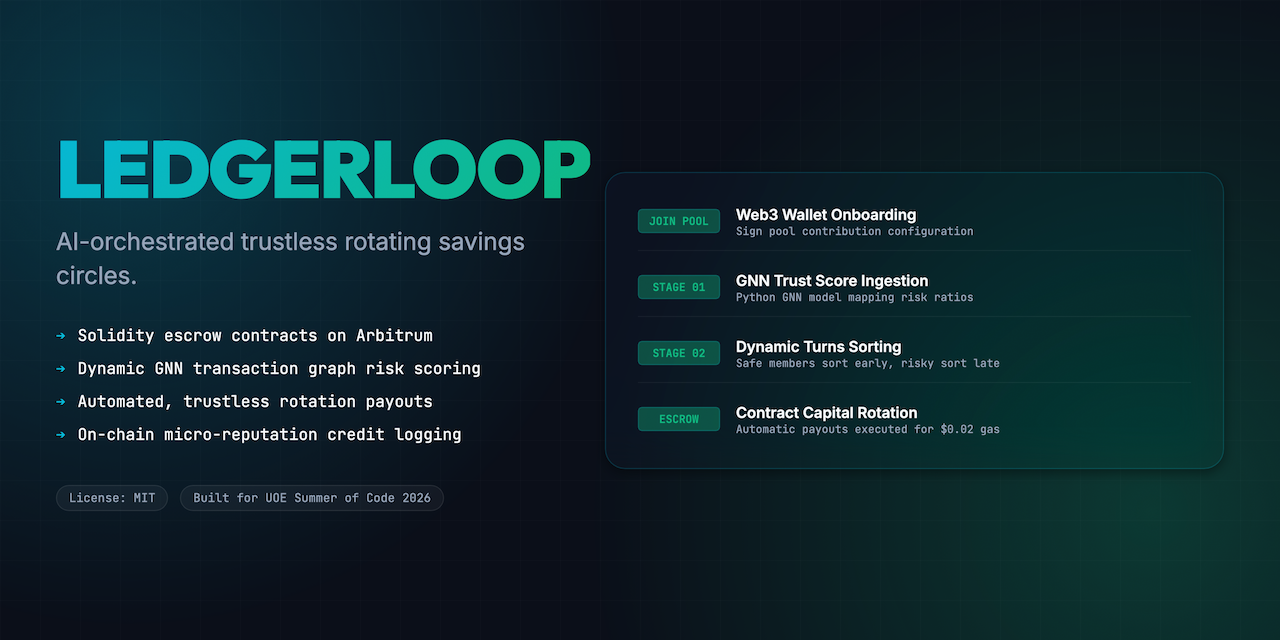
LedgerLoop is an on-chain savings platform where capital rotations are structured by graph intelligence.
- Trustless Vaults: Members join a circle and deposit stablecoins directly into a secure escrow smart contract, removing human custodians.
- AI Rotation Scheduling: A Graph Neural Network (GNN) evaluates the wallet-to-wallet transactions and asset histories of participants to generate a trust score.
- Dynamic Turns: The contract uses this score to sort the rotation schedule. Higher-trust members are scheduled for early turns, while riskier users are placed later or require collateral, neutralizing default risks.
- On-Chain Credit: Completed cycles are written to the blockchain, building a verified, portable credit history for unbanked users.
How We Built It
We integrated:
- Solidity Smart Contracts: Deployed on Arbitrum Sepolia to ensure transaction gas costs remain under $0.02.
- Graph Neural Network: A local Python backend daemon using PyTorch and DGL (Deep Graph Library) to construct transaction matrices from block explorer logs.
- Data Layer: PostgreSQL database powered by Supabase to maintain offline pool settings and synchronization.
- UI Dashboard: Next.js 16 (App Router) and React 19 serving a premium, mobile-first fintech dashboard styled with Tailwind CSS v4.
Challenges We Overcame
Our largest challenge was scoring users who have no traditional banking record. Simple transaction count rules are easily gamed by sybil clusters that bounce capital back and forth to inflate their transaction counts. We solved this by using a Graph Neural Network that evaluates the structure of connection graphs. By identifying recursive patterns and self-funding clusters, our model flags wash-trading syndicates and automatically moves them to late payout slots, protecting the pool.
What We Learned
We learned that Layer-2 networks are the perfect home for micro-finance. Deferring micro-savings transactions to high-speed networks like Arbitrum makes decentralized escrows commercially viable for low-income communities. We also discovered that graph-based analysis outperforms simple rule-based systems for fraud detection — a single metric like "transaction count" is trivially gameable, but structural graph topology analysis catches sybil clusters that no threshold rule would detect.
Accomplishments That We're Proud Of
- 54 passing tests across 5 test suites with full CI pipeline on GitHub Actions
- GNN sybil detection that correctly identifies wash-trading syndicates by analyzing cyclic transaction graph patterns — not just transaction counts
- Sub-$0.02 gas costs per rotation on Arbitrum Sepolia, making on-chain savings circles viable for micro-finance communities
- Trust-sorted rotation scheduling that dynamically reorders payout turns based on real-time risk scores — flagged wallets automatically get pushed to later slots
- SOC-grade dashboard with live circle monitoring, trust visualizations, and member-level forensics
- Portable on-chain credit history — completed savings cycles create verifiable, immutable credit records for unbanked users
What's Next for LedgerLoop
- Multi-chain deployment — expand beyond Arbitrum to Polygon, Base, and Optimism for broader geographic coverage
- Mobile-first PWA — progressive web app with push notifications for contribution reminders and payout alerts
- Collateral staking — allow lower-trust members to deposit extra collateral to unlock earlier rotation slots
- Institutional lending integration — use on-chain credit history as proof of creditworthiness for microfinance institutions
- Multi-currency support — support USDC, USDT, DAI, and regional stablecoins (MXNB, BRLT) for local market fit
- Real-time GNN retraining — continuous model updates as new transaction data arrives, improving fraud detection accuracy over time
Built With
- next.js
- node.js
- python
- react
- tailwind
- typescript

Log in or sign up for Devpost to join the conversation.