LedgerLens Pro — See Beyond Your Balance
AI-Powered Financial Intelligence for PayPal Merchants
The Problem
For online merchants, knowing how much money is currently available is only one part of financial management.
The bigger challenge is understanding where money is moving, identifying unusual transaction patterns, anticipating recurring financial obligations, and evaluating how future financial decisions could affect available cash.
Traditional payment dashboards primarily focus on transaction history and current balances. Merchants still need to interpret financial activity, identify potential irregularities and reason about their future cash position.
We built LedgerLens Pro to address this gap.
Our Solution
LedgerLens Pro is an AI-powered financial intelligence platform designed for PayPal merchants.
It transforms payment and transaction information into actionable financial insights through:
- Financial Intelligence Dashboard: A consolidated view of financial position and transaction activity.
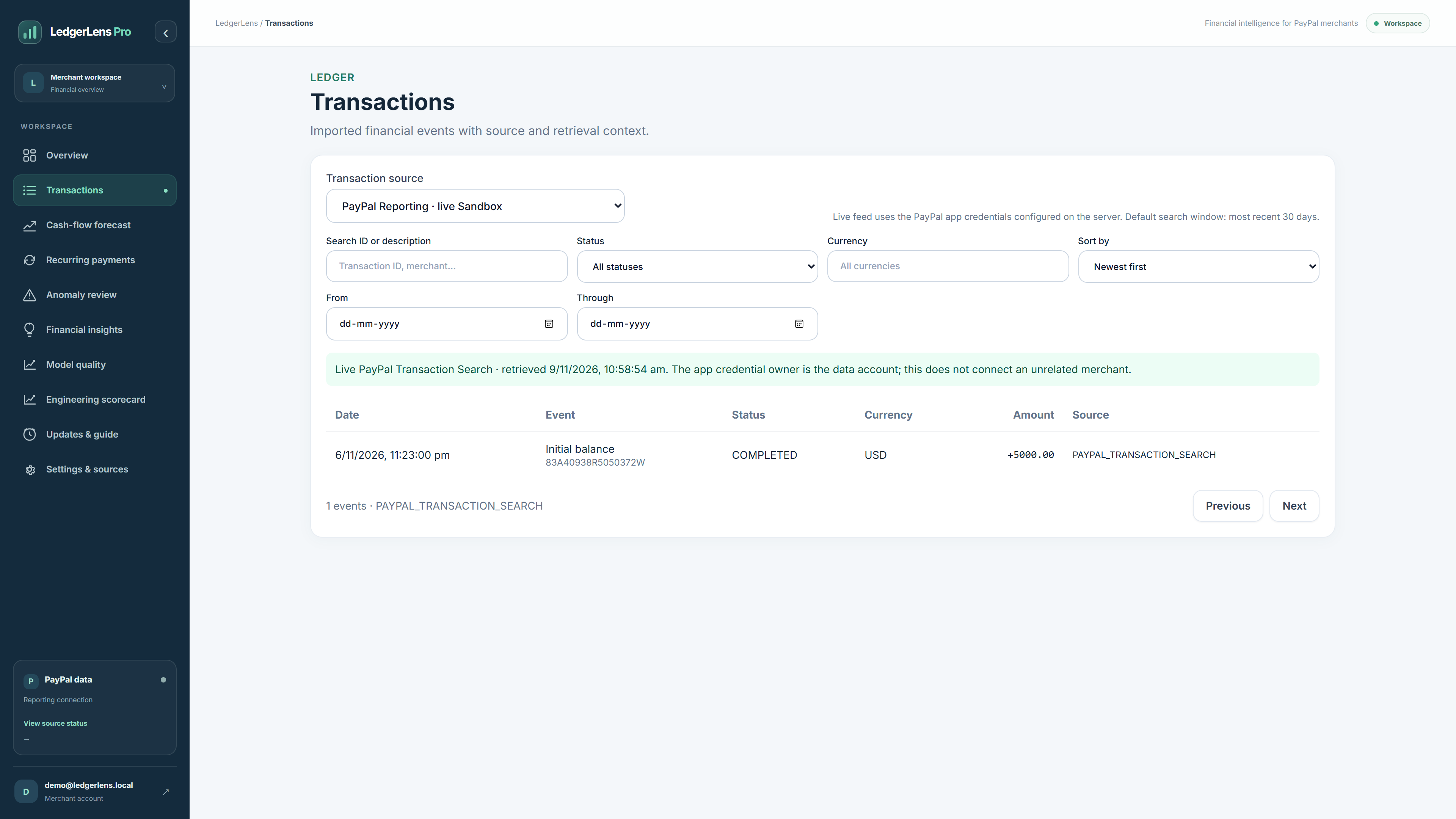
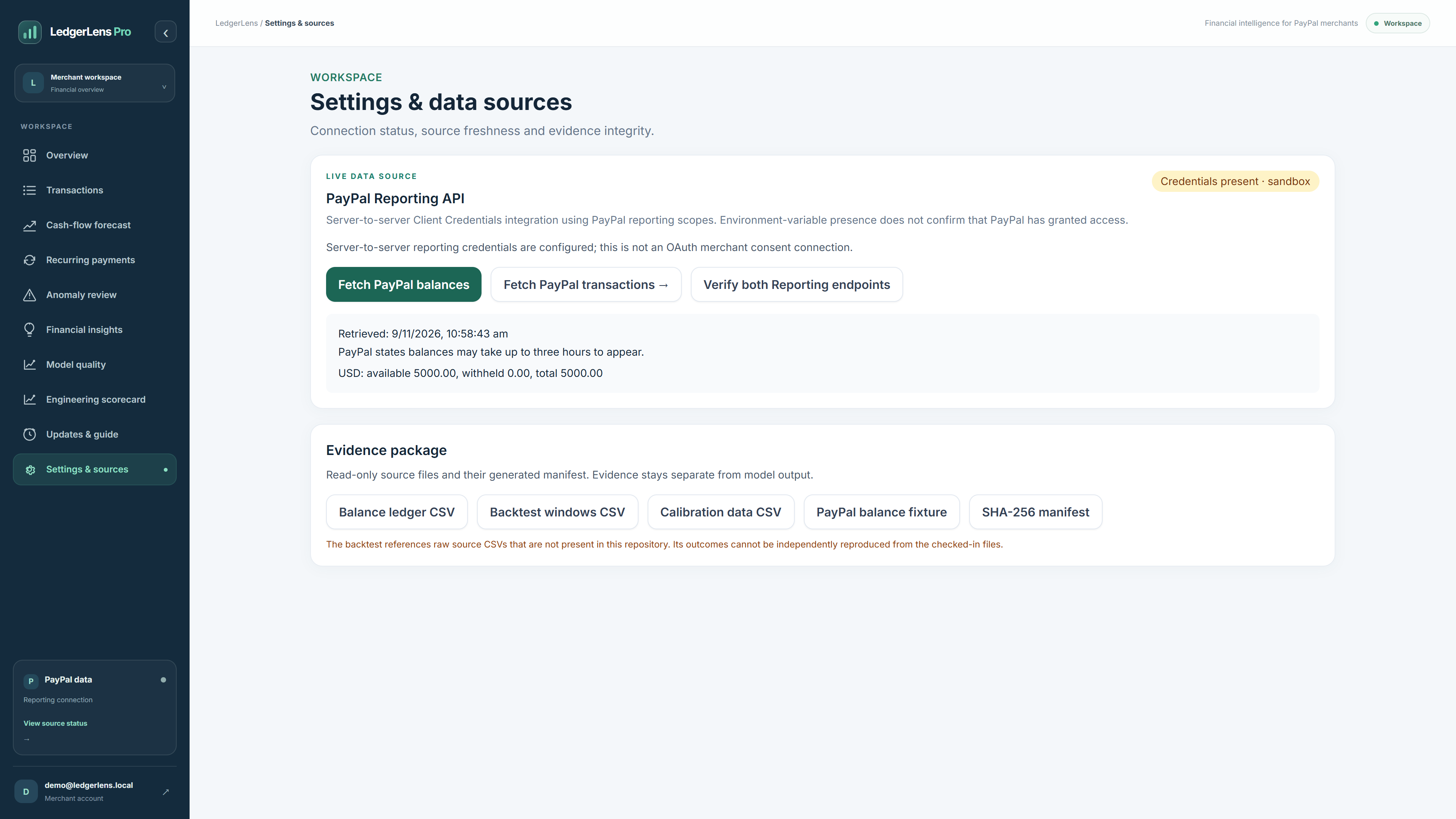
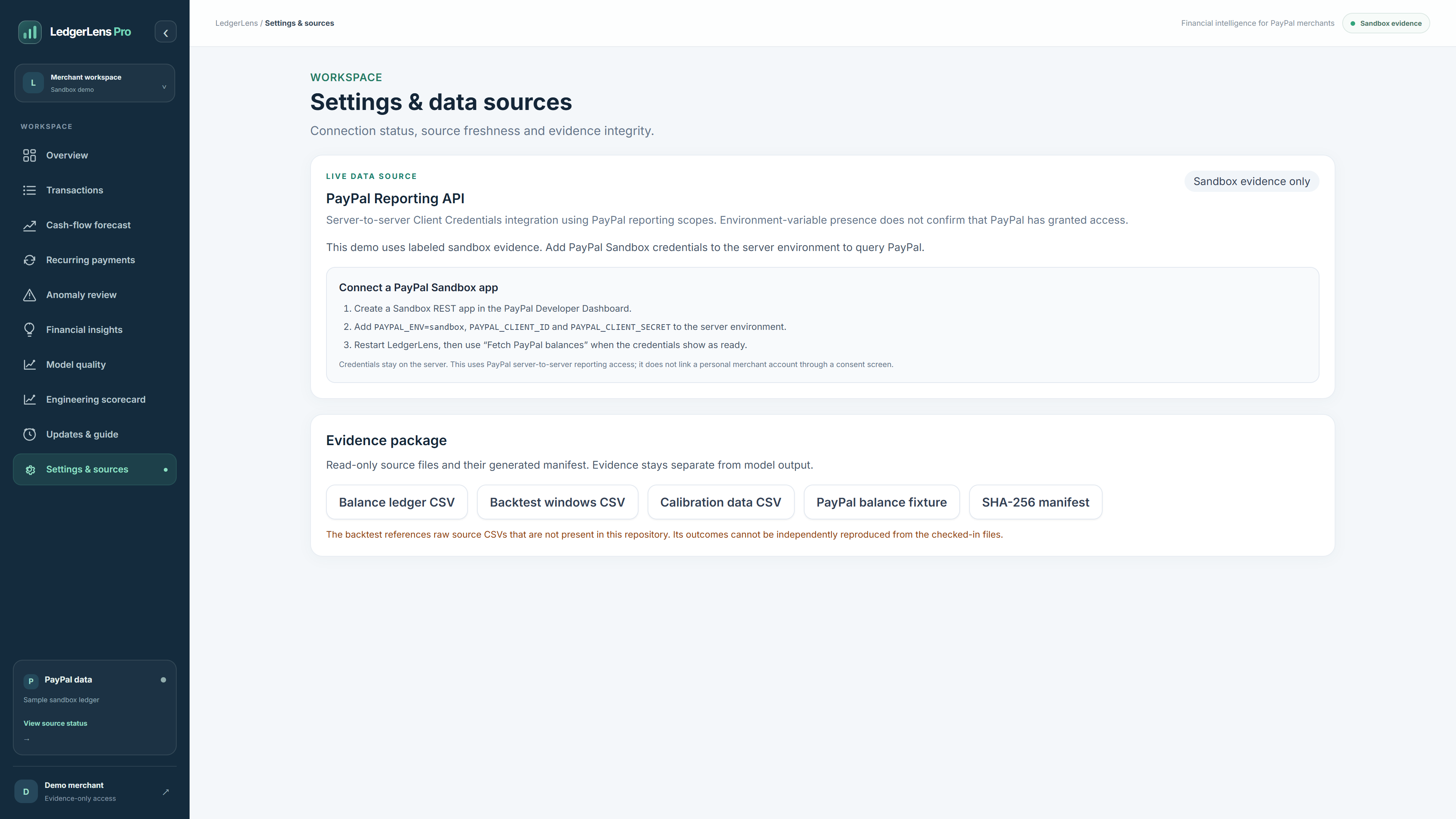
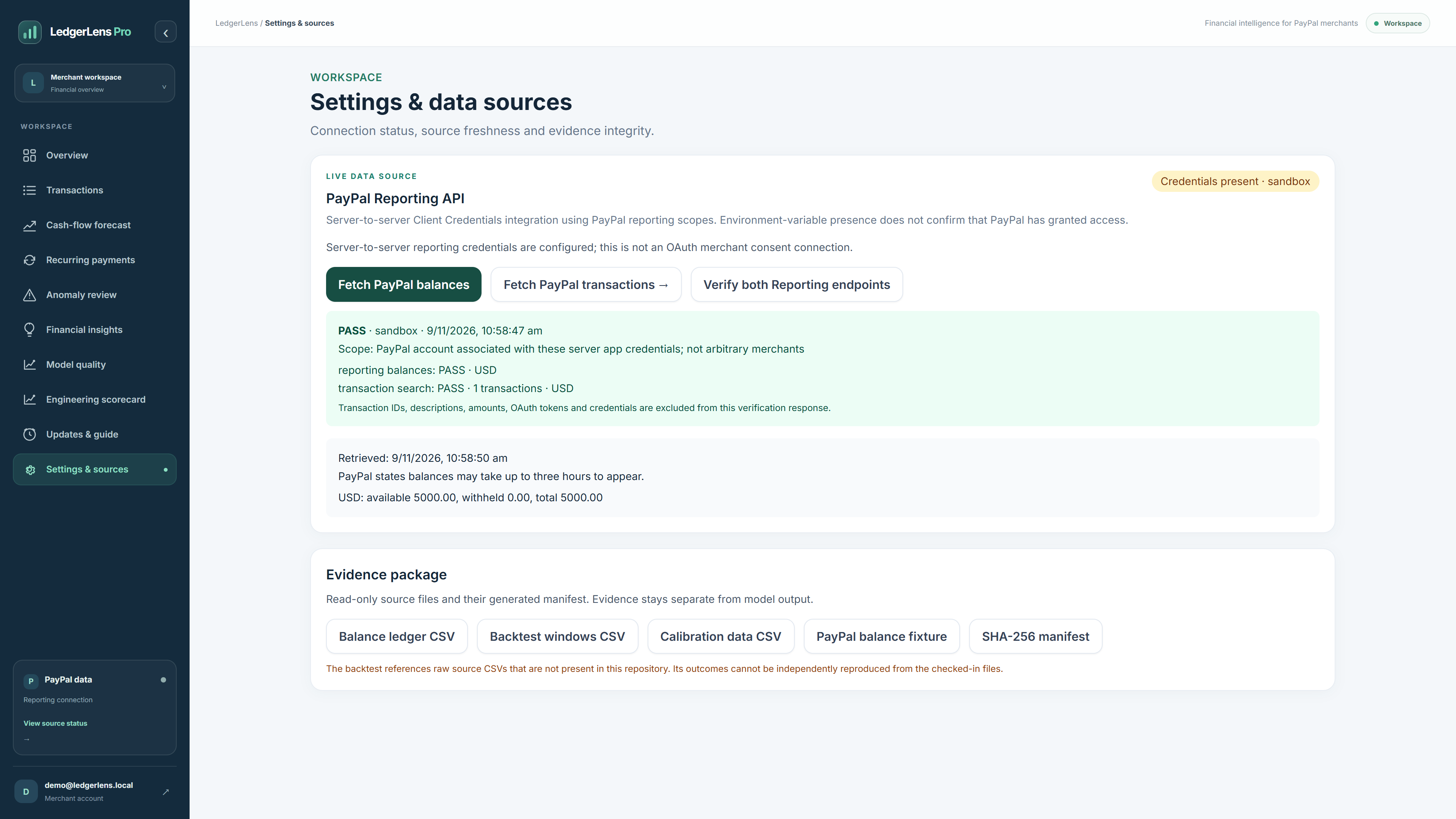
- PayPal Integration: Server-side PayPal Sandbox integration for retrieving balance information and transaction records.
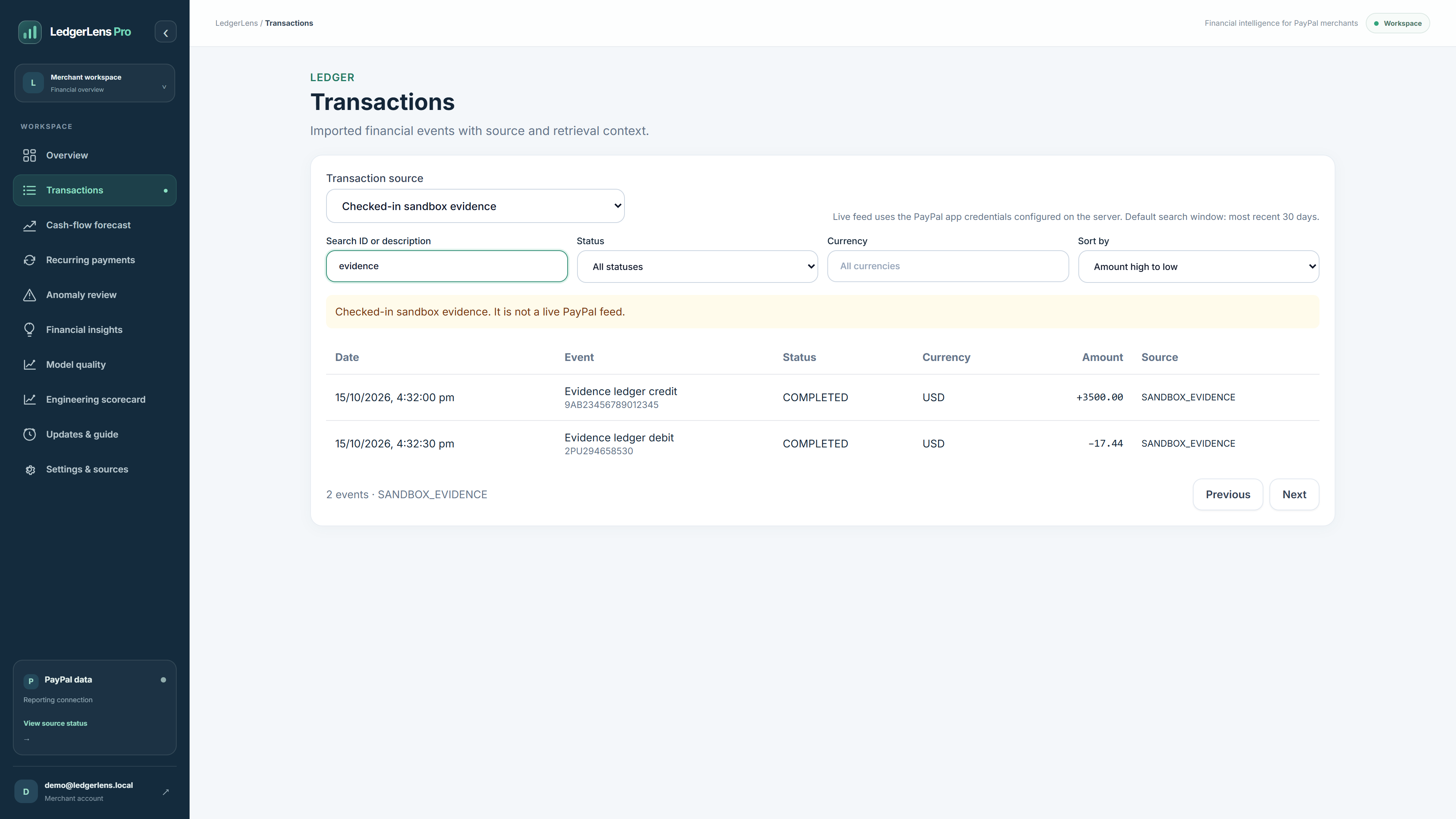
- Transaction Intelligence: Search, filtering, sorting and transaction investigation workflows.
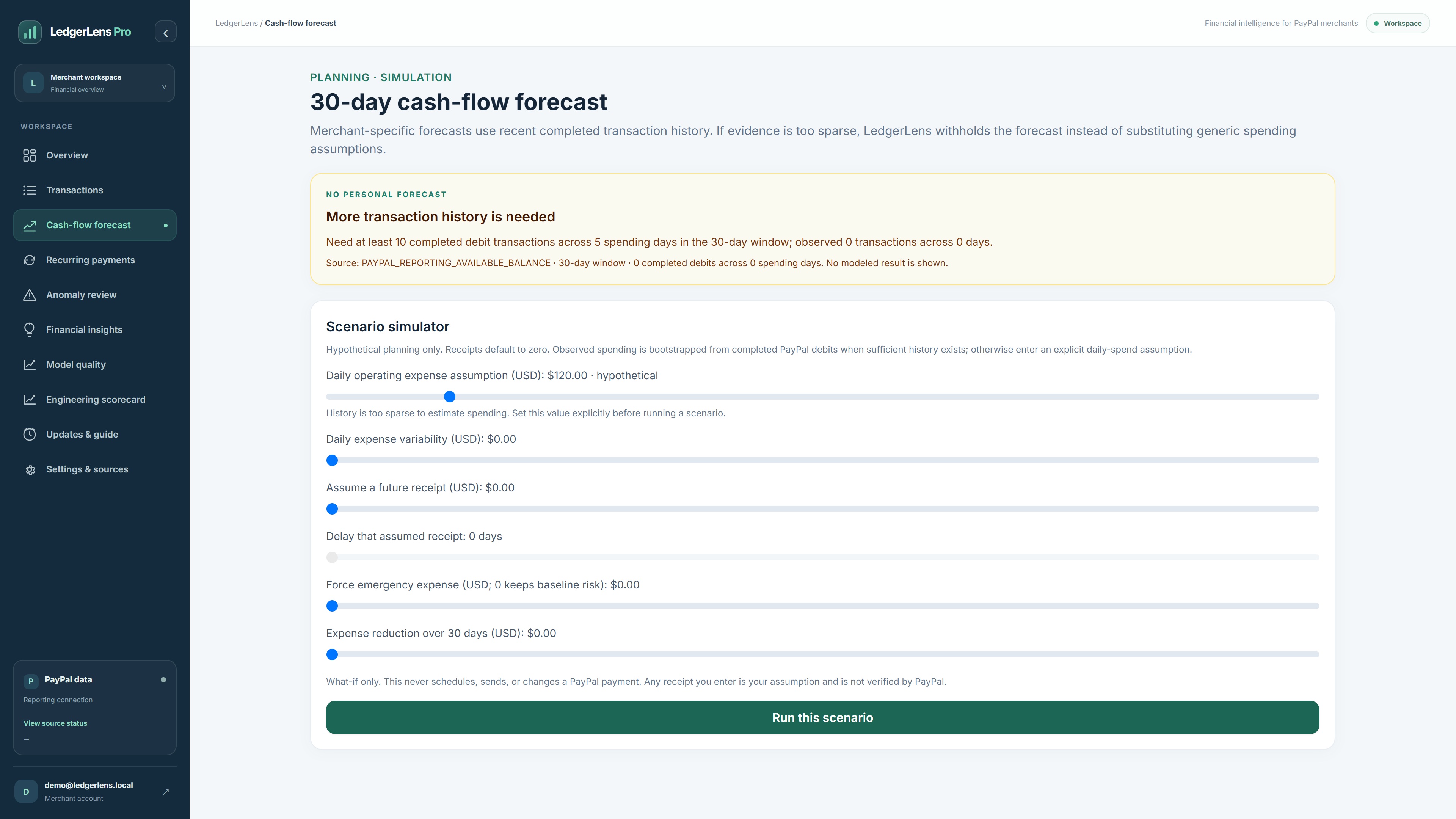
- Cash-Flow Scenario Simulation: Monte Carlo-based scenario exploration to understand how different financial assumptions can affect future cash positions.
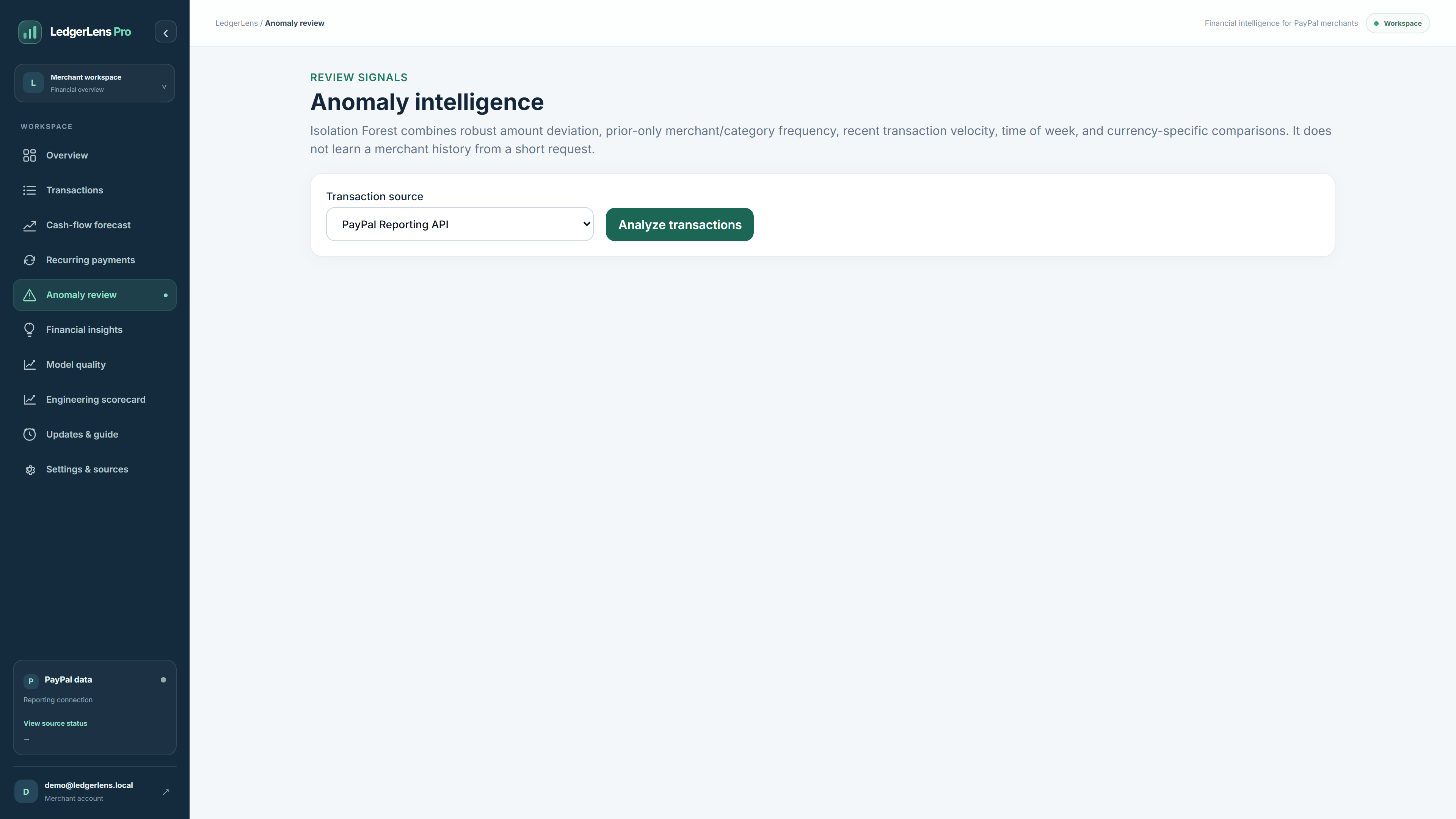
- Anomaly Detection: Machine-learning-assisted identification of unusual transaction patterns that may require investigation.
- Recurring Payment Intelligence: Detection and analysis of recurring transaction patterns.
- Model Quality and Transparency: Evaluation metrics, calibration analysis, reliability diagrams, evidence gates and explicit separation of synthetic benchmarks from real-world evidence.
Our goal is not simply to display financial information. It is to help merchants understand their financial activity and make more informed decisions.
What Makes LedgerLens Pro Different?
We believe financial intelligence must be explainable and evidence-backed.
A system should not claim that a transaction is fraudulent simply because it looks unusual. It should not claim that a forecast is accurate without comparing predictions against actual outcomes.
LedgerLens Pro therefore separates:
- Verified financial evidence.
- Model-generated predictions.
- Scenario-based simulations.
- Synthetic experimental benchmarks.
- Unverified assumptions.
Our transaction investigation workflow includes a distinct Needs Investigation state. This state is not automatically converted into a positive or negative machine-learning label.
Our Model Quality dashboard makes limitations visible rather than hiding them behind attractive accuracy percentages.
This approach makes transparency and responsible AI central to the product.
How We Built It
LedgerLens Pro combines a full-stack application with financial data processing and machine-learning services.
Frontend
We built the user interface using React and Vite.
The application includes dedicated experiences for:
- Dashboard
- Transactions
- Forecasting
- Financial Insights
- Anomaly Detection
- Recurring Transactions
- Settings
- Model Quality
Backend
The backend uses Node.js and Express to manage application APIs, financial data processing, authentication and PayPal integration.
Machine Learning
A Python-based ML service supports analytical workflows, including anomaly detection, forecasting experiments and model evaluation.
We implemented a reproducible chronological synthetic benchmark to compare model and calibration approaches against a baseline.
The synthetic benchmark is explicitly separated from real-world evaluation.
PayPal Integration
We implemented server-side PayPal API integration and locally verified the Sandbox balance retrieval and Transaction Search workflows.
The current verified integration uses application-owner Sandbox access. Third-party merchant OAuth and production integration remain future work.
Evidence and Evaluation
We developed an evidence verification workflow using structured financial evidence, validation scripts and manifest checks.
The Model Quality dashboard reports calibration statistics, Brier score, Expected Calibration Error, reliability bins and positive-event evaluation limitations.
Experimental Results
Our controlled synthetic benchmark produced the following held-out results:
| Metric | Result |
|---|---|
| ROC-AUC | 94.8% |
| PR-AUC | 88.4% |
| Brier Skill Score | 80.5% |
Important: These results come from controlled synthetic patterns. They demonstrate experimental model behaviour and do not represent validated performance on real PayPal merchant transactions.
Our supplied real calibration dataset currently contains 646 observations with zero positive labels. Consequently, real positive-event detection performance cannot yet be established. Historical forecast outcome evidence is also incomplete.
We deliberately keep these limitations visible.
Challenges We Faced
One of our biggest challenges was distinguishing an impressive-looking model metric from a statistically meaningful result.
Our initial calibration evidence contained only negative labels. This made positive-event detection metrics mathematically unevaluable and exposed the importance of representative datasets.
We also encountered challenges around:
- PayPal Sandbox permissions and API verification.
- Separating fixture data from actual API responses.
- Maintaining transaction evidence integrity.
- Designing chronological model evaluation.
- Distinguishing scenario simulations from validated predictions.
- Building reliable application and storage workflows.
Rather than hiding these limitations, we built explicit evidence gates and validation mechanisms into the application.
What We Learned
Building LedgerLens Pro taught us that financial AI requires more than a machine-learning model.
It requires reliable data ingestion, financial correctness, temporal validation, model transparency, secure architecture and a clear understanding of uncertainty.
We also learned that synthetic benchmarks are useful for experimentation but cannot substitute for real-world validation.
Our approach is to make financial intelligence useful without overstating what the underlying evidence proves.
Project Demonstrations
We have prepared two videos to demonstrate LedgerLens Pro from both a product and engineering perspective.
1. Product Overview
An introduction to LedgerLens Pro, the problem it addresses, its financial intelligence capabilities and our vision for AI-powered financial management.
2. Live Application Walkthrough
A practical demonstration of the working application, showcasing the user interface, PayPal Sandbox integration, transaction intelligence, cash-flow simulation, anomaly detection and model evaluation dashboard.
Together, these demonstrations present both the product vision and its actual implementation.
What's Next?
Our next development milestones include:
- Representative, human-reviewed financial outcome datasets.
- Real historical cash-flow forecast validation.
- Merchant-specific predictive models.
- Third-party merchant authorization.
- Persistent multi-merchant data isolation.
- Production deployment and operational monitoring.
- More comprehensive financial intelligence and proactive alerts.
Final Vision
We want to help online merchants move from simply checking their balances to understanding their financial position, investigating unusual activity and exploring what could happen next.
LedgerLens Pro — See Beyond Your Balance.
Built With
- artificial-intelligence
- carlo
- data-visualization
- express.js
- javascript
- machine-learning
- monte
- node.js
- paypal
- python
- react
- rest-api
- vite

