-
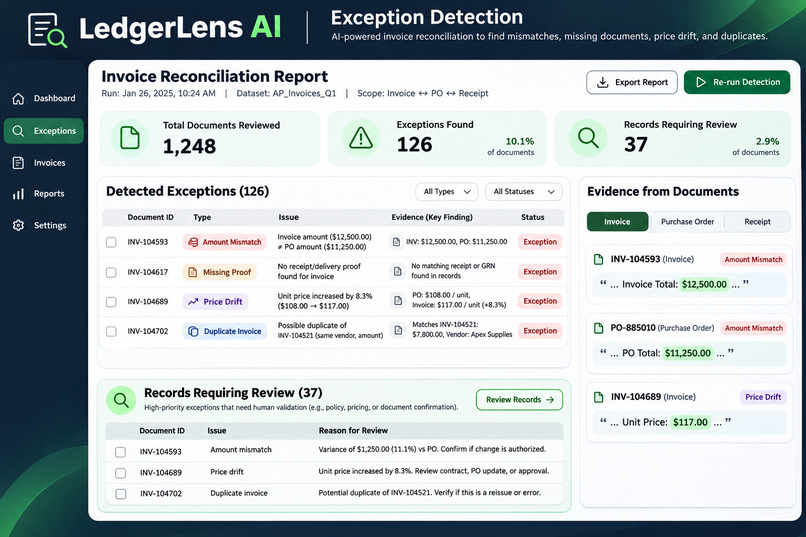
Dashboard
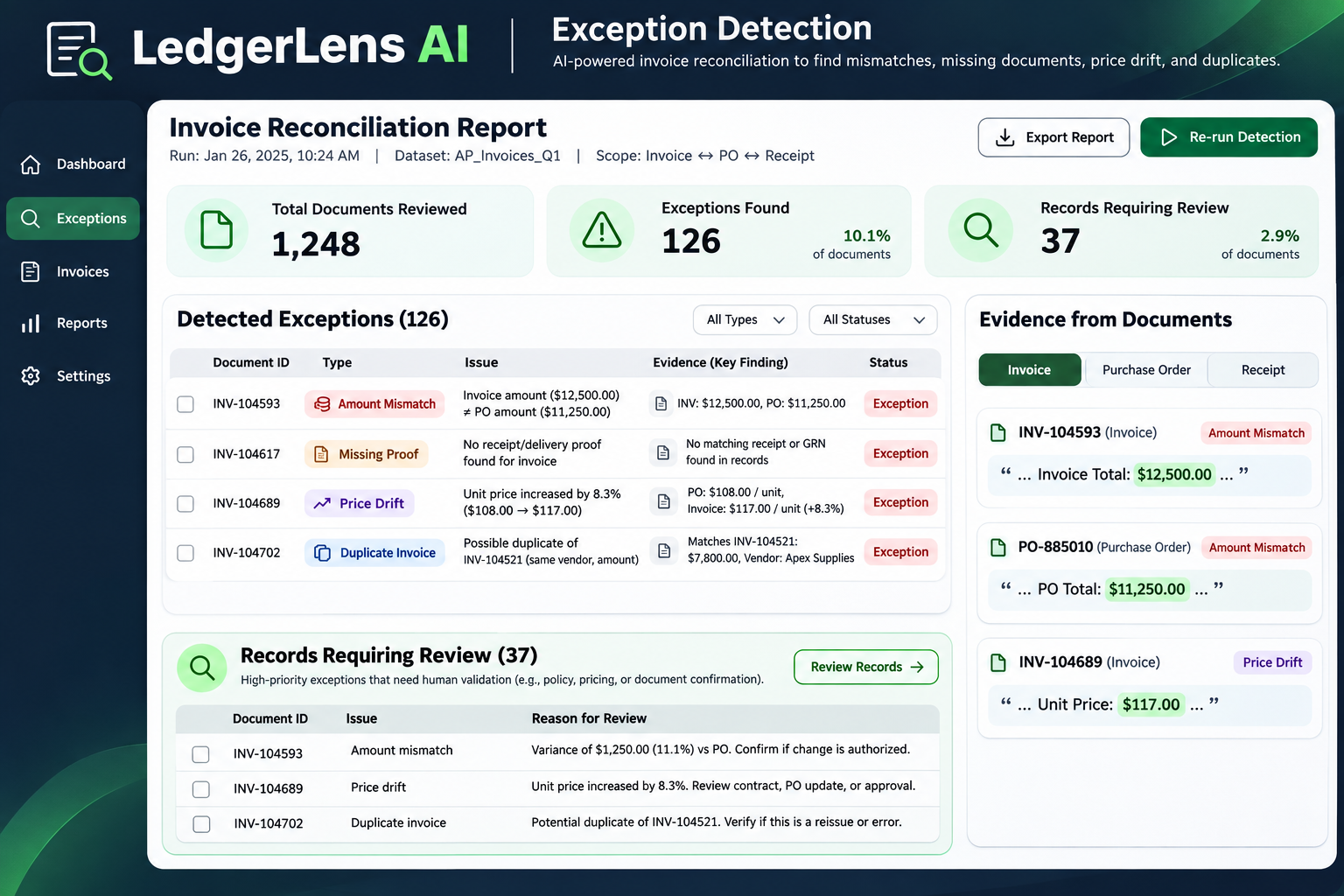
LedgerLens AI — TraceWorks
Inspiration
Businesses process countless invoices, purchase orders, contracts, and delivery receipts. Yet many small and medium-sized companies still verify these documents manually, spending valuable time searching for inconsistencies, missing records, and unexpected price changes.
We saw an opportunity to transform this repetitive process into a smarter, faster, and more reliable workflow.
Our inspiration was simple: What if businesses could focus on resolving financial discrepancies instead of spending hours searching for them?
With UGREEN AI NAS, we envisioned a solution that combines AI-powered document analysis with secure, centralized storage to help businesses reduce administrative costs, improve financial visibility, and make better-informed decisions.
What it does
LedgerLens AI is an intelligent invoice reconciliation and exception detection Skill designed for UGREEN AI NAS.
It analyzes three types of business documents: purchase agreements, supplier invoices, and delivery or payment proofs.
Its core capabilities include:
- Three-way document matching: Identifies relationships between agreements, invoices, and supporting proofs.
- Automated exception detection: Flags discrepancies in written prices, quantities, and totals.
- Price drift monitoring: Identifies changes in supplier prices across a selected period.
- Duplicate invoice detection: Highlights potentially repeated records for review.
- Evidence-based reporting: Produces concise reports containing discrepancies, source references, and supporting quotations.
- Privacy-focused processing: Works within authorized NAS directories without modifying original documents.
Instead of overwhelming users with every transaction, LedgerLens AI focuses on exceptions that require attention, helping businesses prioritize investigations, reduce manual verification effort, and potentially prevent costly billing mistakes.
How we built it
We developed LedgerLens AI using the UGREEN Uliya Skill Developer Kit, following the official Skill Development Standard.
Our two-person team began by defining the business problem, identifying the essential modules, and establishing the functional requirements.
We structured the solution around a SKILL.md entry point and six supporting Markdown references covering reconciliation rules, evidence handling, privacy, reporting, disclosures, and validation.
The Skill is designed to orchestrate UGREEN's supported capabilities through specialized agents:
ug-filesystemfor discovering authorized files.ug-filemgrfor detecting duplicate files.ug-documentfor extracting structured document information and retrieving evidence.ug-photofor OCR processing of approved receipt images.ug-knowledgefor saving approved reports.
We established a workflow that connects document discovery, information extraction, evidence verification, exception identification, and report generation.
We also incorporated safeguards against unsupported comparisons, ambiguous matches, incomplete evidence, and unauthorized file modifications.
The initial package underwent local static validation against UGREEN's capability catalog, reaching zero errors, zero warnings, and zero informational diagnostics.
Challenges we ran into
One of our biggest challenges was understanding the boundaries of the existing UGREEN NAS capabilities.
We discovered that the available document reconciliation action already supports contract-to-invoice amount comparisons. However, it does not independently provide our complete three-document validation workflow, supplier price drift analysis, or exceptions-only reporting approach.
Rather than duplicating an existing feature, we redesigned our orchestration logic to create additional business value.
Another challenge involved ensuring that AI-generated findings remain trustworthy. Documents may contain missing identifiers, inconsistent formats, unreadable images, or ambiguous supplier references.
To address these situations, we designed explicit Needs Review classifications instead of allowing the system to invent missing information or assume that uncertain matches are correct.
We also had to respect UGREEN's Skill restrictions, designing the workflow around registered expert agents rather than custom executable scripts.
Accomplishments that we're proud of
Our most important accomplishment is transforming an initial business idea into a structured AI Skill package designed around the supported UGREEN NAS ecosystem.
We are particularly proud of:
- Defining a differentiated three-way document reconciliation workflow.
- Designing evidence-traceable exception reports rather than generic AI summaries.
- Integrating privacy, permissions, and human approval into the workflow.
- Establishing validation scenarios for price mismatches, missing proofs, duplicate records, and ambiguous evidence.
- Successfully passing local static validation without errors or warnings.
We also created a clear technical foundation that can be refined and tested on real NAS hardware.
What we learned
This project taught us that effective AI automation requires much more than connecting an AI model to business documents.
We learned the importance of requirements analysis, modular architecture, reliable evidence handling, and human oversight when designing systems that support financial decisions.
Working with the UGREEN developer ecosystem helped us understand how specialized AI agents and predefined NAS capabilities can be coordinated into a more complete business workflow.
We also learned to distinguish technical validation from actual execution: passing static checks confirms structural compatibility with published specifications, but it does not establish successful operation on physical NAS hardware.
Most importantly, we learned that trustworthy automation must recognize uncertainty instead of hiding it.
What's next for LedgerLens
Our next milestone is validating LedgerLens AI on an actual UGREEN AI NAS environment if selected for the final round.
Our priorities include:
- NAS deployment and execution: Verify installation, expert-agent orchestration, and compatibility with the available UGOS environment.
- Real workflow testing: Validate document matching, price discrepancy detection, and missing-proof identification using synthetic business documents.
- OCR and edge-case validation: Test blurred receipts, incomplete records, and ambiguous document relationships.
- Reporting improvements: Refine evidence presentation, exception prioritization, and approval-controlled report saving.
- Future expansion: Explore additional business workflows, broader document support, and integration opportunities within the supported NAS ecosystem.
Our long-term vision is to evolve LedgerLens AI into a practical financial document review assistant that helps businesses save time, reduce operational risk, and gain greater confidence in their supplier transactions.
LedgerLens AI — Less paperwork. Fewer surprises. Better business decisions.
Built With
- agents
- ai
- data-extraction
- file-management
- markdown
- ocr
- privacy
