Inspiration
Finance teams still spend too much time manually reviewing invoice mismatches, vendor issues, tax inconsistencies, and purchase order exceptions across old ERP systems. These workflows are repetitive, slow, and risky because a small error can delay payments, create compliance issues, or trigger costly escalations.
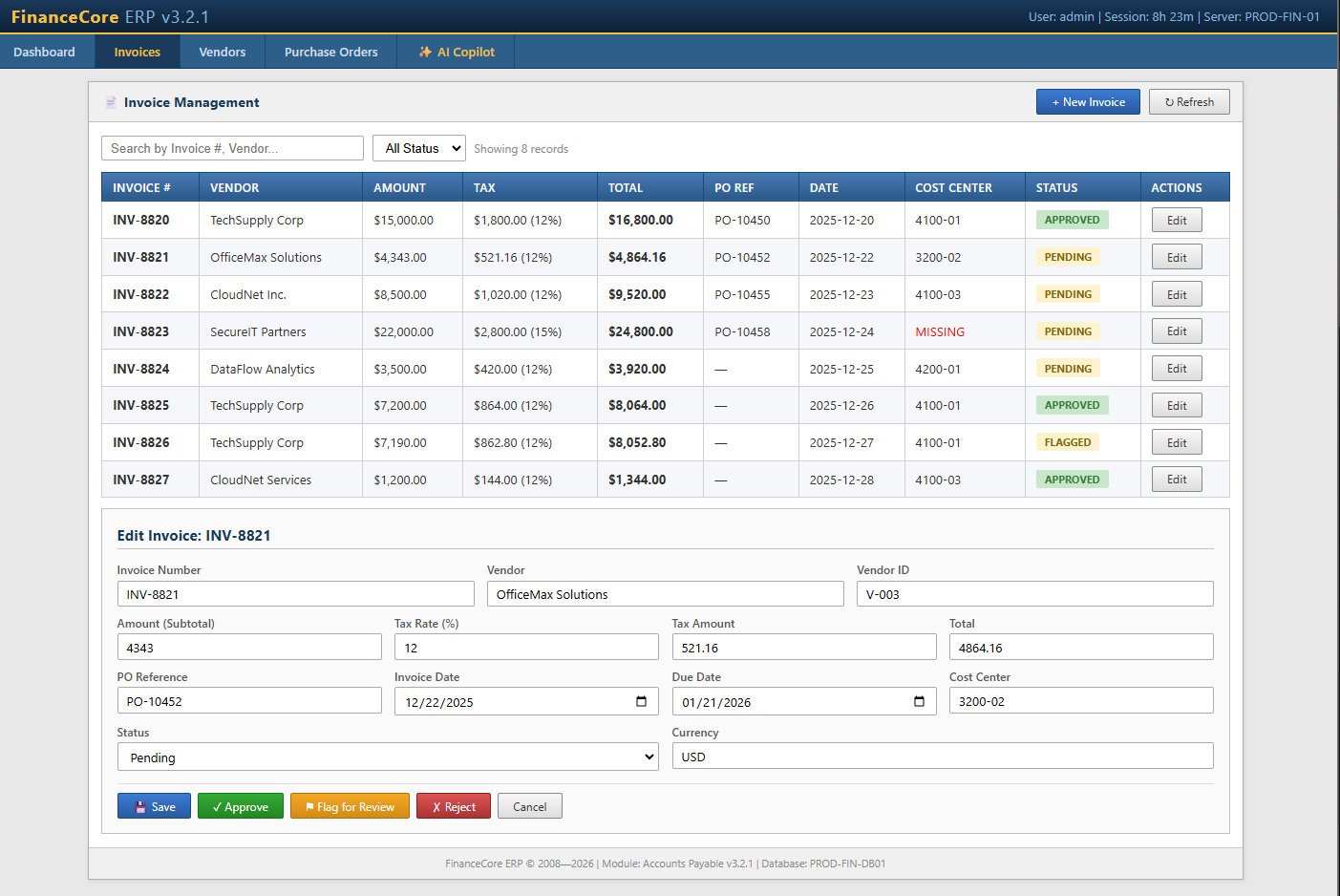
We built LedgerFlow AI to explore how Amazon Nova can transform this process from manual exception handling into an intelligent, auditable workflow. The idea was simple: instead of using AI only to analyze documents, we wanted to build a system that could understand evidence, reason over policy, ask for human approval when needed, and then take action inside a legacy UI.
That made this project a natural fit for the Amazon Nova Hackathon because it combines agentic AI, multimodal understanding, and UI automation in a real-world business scenario.
What it does
LedgerFlow AI is an AI-powered finance exception resolution system.
A user creates a case, uploads supporting evidence such as invoices or screenshots, and triggers the workflow. The system then:
- extracts structured financial information from the uploaded evidence
- retrieves relevant internal policy documents using semantic search
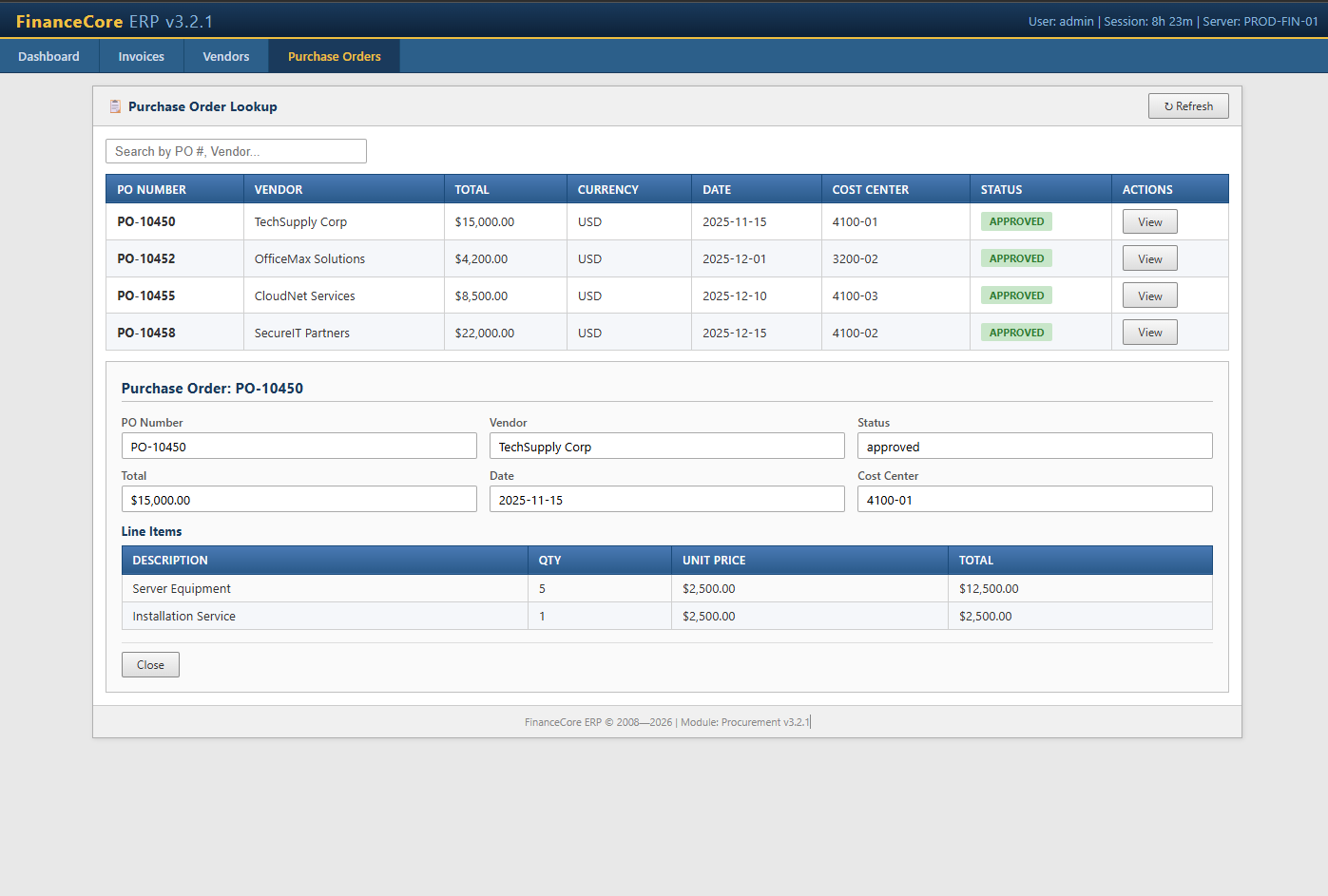
- compares invoice data against purchase orders and vendor records
- identifies discrepancies and creates a resolution plan
- decides whether the case can be auto-resolved or should be escalated for human approval
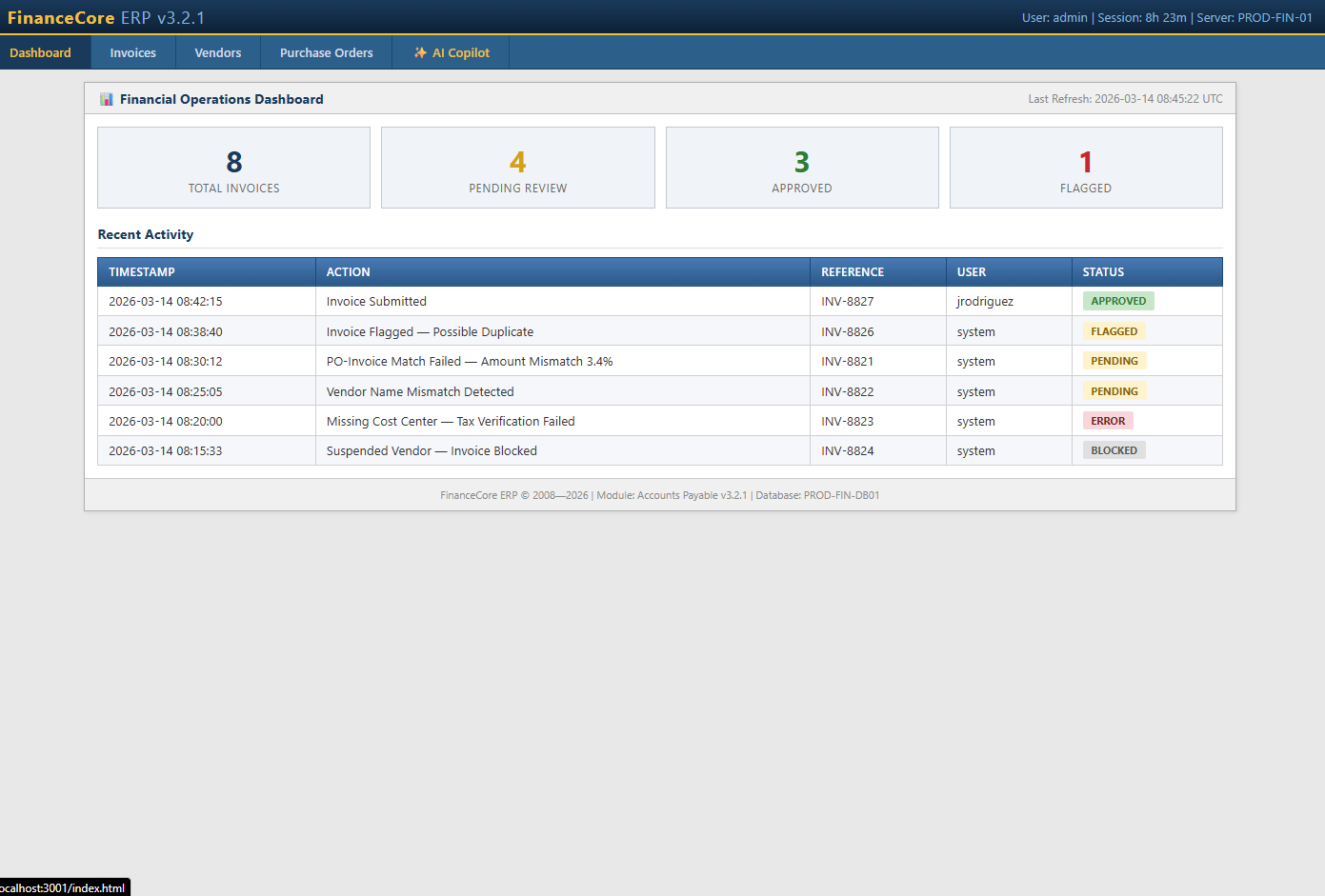
- performs the required action in a mock ERP using UI automation
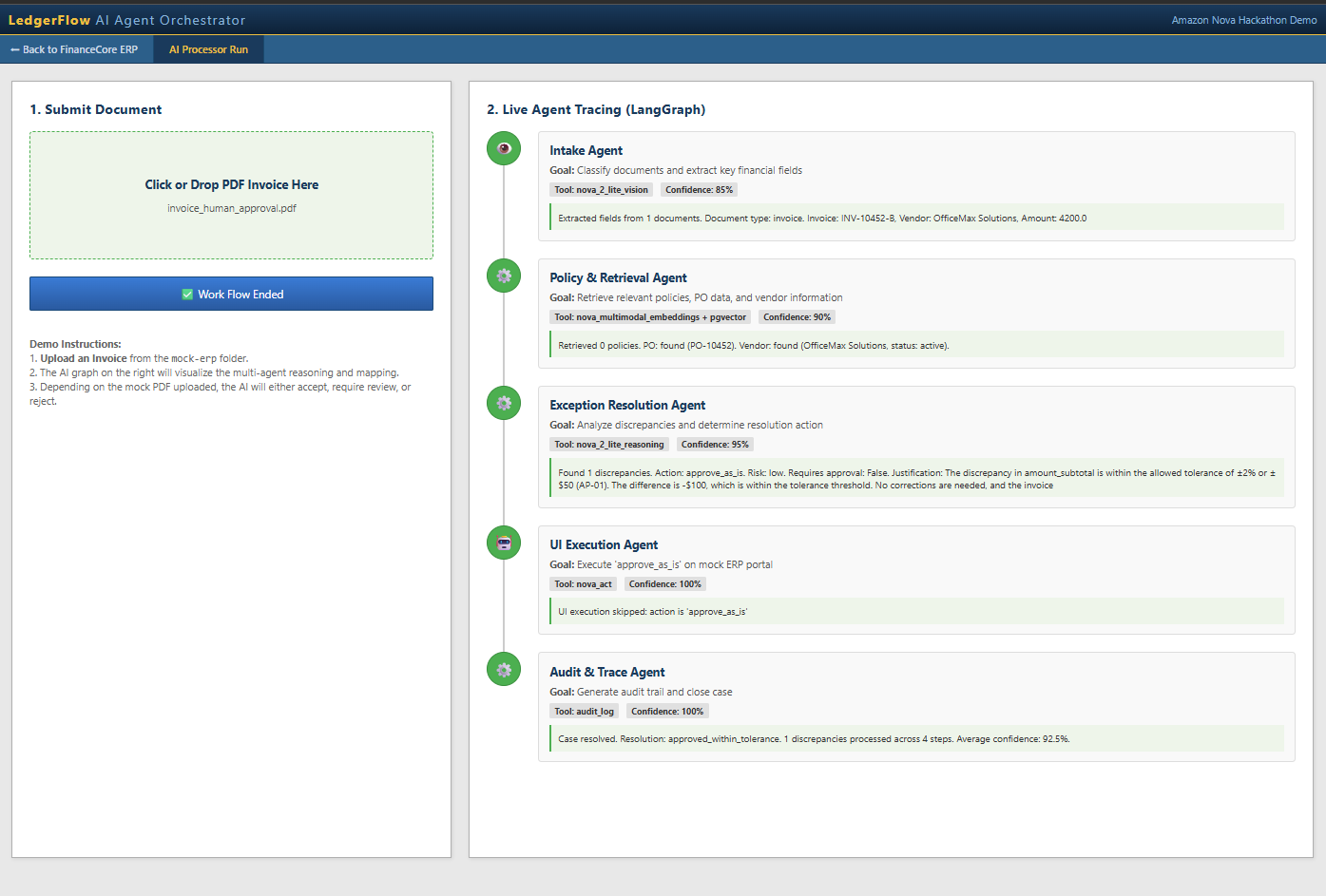
- stores a full decision trace for auditability
The result is a workflow that helps finance teams move faster while keeping transparency and control.
How we built it
We built LedgerFlow AI as a multi-agent system with a FastAPI backend, PostgreSQL database, vector search, and a mock ERP interface.
The backend manages cases, evidence, approvals, workflow execution, and result retrieval. We used LangGraph to orchestrate the agent flow across these stages:
- Intake Agent
- Retrieval Agent
- Resolution Agent
- Human Approval Gate
- UI Execution Agent
- Audit Agent
We used Amazon Nova 2 Lite for document understanding and reasoning. It helps extract structured invoice data and generate resolution decisions based on discrepancies and policy context.
We used Amazon Nova multimodal embeddings with pgvector to index and search internal financial policies so the agent can retrieve the most relevant guidance before deciding what to do.
We used Nova Act to automate actions in a mock legacy ERP workflow, such as navigating invoice screens, updating fields, and flagging items for review.
On the data side, we used PostgreSQL with SQLAlchemy to store cases, evidence, approvals, UI execution logs, and structured decision steps. We also built a mock ERP frontend using HTML, CSS, and JavaScript to simulate real enterprise UI constraints.
Challenges we ran into
One of the biggest challenges was integrating multiple AI-driven steps into a workflow that still feels reliable and controllable. It is easy to make a model return an answer, but much harder to build a system that can safely move from extraction to reasoning to action.
We also ran into challenges around state management, especially when a case pauses for human approval and then needs to resume correctly afterward. Preserving business context across multiple agents was an important design challenge.
Another challenge was Bedrock authentication and environment setup, since the workflow depends on Nova for both retrieval and reasoning. If model access is misconfigured, multiple parts of the pipeline can fail at once.
Finally, UI automation introduced its own complexity. Legacy interfaces are rarely clean or predictable, so bridging AI reasoning with real ERP-style actions required careful prompting, structured plans, and fallback behavior.
Accomplishments that we're proud of
We are proud that LedgerFlow AI is more than a simple chatbot or single-model demo. It is an end-to-end system that shows how Amazon Nova can support a real operational workflow.
Some accomplishments we are especially proud of:
- building a multi-agent workflow that combines reasoning, retrieval, approvals, and execution
- using Amazon Nova models for both structured analysis and semantic policy retrieval
- integrating Nova Act into a realistic finance operations use case
- creating a full audit trail of decisions, approvals, and UI actions
- designing the system around enterprise trust, not just automation
We are also proud that the project addresses a practical business problem with clear value: reducing manual effort while improving consistency and traceability.
What we learned
This project taught us that production-style AI systems need much more than strong model outputs. Workflow design, state handling, human checkpoints, and auditability are just as important.
We learned that multimodal AI becomes much more powerful when connected to operational systems, not just used for isolated document analysis.
We also learned that agent orchestration matters. Breaking the workflow into specialized agents made the system easier to reason about and improved clarity around responsibilities such as parsing, retrieval, decision-making, and execution.
Another key lesson was that trust is a product feature. In enterprise workflows, users need to know not only what the system decided, but why it decided it, which policy it used, and whether a human approved the action.
What's next for LedgerFlow AI
Our next step is to evolve LedgerFlow AI from a hackathon prototype into a more production-ready finance operations assistant.
We plan to:
- connect the workflow to real ERP, procurement, and approval systems
- support more exception types such as duplicate invoices, vendor onboarding, and payment holds
- improve state persistence and resumability across human approval steps
- expand the policy knowledge base and retrieval quality
- add voice-based supervisor review using Amazon Nova 2 Sonic
- strengthen UI automation reliability for more complex business workflows
Long term, we see LedgerFlow AI as a blueprint for how organizations can use Amazon Nova to build intelligent, auditable, human-aware operational agents for finance and beyond.
Built With
- aiofiles
- amazon-bedrock
- amazon-nova-2-lite
- amazon-nova-multimodal-embeddings
- asyncpg
- boto3
- css
- docker-compose
- fastapi
- html
- javascript
- langchain-core
- langgraph
- nova-act
- pgvector
- postgresql
- pydantic
- python
- sqlalchemy


Log in or sign up for Devpost to join the conversation.