-
-
Logo 2
-
Logo 1
-
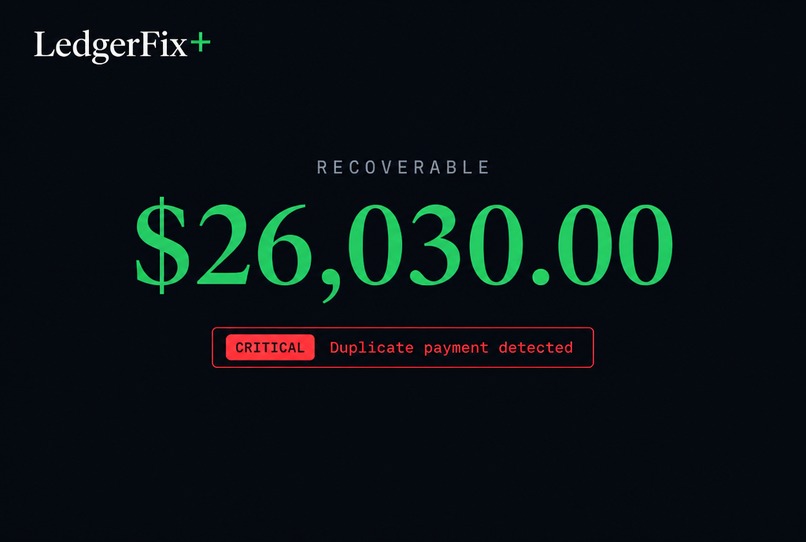
Image 2
The pitch
Claims practices, workers' comp administrators and legal billing teams close their books by hand every month. A line-by-line clerk catches the small stuff and misses the expensive one: the claim paid twice, the denial nobody re-billed, the variance that never got a corrected payment. In a business where one billing error is a penalty or an audit, that is a liability, not a bookkeeping nuisance.
LedgerFix is an agentic reconciliation copilot. Drop in a month of claims as CSV; it reconciles the ledger, ranks every exception by severity, hands back an auditable JSON report with a next-action queue a clerk can work without opening the source file, and reads the findings out loud in the owner's own cloned voice.
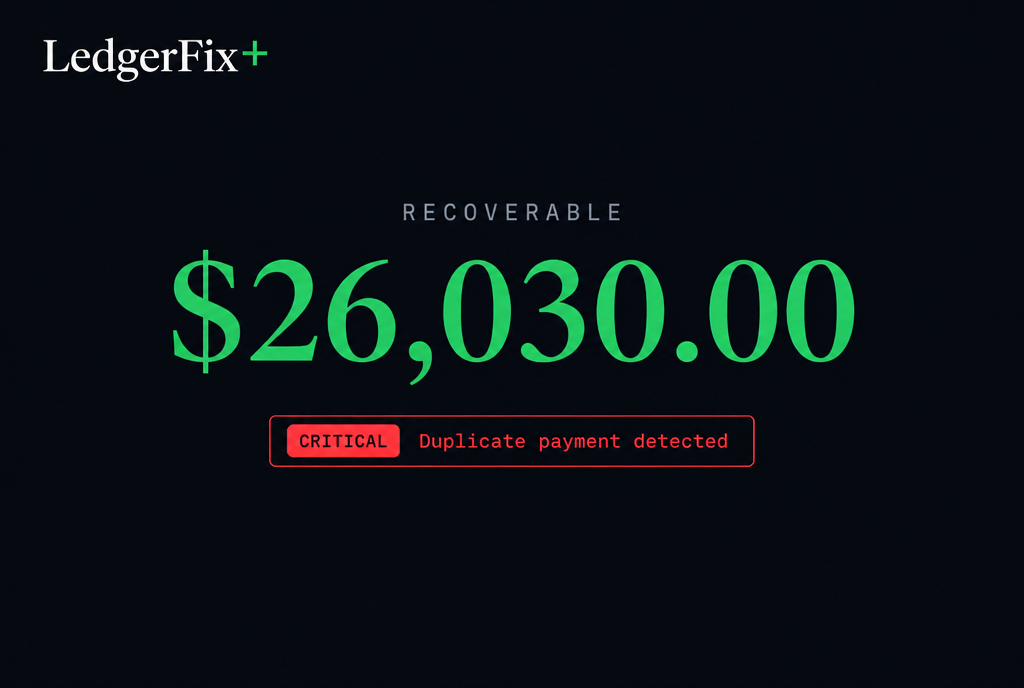
The math is deterministic: three plain rules, no LLM arithmetic, so every dollar traces to a ledger line. The agentic layer decides what matters, writes the plain-English finding and the specific next action, and briefs you through ElevenLabs. On the bundled sample month of 14 claims it finds 6 exceptions and $26,030 recoverable, led by an $18,400 duplicate a manual review had missed.
Accounting records the past. LedgerFix owns the close.
What it does
Upload a claims ledger (CSV). LedgerFix runs three reconciliation rules and returns a ranked exception report:
- DUPLICATE_PAY (CRITICAL): the same claimant, date of service and policy paid on more than one line
- PAID_VARIANCE (HIGH / MEDIUM / LOW): paid does not equal billed, over- or underpayment, ranked by gap
- DENIED_NO_REBILL (HIGH): a denied claim with $0 paid that was never re-billed
Each exception carries severity, type, claim ID, claimant, a plain-English finding, the amount, and the next action (void and reissue, appeal, recovery demand, corrected payment). The recoverable total counts a duplicate once, on its primary line.
Sample result: 14 claims scanned, 6 exceptions, $26,030.00 recoverable, CRITICAL #1 = the $18,400 Carmen Delgado duplicate (WC-1051 / WC-1052).
Agentic workflow and tool use
Mel was the build agent: it scaffolded the server, wrote and fixed the engine, report and voice layers, ran the test suite, and pushed to GitHub, with a human approving each command. Mel's MCP bridge exposes the reconcile and narrate tools to other agents.
ElevenLabs delivers the voice: the report is converted to speech-safe text (figures become words, symbols stripped) and synthesized with eleven_v3 on a cloned voice, streamed back to the browser. A pre-recorded narration ships as the offline fallback.
Verification and human oversight
Numbers come from rules, not a model. The report artifact is the audit trail: generated_at, source ledger, totals, exception summary and a per-exception finding with amount and next action. A test suite asserts the expected result on the sample ledger and runs before every deploy. The ElevenLabs key is supplied by the user at runtime, masked in the UI, held in memory for the session only and never stored server-side. Nothing is auto-executed against a real ledger; a human works the queue.
How we built it
Node 18+ on the built-in http module, zero dependencies. Deterministic engine (engine.js), report builder (report.js), narration layer (voice.js), single-screen dark UI. Deployed on Render from GitHub with auto-deploy on push, custom domain via Cloudflare. Built Sep 19 during the 12:30 PM to 6:00 PM window.
Challenges
The engine initially counted the duplicate's recoverable amount as $0 and the narration leaked raw $ symbols into speech; both were caught by the test suite mid-build and fixed. Git was not installed on the build laptop when the hackathon started.
What's next
CSV validation with row-level feedback, a settings drawer with key verification, and fee-schedule and late-filing rules for real claims practices.
Built With
- cloudflare
- elevenlabs
- javascript
- mel
- node.js
- render

Log in or sign up for Devpost to join the conversation.