
Inspiration
We had seen a variety of infinity mirror projects and thought we could adapt these ideas to make them more interactive. We wanted our project to be a fun device so we explored ways to elevate the experience of the infinity cube.
What it does
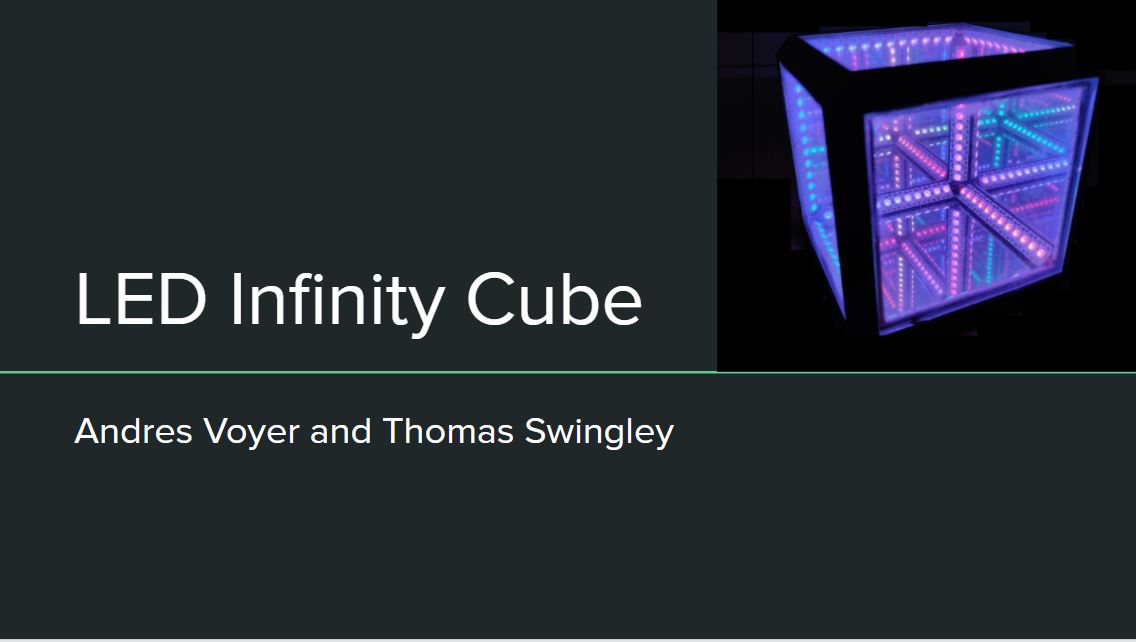
The Infinity Cube can be used as a desktop accessory, party centerpiece, or a fun toy to hold in your hand. The LEDs sync to the music waveforms being played to create an immersive experience. Via a mobile phone, you can visualize the music waveforms and control the LED patterns.
How we built it
The LED Infinity Cube is built from bars of aluminum along the edges of a cube as its structure. On the inside of those edges is a strip of 12V LEDs that wraps around each of the 12 edges of the cube. The 6 faces are made of acrylic with a mirror coating. When looking through a face, you can see the LED strips on each edges but you can also see the reflections of LEDs on other edges, as well as those reflections' reflections, and so on. This creates the illusion of the lights fading into the distance while still remaining in the cube. The end of the strip of LEDs that runs through the cube is connected to 12V, R, G, and B wires that connect to the NodeMCU, power, and the Arduino so they can be controlled.
Challenges we ran into
We ran into a few obstacles before arriving at our final design. The sound sensor turned out to be fairly finicky and responded to different music differently. For example, songs with strong beats or distinctive melodies were easier to detect compared to songs that didn't have as many sharp sounds for the sensor to pick up. On the manufacturing side, we initially wanted to 3D print the frame of the cube, however there were printer malfunctions that led us to use aluminum instead. Overall, we were able to solve these issues in our end product.
Accomplishments that we're proud of
Despite having many last minute challenges and changes, our final product was a success. We were able to include both the sound sensor and the NodeMCU components into our design and give our project multiple functions. We think the final product turned out very well and accomplished everything we wanted it to.
What we learned
We learned a lot about transistors and how to use them. We also learned about how to connect over the counter LED strips to the Arduino circuit. Understanding how to integrate different technologies and systems into your projects is a very important skill to have in electrical engineering and engineering in general.
What's next for LED Infinity Cube
If we were to create a Version2.0 of the LED Infinity Cube, we'd look into soldering the connection points of the LEDs together to create a cleaner lighting effect with straighter LED edges. Also, we would try to reprint the frame, including a stand for the cube to sit on.

Log in or sign up for Devpost to join the conversation.