-
-
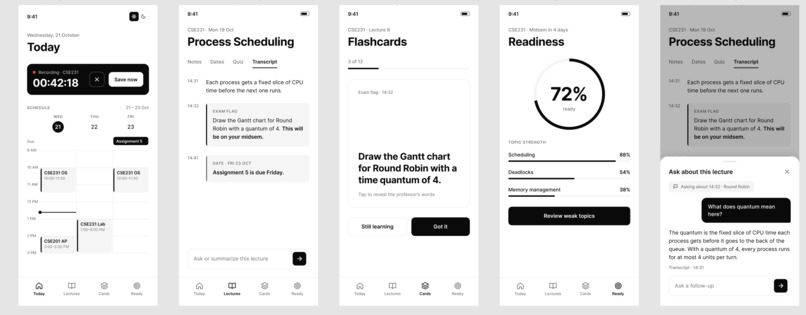
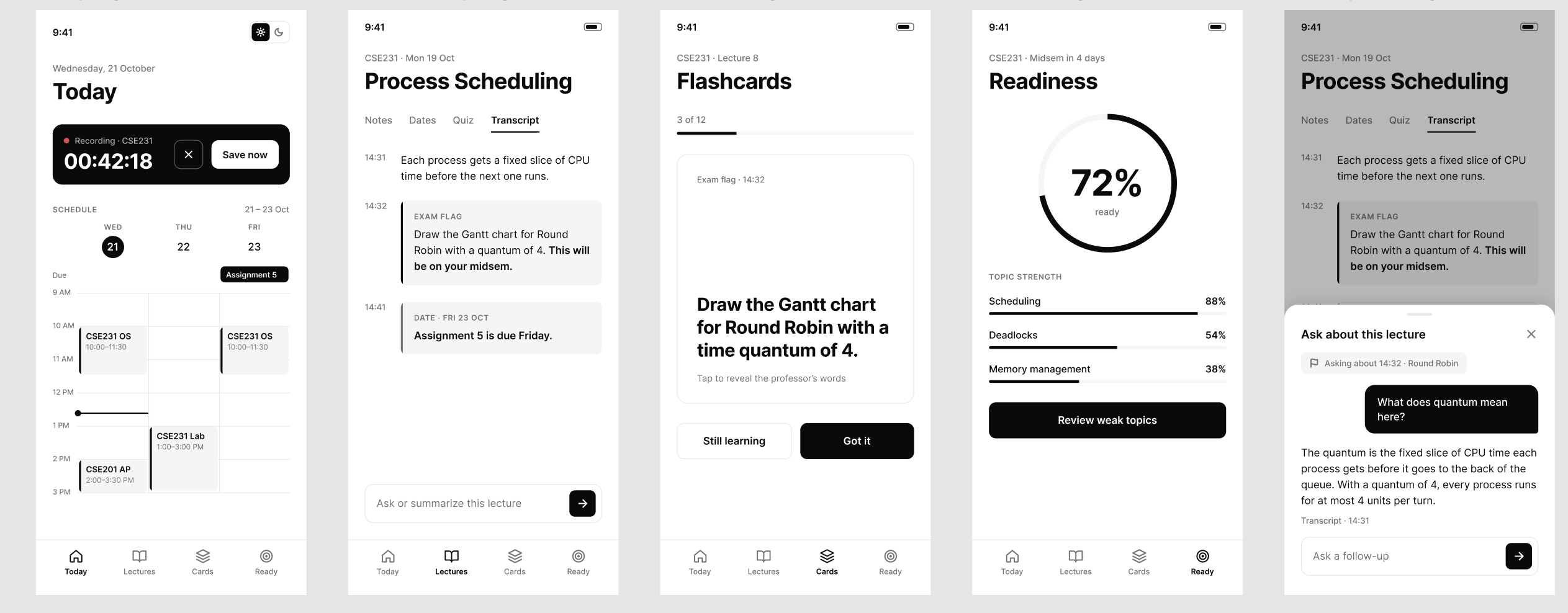
Light mode screens for lecture os
-
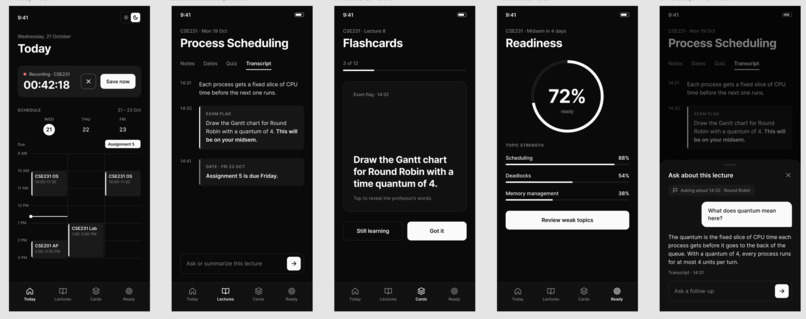
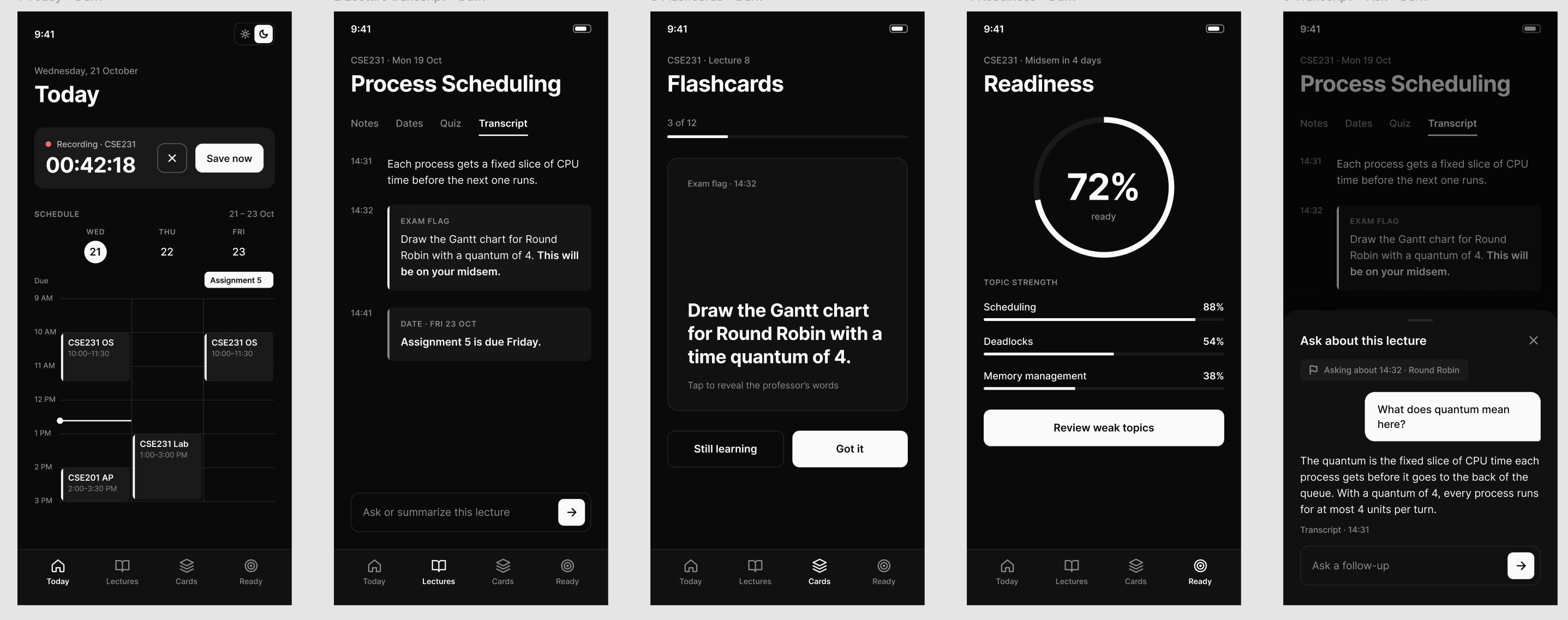
Dark mode screens for lecture os
Inspiration
The most important sentence in a lecture is often said only once: "this will be on your midsem", "the lab report is due Friday". Miss it and you find out the night before the exam. As students, we already wear a microphone on our wrist every day, so we asked: what if it caught those moments for us, and then helped us revise until we were actually ready?
What it does
Lecture OS turns Bee on the Apple Watch into a study companion.
- Live exam alerts on your wrist. While Bee records, Lecture OS reads the transcript as it streams in. When the professor flags something for the exam, a notification with the topic reaches your Watch within seconds.
- Deadlines caught automatically. "Class test on Monday" or "the lab report is due next Friday" becomes a dated entry, with a reminder on your phone and Watch the evening before.
- Notes the moment class ends. Tap Save to get a summary, revision notes, key terms and a multiple-choice quiz covering every concept from the transcript.
- Ask your lecture. Tap any moment in the transcript and ask about it. Answers are grounded in what the professor actually said.
- Flashcards and readiness. Flashcards are built from exam flags and key terms. A readiness score per course tells you how prepared you are and what to revise next.
So recording a lecture isn't enough: you're only "ready" once you've revised and tested yourself on it.
- "Lecture over?" After 30 seconds of silence your wrist asks whether class is done, so saving is one tap.
How we built it
- Bee integration: a Node.js + TypeScript backend uses the Bee Node client (
@beeai/cli):- the real-time stream reads utterances live,
- the Conversations API fetches finished transcripts,
- todos with alarms deliver notifications to the phone and Apple Watch,
- facts save exam topics back into Bee's memory.
- Detection: we built
lecture-cues, an open-source, zero-dependency TypeScript library that finds exam cues and deadlines in transcript lines. It resolves relative dates ("next Friday"), handles two dates in one sentence, and classifies events (exam, lab, submission, presentation). - AI layer: this is provider-agnostic. Notes, quizzes and answers come from Amazon Bedrock (Converse API, Amazon Nova Pro) or any OpenAI-compatible model. If the AI is unavailable, an offline engine writes notes from the transcript, so no lecture is ever left without notes.
- App: a mobile-first web app (HTML, CSS and JS, light and dark mode) built to our team's designs: Today, Lectures, Cards, Ready.
- Privacy first: everything runs locally on the student's laptop, and the Bee login and lecture data stay inside one project folder.
- Quality: 65 automated tests, including end-to-end runs of scripted lectures.
Challenges we ran into
- Bee never told us when a Watch recording ended. Conversations stayed
CAPTURINGfor minutes after stopping, and the stream sent no lifecycle event. We built our own end detection, with silence tracking, a "Lecture over?" nudge and Save now, and write notes from the live transcript instead of waiting. - Undocumented data shapes. We read the CLI package source to find the transcript JSON, and discovered that
spoken_atandstart_timeuse different clocks: every timestamp showed00:00until we switched fields. - AWS account verification. Our new account was still under review at the deadline, so every Bedrock call returned "Operation not allowed". Because the AI layer was provider-agnostic, with an automatic fallback, we kept building and validated our prompts with another model.
- Natural speech is messy. "This is important" usually refers to the previous sentence, and "next Monday" said on a Sunday is ambiguous. Every case like that got its own rule and test.
Accomplishments that we're proud of
- It works end to end on a real Apple Watch in a real lecture: the alert reaches the wrist within seconds, and notes arrive within a minute of saving.
- We released
lecture-cuesas a reusable open-source library for anyone building on lecture transcripts. - Nothing about a student's lectures leaves their laptop unless they choose an AI provider.
What we learned
- Real-time wearable data needs its own state machine. You can't assume "recording ended" will ever arrive.
- Designing for failure (offline fallback, retries, provider-agnostic AI) mattered more than prompt tuning.
- Fast rules for detection plus AI for understanding beat AI alone: rules run instantly and for free during class, and AI adds depth afterwards.
What's next for Lecture OS
- A native watchOS companion app, so students can see readiness, deadlines and flashcards on the wrist. The designs are done.
- AI notes and Ask via Amazon Bedrock once our account is verified.
- Spaced repetition for flashcards, and semester-wide exam prep across every course.
Built With
- amazon-bedrock
- amazon-nova
- amazon-web-services
- apple-watch
- bee
- css3
- figma
- github
- google-gemini
- html5
- javascript
- node.js
- stitch
- typescript

Log in or sign up for Devpost to join the conversation.