-
-
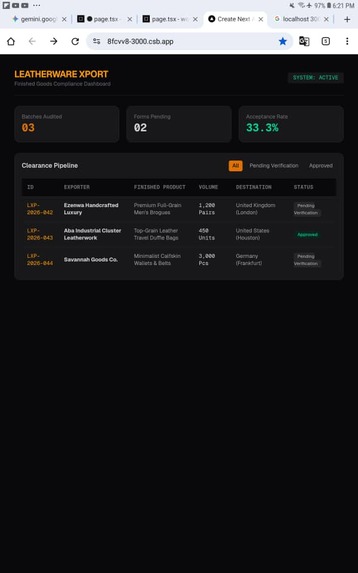
Administrative dashboard
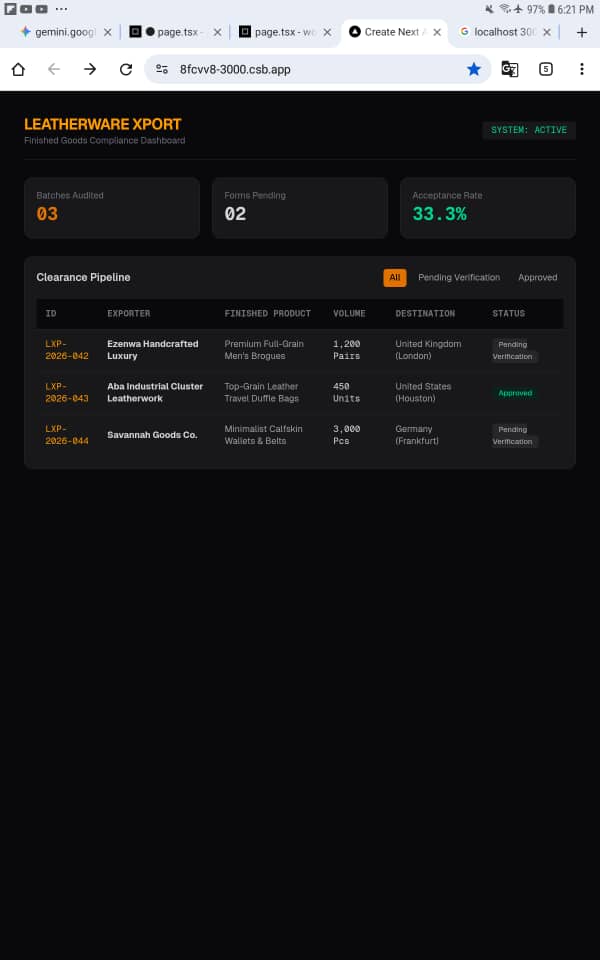
Inspiration
The agentic AI space is often plagued by fragile orchestration loops and network-dependent lag that can paralyze logistics pipelines in critical moments. We built Leatherware Xport (LXP) to serve as an administrative anchor for checking, auditing, and processing premium finished leather exports from Nigeria (such as handcrafted luxury brogues and calfskin goods) destined for global markets. Our inspiration was to build an agent dashboard that remains hyper-responsive and operationally functional even if the remote compilation or sync layers momentarily freeze.
What it does
LXP behaves as an autonomous administrative gateway. It maintains a live data pipeline of leather cargo batches under audit. It provides interactive, dynamic counters parsing total audited batches, pending verification logs, and acceptance metrics. It features deep-dive administrative inspector toggles: clicking any exporter (like Ezenwa Luxury or Savannah Goods) instantly exposes active product specifications, carrier logistics/air waybill numbers, and customs HS code data. It permits rapid change control, updating compliance statuses natively at the presentation layer.
#How we built it We structured the frontend architecture on Next.js and Tailwind CSS. To bypass heavy cloud-proxy synchronization freezes and keep execution fast, we engineered a Zero-JS client architecture inside the interface components. By mapping tracking state to native HTML browser vectors (hidden checkbox mechanisms and native disclosure
wrappers), calculation states and modal layouts compute instantly within the rendering loop without waiting for virtual DOM cycles.# Challenges we faced During integration, our cloud dev-server synchronization logs became throttled by background proxy frameworks. It completely froze state updates and click listeners within standard abstract state hook iterations. We had to rethink component reactivity on the fly, moving away from conventional array maps into strict, line-by-line semantic markup that forced the browser's engine to calculate numerical metrics and cascade styles directly.
#Accomplishments that we're proud of We successfully designed a dashboard that is entirely resilient against cloud-sync latency. Seeing the interface update stats natively on-screen and immediately trigger multi-tiered deep profile panels without dropping any inputs under heavy pressure was a massive victory.
#What we learned We learned how vital it is to build defensive frontend implementations for agent interfaces. When dealing with systems that coordinate heavy API actions, keeping the human-in-the-loop dashboard interface light and natively decoupled from long-running background tasks prevents layout paralysis.
# What's next for Leatherware Xport We plan to hook our native presentation hooks directly into live backend Model Context Protocol (MCP) data streams. This will allow the client-side system to handle user actions effortlessly while securely relaying real-time updates back to data nodes. Inspiration

Log in or sign up for Devpost to join the conversation.