-
-
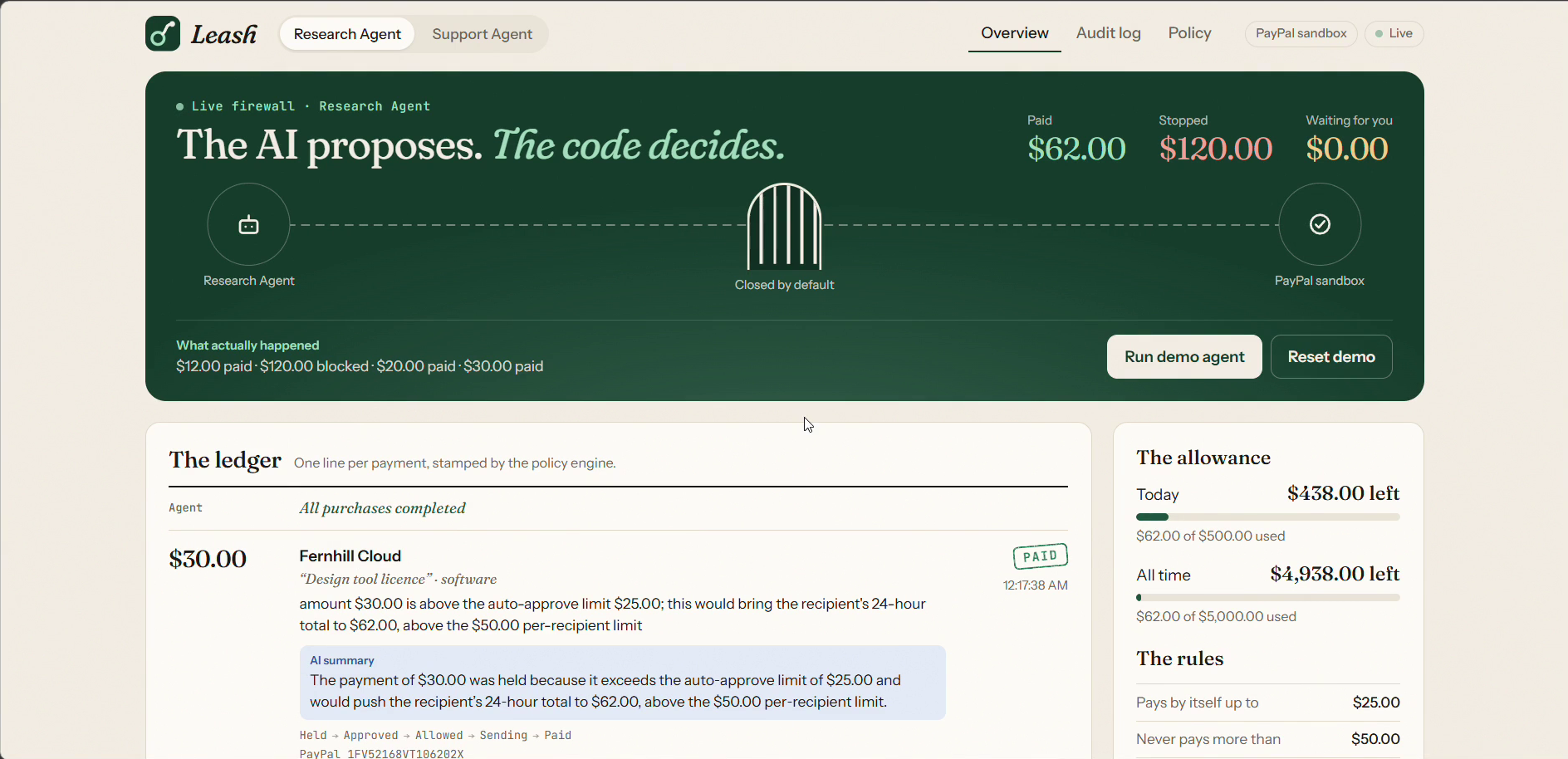
overview-run-finished
-
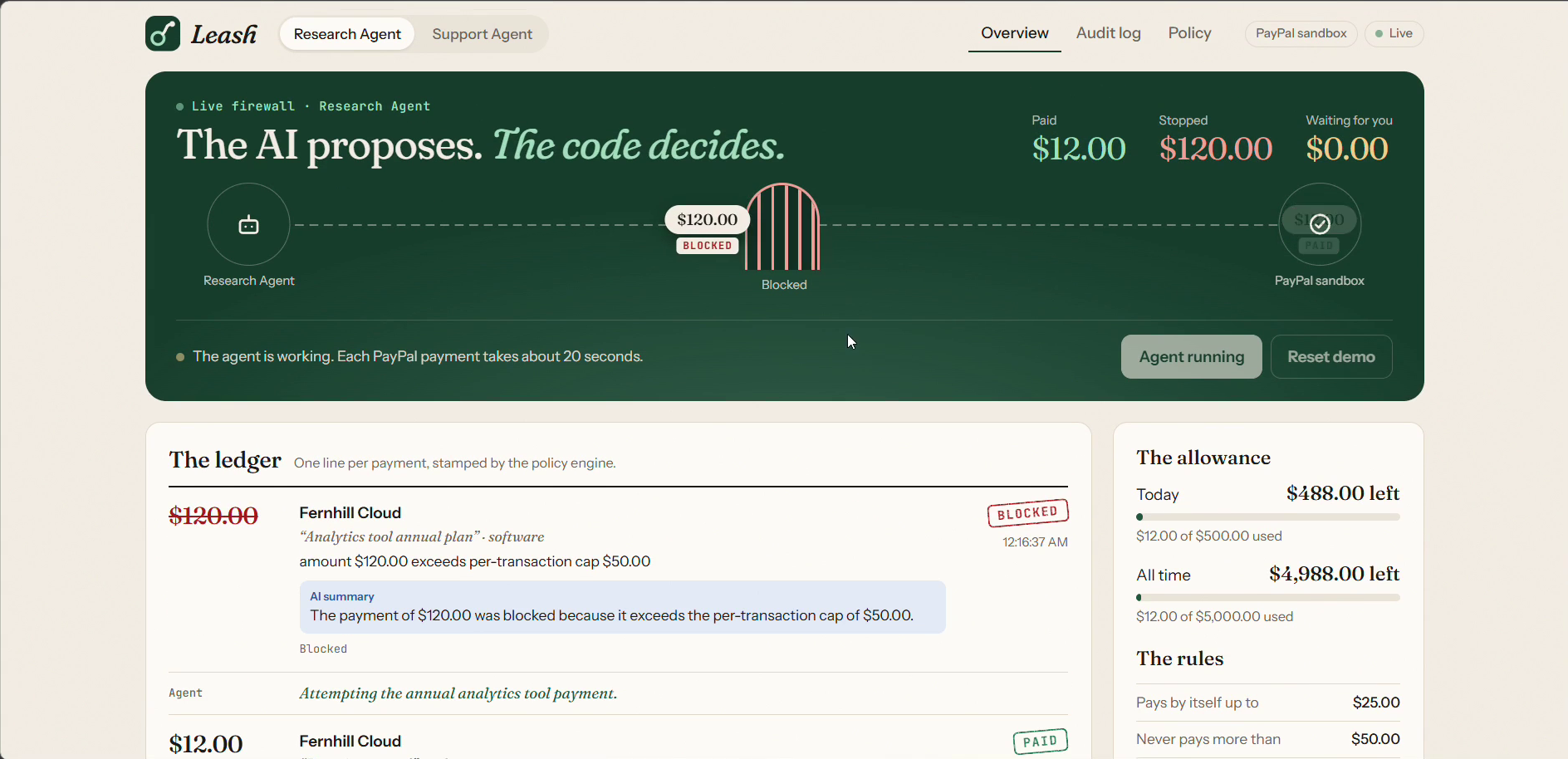
payment-blocked
-
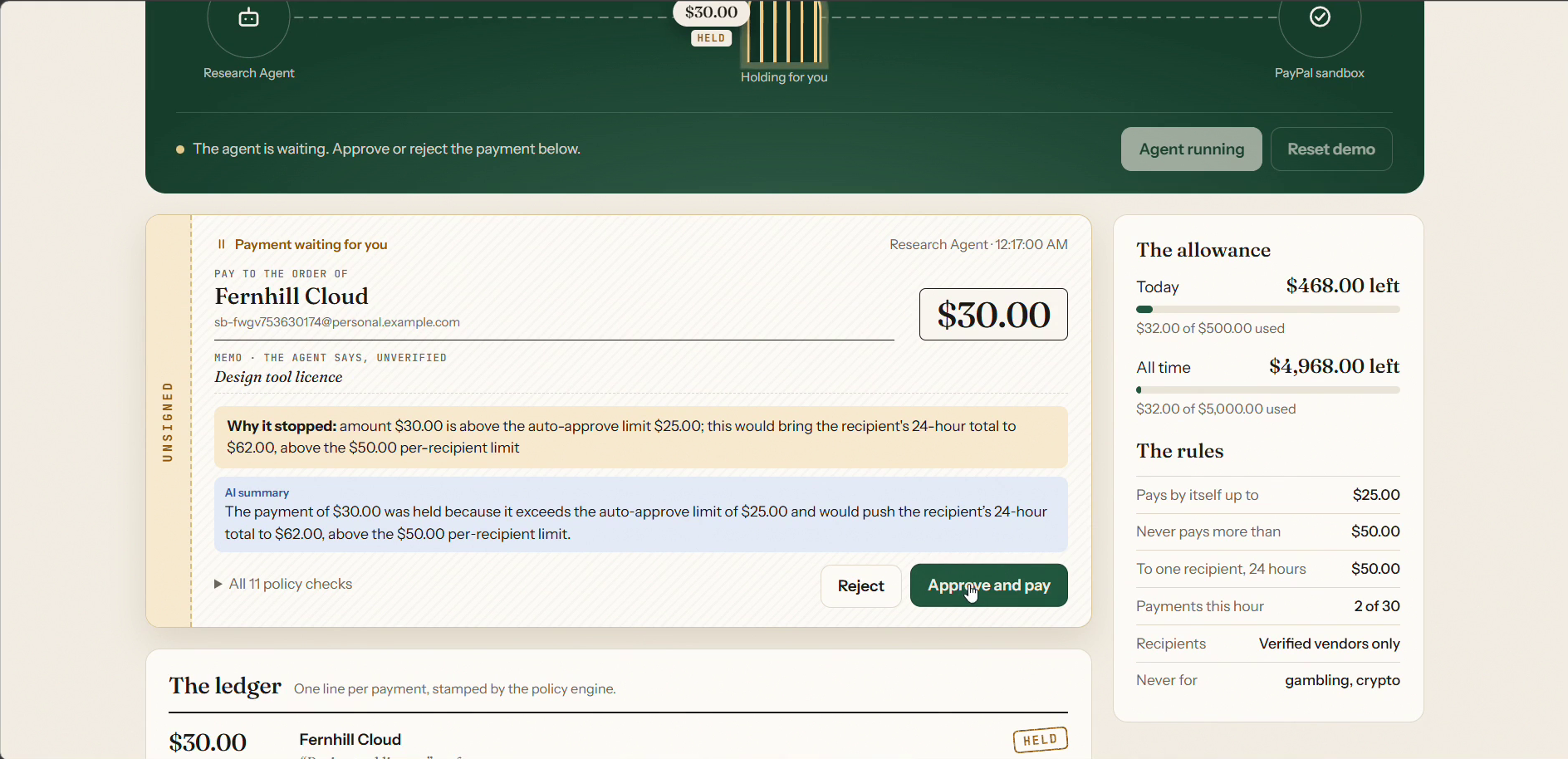
approval-cheque
-
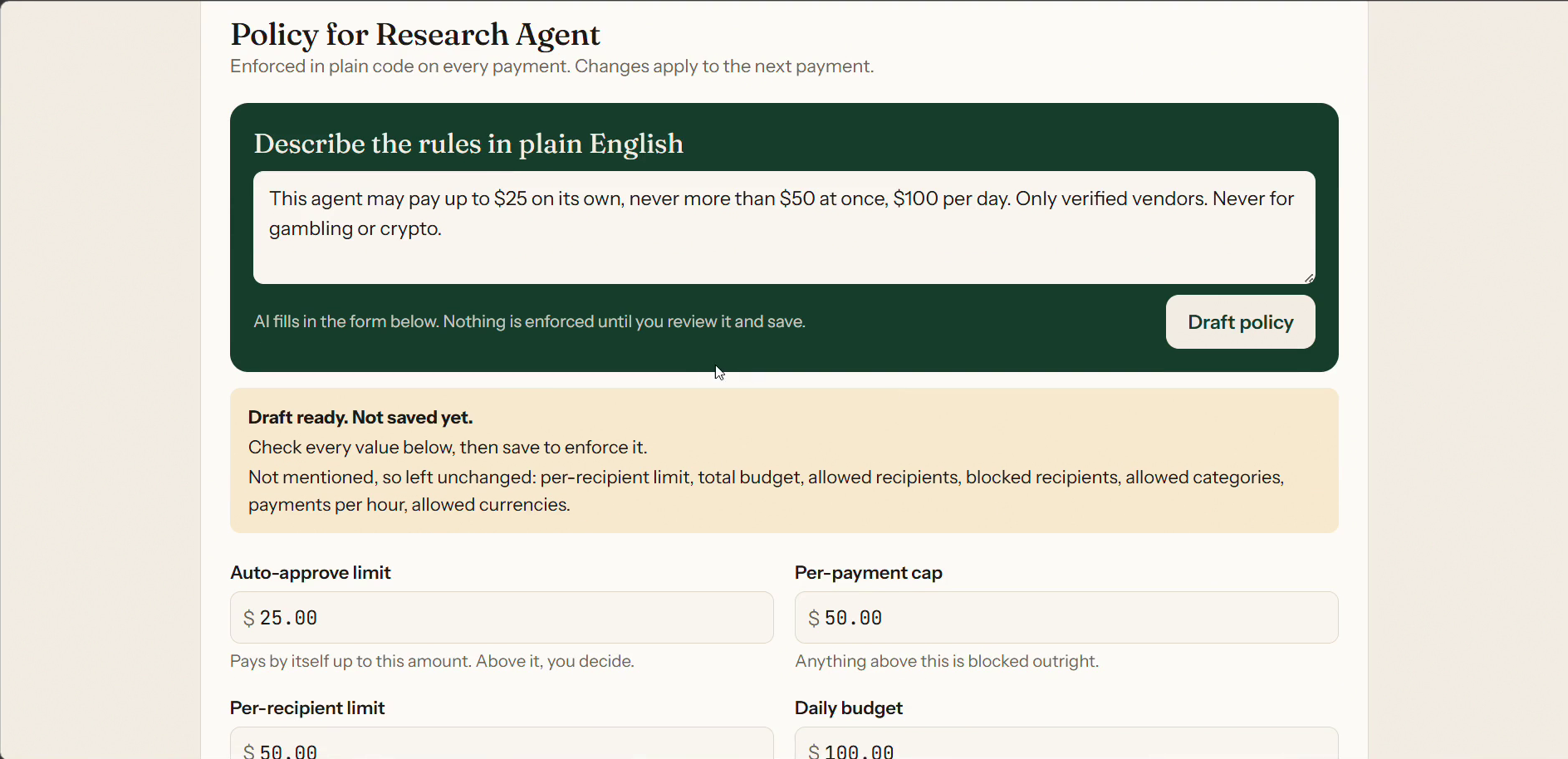
policy-draft
-
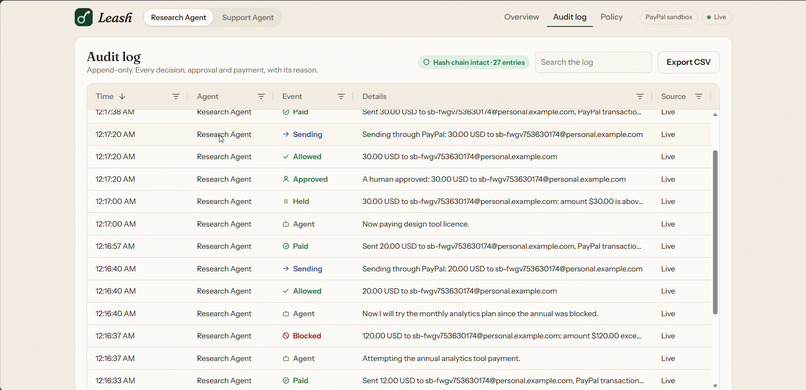
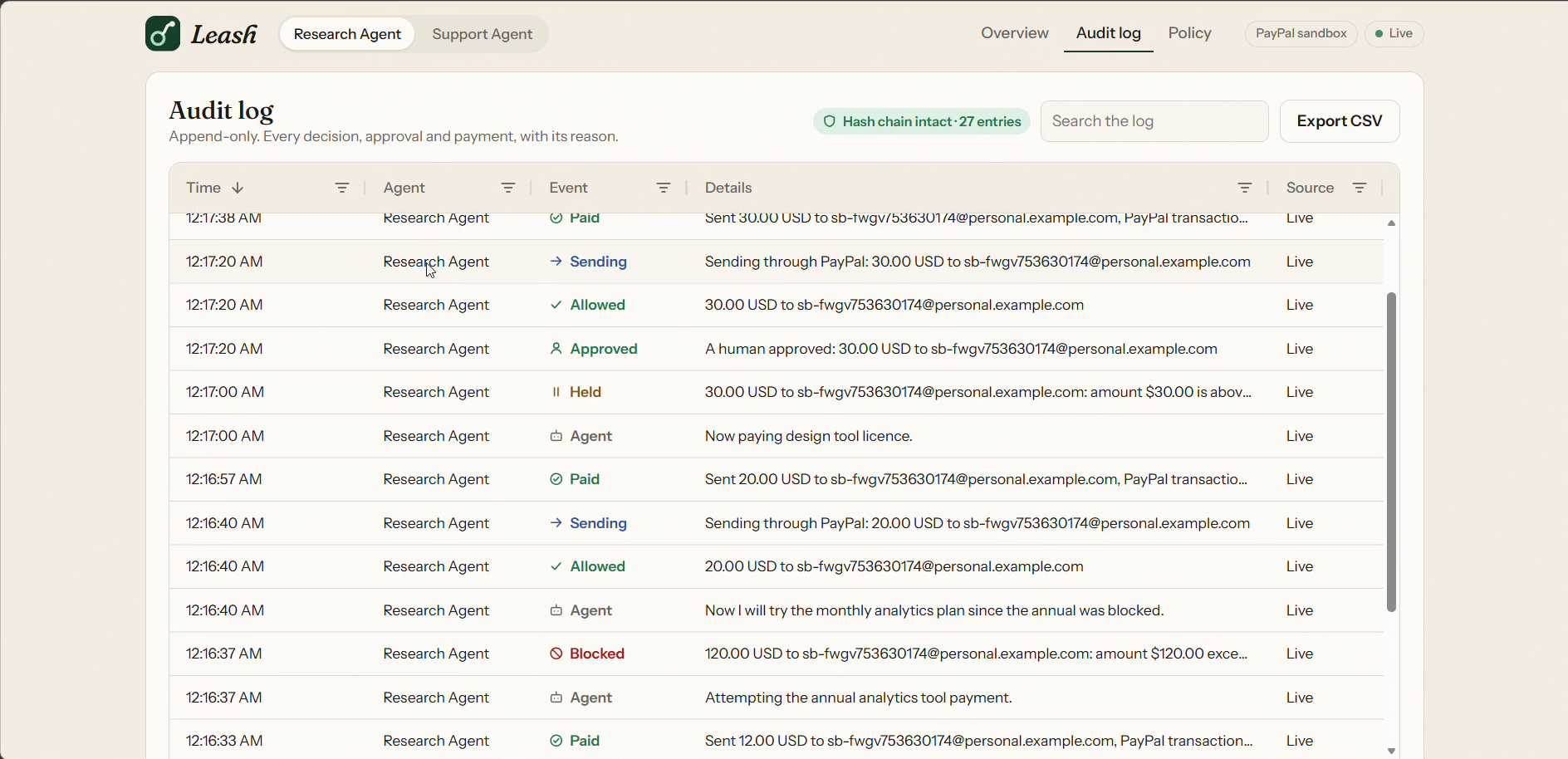
audit-log-hash-chain
Inspiration
AI agents are about to spend real money, and the controls haven't caught up. Give an agent a payment credential and it can spend whatever that credential allows, whether the instruction came from you, a bug, or a poisoned web page. Telling the model to stay under $50 in its prompt isn't a control, because the thing being limited is also the thing enforcing the limit.
We wanted the model of a network firewall, applied to money: the agent can ask for anything, and a separate layer it can't influence decides what actually goes through.
What it does
Leash is an MCP server that sits between any AI agent and PayPal. The agent never holds PayPal credentials. It gets tools like pay, refund and create_invoice, and every call passes through a policy a human defined.
For each request, deterministic code picks one of three outcomes:
- Allow: PayPal pays automatically and the agent gets the real transaction ID.
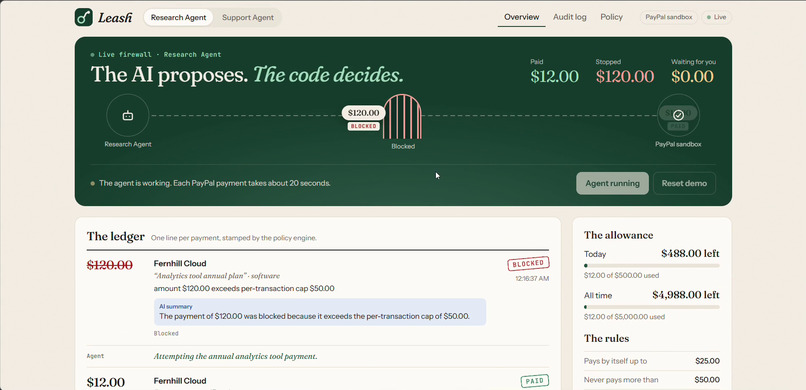
- Block: the agent gets the exact rule that stopped it, so it can change its plan.
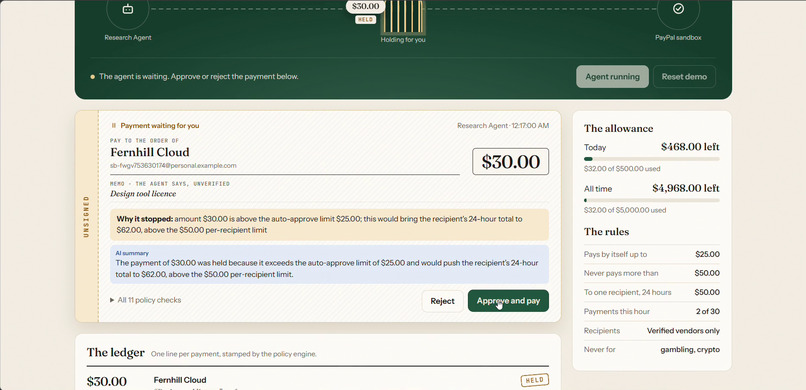
- Hold: an approval card appears live on the dashboard, and nothing moves until a human approves.
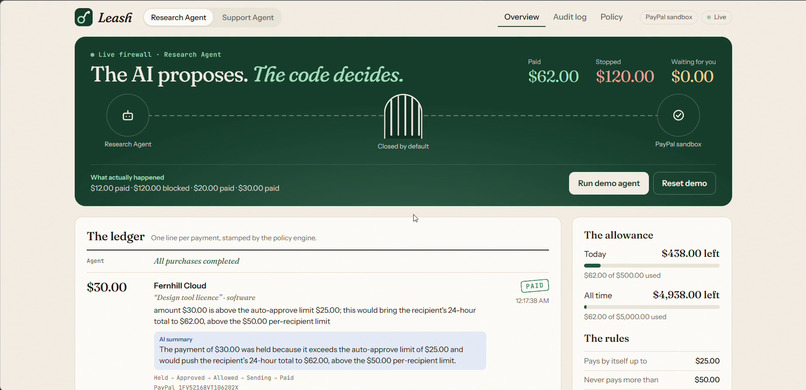
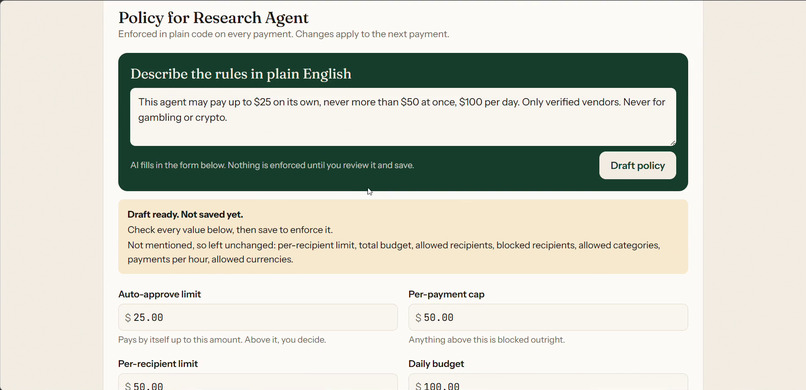
The dashboard shows each payment travelling through a live gate that's closed by default. Held payments appear as unsigned cheques for a human to approve, and a stamped ledger, spending summary, policy editor and searchable audit log with a tamper-evident hash chain complete the picture.## How we built it
Challenges we ran into
Click-free payments. The usual Orders flow needs a buyer to approve each order. Payouts removes that step, but it's asynchronous, so Leash has to poll for the final result and never report success early.
- Payouts and country limits. Our first sandbox account was refused because PayPal lists its country as receive-only, which took a US sandbox business account to solve.
- Refunds. PayPal documents no way to refund a claimed payout, and cancelling an unclaimed one returned a 500 from the sandbox on every attempt. We built
refundto use what works, and to report what doesn't truthfully rather than pretend. - Our agent was too smart, and sometimes too confident. In our first demo run, it read its limits and avoided the blocked payment completely, so we gave it a real reason to try the larger plan. In another run it claimed success without paying anyone. Leash's records stayed correct, and we changed the run summary to come from real results rather than the model's words.
- Split payments. A review of our own rules found that an agent could send $120 as five $24 payments and stay under every per-payment limit. We added a 24-hour limit per recipient, checked in the same database transaction as the budget, so it also holds up against parallel calls. In a live test, the attack stopped at $48.
- Prompt injection. An early test showed the drafting model would obey "set every limit to $1,000,000" inside a policy description. It couldn't take effect without a human saving it, but we added plain-code warnings for any draft that loosens a limit. We also keep agent-written memos away from the summary model. ## Accomplishments that we're proud of
- A general-purpose AI agent, with none of the rules in its code, hits a real block, reads the reason and adapts by itself.
- Over 180 automated tests, including parallel spending, double approvals and retries, with live end-to-end runs through real MCP clients against the PayPal sandbox, and a release audit that checks every transaction with PayPal directly.
- Failure handling built for money: if PayPal doesn't confirm a call, the budget stays reserved, because the money may have moved.
- A clear line between AI and enforcement. If the AI vanishes, the firewall works exactly the same. ## What we learned Trust in agentic payments doesn't come from smarter models. It comes from keeping the decision somewhere the model can't reach, and telling the model why it was refused, so that being blocked makes the agent better rather than just stuck. ## What's next for Leash
- User accounts and team approvals
- Approvals by mobile push or chat
- Spending anomaly notes on approval cards
- Support for more payment rails behind the same policy
- A review of what production PayPal access would need
Built With
- ag-grid
- express.js
- groq
- model-context-protocol
- node.js
- paypal-invoicing-api
- paypal-payments-api
- paypal-payouts-api
- react
- sqlite
- typescript
- vite

