Inspiration
Personalized education has always been a privilege of the few. As a student, I was frustrated seeing how my classmates and I learned at different paces, yet the traditional educational system treated us all the same. I wanted to create a tool that would democratize adaptive learning, where every person could have an intelligent personal tutor that adapts to their unique style and needs.
What it does
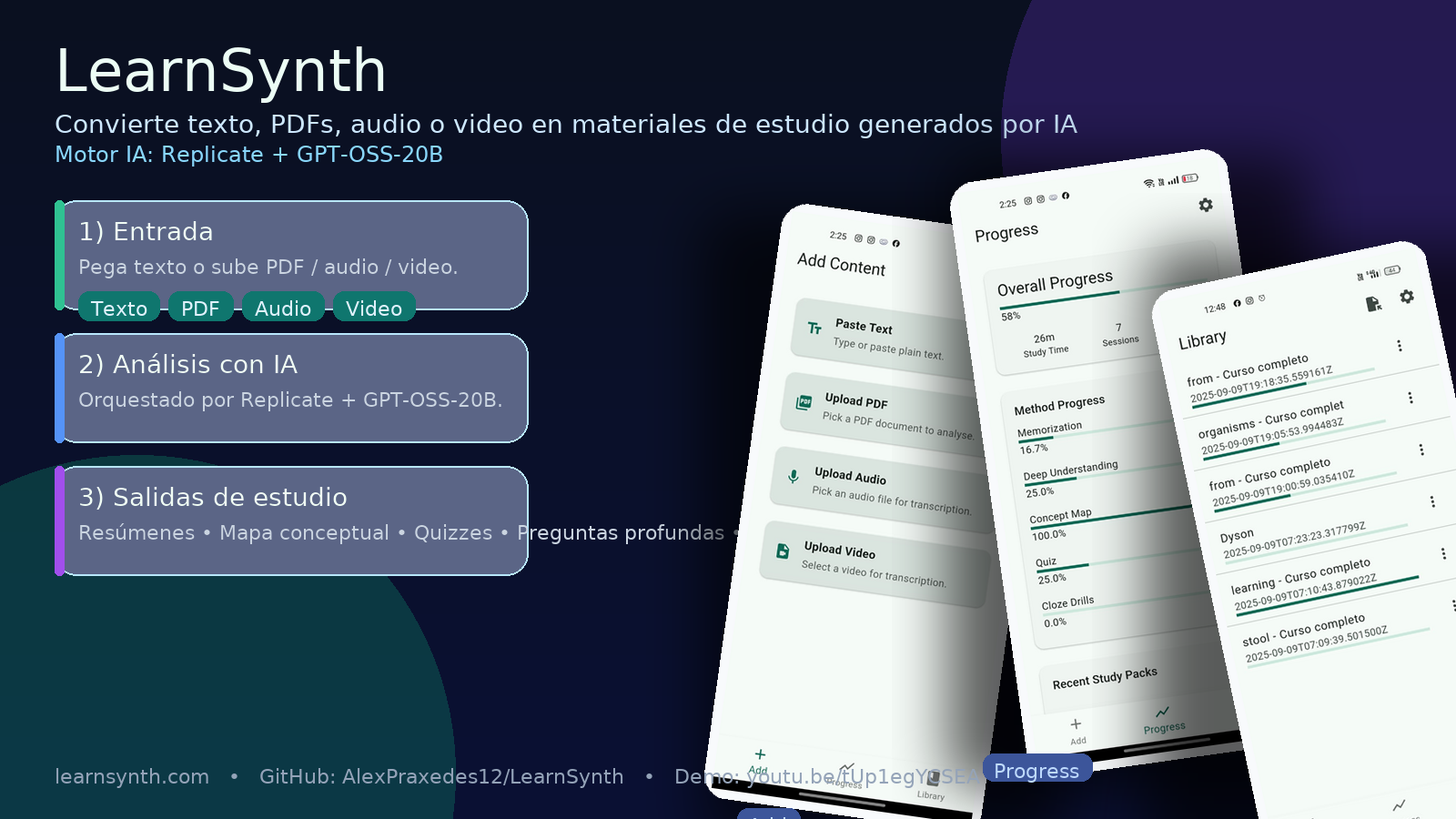
LearnSynth transforms any educational content (PDFs, videos, audio, text) into personalized learning experiences. It uses AI to:
- Extract and process information from multiple formats
- Generate adaptive study materials
- Create personalized quizzes and exercises
- Provide explanations at different complexity levels
- Offer intelligent real-time feedback
How we built it
I developed LearnSynth with a modular architecture:
- Backend: Python with FastAPI for robust and scalable APIs
- Mobile frontend: Flutter/Dart for native cross-platform experience
- Web prototype: React/Next.js for rapid demonstrations
- Integrated AI: OpenAI APIs (GPT, Whisper), Anthropic, and support for local models
- Processing: PyMuPDF for PDFs, OCR with pytesseract, voice synthesis with gTTS
- Deployment: Docker to facilitate implementation in any environment
Challenges we ran into
- Multimodal integration: Seamlessly combining text, audio, and video was complex
- Performance optimization: Processing large documents without affecting user experience
- Effective personalization: Creating algorithms that truly adapt to individual learning styles
- Compatibility: Ensuring it works with different AI providers and file formats
Accomplishments that we're proud of
- Created a truly multimodal platform that processes any type of content
- Implemented a flexible system that works with both local models and cloud services
- Developed an intuitive interface that makes AI accessible to any student
- The project can positively impact the education of thousands of people
What we learned
- The importance of modular architecture for complex AI projects
- How to integrate multiple APIs efficiently and robustly
- Advanced document processing and OCR techniques
- The crucial difference between superficial personalization and truly intelligent adaptation
What's next for LearnSynth
- Learning pattern analysis: Implement machine learning to improve recommendations
- Social collaboration: Allow students to share and discover content
- Institutional integration: APIs for LMS and existing educational platforms
- Enhanced accessibility: Support for students with special needs
- Global expansion: Multi-language support and cultural adaptation

Log in or sign up for Devpost to join the conversation.