-
-
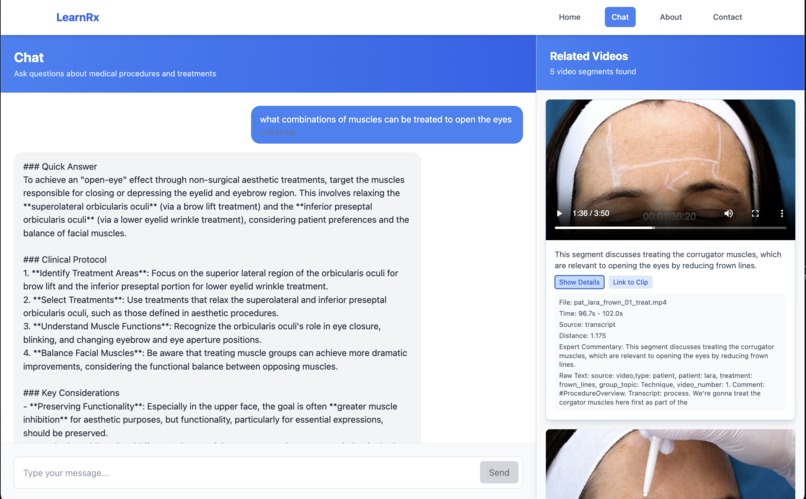
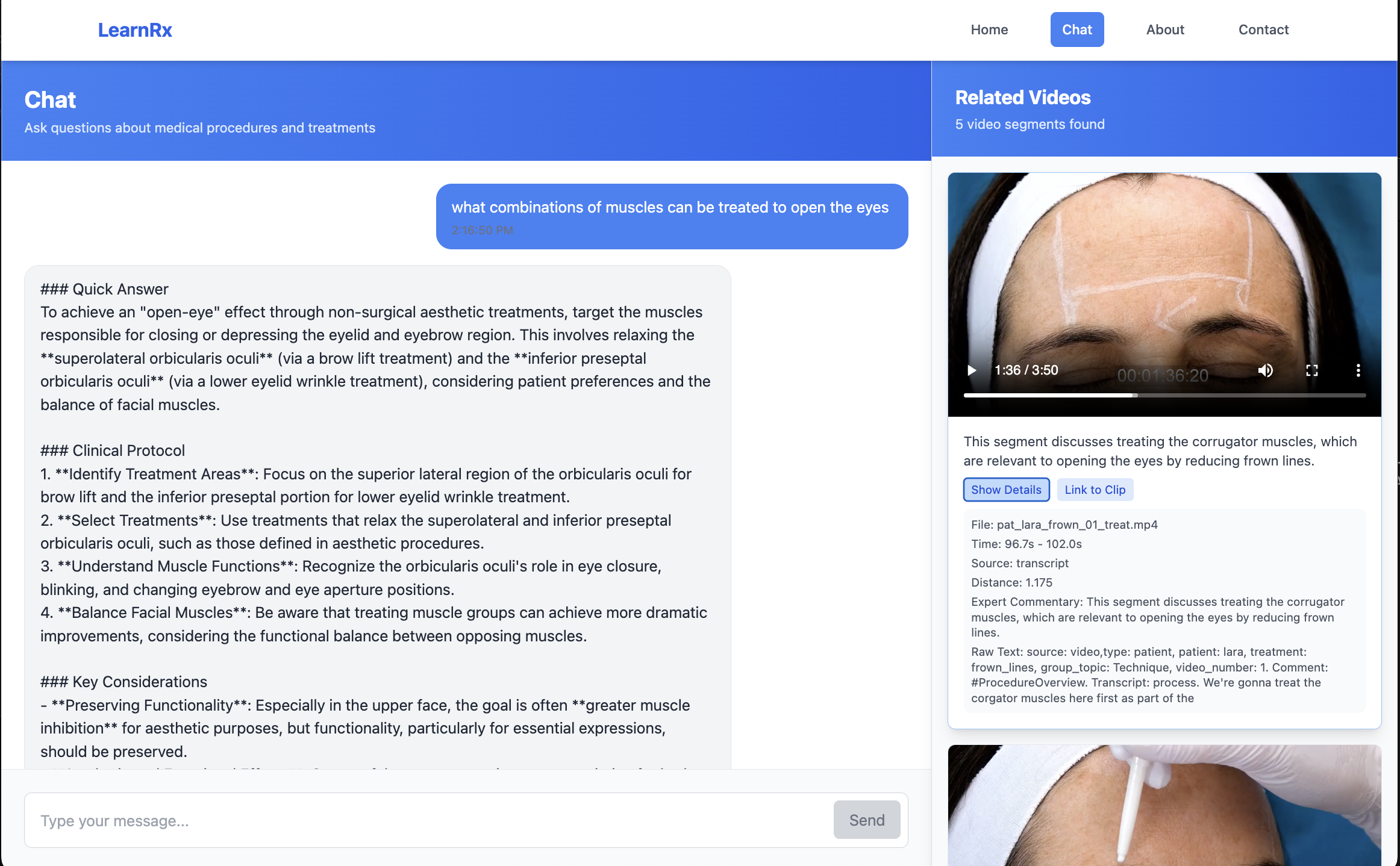
Q&A Learner Module Interface with Dr. Small's content
Inspiration
Dr. Small, our pilot educator ( https://www.amazon.com/stores/Rebecca-Small-MD-FAAFP/author/B00J2LDTRO ), brings deep domain expertise and a clear pain point. Since 2019, she’s been trying to turn her decades of teaching into a scalable education business — she’s tried Kajabi, hired a dev team to build a custom platform, and is now close to launch five botulinum toxin modules via SquareSpace. She has everything needed to succeed — global recognition, a full library of video and slide content, patient releases, and copyrights to her book content— but lacks the right tools. Our platform is purpose-built to solve that.
What it does
We’re building an AI-powered clinical education platform that works like Perplexity for students and Kajabi + Spotify for educators — all built for medicine.
For students, it’s a conversational AI mentor that answers clinical questions using trusted, multimodal content — like text, video, diagrams, and slides — all with citations down to the paragraph, timestamp, or slide. Think of it as the future of medical search and tutoring in one tool.
For educators, it’s a plug-and-play publishing and monetization platform: they can upload knowledge (videos, slides, lectures, text), and earn revenue when their content is reused or referenced — like a clinical “Spotify.” They can also build entire courses, with assessments and certification tools, without needing to code, market, or hire a tech team.
Here’s what makes it unique:
Our platform treats expert content like Lego blocks — reusable, remixable, and monetized. One expert might contribute anatomy diagrams. Another might upload a live injection demo. A third might bundle those into a Botox course. All contributors get automatically credited and paid when their content is used. Academics call it "combinatorial innovation - creating greater economic value by recombining existing components into something new that is worth more than the sum of its parts.
We’re combining trusted clinical knowledge, AI-powered delivery, and a new way to reward collaboration and reuse, making learning faster and teaching more sustainable.
How we built it
We've built it on FastAPI, Qdrant, FAISS, LlamaIndex, Llama, Groq, Langgraph.
We built an initial version at the very first Ragathon with a different stack. We then iterated on the concept with Dr. Small (our first customer and co-founder). What we have now is a much more technologically capable system ready for test cases.
Challenges we ran into
Basically controlling output, ensuring quality, creating adequate knowledge hierarchies in clinical knowledge delivery while making it adaptable and future proof.
Accomplishments that we're proud of
In blind A/B tests against mainstream LLMs we consistently outperformed in clinical knowledge questions (should be a layup for this system admittedly) and we've created a unique system for managing knowledge that is at the cutting edge.
What we learned
We've learned a lot about knowledge layers for LLMs. How to control and test output in high stakes scenarios like medical.
What's next for LearnRx
We're raising money and launching a private beta with 12 health care providers. We're talking with another educator in a different specialty to bring them on as a second client.
In the next week we will be approaching pre-seed investors.
Built With
- arize
- faiss
- fastapi
- groq
- langgraph
- openai
- qdrant
- react
- typescript


Log in or sign up for Devpost to join the conversation.