-
-
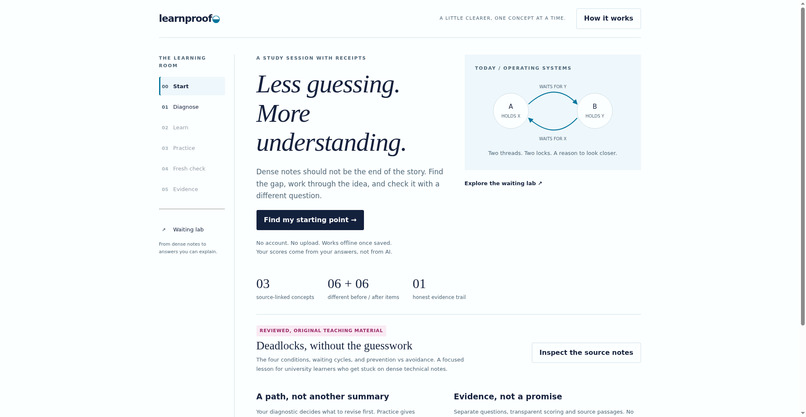
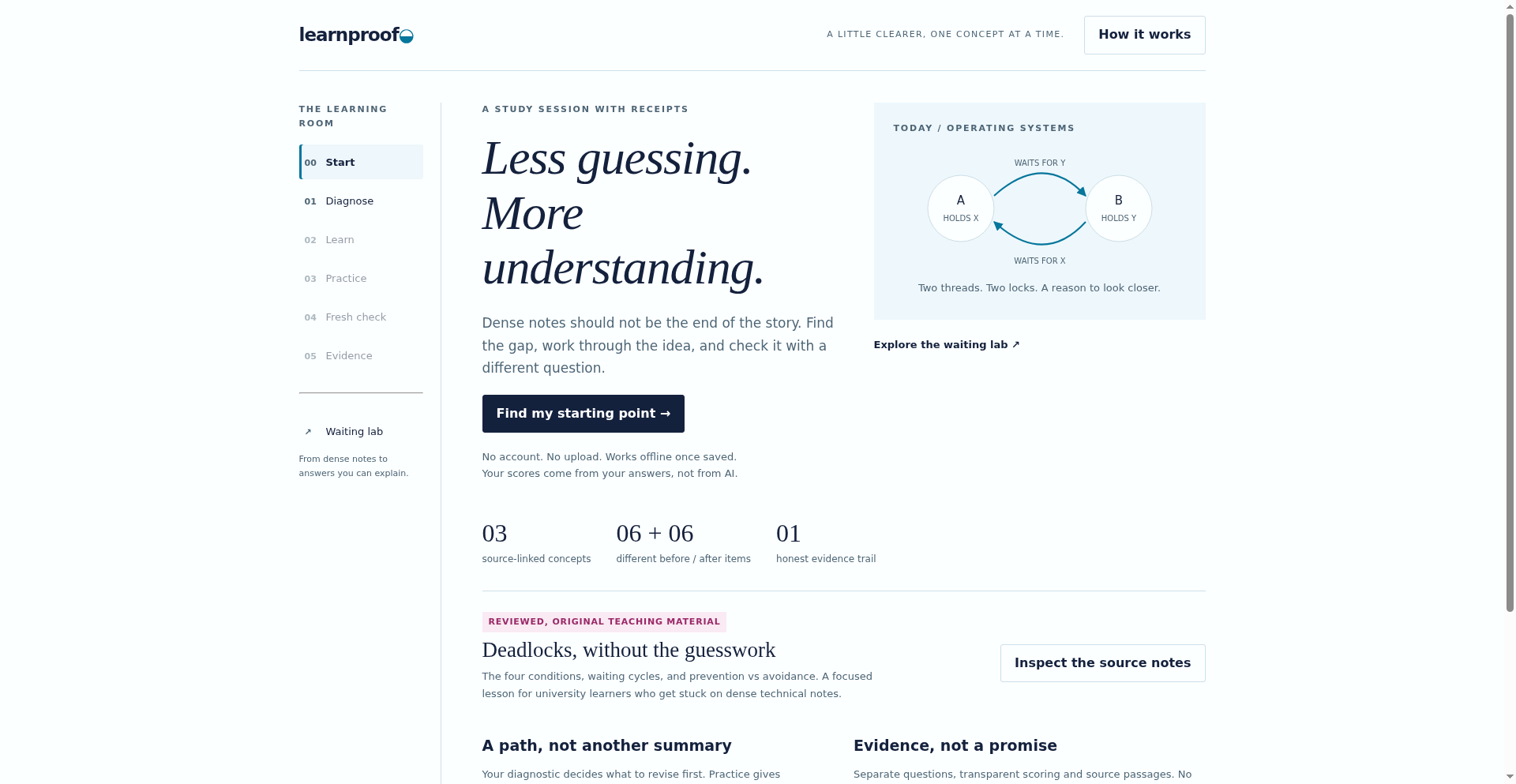
The deployed, account-free room: source-linked revision, waiting lab, fresh checks and portable answer evidence.
-
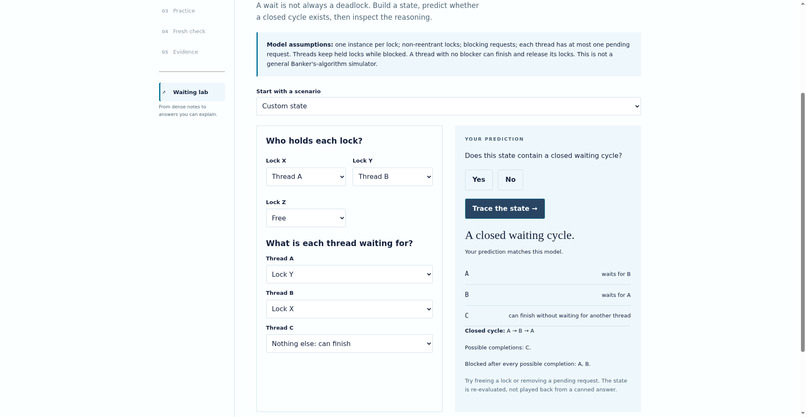
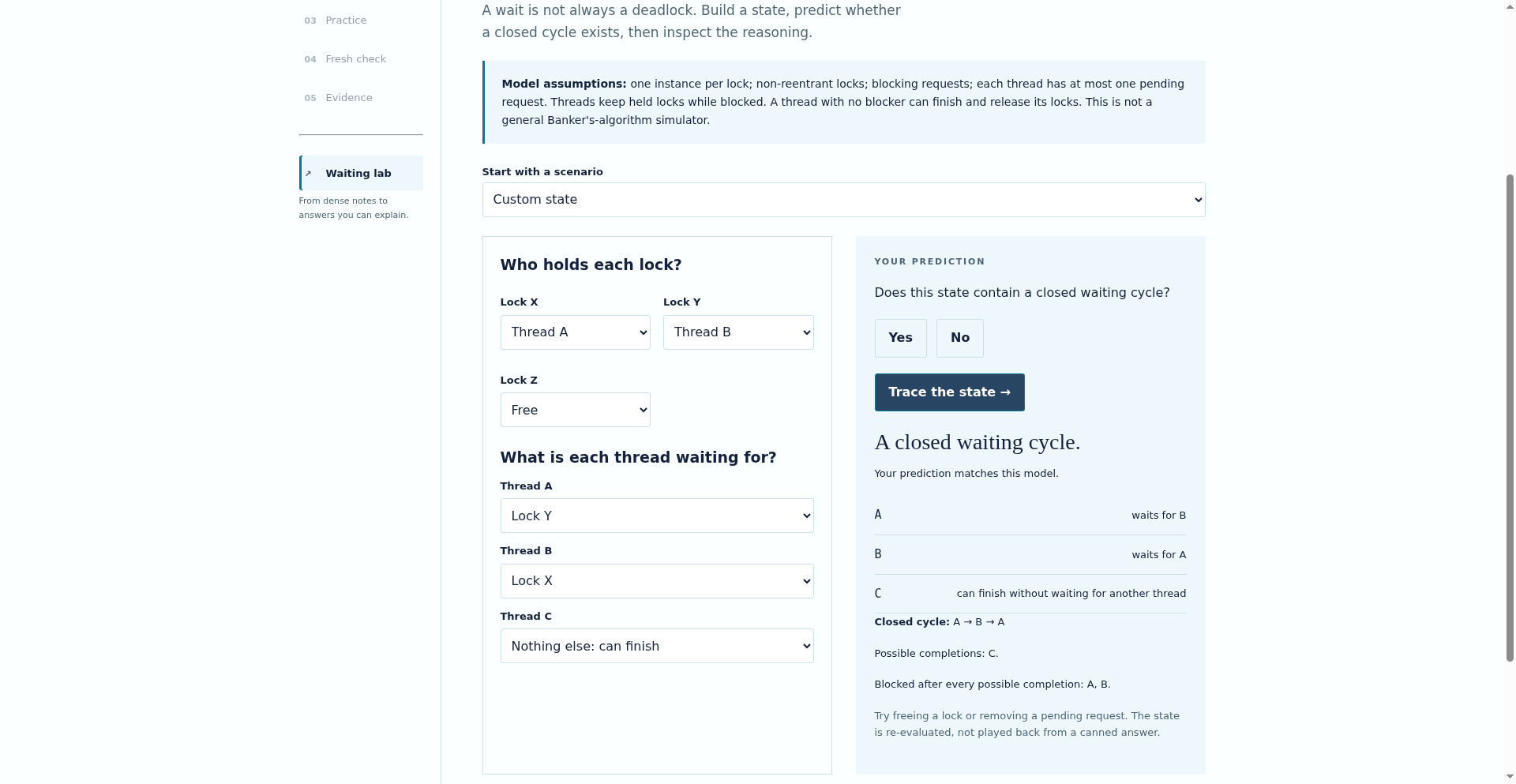
Live waiting lab: predict, edit the lock owners/requests, then inspect the computed blocker trace. Actual deployed UI.
-
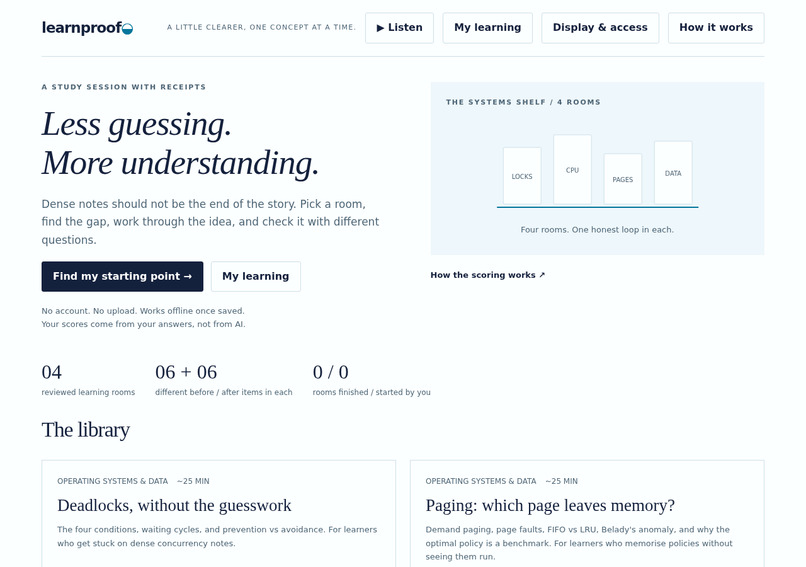
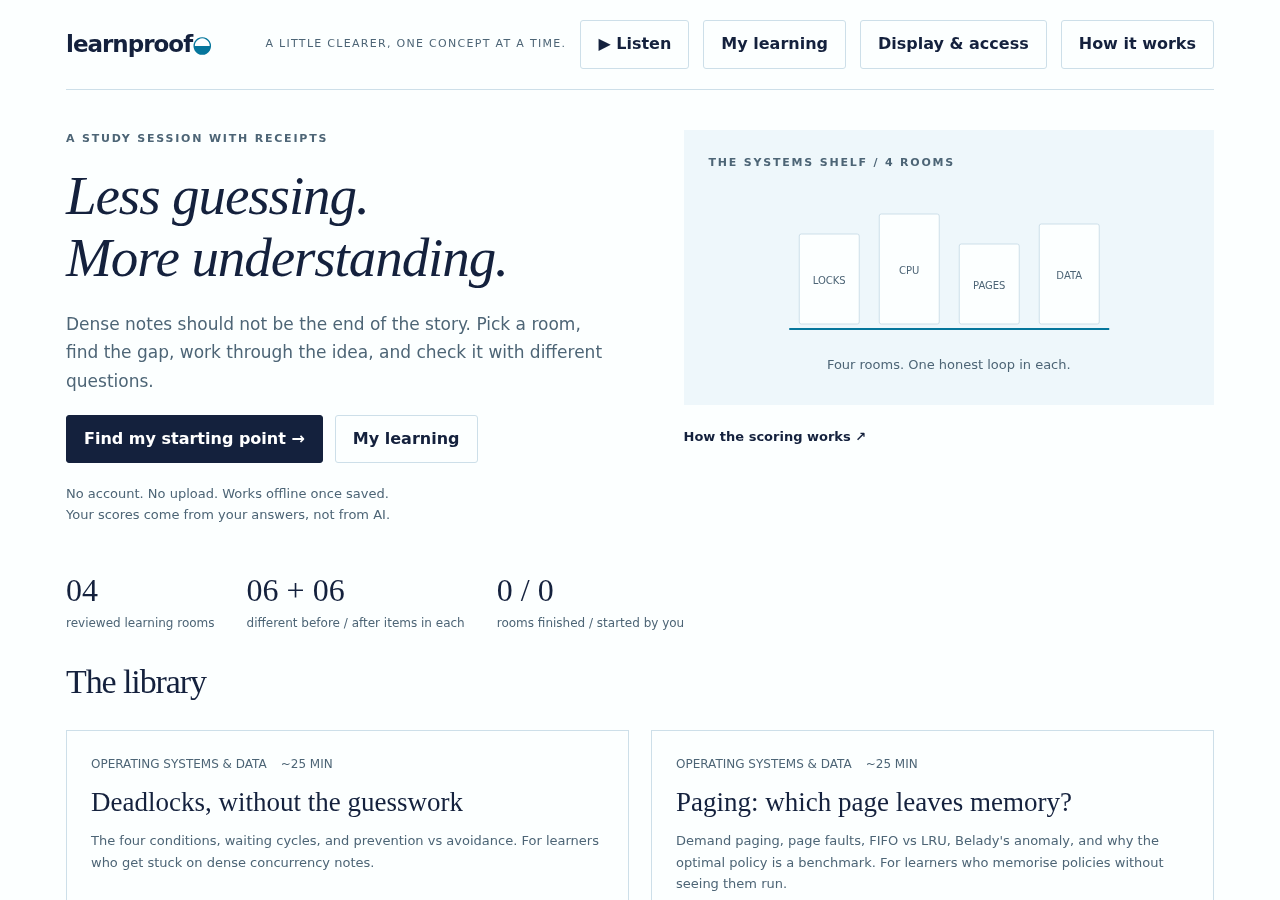
New v3 library: four complete learning rooms - deadlocks, CPU scheduling, paging and transactions. Actual deployed UI.
-
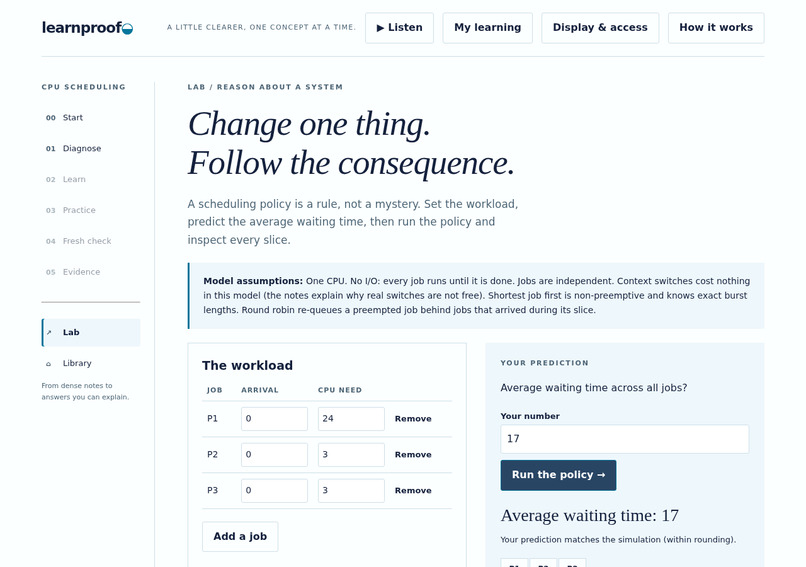
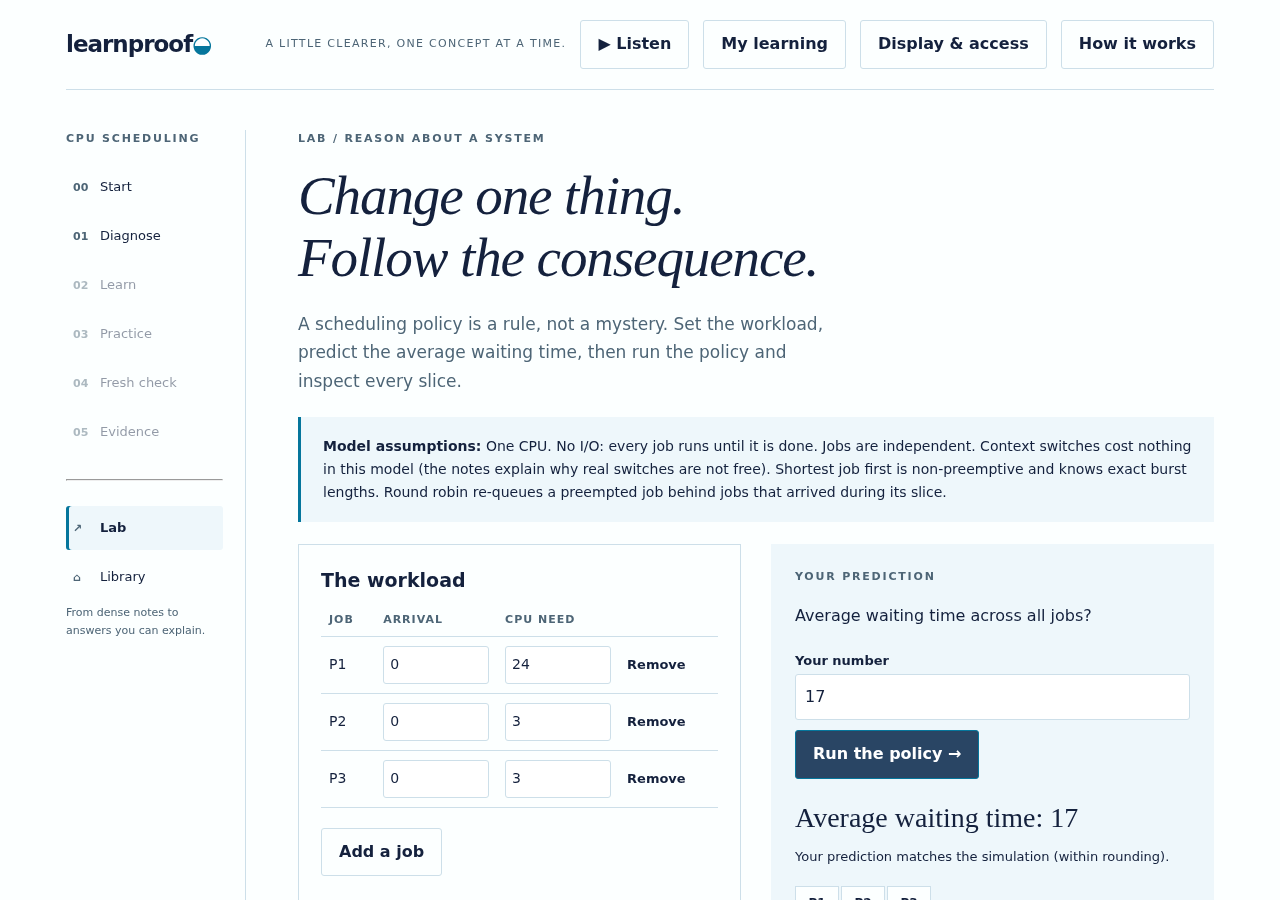
CPU scheduling lab: run FCFS, shortest-job-first and round robin on an editable workload, assumptions beside the controls. Deployed UI.
-
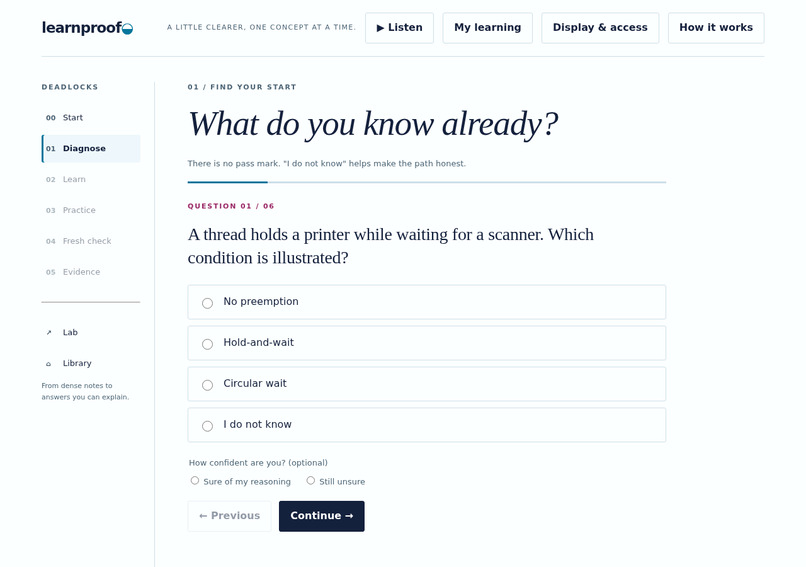
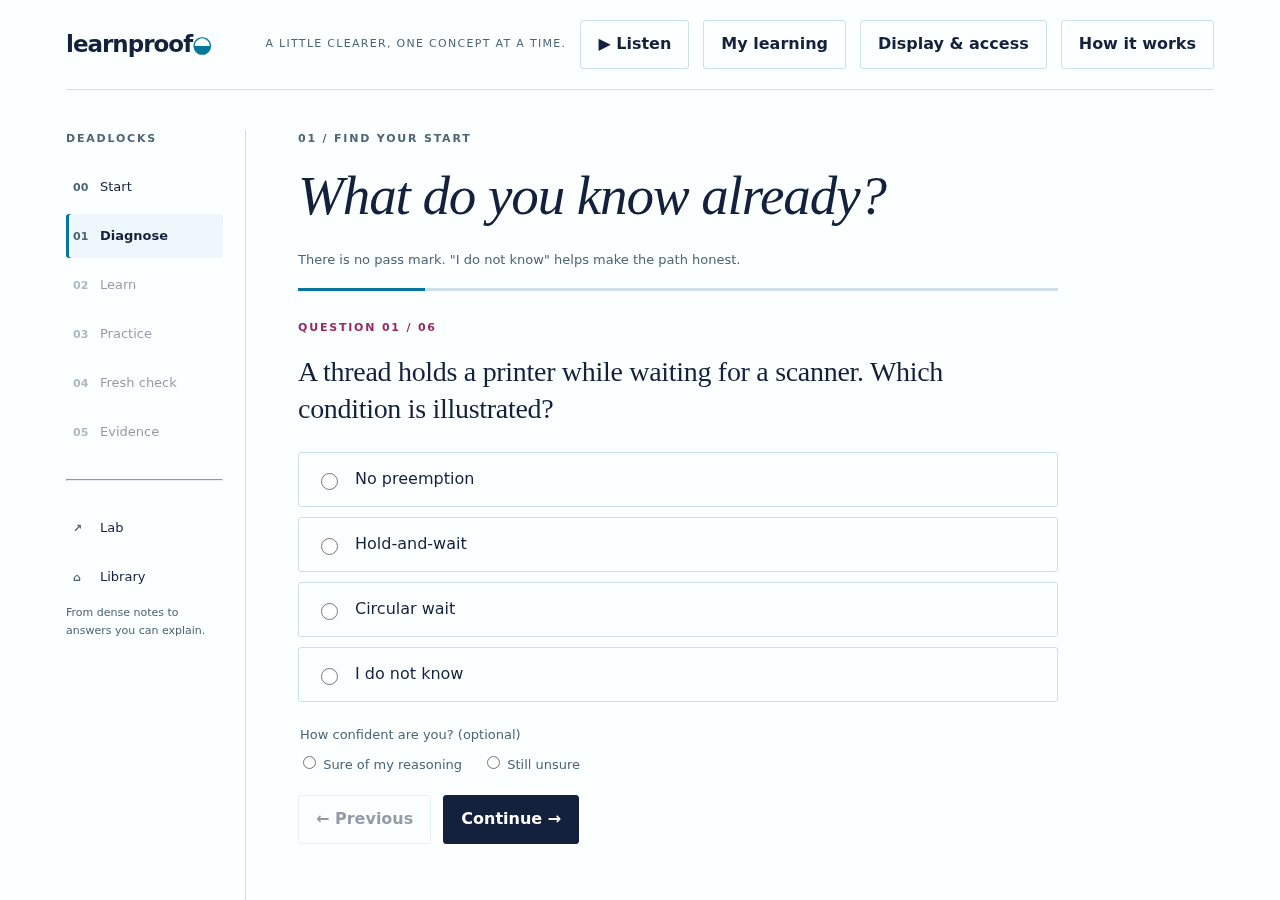
Fresh-check question with an honest I-do-not-know option; every score comes from the learner’s own answers. Actual deployed UI.
The barrier
A university learner can have the course notes and still be locked out by dense technical language. Reading another summary does not tell them which idea they misunderstood or whether they can apply it without hints.
LearnProof meets that barrier with a small library of four complete learning rooms - deadlocks, CPU scheduling, paging and transactions - each one a full, honest loop rather than a page of notes.
What it does
Every room runs the same working loop: diagnostic -> source-linked revision -> practice -> a hands-on lab -> a different fresh check -> answer evidence, with a recall set for later.
- Six starting questions with an honest "I do not know" choice and optional confidence.
- Lower-scoring concepts first, with plain language, worked examples and exact passages quoted from the room's own source-checked notes.
- A live lab per room: a three-thread / three-lock waiting model; a CPU scheduler (FCFS, shortest-job-first, round robin); a paging policy bench (FIFO, LRU, OPT); a transaction interleaving checker that builds the precedence graph. Each lab prints its model assumptions beside the controls.
- Three practice questions with reasons; they do not count toward the before/after comparison.
- Six different fresh-check questions with no hints or correctness feedback until completion.
- An evidence report: actual choices, per-concept percentage-point change, sure-but-wrong answers flagged, source-quoted corrections and next steps. Restored reports are re-scored, never trusted.
- My learning: cross-room progress, on this device only. Display & access: three text sizes, bundled OpenDyslexic as an opt-in (the research on it is mixed, and the app says so), and read-aloud that labels each voice local or network.
- A self-contained offline HTML copy that runs from file://, and a calendar (.ics) recall reminder. An immediate recall re-attempt is labelled practice, not proof of retention.
A concrete before-and-after
Before: the learner reads "circular wait" in a dense paragraph and may treat any waiting as deadlock.
After, in the product: they set A waiting for B, watch B finish and release, then change B to wait for A and trace the closed A -> B -> A cycle. In the scheduling room they predict the convoy's average waiting time before running FCFS over bursts 24, 3, 3 (it is 17), then switch to shortest-job-first and see 3. The task changes from memorising a definition to making and checking an explicit prediction.
This is a demonstration of what the interface makes possible, not a measured claim that a learner improved. Any numeric scores in demos are scripted software-test choices, not student-study results.
How we built it
The public app is self-contained HTML, CSS and JavaScript, produced from readable sources by a one-command, dependency-free build (node build.mjs). Four content packs (lessons/*.json) are validated before every build: each concept's quote must be a verbatim passage of its teaching page. Scoring, path ordering, reports and all four labs are pure functions (LPCore, LPLabs) running entirely in the browser. No learner account, server, AI endpoint, external font or analytics is required by the room.
The three OpenDyslexic fonts ship as base64 text assets (SIL OFL 1.1) that the build inlines, keeping the zero-network claim true in the shipped file. The earlier private Streamlit author workspace stays separate, accepts only bundled non-sensitive notes, and is not called by the public room. No key or provider quota is exposed to judges.
A private prototype began on 28 October 2026, within the event window. The 13 November v2 rebuild added targeted revision, the waiting lab, confidence-linked corrections, restorable evidence, a recall set and offline operation. The 13 November v3 upgrade - also within the window - grew the product from one reviewed room into a library of four complete rooms with four labs, the My learning and Display & access surfaces, and per-room export, while preserving the navy/sky editorial identity.
Testing and challenges
92 pure-function checks pass. They include all 4,096 states of the deadlock lab's three-lock model, with invariants for completion, blocked states and cycle membership; the classic paging reference string (FIFO 9 faults, LRU 10, OPT 7 with three frames); the FCFS convoy (average waiting 17 vs 3 for shortest-job-first on the same jobs); a pinned round-robin timeline; and a reproducible-build check that rebuilds the shipped file from sources and requires an exact match.
50 real-browser checks (Playwright + axe-core) pass against the live site: the full learning flow, lab interactions, progress persistence, storage opt-in, the offline copy booting with zero page errors, and 320/390/1280 pixel layouts without horizontal overflow. After deploy, the live file was hash-verified byte-identical to the tested local build. Semantic controls, keyboard focus, a skip link, diagram text alternatives and live validation errors are implemented; there has not been a formal accessibility certification or assistive-technology user study.
The hardest part was making the evidence honest. Different stems do not guarantee equal difficulty. A waiting thread is not automatically a cycle member. A saved report is not a certificate. Those distinctions drove the model, the locked diagnostic baseline, the re-scored restores and the language beside every score. Mid-deploy, GitHub's web uploader refused the raw font binaries; the fonts became checked-in base64 assets and the build learned to decode them, verified by a byte-identical rebuild.
Limits and next steps
Four reviewed rooms, three concepts each. Material is original and source-checked but not expert-certified. The before/after forms follow a blueprint but are not statistically equated. Scores do not prove mastery, lasting retention or that LearnProof caused a change. Reports are editable and checks are unproctored. Read-aloud voices marked as network may send text off the device; no offline speech is guaranteed. No screen-reader (NVDA/VoiceOver) testing was possible in this environment. No arbitrary PDF tutor, account system, cloud sync or teacher database is claimed.
Next: expert item review and a permissioned, privacy-reviewed learner pilot; more rooms on the same engine; optional cross-device sync.
Team, credits and AI assistance
Solo project directed by M J Anthony. Implementation, original teaching drafts, tests, interface, documentation and synthetic narration were made with AI assistance. The detailed technical/interview manual documents architecture, maths, tradeoffs, limits and 30 interview questions with answers.
The bundled note prose, questions and examples are original. Reference reading: OSTEP chapters on deadlock, CPU scheduling and paging policies (Remzi and Andrea Arpaci-Dusseau), and the PostgreSQL documentation on transaction isolation. OpenDyslexic font by Abbie Gonzalez, SIL OFL 1.1. No AI service is called at runtime; every score comes from the learner's own answers. No private educational records or identifiable learner data are used.
