-
-
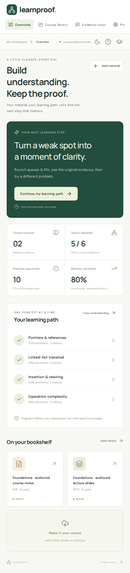
Mobile Overview
-
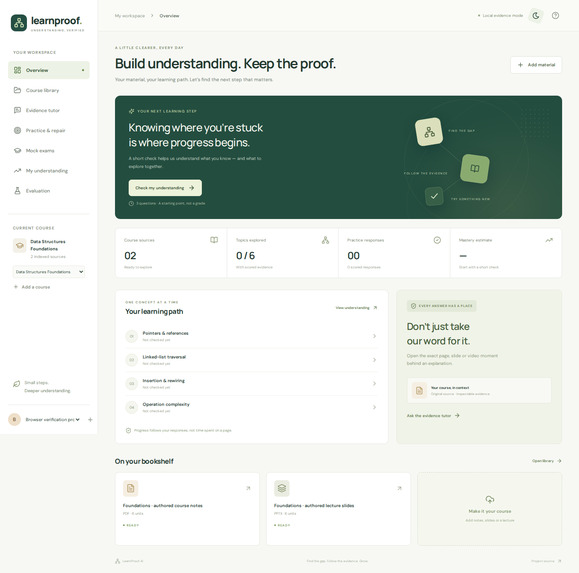
Desktop Overview
Inspiration
A wrong answer tells us that a student is struggling, but rarely explains why. The missing prerequisite might be buried in a textbook, a slide diagram, or a lecture recording.
Our experience building education projects inspired LearnProof AI: a tutor that connects the learner’s next step to both their scored responses and inspectable course evidence.
What it does
LearnProof brings course materials, source-cited tutoring, adaptive practice, and mock exams into one learning workspace.
Its central workflow is a misconception repair loop:
Wrong answer → prerequisite probe → cited feedback → unseen transfer question → updated learning estimate.
Students can:
- Upload PDFs, PowerPoint slides, and lecture videos.
- Ask course questions and open the original supporting page, slide, or video location.
- Practice multiple-choice, short-answer, and numerical questions.
- Resume diagnostic repair sessions after reloading.
- Create topic-scoped mock exams and review cited feedback.
- Explore a concept map and revisit weak topics through source-linked revision.
The included Data Structures course demonstrates pointers, linked-list traversal, insertion, complexity, stacks, and queues.
How we built it
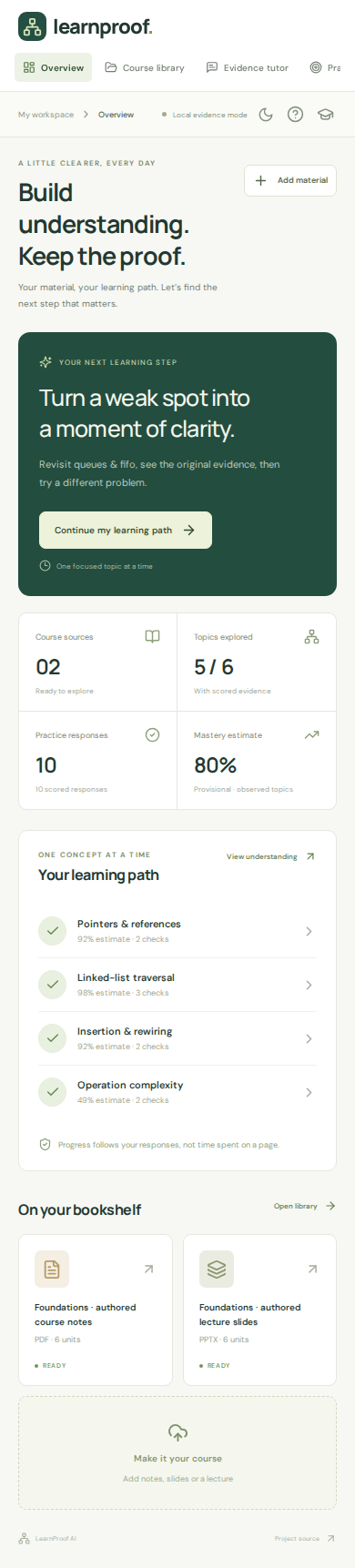
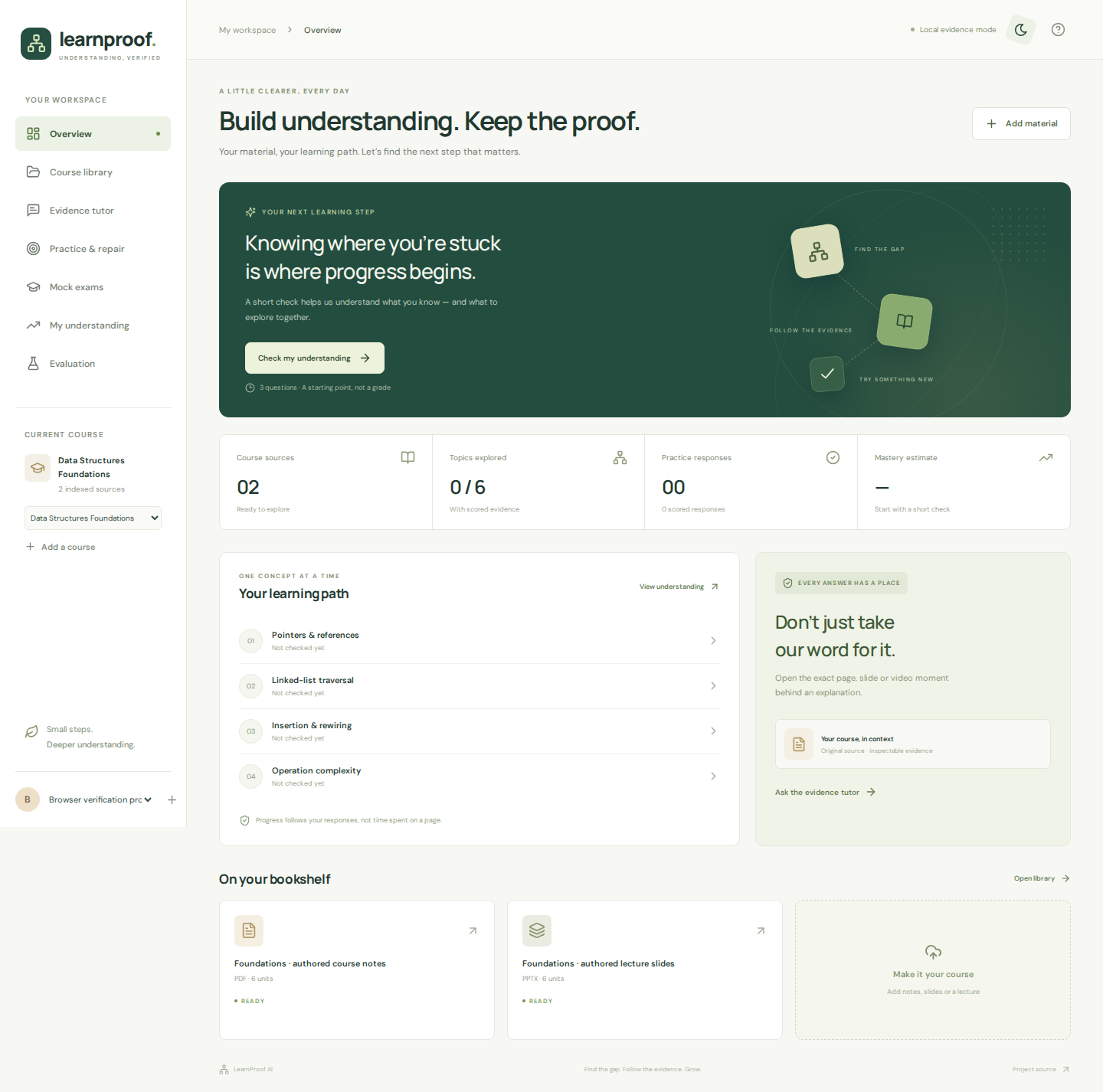
We built the interface with React, TypeScript, and Vite, including responsive layouts and persistent light/dark themes.
FastAPI and SQLite store course sources, extracted units, learner profiles, attempts, repair sessions, and exams. PDF and slide extraction preserve source locations and previews; LibreOffice supports full slide rendering.
The optional Gemini integration implements diagram and lecture interpretation, semantic embeddings, generated explanations, and separate source-support checks. Retrieval combines lexical ranking with semantic retrieval when an index is available.
Generated claims are checked individually against their own cited evidence. Assessment candidates undergo validation before they enter practice. Ambiguous short answers remain unscored rather than artificially increasing mastery.
Personalization uses Bayesian knowledge tracing with illustrative parameters and a prerequisite graph. Suggested prerequisite relationships are labeled tentative.
What we learned
A citation is useful only when it supports the claim and lets the student inspect the original evidence.
We also learned that personalization needs persistent state: diagnostic probes, transfer checks, reserved exam items, and previous attempts must remain consistent across sessions.
Finally, a mastery estimate is not proof of learning. An unseen transfer response provides a concrete observation, while lasting educational benefit requires further student evaluation.
Challenges we faced
Our main challenges were:
- Separating supported explanations from fluent but unsupported model output.
- Preserving page, slide, and video locations across different media.
- Resuming repair sessions without repeating previously answered questions.
- Keeping mock exams distinct from practice.
- Distinguishing measured results from planned evaluation.
Validation and results
All four GitHub Actions jobs pass, covering 29 regression tests, the production frontend build, dependency audits, browser workflows, LibreOffice slide rendering, Docker preview, and optional Ragas adapter imports.
The browser checks exercise cited source inspection, repair across reloads, a six-question mock exam, persisted progress, theme switching, and mobile layouts.
On a 30-case authored text reference set, our programmatic audit measured:
- Source hit@4: 95%
- Off-material refusal: 100%
- False refusal on answerable questions: 5%
- Locator validity: 100%
- Exact-quote integrity: 100%
These checks do not measure semantic faithfulness, answer relevance, or student learning gains. Live Gemini multimodal validation and the 60-case Ragas benchmark remain pending; successful adapter imports are not benchmark results.
What’s next
Run and publish the live multimodal benchmark, inspect diagram and timestamp fidelity, improve question-bank coverage, and evaluate the repair workflow with real learners.
Production deployment would also require authenticated accounts, durable ingestion workers, and per-user access controls.
Prior work and contributions
Academia-Lab and DS-Portal informed our understanding of education workflows; their codebases were not copied into this project.
The LearnProof proposal and initial prototype were committed on 11 October 2026, with submission-focused improvements on 14 October 2026. Frontend modularization and dark mode were contributed by GitHub user sravyakalluri26, with original authorship preserved.


Log in or sign up for Devpost to join the conversation.