-
-
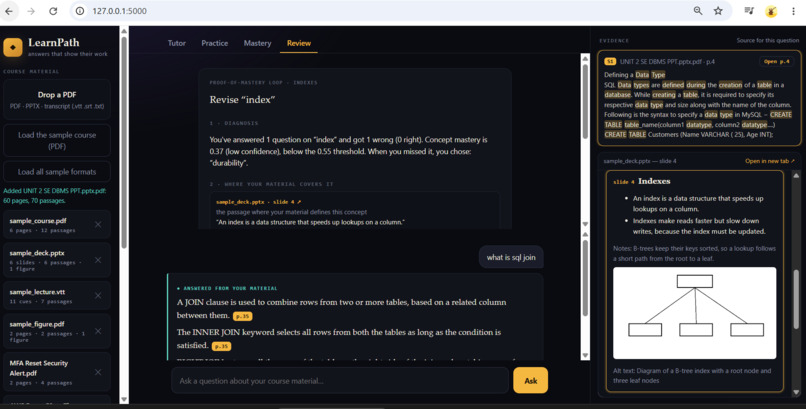
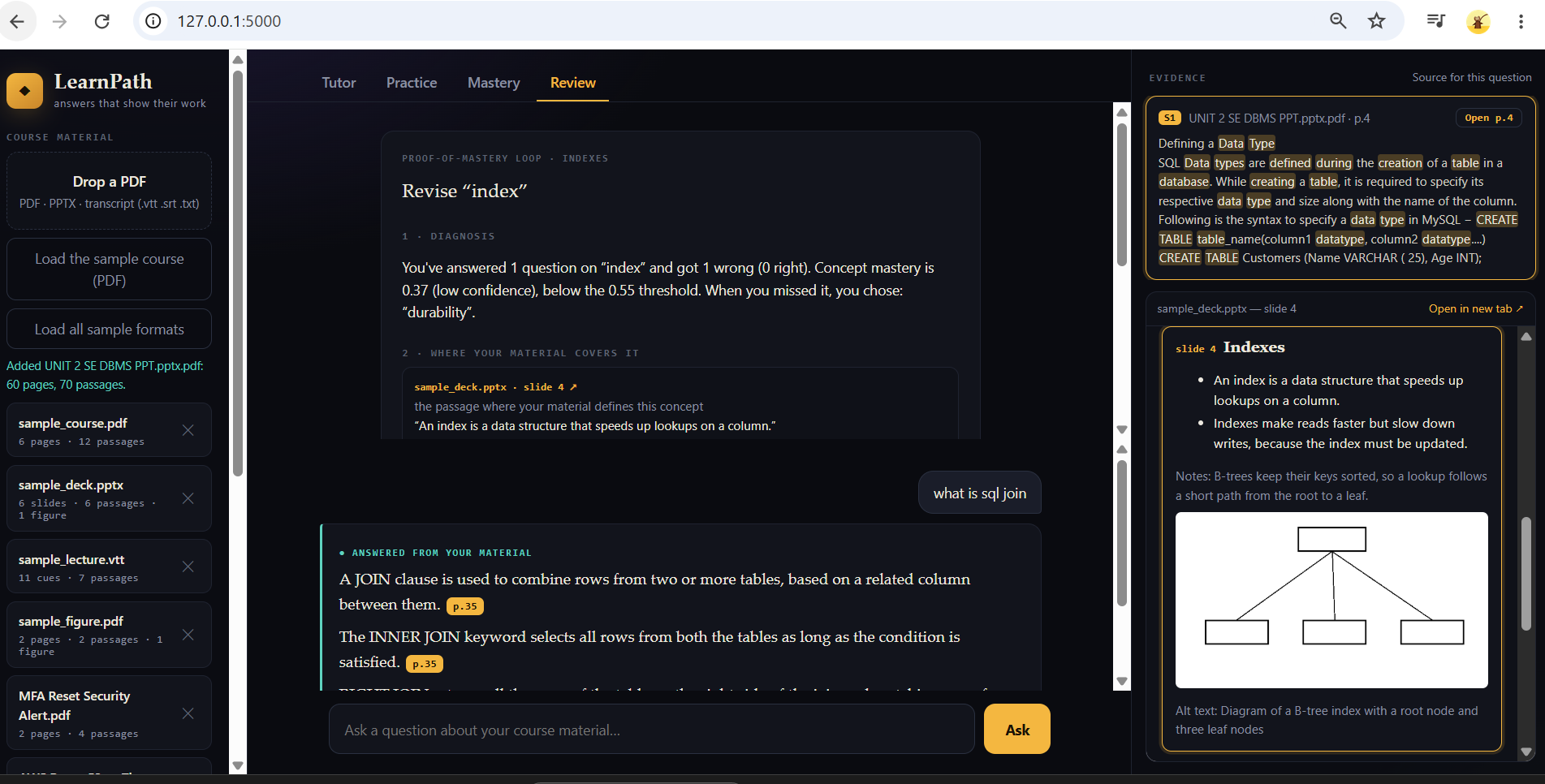
Dashboard testing image
Inspiration
Students often have their learning materials spread across PDFs, PowerPoint presentations, and lecture recordings. Finding the right information, verifying answers, and preparing for assessments can take significant time. We built LearnPath AI to make studying more organized, interactive, and evidence-based.
What It Does
LearnPath AI is an AI-powered learning assistant that helps students learn from their own course materials. Instead of relying only on generic answers, it retrieves relevant passages from uploaded materials and uses them to answer questions with source citations.
Key features include:
- Document-based learning: Process supported learning materials, including PDF, PPTX, and VTT files.
- Evidence-grounded Q&A: Ask questions and receive answers based on retrieved course content.
- Source citations: Trace answers back to relevant learning material.
- Interactive assessments: Practice through quizzes and assessment workflows.
- Mastery tracking: Track learning progress and identify topics that need further review.
- Flexible operation: Use extractive answering without an LLM, with optional LLM integration.
How We Built It
We built LearnPath AI using Python and a Flask-based application, with a web interface for interacting with learning materials. The system processes uploaded documents, retrieves relevant passages, evaluates whether the available evidence is sufficient, and generates answers with source references.
We also developed assessment and review workflows to help learners practice and track mastery. Automated tests and benchmark evaluations help us check application behavior, answerability decisions, and citation quality.
Challenges We Faced
One of the main challenges was balancing helpfulness with reliability. A learning assistant should not refuse every difficult question, but it also should not invent an answer when the uploaded material does not support one.
Another challenge was citation quality. Retrieving a related passage is not enough; the cited evidence should genuinely support the answer. We used automated tests and evaluation datasets to examine these behaviors and identify areas for improvement.
What We Learned
We learned that building a useful AI learning assistant involves more than connecting a language model to documents. Retrieval quality, evidence sufficiency, source attribution, testing, and clear handling of unsupported questions are all important.
LearnPath AI is our step toward making course-specific learning more accessible, structured, and verifiable.
What's Next
We aim to improve retrieval for paraphrased questions, strengthen evidence checks, increase citation precision, and evaluate the system on broader and more diverse educational materials.
Built With
- artificial-intelligence
- css
- flask
- html
- information-retrieval
- javascript
- natural-language-processing
- python

Log in or sign up for Devpost to join the conversation.