Inspiration
Learnova AI — Your Learning, Understood.
Project Category: Multimodal AI, Personalized Education, Adaptive Learning
Project Overview
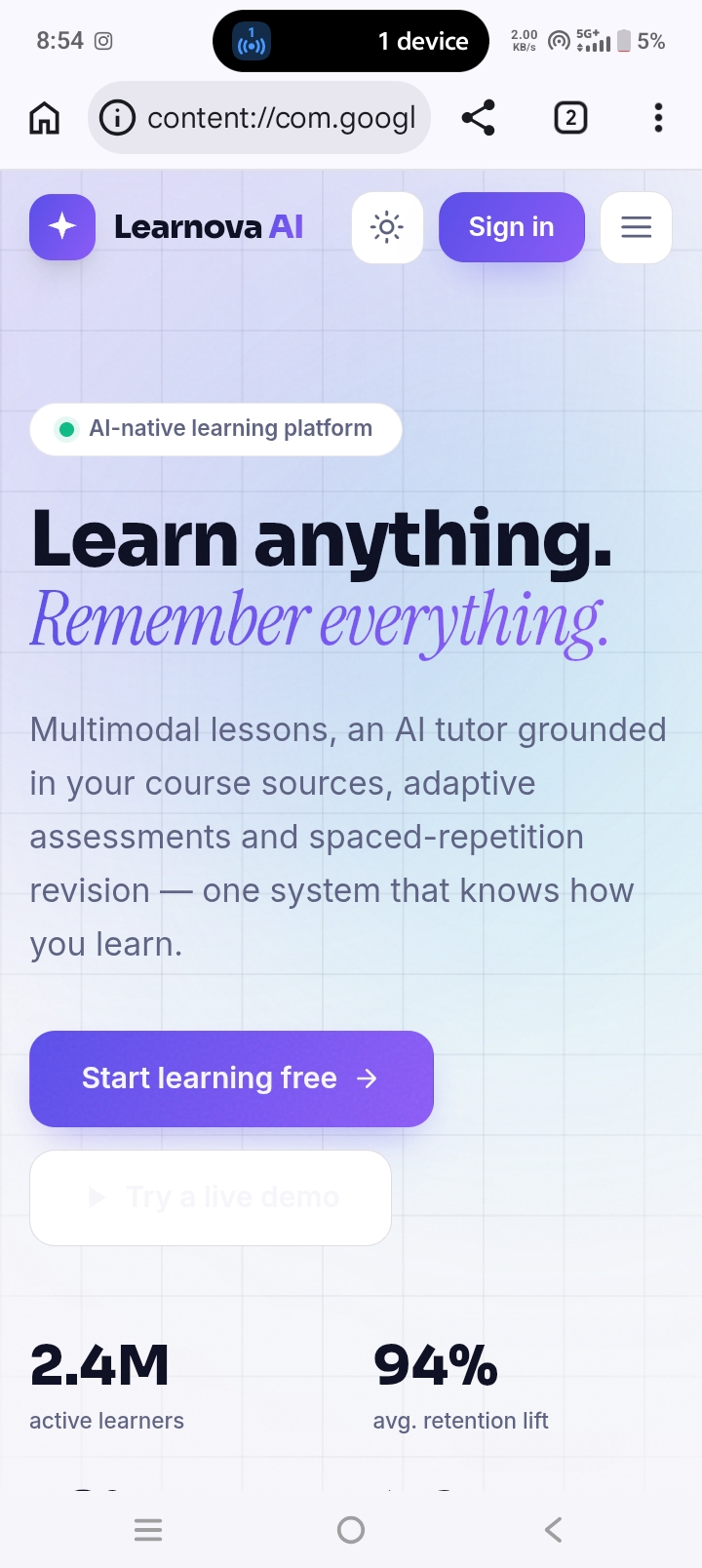
Learnova AI is an AI-powered learning companion that brings textbooks, lecture videos, presentations, and diagrams together in one intelligent learning platform. It helps students understand concepts, receive source-cited answers, assess their knowledge, identify weak topics, and follow personalized revision plans.
Unlike a general-purpose chatbot, Learnova AI aims to ground its responses in the student's actual course materials and adapt the learning experience according to the student's assessment performance.
The Problem
Students often rely on scattered learning resources, including PDFs, textbooks, lecture videos, and presentation slides. Traditional study tools rarely connect these resources, while general AI chatbots may provide answers that are not aligned with the student's syllabus or lack verifiable source references. Students also struggle to identify knowledge gaps and decide what to study next.
Our Solution
Learnova AI creates a unified, multimodal knowledge base from learning materials and combines it with source-grounded tutoring, adaptive assessments, learner modelling, and personalized revision recommendations.
Five Standout Features
- Course DNA — Intelligent Knowledge Engine
- Processes textbooks, PDFs, presentations, and lecture videos.
- Extracts text and relevant diagrams or figures.
- Organizes topics, subtopics, concepts, and prerequisites.
- Preserves source references such as page numbers, slide numbers, and video timestamps.
- Evidence-Locked Tutor — Trustworthy AI Assistance
- Answers questions using relevant uploaded course materials.
- Provides citations linked to exact pages, slides, or video timestamps.
- Flags questions that cannot be answered from the available sources.
- Separates course-grounded information from outside knowledge.
- Learner Twin — Personalized Progress Tracking
- Maintains an evolving estimate of mastery for each topic.
- Updates progress using quiz results and learning interactions.
- Identifies weak concepts, prerequisite gaps, and recurring misconceptions.
- Provides a diagnostic assessment for new learners.
- Adaptive Exam Arena — Intelligent Assessment
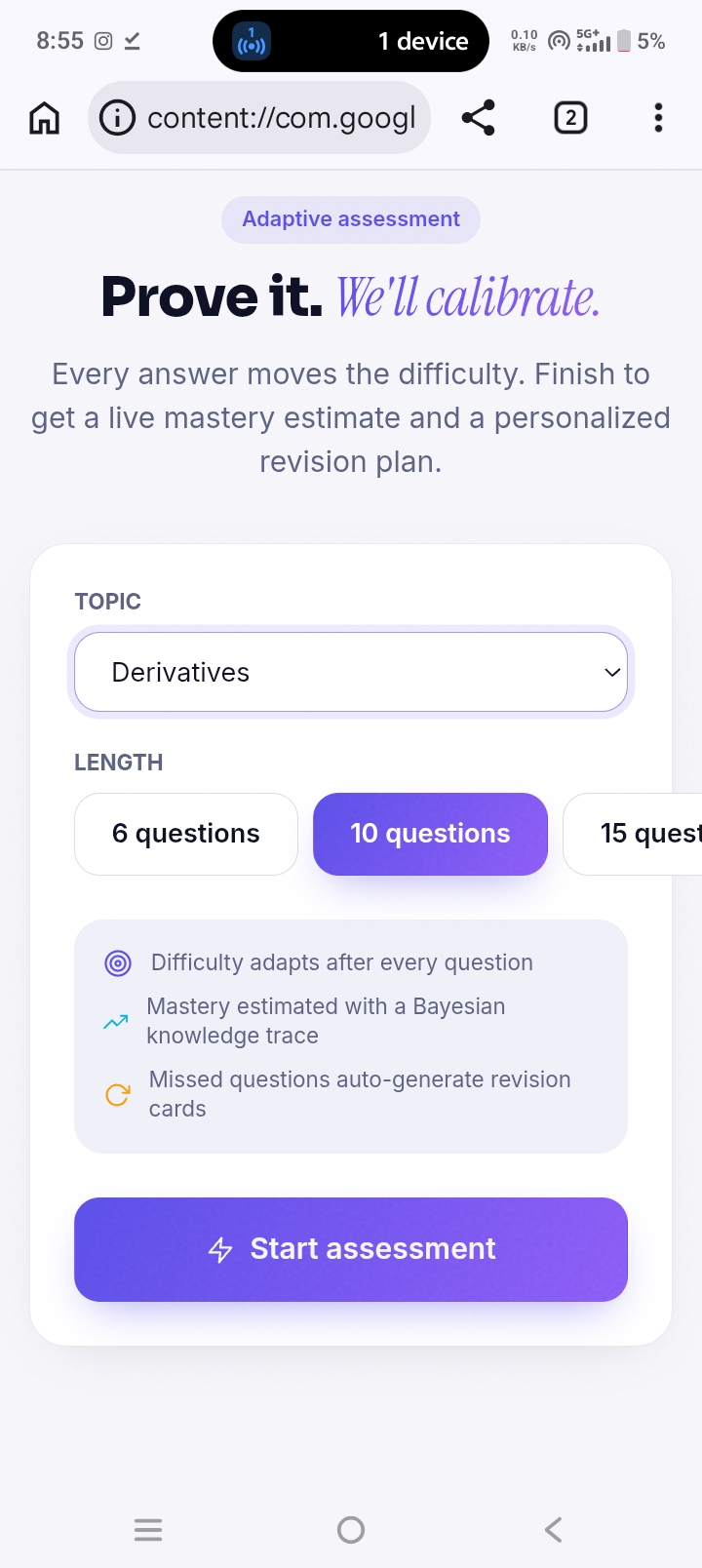
- Generates multiple-choice, short-answer, and numerical questions.
- Tags questions by topic, source, and difficulty.
- Provides answer verification and explanations supported by course materials.
- Reduces repeated questions and generates reports highlighting weak areas.
- FutureReady Engine — Personalized Revision
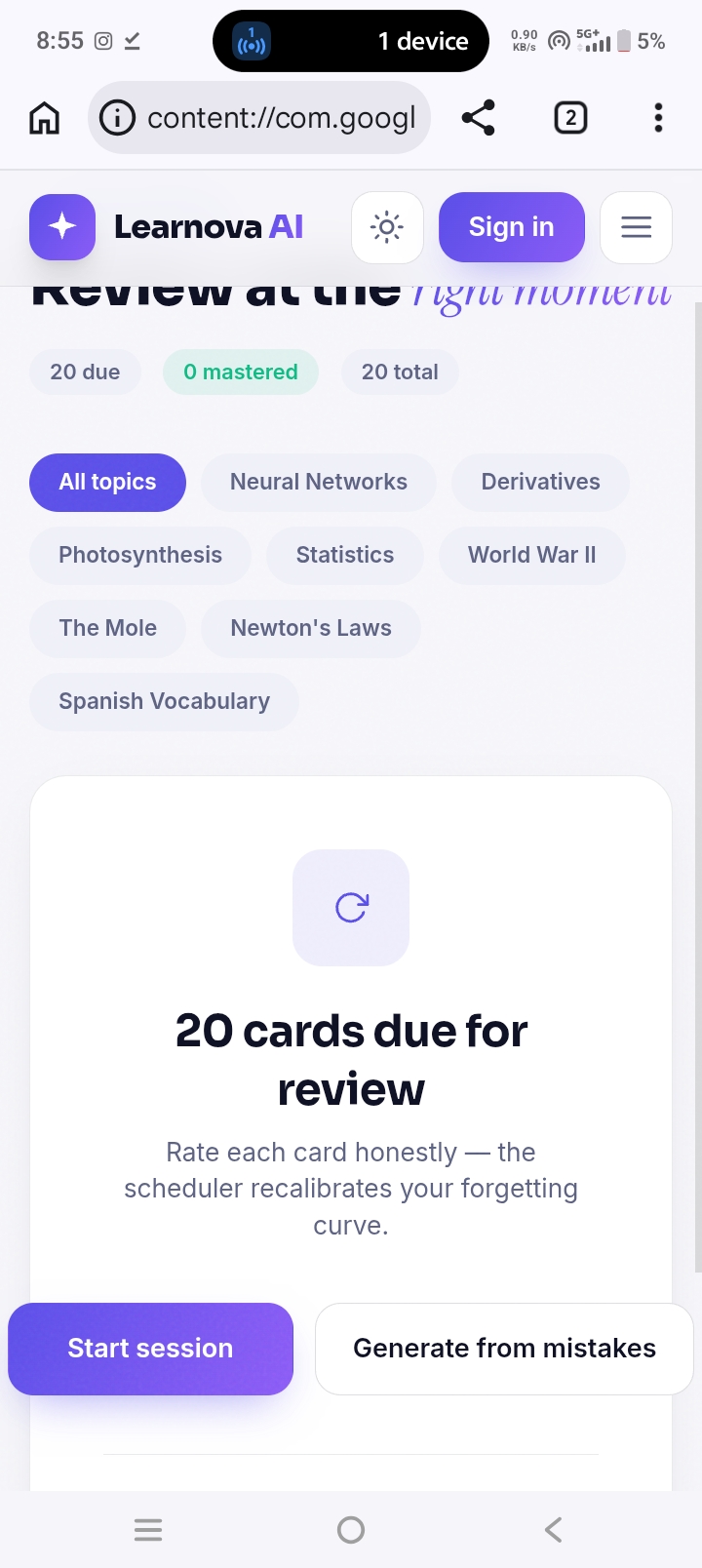
- Creates revision plans based on topic mastery and upcoming examinations.
- Recommends targeted practice for weak concepts.
- Uses spaced repetition to reinforce learning over time.
- Tracks progress through repeated assessments and evaluation.
How It Works
- The student uploads textbooks, PDFs, presentations, or lecture videos.
- The system extracts and organizes the content into a searchable knowledge base.
- The AI tutor answers questions using retrieved evidence and source citations.
- The assessment engine generates quizzes from selected learning materials.
- The learner model updates topic-mastery estimates based on performance.
- The revision engine recommends what to study and practise next.
- The system evaluates its reliability and tracks learning progress over multiple sessions.
Proposed Technology Stack
- Frontend: React and Tailwind CSS
- Backend: Python and FastAPI
- AI: Large Language Model (LLM) and Retrieval-Augmented Generation (RAG)
- Content Processing: PDF and presentation extraction, OCR, image analysis, and speech-to-text
- Database: PostgreSQL or Supabase
- Semantic Search: Embeddings and vector search
- Learner Modelling: A topic-mastery model, potentially using Bayesian Knowledge Tracing
- Evaluation: RAGAS, DeepEval, or TruLens
Innovation and Differentiation
Learnova AI integrates source-grounded answers, multimodal content understanding, adaptive assessments, learner modelling, and personalized revision in one workflow. Its focus is not merely generating answers but helping students understand what they know, identifying what they need to improve, and recommending their next learning steps.
The system will also be evaluated for answer faithfulness, citation correctness, retrieval quality, unsupported-question handling, question repetition, and changes in simulated learner mastery.
Expected Outcome
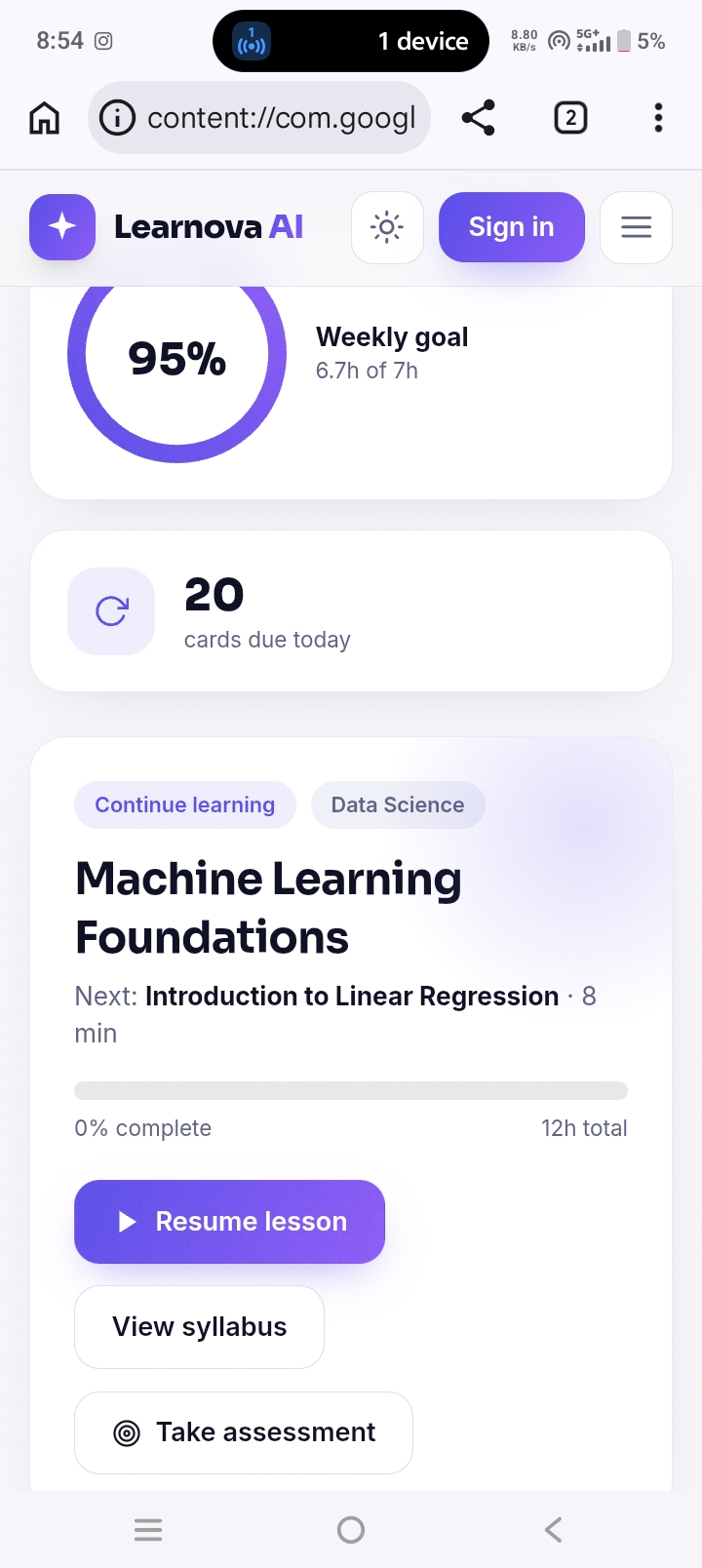
A working web application featuring multimodal learning-material ingestion, a source-cited AI tutor, adaptive quiz generation, a learner progress dashboard, and personalized revision recommendations.
Project Vision
To make learning more trustworthy, personalized, and measurable by transforming scattered educational resources into an intelligent learning experience.
Tagline: Learnova AI — Your Learning, Understood.
What it does
Learnova AI transforms textbooks, PDFs, presentations, lecture videos, and diagrams into a personalized learning experience. It organizes course content, answers students' questions using source-cited explanations, generates quizzes based on their study materials, and tracks their progress across different topics.
By analyzing assessment performance, it identifies areas where students need more practice and recommends targeted revision plans. If an answer is not supported by the uploaded learning materials, the system flags that limitation instead of presenting unsupported information as fact.
Learnova AI combines multimodal content understanding, AI-powered tutoring, adaptive assessments, and personalized learning recommendations to help students study smarter and understand their subjects more effectively.
How we built it
We designed Learnova AI as a modular AI-powered learning platform combining a modern web interface, a backend processing system, and intelligent learning capabilities.
Frontend Development: We use React and Tailwind CSS to create an interactive, responsive interface where students can upload learning materials, interact with the AI tutor, attempt assessments, and track their progress.
Multimodal Content Processing: The platform processes educational resources such as PDFs, textbooks, presentations, and lecture videos using document extraction, OCR, image understanding, and speech-to-text technologies. Extracted content is organized with references to its original pages, slides, and video timestamps.
AI-Powered Knowledge Retrieval: We use Retrieval-Augmented Generation (RAG) to retrieve relevant information from uploaded course materials before generating answers. This helps ground explanations in the available sources and flag questions that cannot be answered using the retrieved content.
Adaptive Assessment Engine: The system generates multiple-choice, short-answer, and numerical questions from selected course materials. Questions are organized by topic and difficulty, with answer validation, explanations, and feedback designed to help students understand their mistakes.
Learner Modelling and Personalization: We track assessment performance to maintain topic-level mastery estimates, identify knowledge gaps, and recommend targeted practice. A personalized revision engine can use these insights to suggest study priorities and spaced-repetition activities.
Data Management and Evaluation: A database stores course information, source references, assessment results, and learning progress. We evaluate the platform using test questions and metrics for answer faithfulness, citation accuracy, retrieval quality, unsupported-question handling, and repeated questions.
By connecting these components into one workflow, Learnova AI aims to transform scattered educational resources into a source-grounded, adaptive, and personalized learning experience.
Challenges we ran into
Integrating Multiple Learning Resources: One of our main challenges was designing a system that could process different formats, including PDFs, presentation slides, lecture videos, and diagrams, while keeping their content organized and searchable.
Ensuring Reliable AI Answers: AI-generated answers may contain unsupported information. We addressed this challenge by designing a retrieval-based approach that connects responses to relevant course materials and flags questions that cannot be answered from the available sources.
Maintaining Accurate Source References: Linking explanations to the correct textbook pages, presentation slides, and video timestamps requires careful content extraction and retrieval.
Personalizing the Learning Experience: Estimating a student's understanding across different topics is challenging. We designed a learner-modelling approach that uses assessment performance to identify knowledge gaps and recommend targeted practice.
Generating Quality Assessments: Creating relevant questions with correct answers, suitable difficulty levels, and meaningful explanations requires validation to avoid ambiguous questions and incorrect feedback.
Balancing Innovation and Implementation: Integrating multimodal processing, AI tutoring, adaptive assessments, progress tracking, and revision planning into one application requires careful prioritization. We focused on connecting these components into a coherent learning workflow rather than treating them as isolated features.
Through these challenges, we recognized that building an effective AI learning companion requires more than generating answers. It requires reliable source grounding, meaningful assessment, and continuous improvement based on student performance.
Accomplishments that we're proud of
Bringing Learning Resources Together: We developed the concept of a unified learning platform that connects textbooks, PDFs, presentations, lecture videos, and diagrams in one learning environment.
Prioritizing Trustworthy AI: We designed an approach that grounds AI-generated explanations in course materials and provides source references, helping students verify the information they receive.
Connecting Learning with Assessment: We brought AI tutoring and adaptive assessments together in a single workflow, enabling students to move from understanding concepts to testing their knowledge.
Focusing on Individual Learning Needs: We designed a learner-modelling approach that uses assessment performance to identify knowledge gaps and guide personalized revision.
Building an Integrated Learning Vision: We brought content processing, AI tutoring, assessment, progress tracking, and revision planning together under one project instead of treating them as separate tools.
Creating a Foundation for Measurable Learning: We incorporated evaluation into our project vision, focusing on answer reliability, source-citation accuracy, assessment quality, and learner progress.
We are proud of designing Learnova AI around a meaningful goal: moving beyond AI that simply provides answers toward a learning companion that helps students understand, practise, and improve.
What we learned
The Importance of Reliable AI: We learned that generating an answer is not enough. AI-powered learning systems must provide trustworthy explanations grounded in relevant course materials and clearly identify information that cannot be verified.
The Value of Multimodal Learning: We explored how textbooks, presentations, lecture videos, and diagrams can be connected to create a more unified and accessible learning experience.
Personalization Requires Meaningful Feedback: We learned that adaptive learning depends on more than quiz scores. Understanding topic-level performance and identifying knowledge gaps are essential for recommending relevant practice.
The Importance of Accurate Source Retrieval: Connecting AI-generated explanations to the correct pages, slides, and video timestamps is crucial for transparency and helps students verify what they learn.
Integration Is as Important as Individual Features: Combining content processing, AI tutoring, assessment generation, progress tracking, and revision planning requires a well-organized workflow and careful testing.
Evaluation Must Be Part of AI Development: We recognized the importance of testing answer faithfulness, citation accuracy, retrieval quality, question repetition, and learning progress instead of relying only on how impressive the interface looks.
Through Learnova AI, we learned to approach educational AI as a complete learning system—one that should help students not only access information but also understand concepts, recognize their weaknesses, and improve continuously.
What's next for Learnova
Our next step is to evolve Learnova AI from an intelligent learning companion into a more comprehensive, personalized education platform.
Advanced Multimodal Learning: We plan to improve the understanding of lecture videos, complex diagrams, scanned textbooks, and multilingual educational materials.
Smarter Personalization: We aim to enhance learner modelling so the platform can identify knowledge gaps more accurately and adapt explanations, practice questions, and revision recommendations to individual learning progress.
Real-Time AI Tutoring: We envision interactive tutoring with voice-based conversations, step-by-step explanations, and follow-up questions that encourage deeper conceptual understanding.
Personalized Study Planning: We plan to introduce intelligent revision schedules based on examination dates, topic mastery, and spaced repetition to help students prioritize their preparation.
Measurable Learning Outcomes: We want to evaluate Learnova AI through structured testing, tracking answer reliability, citation accuracy, assessment quality, and improvements in student performance over multiple sessions.
Making Learning More Accessible: Our long-term vision includes multilingual explanations, including Hindi, mobile-friendly access, and learning support designed for students with different educational needs.
Our ultimate goal is to make Learnova AI more than an AI chatbot. We want to build a reliable learning companion that connects educational resources, understands learning progress through performance, and guides every student toward continuous improvement.
The future of Learnova AI: From finding answers to mastering concepts.

Log in or sign up for Devpost to join the conversation.