LearnMate AI: Personalized Learning, Powered by AI Inspiration
Every student learns differently, yet most learning platforms deliver the same content at the same pace. Students often struggle to understand difficult concepts, find answers buried in lengthy lecture notes, and identify the topics they need to revise. We wanted to build something that makes learning more personal, interactive, and accessible.
That inspired us to create LearnMate AI, an AI-powered tutoring platform that transforms a student's own learning materials into a personalized learning experience. Instead of simply generating answers, we wanted to build a system that helps students understand concepts, practice what they learn, and improve over time.
What We Built
LearnMate AI brings several learning tools together in one platform:
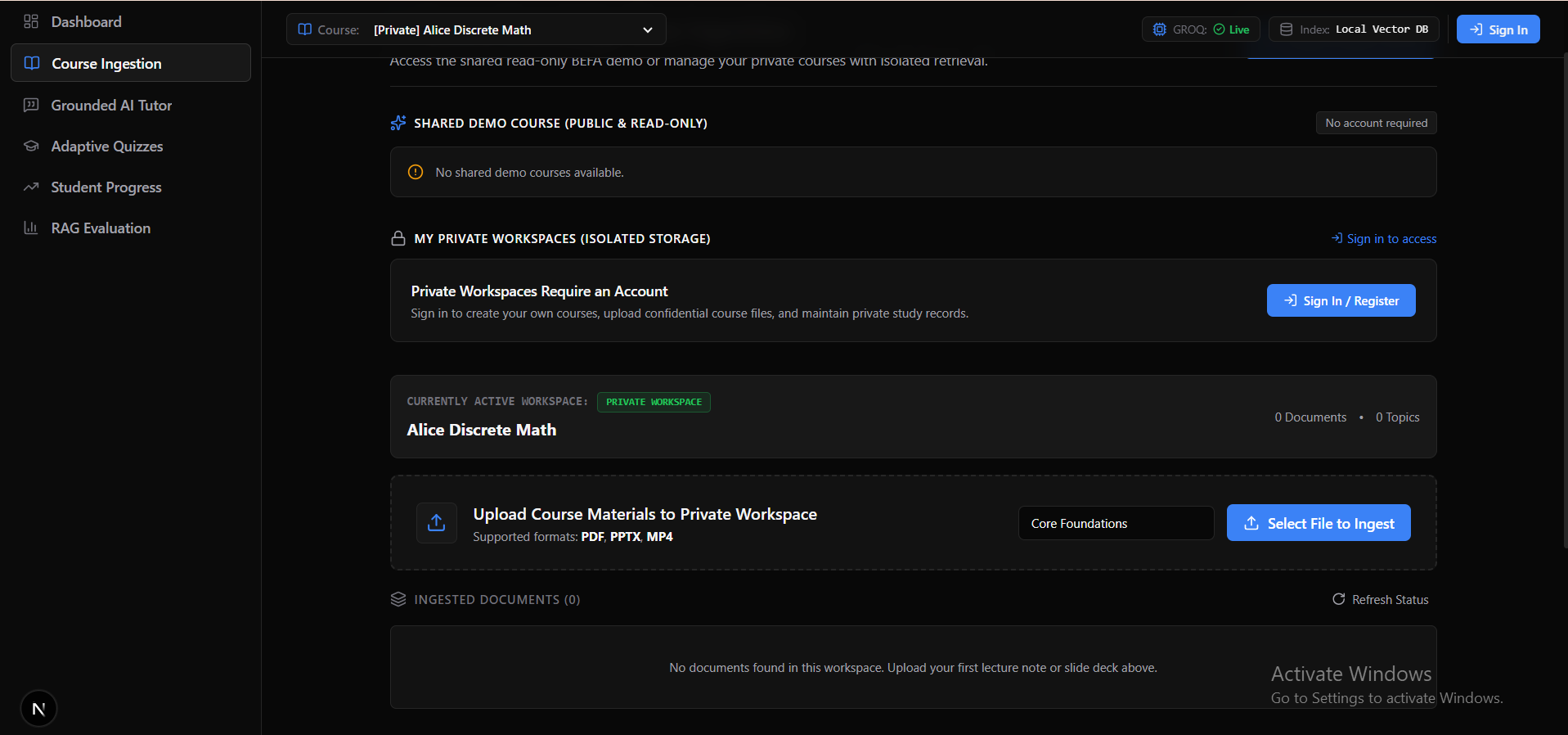
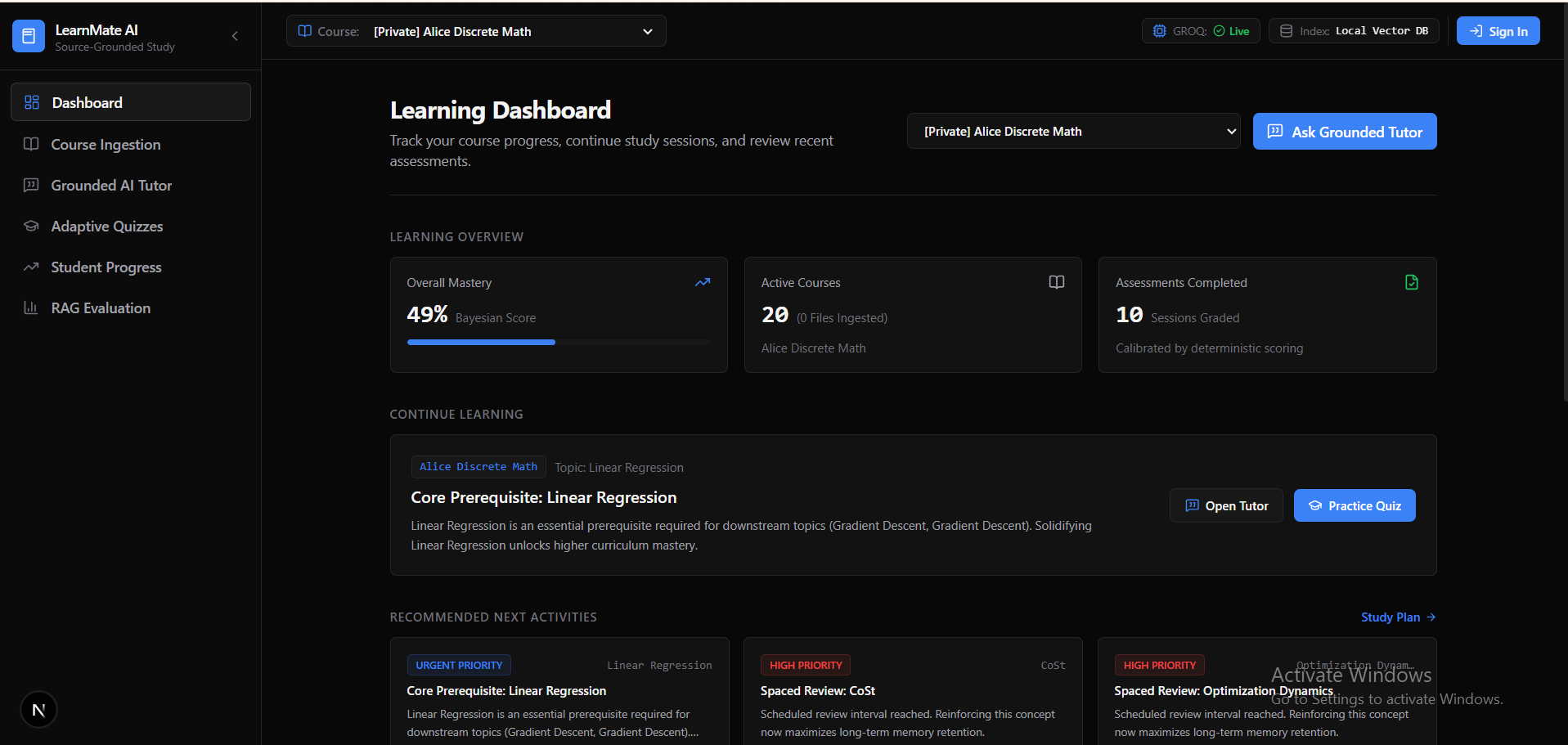
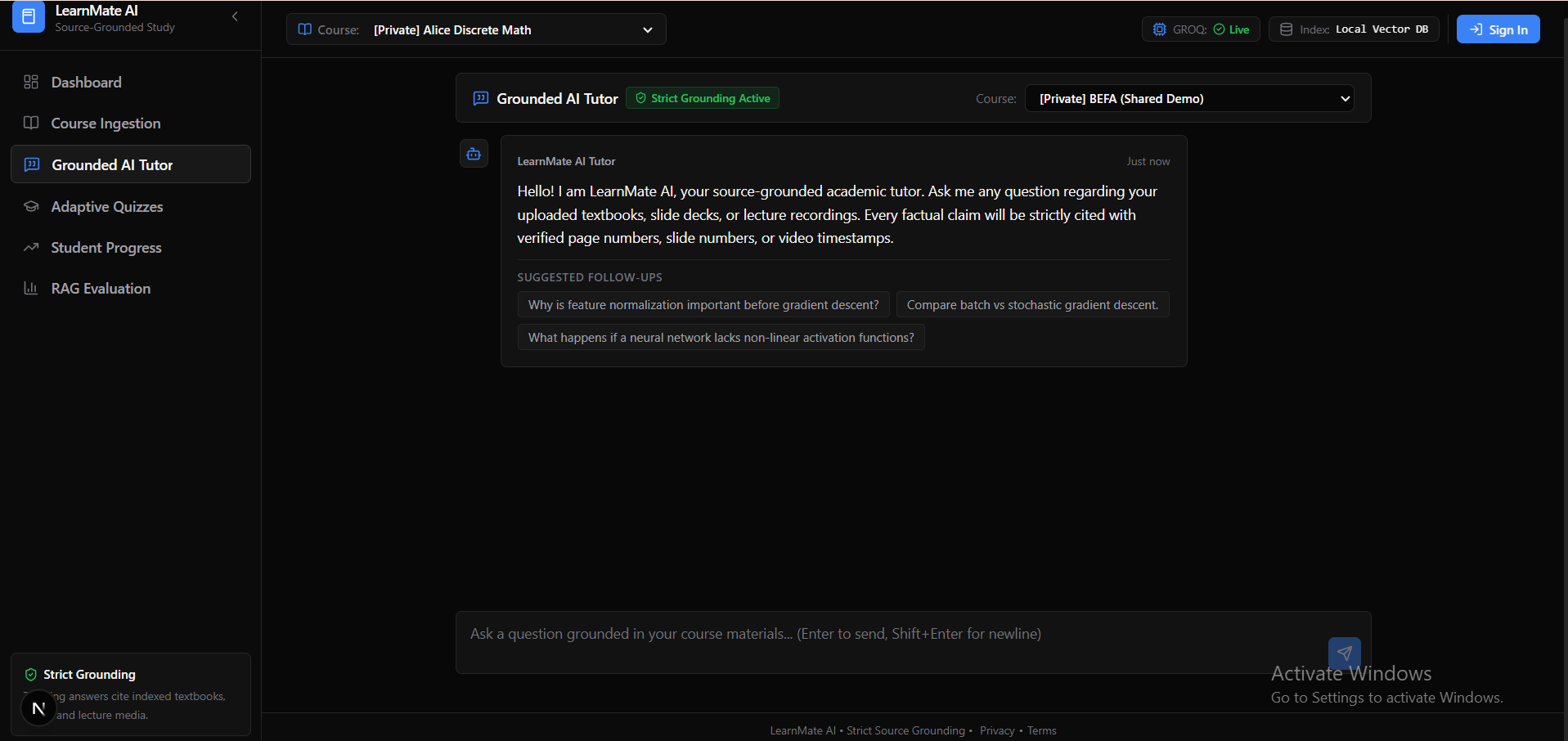
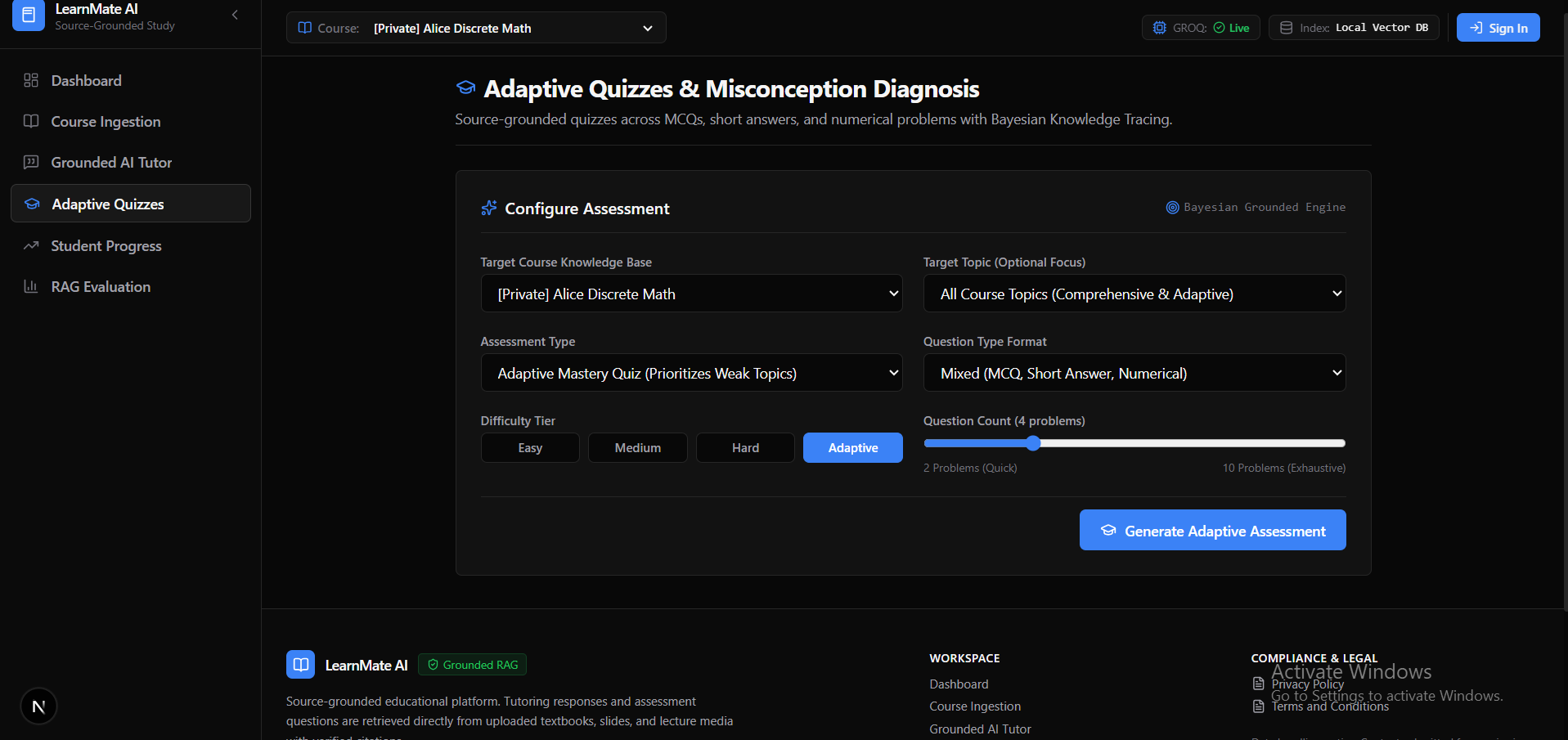
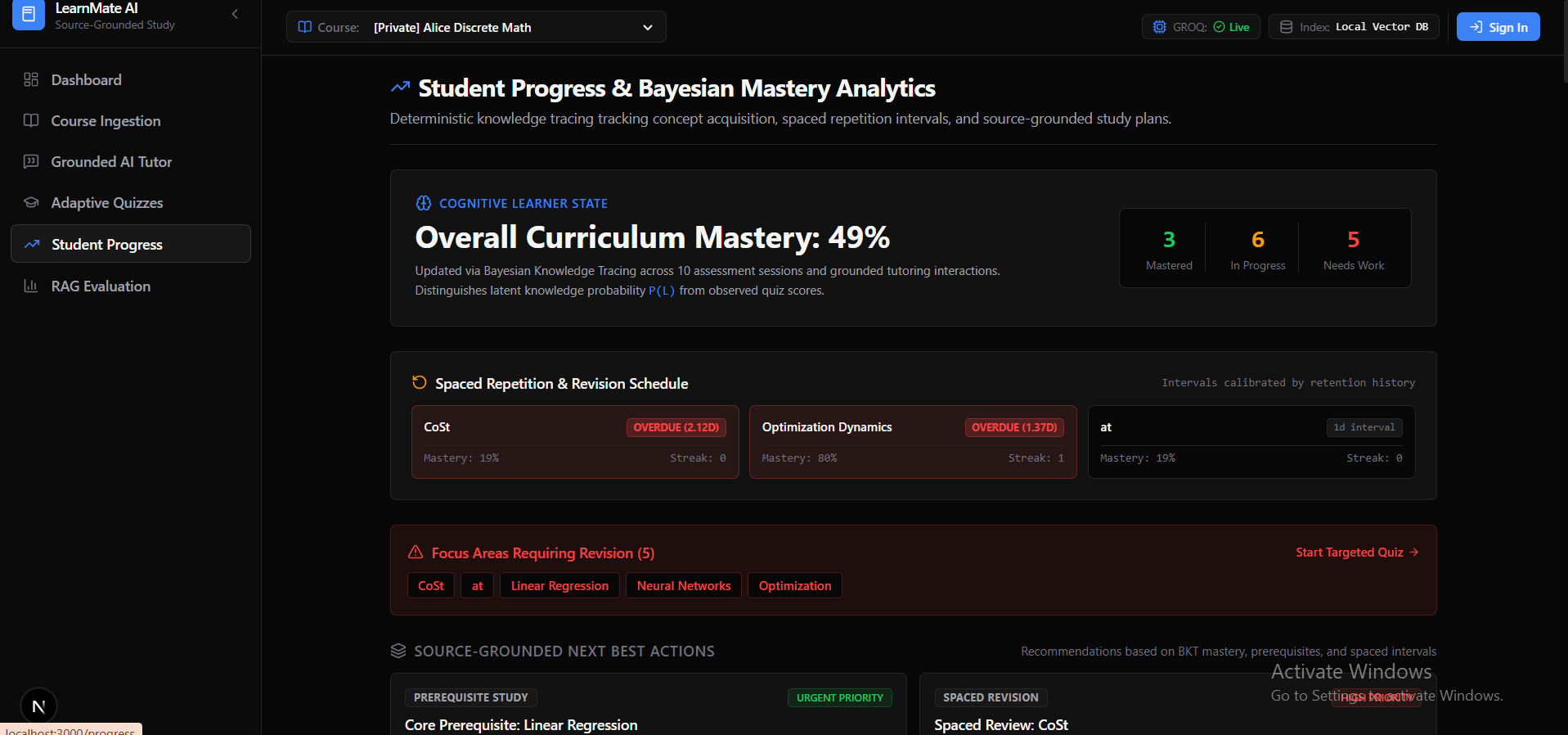
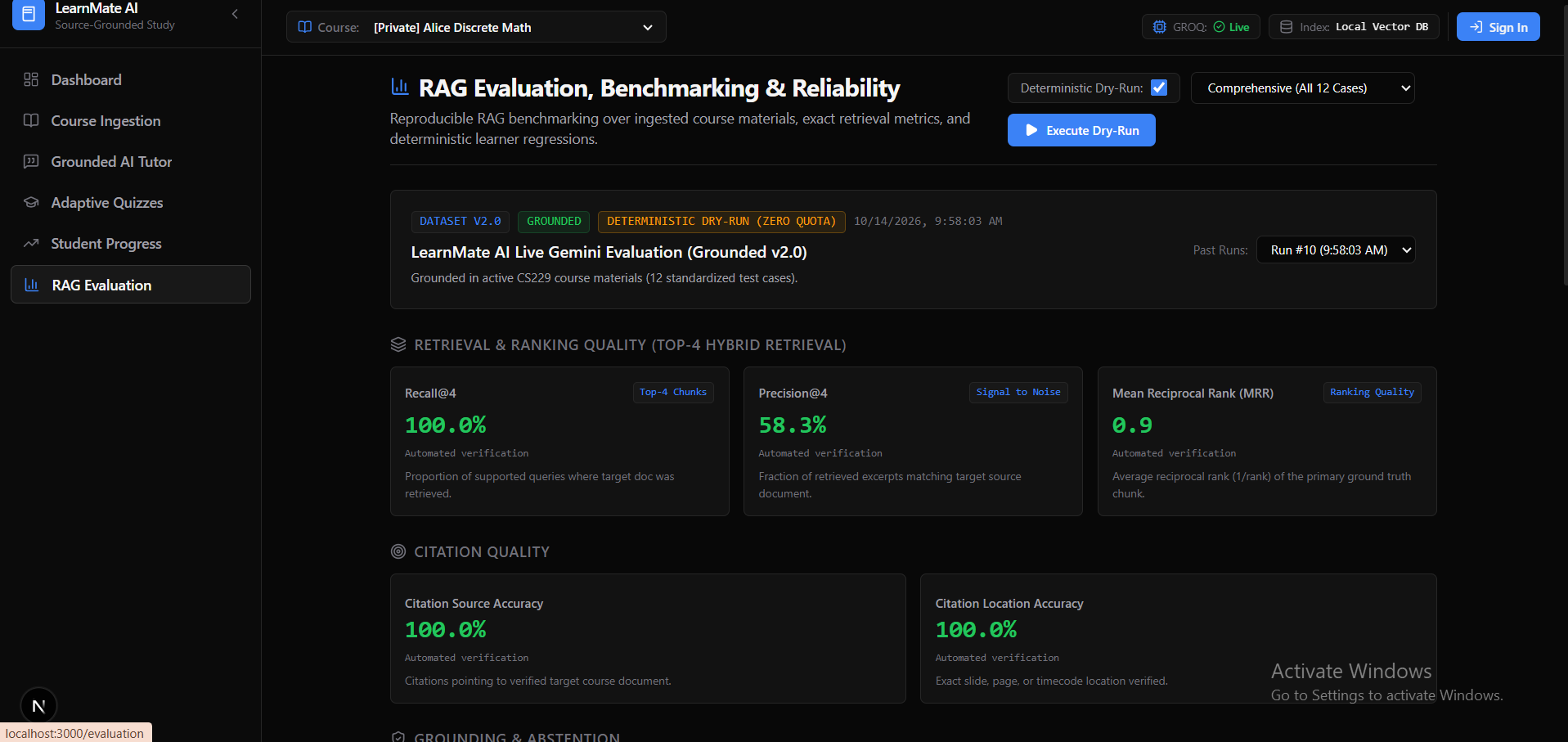
AI Tutor with Grounded Answers: Students can ask questions about their course materials and receive answers grounded in retrieved document content, with citations that help them verify the information. Multimodal Course Ingestion: Students can upload learning resources, including PDFs, PowerPoint presentations, and supported video materials, turning static content into searchable study resources. Adaptive Assessments: The platform generates practice questions based on course content, evaluates student responses, and provides assessment feedback. Personalized Learning Progress: A mastery-tracking system estimates how well students understand individual topics and records changes in mastery over time. Spaced Repetition and Study Planning: The platform uses learning progress to help identify topics for revision and organize study activities. Retrieval Evaluation: We built an evaluation framework to test retrieval quality, citation behavior, grounded responses, and whether the tutor appropriately abstains when sufficient evidence is unavailable. Multiple AI Providers: The system supports Gemini, Groq, and NVIDIA-compatible AI providers, allowing the text-generation provider to be changed through configuration.
Our goal is to connect understanding, practice, and revision in one continuous learning workflow.
How We Built It
We developed LearnMate AI with a full-stack architecture.
Frontend: Next.js and React provide the user interface for course management, tutoring, assessments, progress tracking, and evaluation.
Backend: FastAPI powers the application's API endpoints, course ingestion, retrieval pipeline, assessment workflows, learner modeling, and AI interactions.
Knowledge Retrieval: Uploaded materials are processed into searchable chunks. The retrieval system combines dense vector retrieval with BM25 lexical retrieval to find relevant passages before the tutor generates an answer.
AI Integration: We integrated multiple AI providers through a shared provider layer. This allows the application to switch text-generation providers without redesigning the entire tutoring workflow. Gemini embeddings are used for the existing vector index.
Adaptive Learning: We implemented a Bayesian Knowledge Tracing-inspired mastery model, mastery history, prerequisite relationships, and spaced-repetition logic to support more targeted revision.
Evaluation: We created a benchmark suite to test retrieval metrics, citation correctness, grounded-answer behavior, abstention on insufficient evidence, and learner-model regressions.
Throughout development, we focused on preserving the connection between answers and source materials rather than treating AI-generated explanations as automatically trustworthy.
Challenges We Faced
One of our biggest challenges was making AI tutoring grounded and reliable. A fluent answer is not necessarily a correct one. We therefore worked on retrieving relevant course passages, validating citation provenance, and ensuring the tutor can decline to answer when the available evidence is insufficient.
Another challenge was handling AI provider limitations. API quota exhaustion and temporary service unavailability can interrupt the learning experience. We added provider configuration and error handling so the application can communicate service problems instead of silently presenting fabricated answers as genuine AI output.
We also encountered retrieval-quality issues. Documents can contain overlapping terminology, and lexical retrieval can behave unexpectedly when many terms are shared across documents. We improved course resolution, retrieval behavior, and document isolation, and added regression tests to catch problems.
Building adaptive assessments presented a different challenge: generating questions is only part of the problem. Questions must be valid, linked to source material, graded consistently, and recorded so that learner progress can inform future practice.
Finally, we learned that evaluation metrics need careful interpretation. Automated checks can measure retrieval and citation behavior, but simple text matching cannot fully determine whether an explanation is semantically correct. We documented these limitations rather than treating every passing metric as proof of perfect learning quality.
What We Learned
Building LearnMate AI taught us that a useful AI learning platform requires much more than connecting a language model to a chat interface.
We learned the importance of:
Grounding answers in trusted learning materials. Treating citations as verifiable evidence, not decoration. Designing systems that can admit when they do not know an answer. Combining semantic and lexical retrieval for document-based question answering. Using learner models to support more personalized revision. Testing AI behavior with benchmarks and regression tests. Designing provider abstractions that make AI integrations easier to maintain. Communicating service failures honestly rather than disguising them with simulated results.
We also learned that personalization should be built around a student's demonstrated learning needs, not simply around the number of questions they have answered.
What's Next
We want to continue improving LearnMate AI's retrieval accuracy, assessment quality, and personalization. Future improvements include stronger semantic evaluation, more robust long-term learner modeling, better prerequisite-aware learning paths, and reliable production infrastructure for user accounts and uploaded learning resources.
Our vision is to make LearnMate AI a learning companion that helps students move beyond memorizing answers toward understanding concepts, identifying knowledge gaps, and learning at their own pace.
LearnMate AI is built around one simple idea: learning should adapt to the student, not the other way around.
Built With
- fastapi
- genai
- groq
- jetson-nano
- multimodal
- next.js
- python
- rag
- react
- sqlite
- typescript

Log in or sign up for Devpost to join the conversation.