-
-
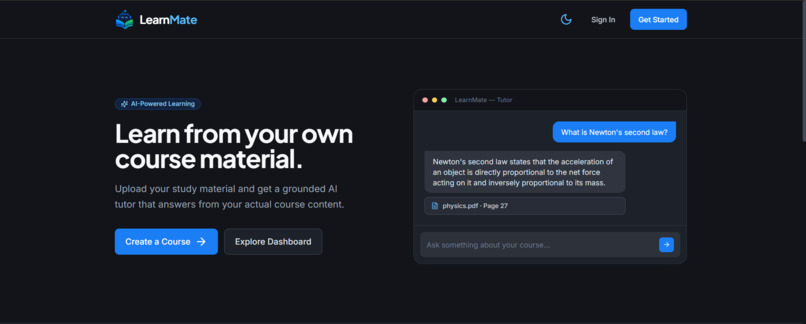
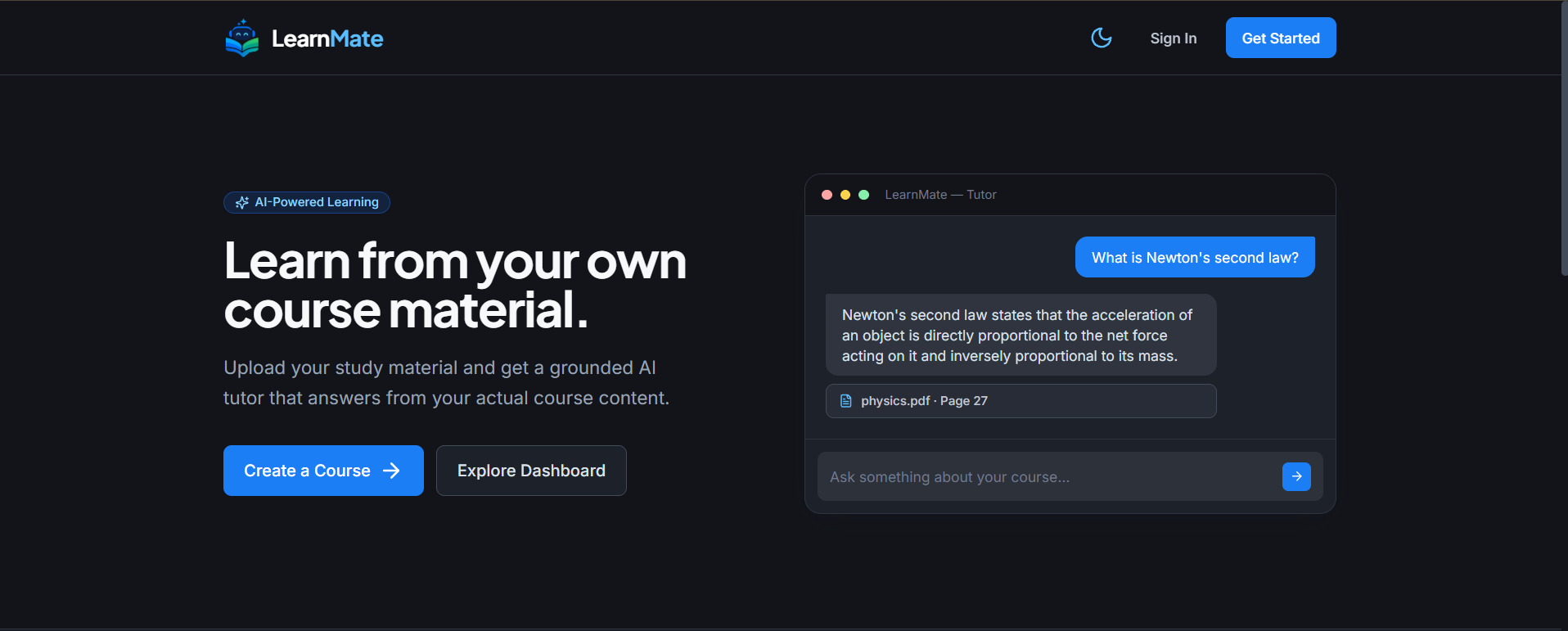
Landing Page
-
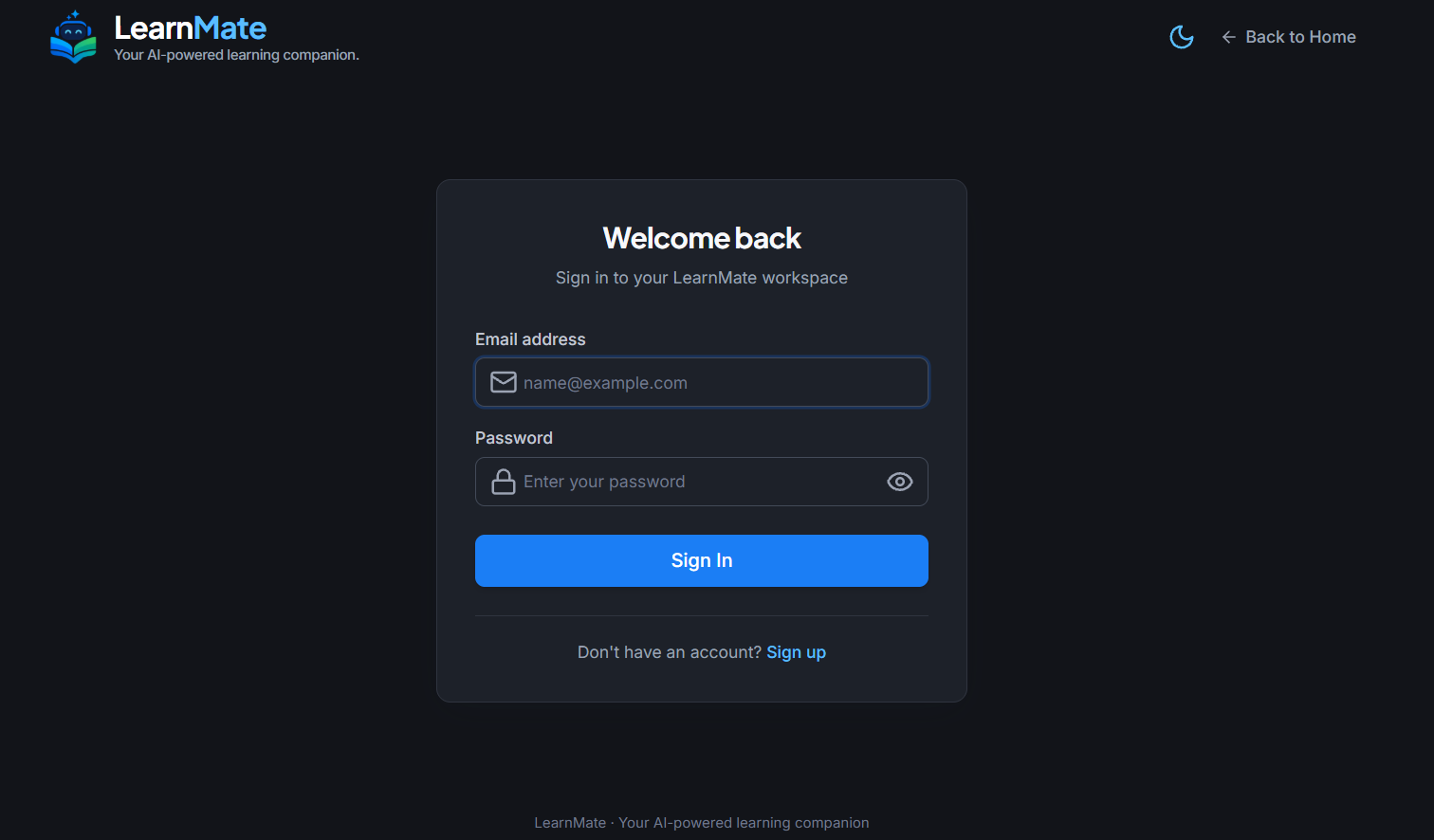
Log in/Sign up Page
-
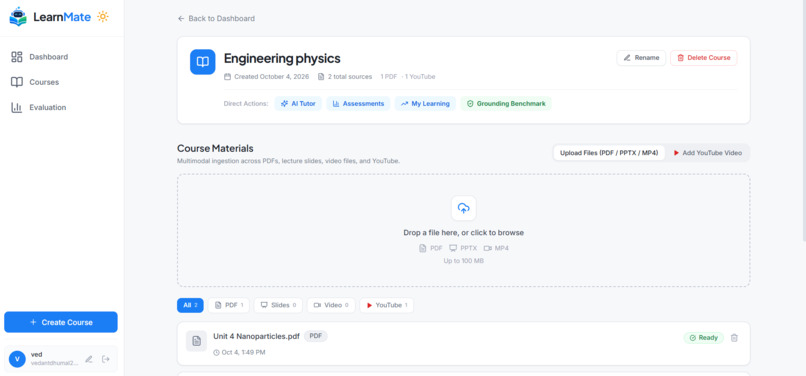
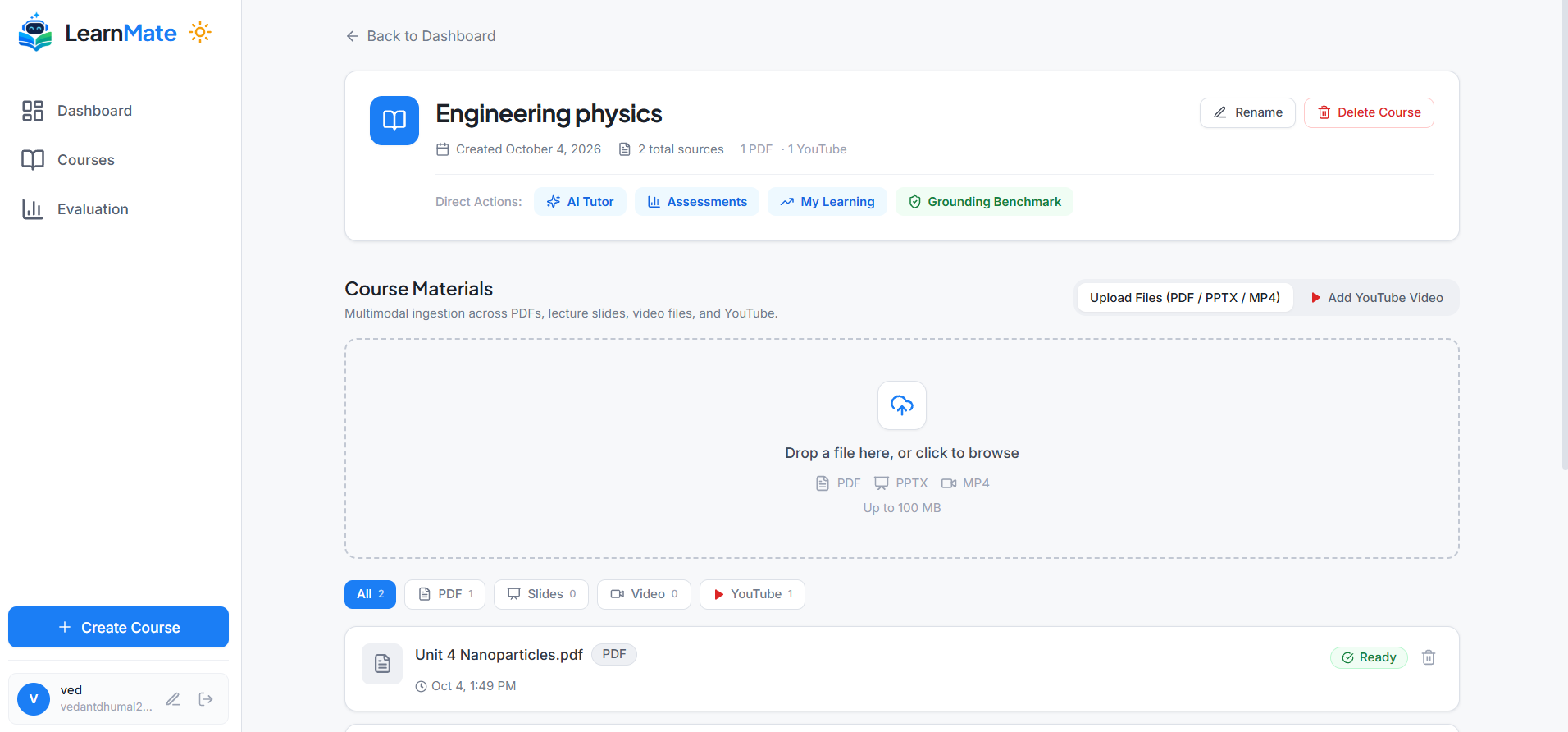
Course Page{
-
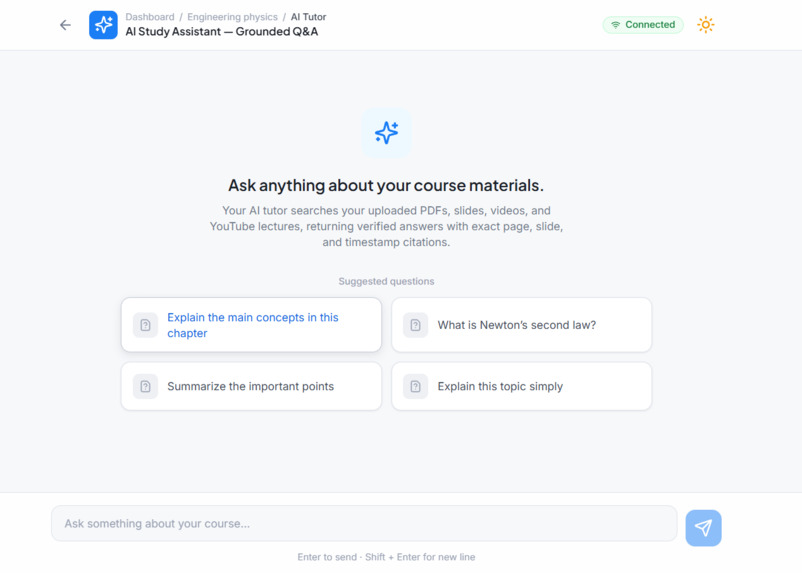
-
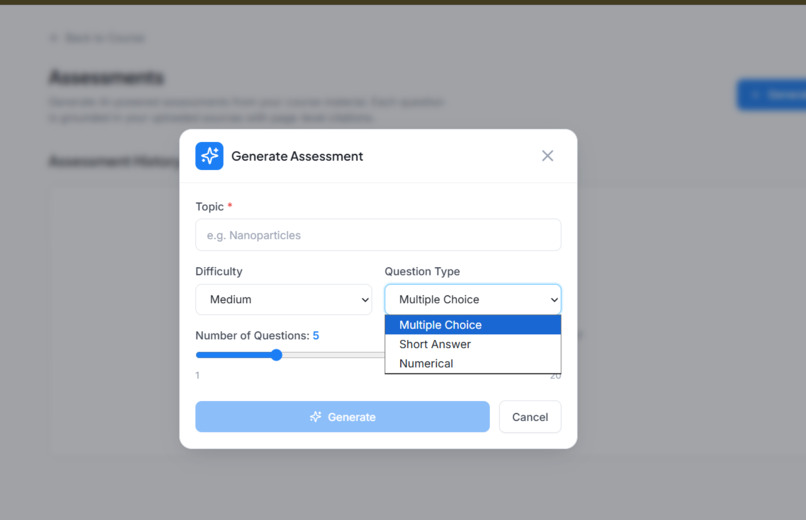
-
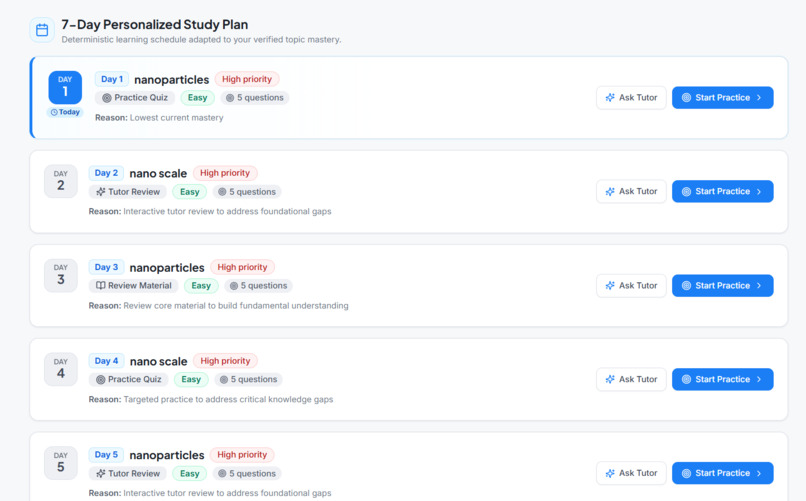
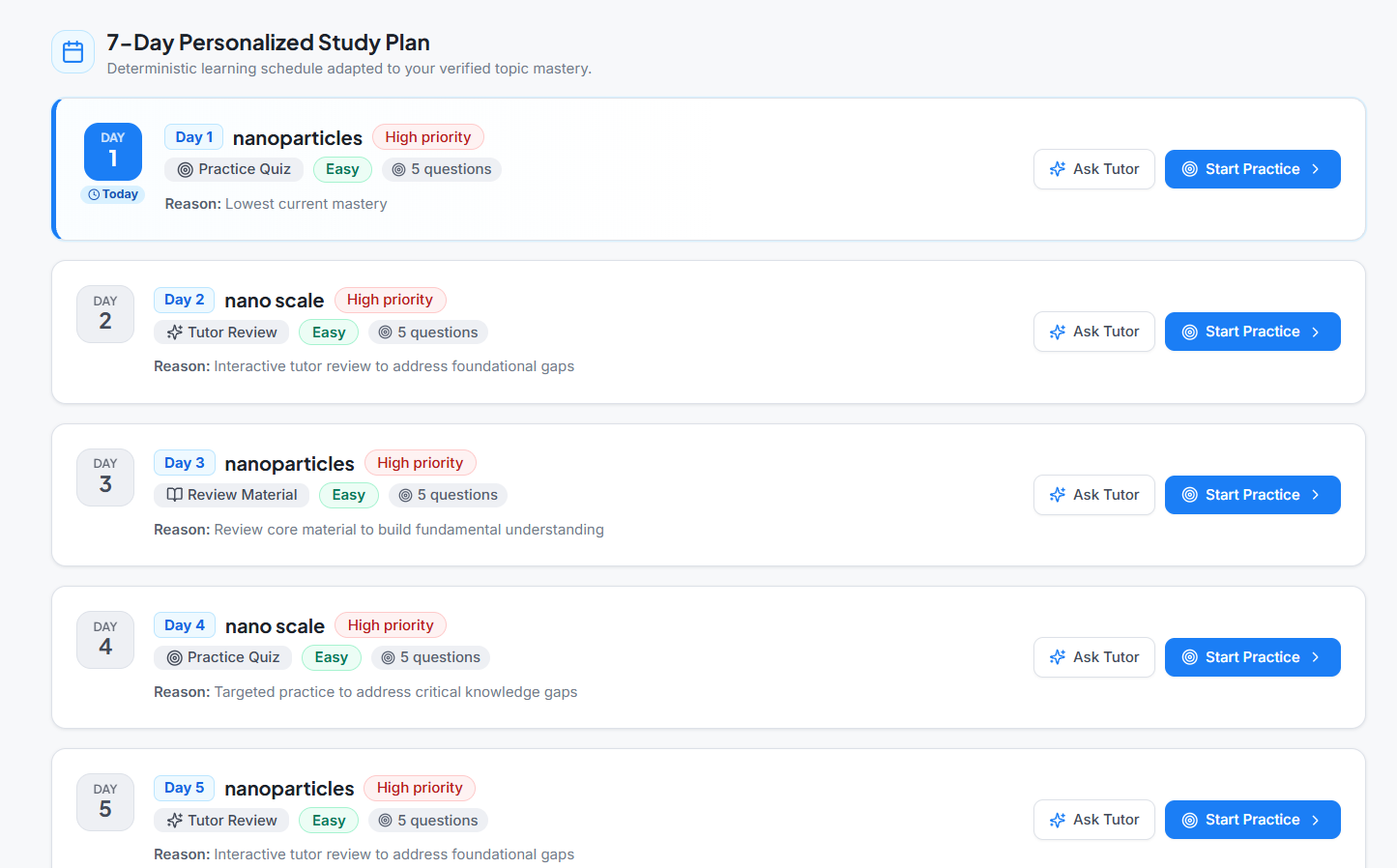
Personalized Study Plan
🎓 The Inspiration
Learning from scattered resources can be frustrating. Students often have PDFs, lecture slides, recorded videos, and YouTube lectures, but there is no single place that truly understands all of that material and helps them learn from it.
I wanted to build something different from a traditional chatbot — an AI learning companion that actually understands a student's course materials and stays grounded in them.
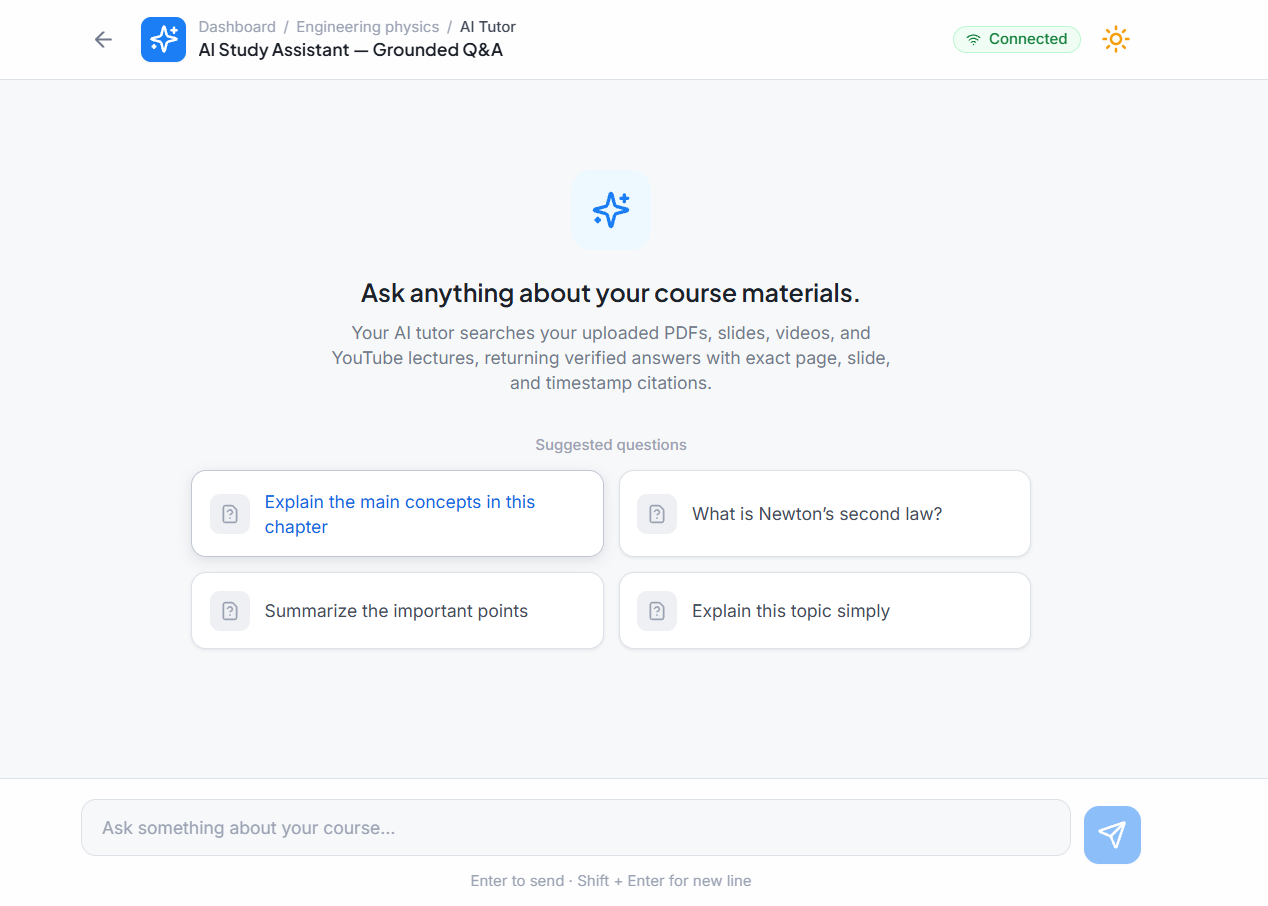
That idea became LearnMate: a multimodal AI-powered learning platform where students can upload PDFs, PowerPoint slides, and videos, or add YouTube lectures, and then interact with an AI tutor that answers questions based on those materials.
The goal was simple:
Turn a collection of learning resources into a personalized AI learning experience.
💡 What I Built
LearnMate combines multimodal ingestion, Retrieval-Augmented Generation (RAG), AI tutoring, assessments, and personalized learning analytics into one platform.
A student can create a course and add learning materials such as:
- 📄 PDF documents
- 📊 PowerPoint presentations
- 🎥 Video files
- ▶️ YouTube lectures
The system processes and indexes these materials so that the AI can retrieve relevant information when the student asks a question.
Instead of simply generating an answer from the model's general knowledge, LearnMate retrieves relevant course content and uses it to generate a grounded response with citations such as document pages, presentation slides, or video timestamps.
Students can then:
Learn → Ask → Practice → Measure → Improve
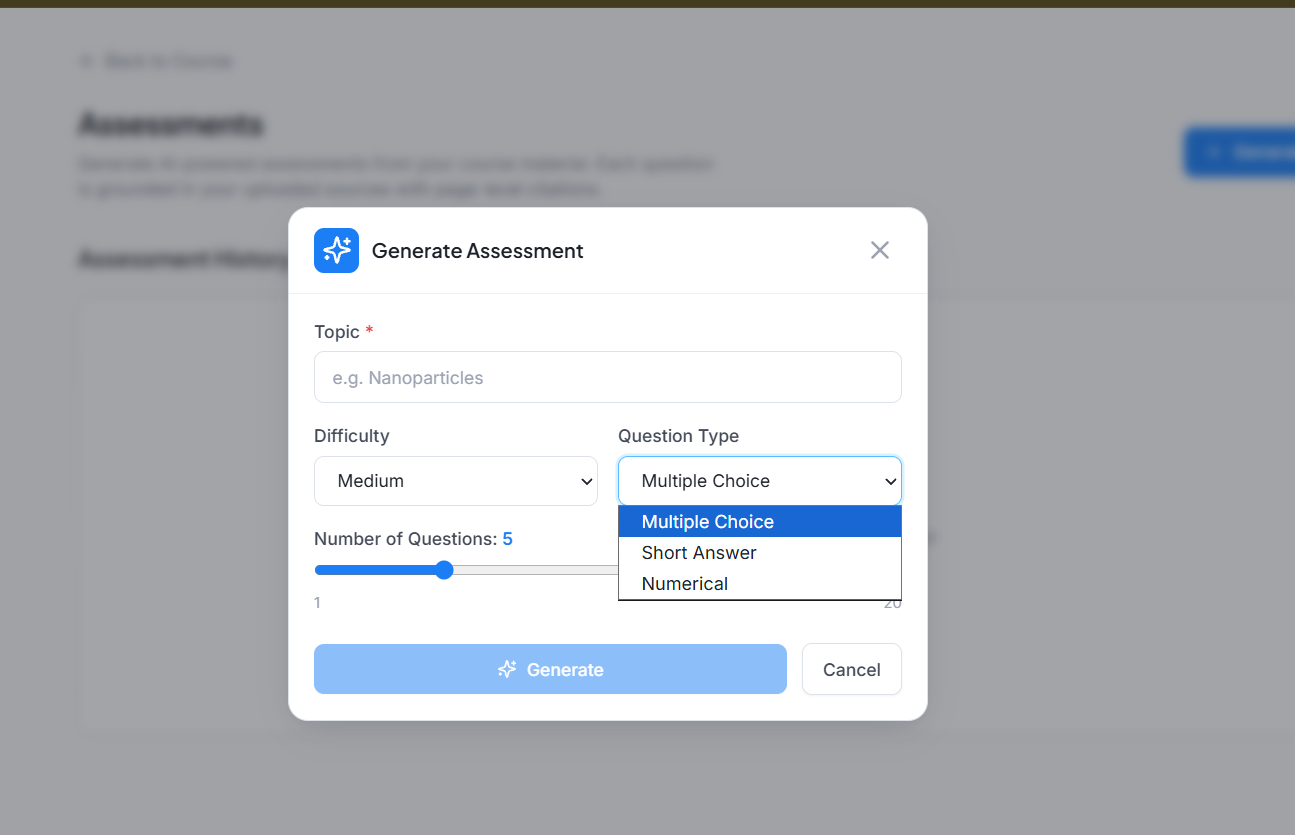
The platform also provides AI-generated assessments and learner analytics to identify knowledge gaps, track topic mastery, and provide personalized recommendations.
🛠️ How I Built It
I built LearnMate as a full-stack application with a modern web frontend and an AI-powered backend.
The frontend uses React and TypeScript, providing the course dashboard, multimodal material management, AI Tutor, assessments, and personalized learning interfaces.
The backend is built around Python and FastAPI, exposing APIs for authentication, courses, material ingestion, AI tutoring, assessments, learner analytics, and evaluation.
For the AI layer, I designed a Retrieval-Augmented Generation (RAG) workflow:
Learning Materials
       ↓
Document / Video Processing
       ↓
Chunking + Metadata
       ↓
Embeddings + Vector Index
       ↓
Relevant Context Retrieval
       ↓
LLM
       ↓
Grounded Response + Citations
This architecture allows LearnMate to connect the AI's responses directly to the learner's own course material.
I also added an evaluation workflow to measure important properties such as faithfulness, context recall, citation precision, and isolation safety. This helped me think beyond simply asking whether an AI answer "sounds good" and instead evaluate whether it is actually grounded in the supplied learning content.
🧠 What I Learned
One of the biggest lessons was that building an AI application is much more than connecting an LLM to a chat interface.
I learned how important the entire AI pipeline is — from ingestion and preprocessing to retrieval, prompt construction, generation, citations, error handling, and evaluation.
I also learned that grounding matters enormously in education. A confident but incorrect answer can be much more harmful when a student is relying on it to learn.
Building LearnMate therefore pushed me to focus on:
- Reliable retrieval
- Source-aware responses
- Citation quality
- Multimodal content processing
- Personalized learning
- Robust API design
- Evaluation of AI behavior
- Clear and useful user experience
I also learned how frontend and backend decisions directly affect an AI product. Features such as processing-status polling, upload handling, authentication, error states, and responsive course management may not look like "AI features," but they are essential for making an AI system genuinely usable.
🚧 Challenges I Faced
One of my biggest challenges was handling different types of educational content.
A PDF, a slide deck, a video, and a YouTube lecture all contain information in very different formats. I need to transform these sources into representations that could be searched and retrieved consistently while preserving useful metadata such as pages, slides, and timestamps.
Another challenge was maintaining grounding.
A language model can generate an answer that sounds convincing even when the retrieved context does not actually support it. I therefore had to think carefully about retrieval quality, citation generation, and evaluation rather than treating the LLM as an unquestionable source of truth.
I also faced practical engineering challenges around:
- Long-running AI operations
- File and video processing
- Upload and processing states
- API timeouts
- Authentication
- Error handling
- Keeping the frontend synchronized with backend processing
- Designing a simple interface around a relatively complex AI pipeline
These challenges ultimately shaped the product and helped me build a system that is not just a demo chatbot, but a more complete learning platform.
🚀 What Makes LearnMate Different
LearnMate is designed around the idea that AI should adapt to the learner's material, not force the learner to adapt to the AI.
Instead of asking students to repeatedly explain what they are studying, LearnMate allows them to bring their existing learning resources into the platform.
From there, those resources become the foundation for:
📚 Course Knowledge → 🤖 AI Tutor → 📝 Assessment → 📊 Mastery → 🎯 Recommendations
My vision is to make learning more personalized, grounded, multimodal, and measurable.
LearnMate started as an idea about making studying easier, but building it taught me something bigger:
The most useful educational AI isn't necessarily the one that knows the most — it's the one that understands what the learner is studying and helps them learn from it effectively.
Built With
- ai
- fastapi
- genrativeai
- llms
- natural-language-processing
- python
- react


Log in or sign up for Devpost to join the conversation.