-
-
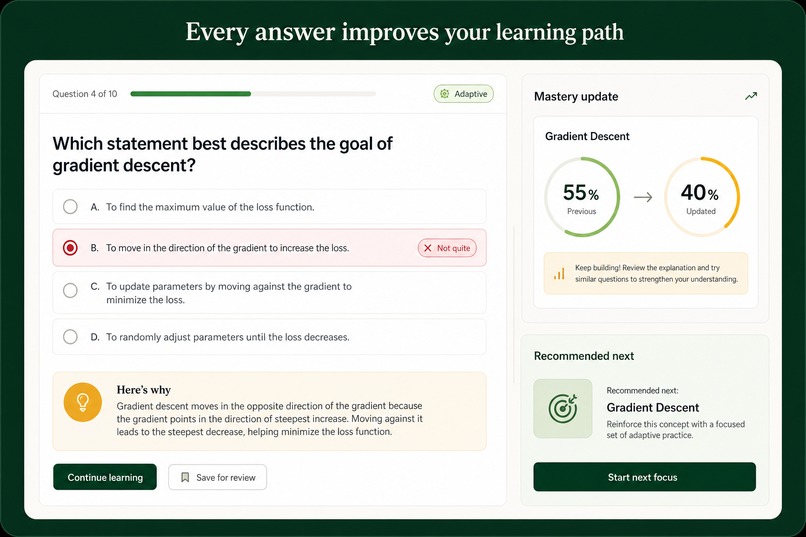
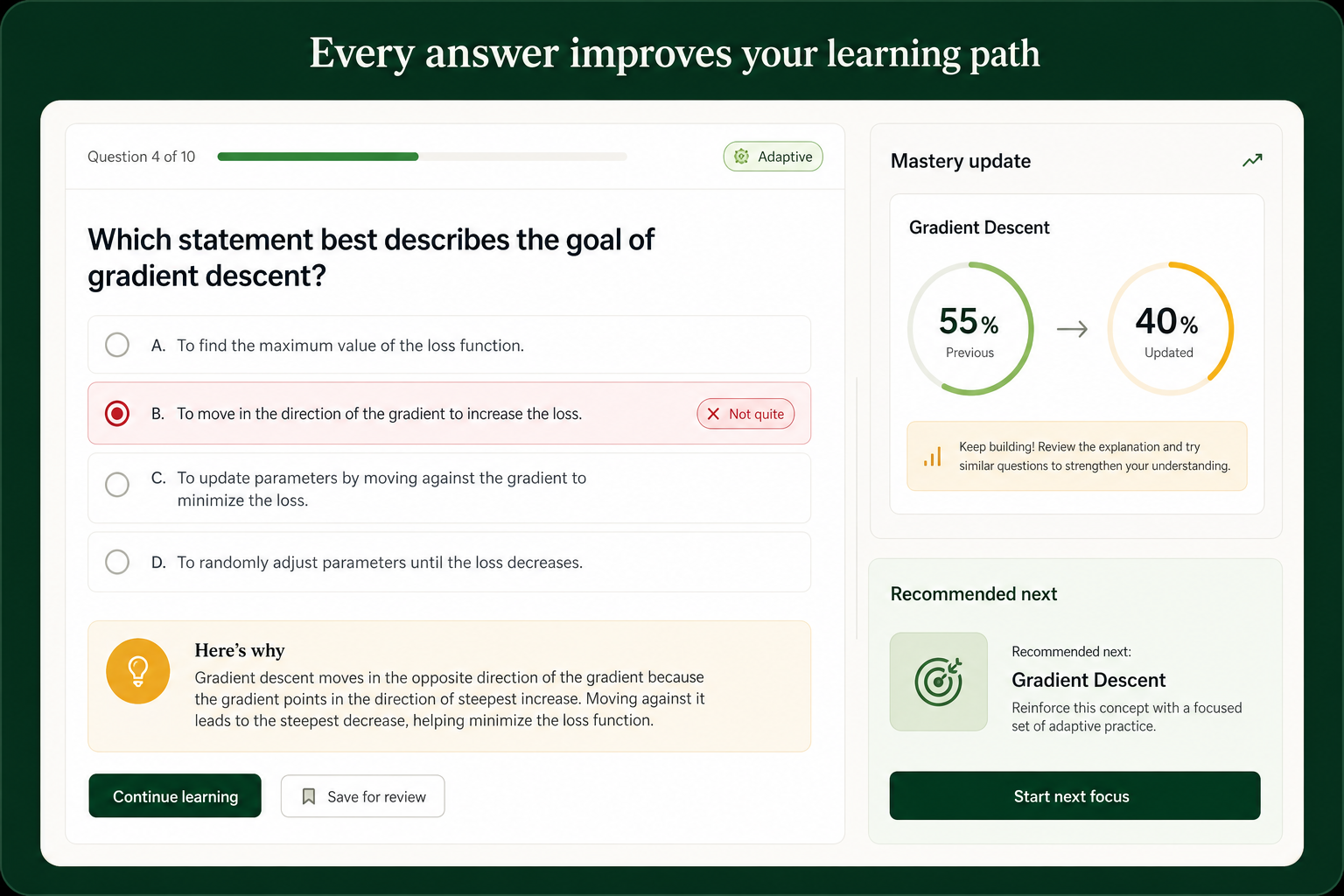
Adaptive Quiz and Mastery Dashboard
-
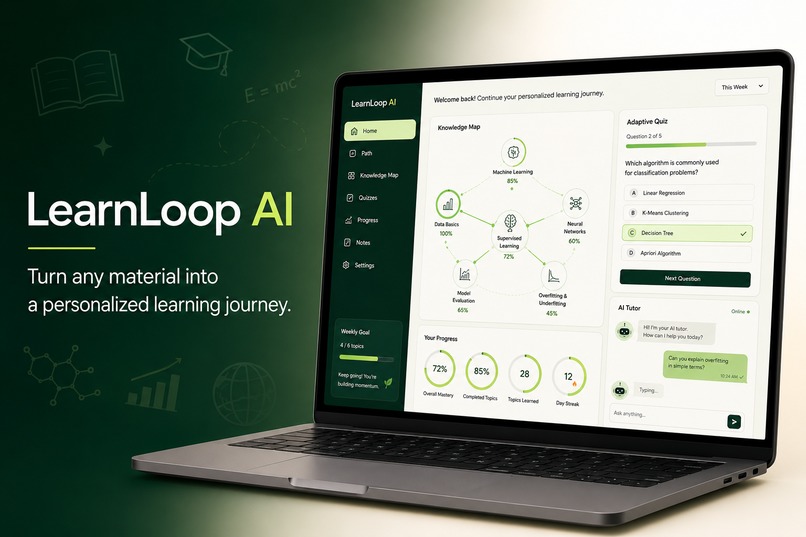
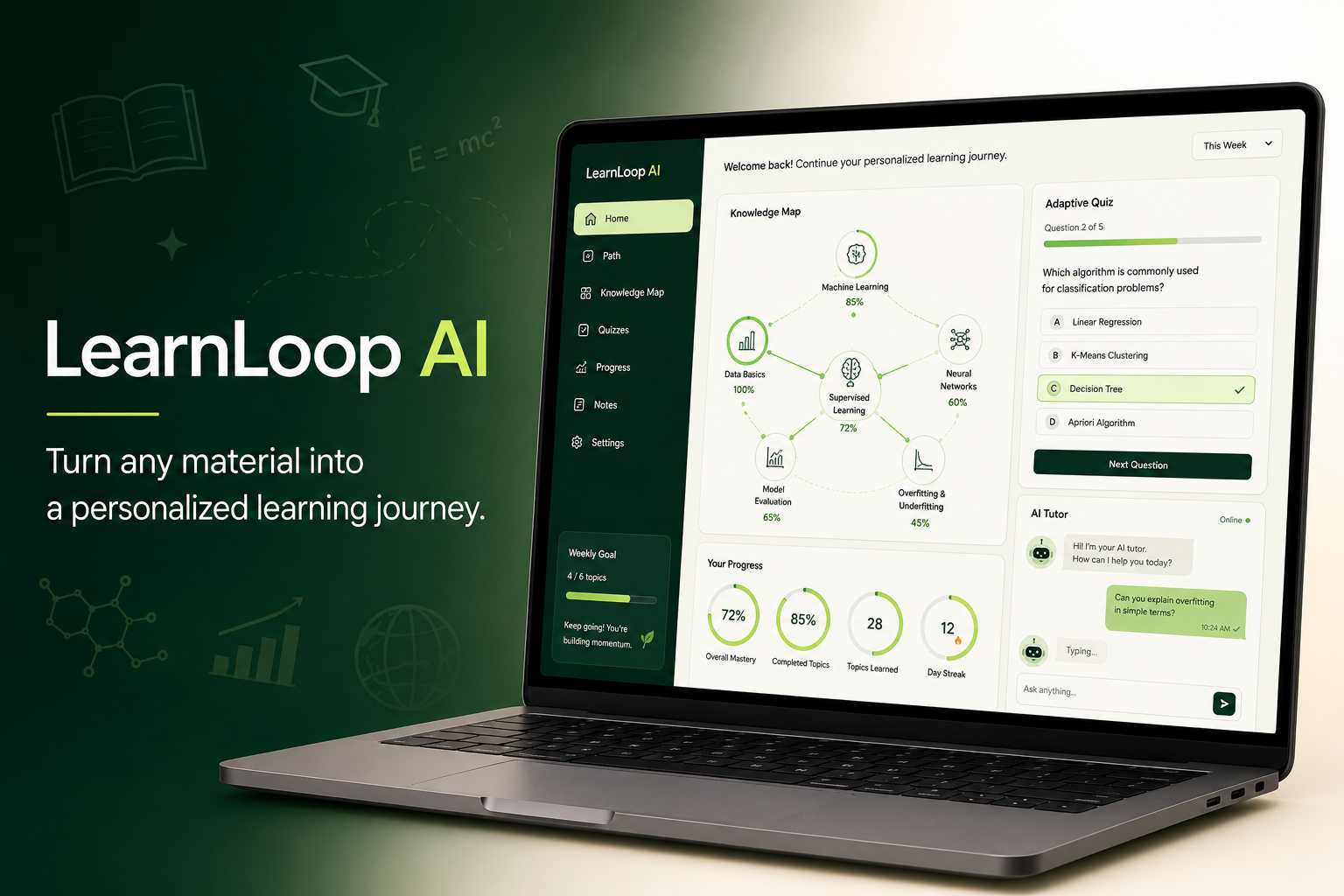
LearnLoop AI Adaptive Learning Dashboard
-
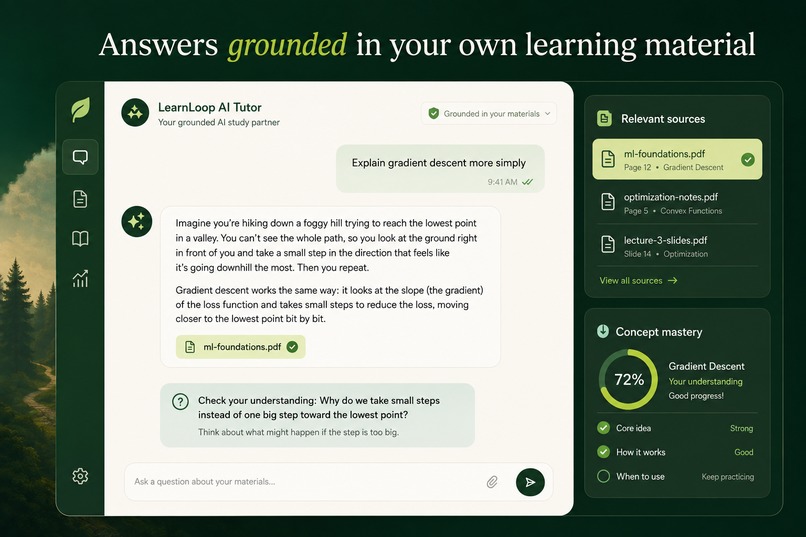
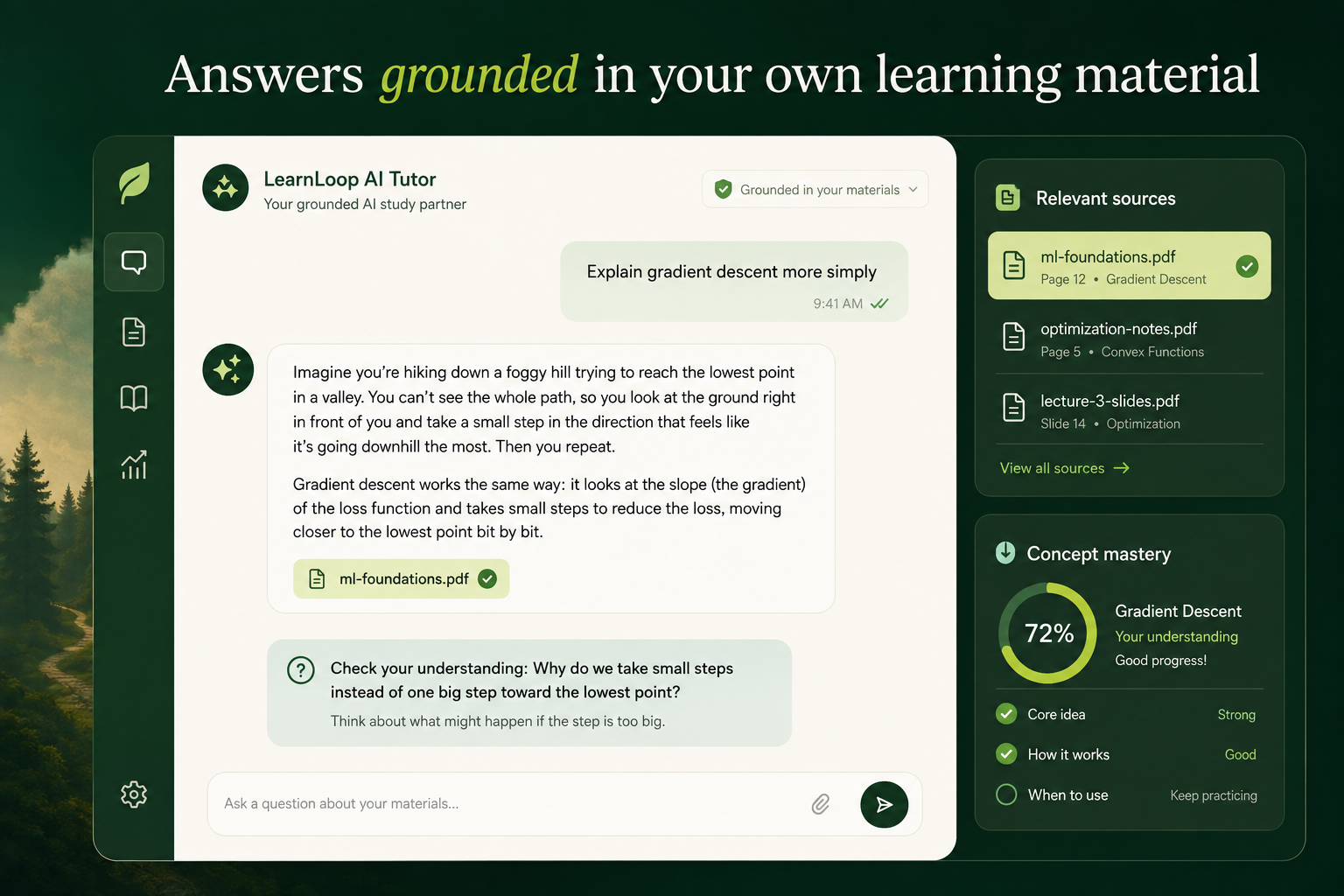
LearnLoop AI explains gradient descent simply
-
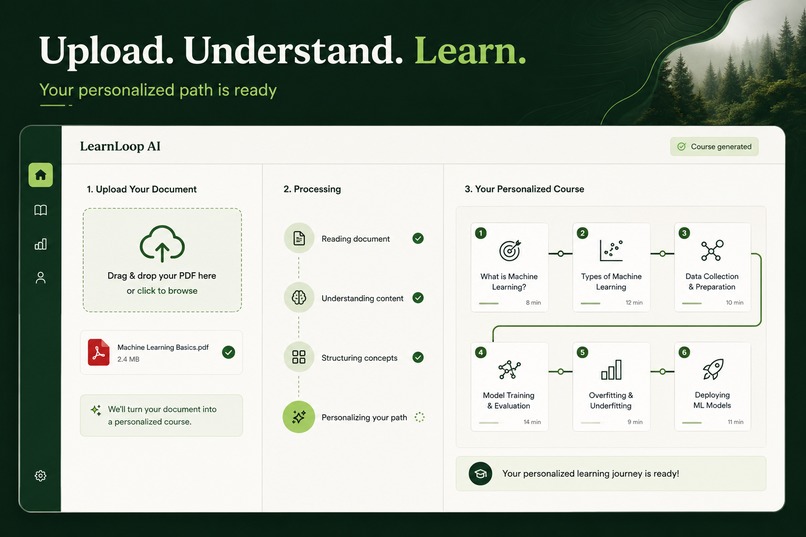
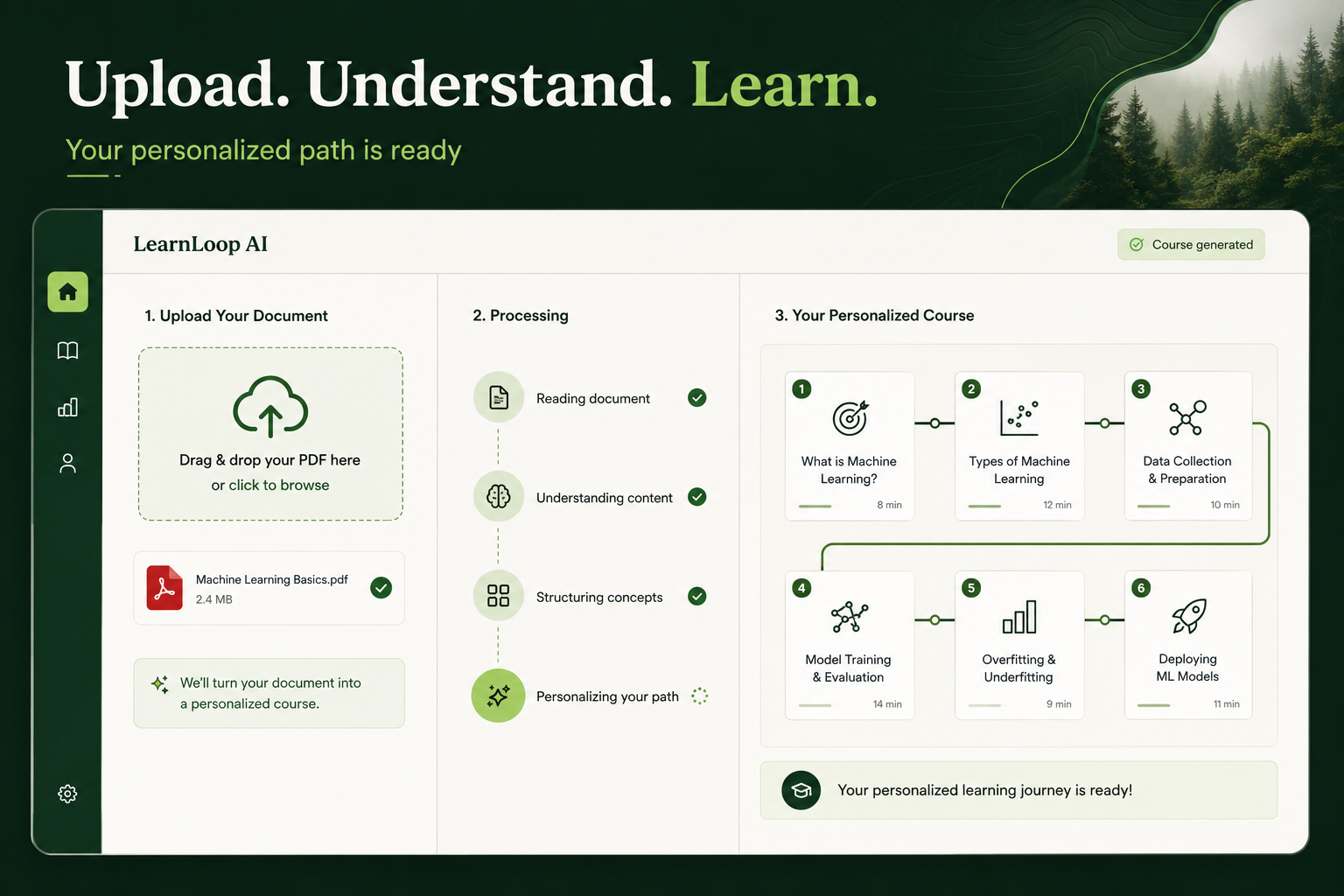
PDF to personalized learning path
Inspiration
Learning resources are everywhere, but they rarely adapt to the individual learner. Students often spend time rereading material without knowing which concepts they truly understand or what they should study next. We built LearnLoop AI to transform static learning materials into personalized, interactive learning journeys.
What it does
LearnLoop AI allows users to upload a PDF, text file, Markdown document, or their own notes. It analyzes the material, identifies important concepts and prerequisites, and automatically creates a visual knowledge map.
The platform generates adaptive quizzes, tracks mastery for each concept, recommends the learner’s next focus area, and provides an AI tutor that answers questions using the uploaded material. When a learner answers incorrectly, LearnLoop updates their mastery score and prioritizes that weak concept in future quizzes and explanations.
How we built it
We built the frontend with React, TypeScript, and Vite, creating a responsive dashboard for courses, quizzes, progress tracking, and tutor conversations. The backend uses FastAPI, Python, SQLAlchemy, and SQLite to manage courses, documents, concepts, quiz results, and mastery scores.
Uploaded documents are extracted, divided into manageable sections, and analyzed to identify recurring concepts. The tutor retrieves the most relevant parts of the learning material before generating a grounded response. LearnLoop runs locally in a deterministic demo mode without an API key, while also supporting OpenAI-compatible language models through environment configuration.
We implemented an explainable mastery formula. After a correct answer, mastery increases according to:
$$ M_{\text{new}} = M_{\text{old}} + (100-M_{\text{old}})\times 0.28 $$
After an incorrect answer, mastery decreases according to:
$$ M_{\text{new}} = M_{\text{old}}\times 0.72 $$
This allows the learning path to continuously adapt while remaining transparent and easy to demonstrate.
Challenges we ran into
One major challenge was generating useful concepts and quizzes without making the application dependent on a paid AI service. We solved this by creating a deterministic local processing mode while keeping the architecture ready for external language models.
Another challenge was making the platform genuinely adaptive instead of building another basic “chat with a PDF” application. We connected every quiz answer to concept-level mastery, recommendations, and future quiz selection so that learner behavior directly changes the experience.
We also had to balance retrieval quality, response speed, and simplicity. For the hackathon MVP, we selected lightweight lexical retrieval and SQLite, which make the project easy to run while preserving clear upgrade paths to vector search and PostgreSQL.
Accomplishments that we're proud of
We are proud that LearnLoop AI delivers a complete learning cycle: upload, understand, practice, measure, adapt, and improve. The platform works without external AI credentials, making it immediately accessible to judges, teachers, and students.
We also created an interactive knowledge map, grounded tutor responses with source references, adaptive quizzes, and an explainable mastery system. Finally, we packaged the project with automated API tests, Docker support, responsive design, sample learning content, and complete documentation.
What we learned
We learned that personalization requires more than generating content. A useful educational AI system needs to model what the learner knows, respond to mistakes, and make deliberate decisions about what should happen next.
We also learned the importance of designing graceful fallbacks for AI applications. Separating deterministic learning logic from optional language-model generation made LearnLoop more reliable, affordable, and easier to demonstrate.
What's next for LearnLoop AI
Next, we plan to add semantic retrieval with embeddings and Qdrant, PostgreSQL persistence, authentication, and support for DOCX files, web pages, audio transcripts, and video lessons. We also want to introduce spaced repetition, teacher dashboards, shared classrooms, multilingual courses, and accessibility features.
For more advanced personalization, we plan to explore Bayesian Knowledge Tracing and Item Response Theory. Our long-term goal is to make LearnLoop AI a learning companion that understands each student’s progress and continually chooses the most effective explanation, example, and activity for them.
Built With
- adaptive-learning
- artificial-intelligence
- css
- docker
- fastapi
- generative-ai
- html
- httpx
- javascript
- machine-learning
- natural-language-processing
- nginx
- openai
- pdf-processing
- pydantic
- pytest
- python
- rag
- react
- rest-api
- sqlalchemy
- sqlite
- typescript
- vite

Log in or sign up for Devpost to join the conversation.