-
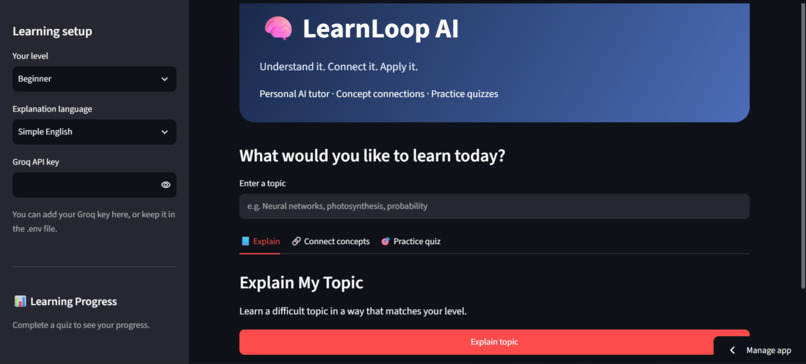
Home Page
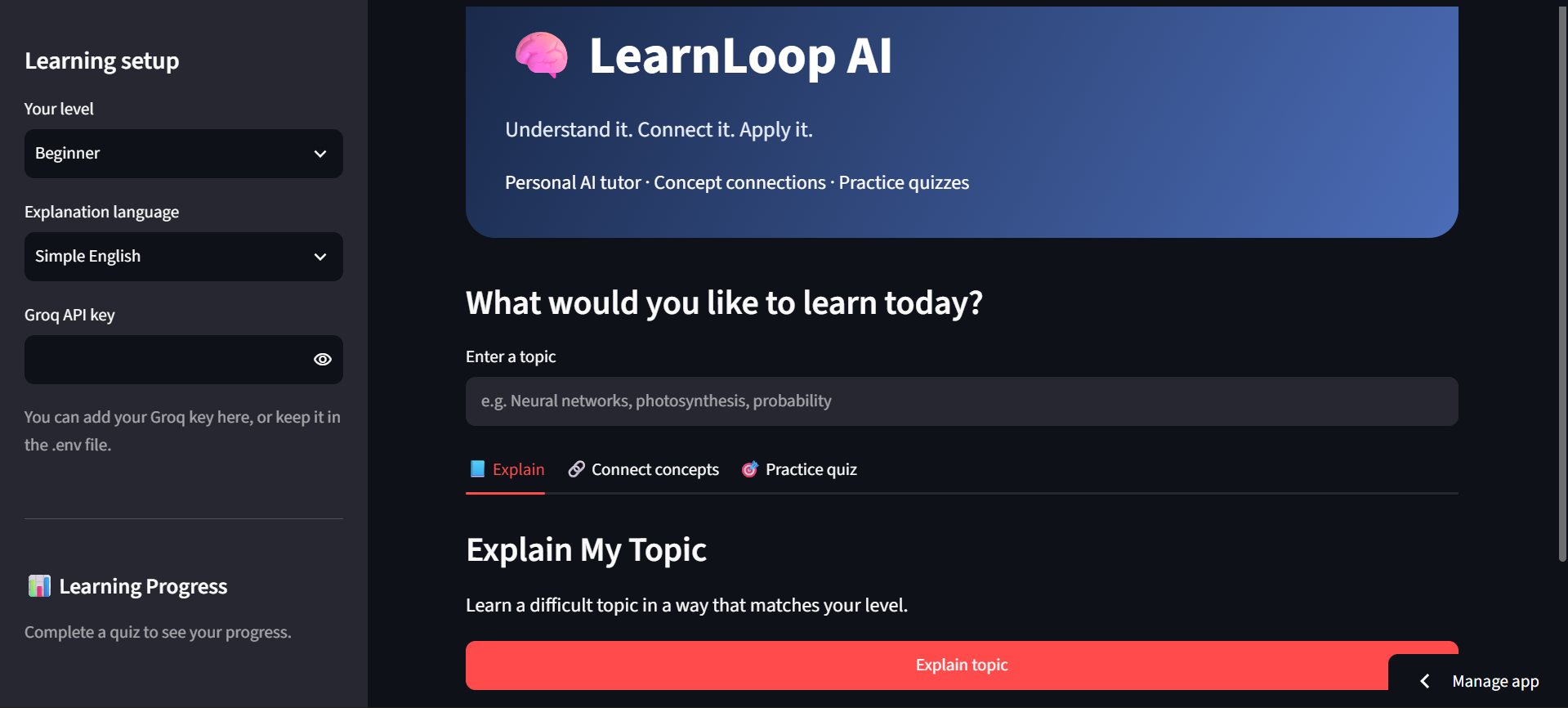
Inspiration
Many students use AI tools to get quick answers, but getting an answer is not always the same as actually learning.
We wanted to build something that makes AI more useful as a learning companion. This idea led us to LearnLoop AI — a simple platform that helps students understand a topic, connect related concepts, practice through quizzes, and identify what they should study next.
Our main idea is:
Understand → Connect → Practice → Measure → Improve
What it does
LearnLoop AI is an AI-powered personal learning assistant designed for students.
Users can:
- Enter any topic and get a structured explanation.
- Choose their learning level: Beginner, Intermediate, or Advanced.
- Choose English, Bangla, or English + Bangla explanations.
- Discover related concepts and understand how they connect.
- Generate interactive quizzes with 3, 5, or 7 questions.
- Submit answers and instantly see their score.
- Review correct answers and explanations.
- Track quiz performance during the current session.
- Receive AI-generated study suggestions based on quiz performance.
Instead of only answering questions, LearnLoop creates a simple learning loop that encourages students to learn, practice, review, and improve.
How we built it
We built LearnLoop AI using Python and Streamlit for the application and user interface.
The main AI functionality is powered by the Groq API using the openai/gpt-oss-120b model.
The application sends structured prompts to the AI for:
- Topic explanations
- Concept connections
- Quiz generation
- Quiz explanations
- Personalized study suggestions
We used JSON-based structured output for quiz data so that questions, options, correct answers, and explanations could be processed reliably inside the application.
We also added session-based progress tracking so users can see their quiz history, completed quizzes, and average score during their learning session.
For deployment, we used Streamlit Community Cloud and kept API credentials outside the source code using environment variables and Streamlit Secrets.
Challenges we ran into
One of the main challenges was making AI-generated quiz content reliable enough for an interactive quiz system. The AI needs to return structured questions and answers that the application can process correctly.
We also had to handle cases where AI responses could contain unexpected formatting instead of clean JSON.
Another challenge was choosing a reliable AI model through the Groq API and handling API configuration securely without exposing credentials in the public GitHub repository.
Finally, we focused on making the interface simple enough for students to use without feeling overwhelmed by too many options.
Accomplishments that we're proud of
We are proud that we turned the idea into a working and publicly accessible application.
Some key accomplishments include:
- Built a complete AI-powered learning workflow.
- Added structured topic explanations.
- Added concept connection and relationship discovery.
- Built interactive AI-generated quizzes.
- Added instant scoring and answer explanations.
- Added session-based learning progress tracking.
- Added personalized AI study suggestions.
- Added English, Bangla, and bilingual learning support.
- Added Beginner, Intermediate, and Advanced learning levels.
- Deployed the application publicly with Streamlit Community Cloud.
- Created a public GitHub repository with documentation.
Most importantly, LearnLoop is not just an AI chatbot. It combines learning, practice, feedback, and next-step guidance into one workflow.
What we learned
Building LearnLoop taught us how to turn an AI idea into a practical end-to-end application.
We learned how to:
- Integrate an LLM API into a real application.
- Design prompts for different learning tasks.
- Work with structured AI-generated JSON.
- Handle AI response errors and unexpected output.
- Build interactive interfaces with Streamlit.
- Manage API keys securely using environment variables and secrets.
- Track user interactions with Streamlit session state.
- Deploy an AI application to the cloud.
- Design an AI experience around a real user problem instead of simply adding AI to an existing interface.
We also learned that a good AI application needs more than a powerful model. The user experience, structure, reliability, and feedback loop are equally important.
What's next for LearnLoop AI
We want to make LearnLoop a more complete personalized learning platform.
Future improvements could include:
- Persistent student profiles
- Long-term learning history
- Topic-wise progress tracking
- Adaptive quiz difficulty
- Spaced repetition
- Personalized learning plans
- Visual concept maps
- Multi-topic learning paths
- Learning achievements and milestones
- Collaborative learning features
Our long-term goal is to make LearnLoop an AI learning companion that understands a student's progress and continuously helps them decide what to learn, what to practice, and what to improve next.

Log in or sign up for Devpost to join the conversation.