Inspiration
LearnLocal was inspired by experiences working with local food and community organizations.
As part of leadership roles with a nonprofit community farm and youth-led food initiatives, we witnessed a recurring challenge in local food systems: food availability does not automatically translate into food access or food use.
Even in agricultural regions with abundant local produce, many low-income and farmworker communities continue to experience barriers to healthy food access. Cost perception plays a role—processed foods are often seen as cheaper, easier, or more familiar than fresh produce.
At the same time, organizations working to improve food access face another challenge: education and outreach.
Many families receive produce but may not know:
- What it is
- How to prepare it
- Why it matters nutritionally
- When it is in season
- How it connects to local sustainability and agriculture
Creating educational materials and outreach programs is expensive, time intensive, and difficult to scale.
We asked:
What if AI could help local organizations turn food into learning?
That question became LearnLocal.
What it does
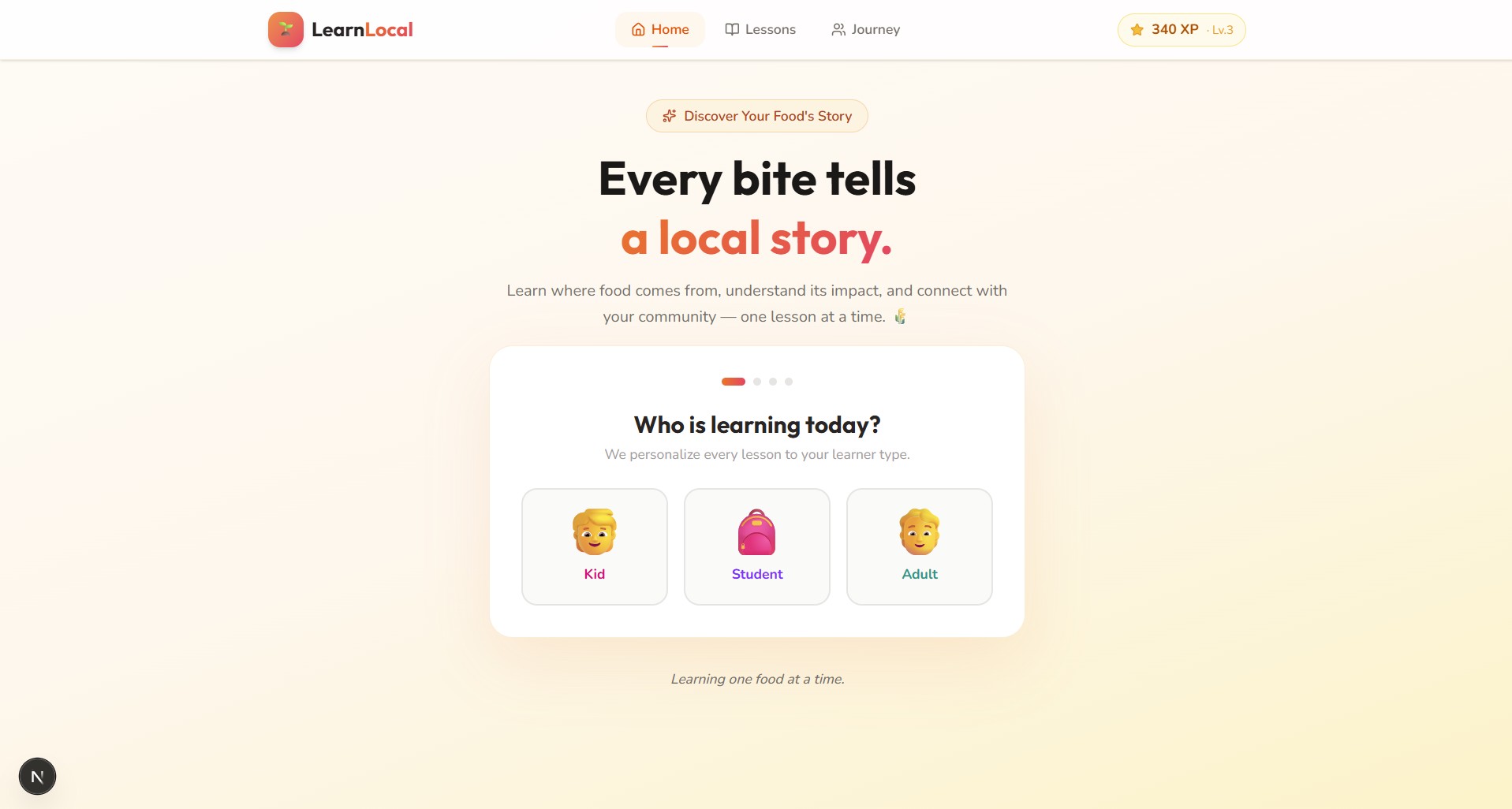
LearnLocal is an AI-powered educational platform that transforms local food information into engaging and accessible learning experiences.
Instead of generating generic content, LearnLocal combines AI with trusted local context to create lessons that are grounded in community knowledge.
Users can:
- Explore local foods and their stories
- Learn about seasonality and sustainability
- Discover preparation ideas and usage guidance
- Engage with community-focused educational content
- Receive personalized lessons that remain persistent across sessions
The goal is not only to teach about food—but to help strengthen connections between people, their communities, and local agriculture.
How we built it
LearnLocal was built as a full-stack web application focused on grounded AI generation.
Our system includes:
- Next.js (App Router) for the web application
- Tailwind CSS for UI development
- Claude API for educational lesson generation
- Static grounding datasets using structured JSON files
- Redis memory layer to persist educational context
To improve quality, we implemented a grounding pipeline:
- User selects or explores a topic
- Structured food and community datasets are retrieved
- Local context is injected into prompts
- AI generates educational content
- Results are stored for continuity and personalization
This architecture helps reduce hallucination while keeping lessons locally relevant.
Challenges we ran into
One of the biggest challenges was balancing AI flexibility with educational trustworthiness.
AI can generate content quickly, but educational systems require accuracy and meaningful context.
We faced challenges including:
- Preventing generic AI responses
- Structuring local food data
- Designing memory without over-personalization
- Creating lessons that remain engaging while grounded
Another challenge was maintaining simplicity while supporting future expansion into community and nonprofit use cases.
Accomplishments that we're proud of
We are proud that LearnLocal goes beyond a standard AI chatbot.
Key accomplishments include:
- Built a grounded AI lesson generation pipeline
- Integrated persistent memory for improved continuity
- Connected educational content with community values
- Designed for accessibility and scalability
- Created a concept that supports nonprofits rather than replacing them
Most importantly, we built something rooted in a real community problem.
What we learned
This project taught us that effective AI systems are not built by adding more generation—they are built by adding better context.
We learned:
- Grounding improves educational quality
- Community knowledge matters as much as technical architecture
- Simplicity often creates stronger user experiences
- AI works best when augmenting human efforts
We also gained experience designing full-stack AI systems that combine memory, structured data, and user interaction.
What's next for LearnLocal
This project is only the beginning.
Next steps include:
- Expanding the local food knowledge base
- Supporting multilingual educational content
- Adding recipes and meal guidance
- Introducing nonprofit and educator dashboards
- Measuring learning outcomes
- Connecting with local food hubs and community organizations
Long term, we envision LearnLocal becoming a platform that helps communities transform food access into food empowerment.
Built With
- claude
- css
- json
- next.js
- redis
- tailwind
- typescript


Log in or sign up for Devpost to join the conversation.