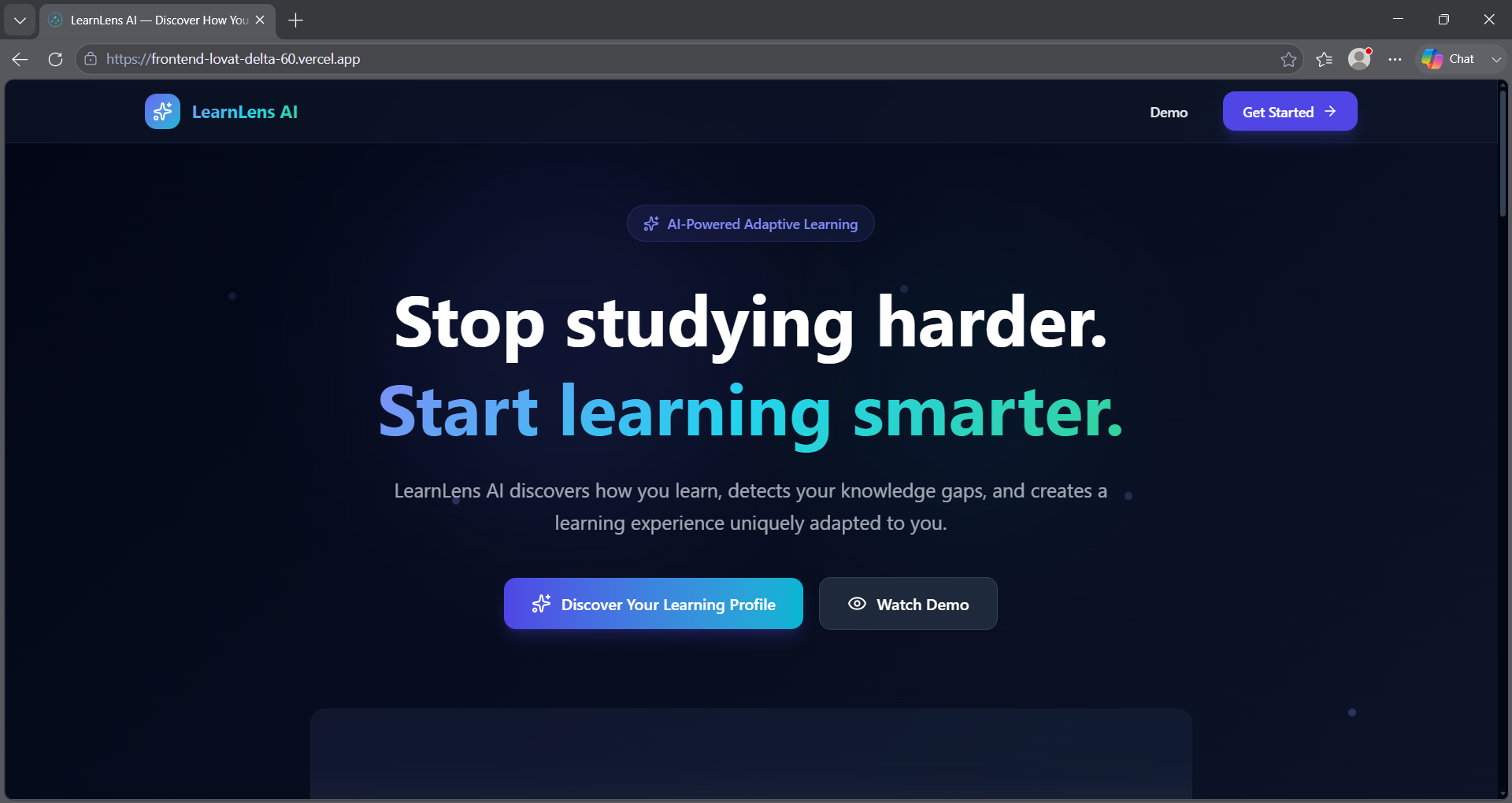
Inspiration
Most learning platforms give everyone the same content at the same difficulty. Students memorize answers without truly understanding concepts. I wanted to build something that sees how you actually think — not just whether you clicked the right option. The key insight: when a student gets a question wrong, the real question isn't "what's the correct answer?" — it's "what misconception caused this error?"
What it does
LearnLens AI is an adaptive learning platform with 3 core innovations:
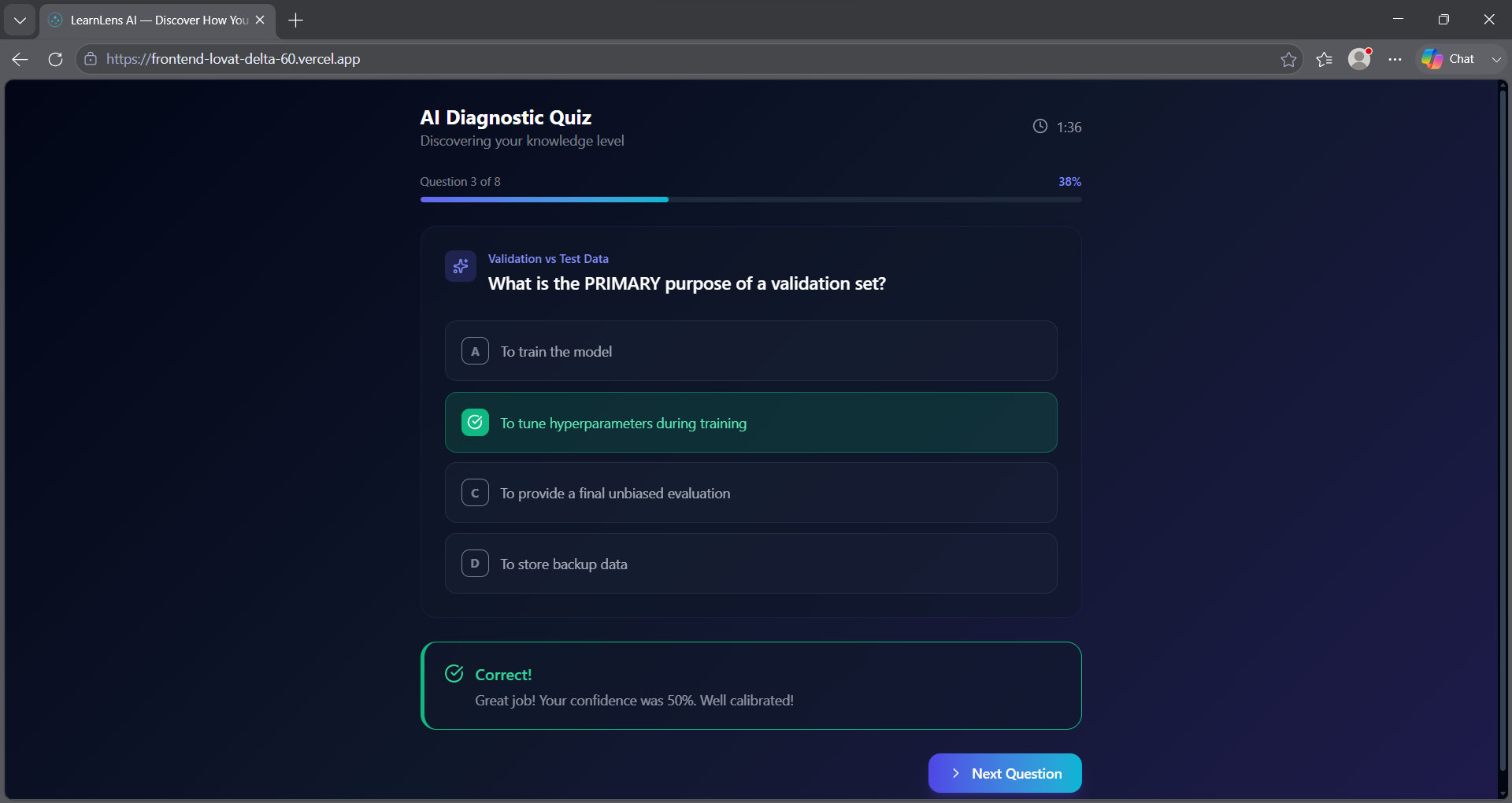
AI Misconception Detection — When you answer incorrectly, the AI identifies the exact belief causing the error, explains why you're confused, and gives a targeted corrective exercise. Instead of "Wrong answer," it says "You're confusing X with Y. Here's why."
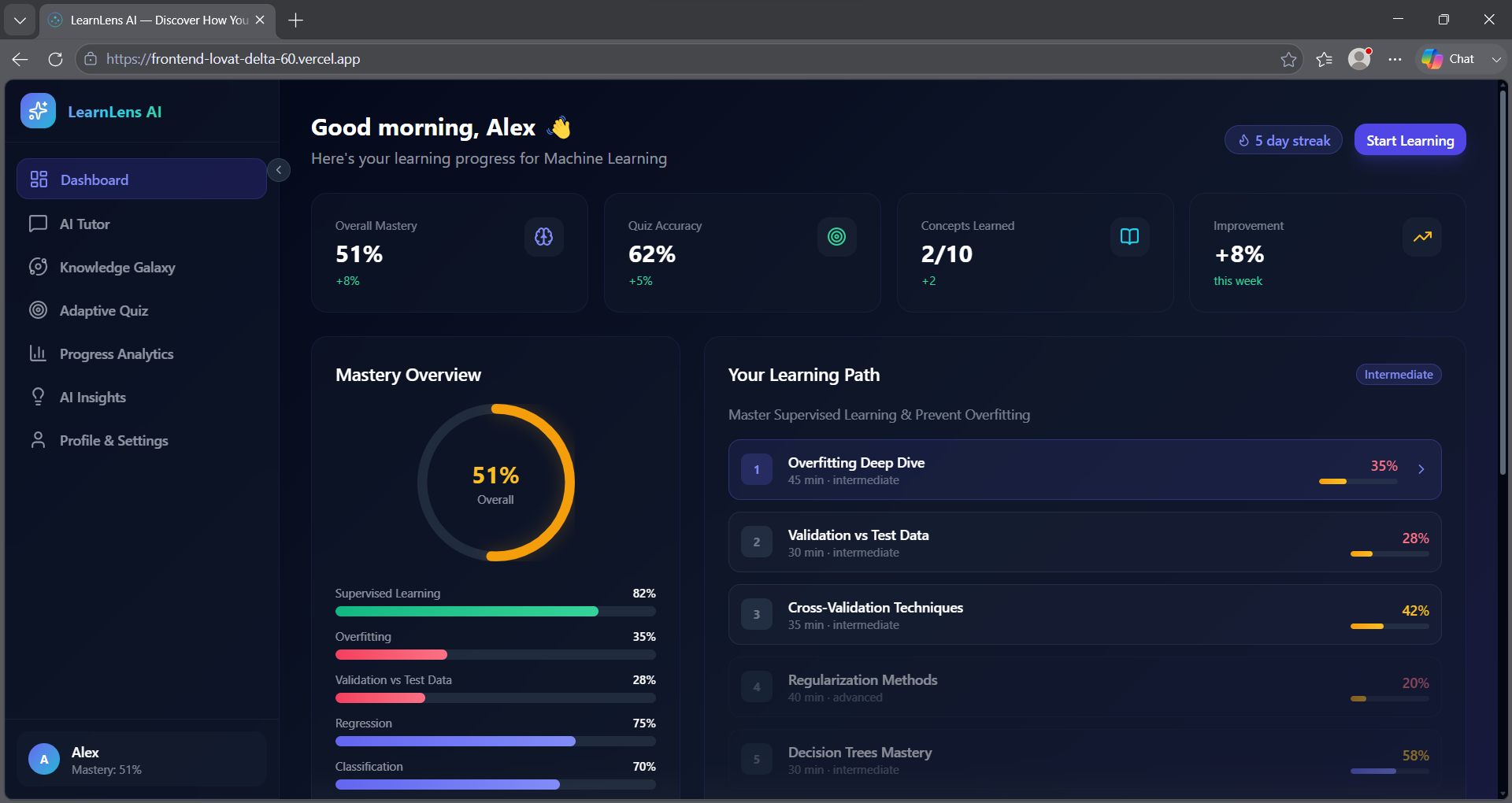
Mastery Lens Algorithm — Multi-dimensional scoring that goes beyond accuracy: $$\text{Mastery} = 0.40 \times \text{Accuracy} + 0.20 \times \text{Confidence} + 0.15 \times \text{Speed} + 0.15 \times \text{Consistency} + 0.10 \times \text{Improvement}$$
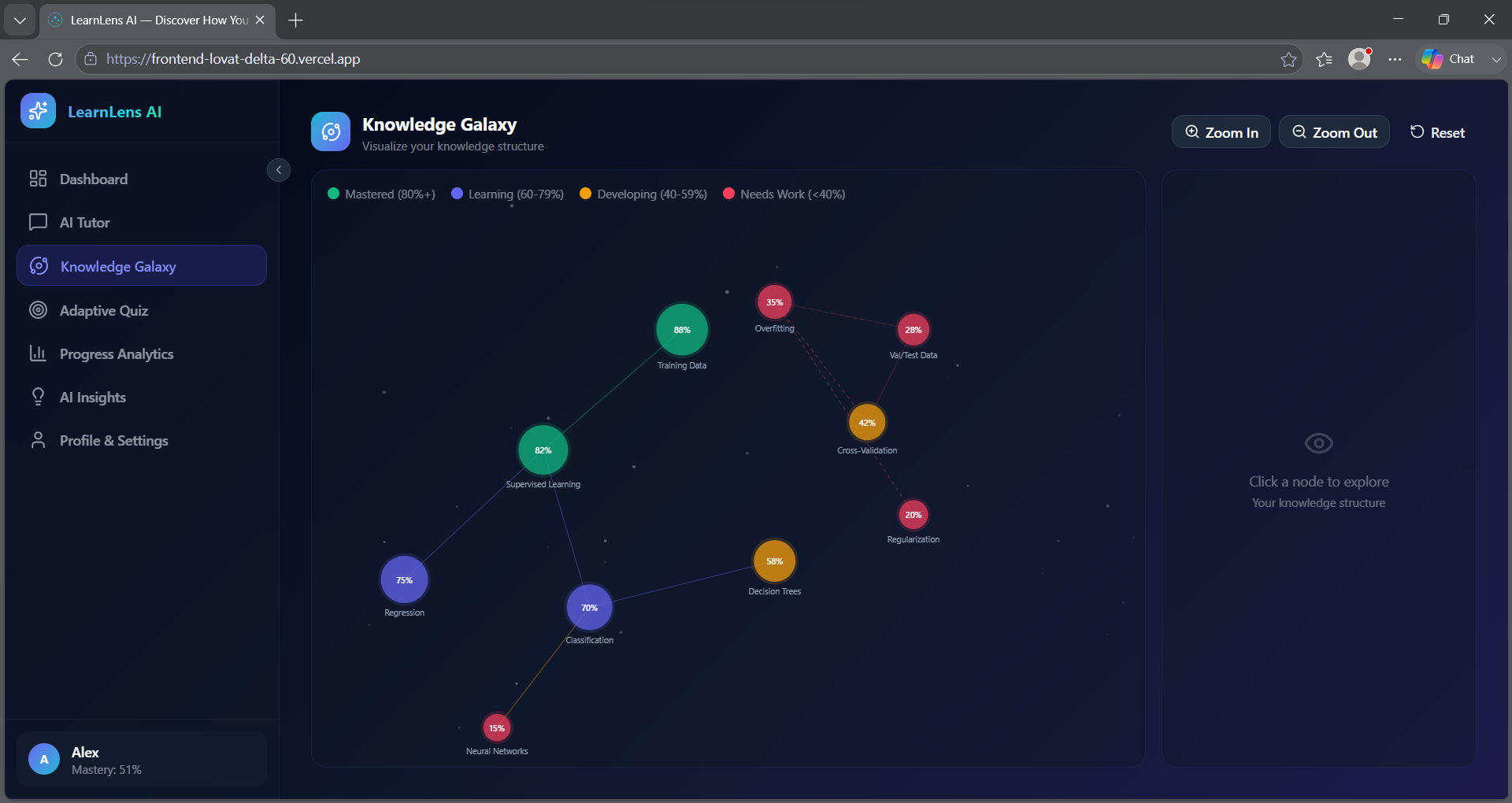
Knowledge Galaxy — Interactive SVG visualization where every concept is a node. Node size = mastery level, color = progress, connections = related concepts. Students literally see their knowledge gaps.
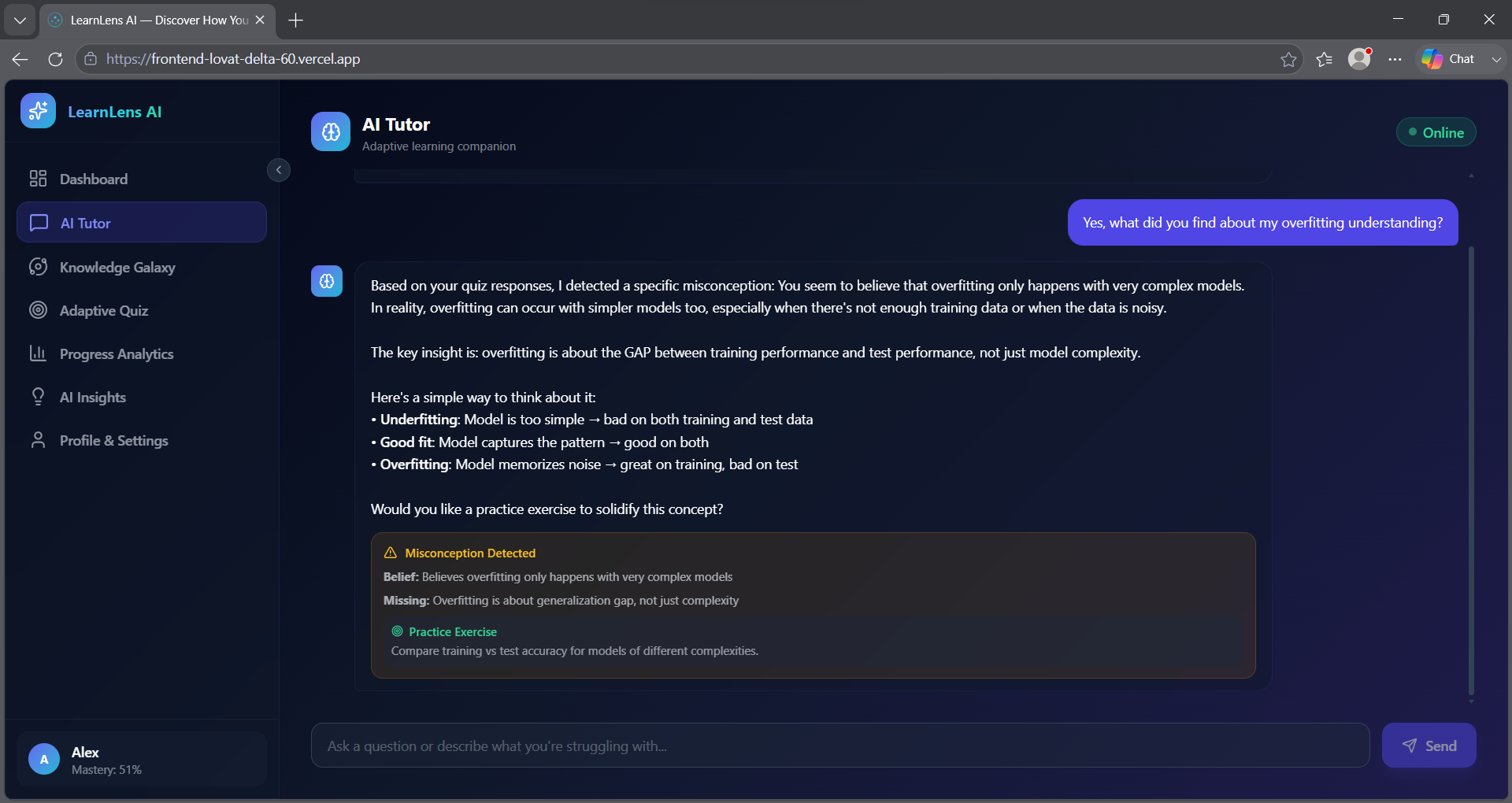
Adaptive AI Tutor — Chat interface that changes explanations based on your detected skill level and learning patterns.
Spaced Repetition — Smart review scheduling that reminds you before concepts fade from memory.
How we built it
Frontend: React 19, TypeScript, Vite, Tailwind CSS v4, Framer Motion, Lucide Icons. Custom glassmorphism dark UI with animated knowledge graph.
Backend: FastAPI (Python) with 5 API endpoints. Structured prompts for misconception detection, quiz generation, tutoring, and learning path creation.
AI: Google Gemini 2.5 Flash Lite — used for misconception analysis, adaptive tutoring, quiz generation, and personalized learning paths. All AI responses are parsed into structured JSON for the frontend to render.
Architecture: React SPA with global state via Context API. Backend proxies through Vite dev server. Demo data fallback when AI rate limits hit.
Challenges we ran into
Gemini SDK deprecation — The
google-generativeaipackage was deprecated mid-build. Migrated to the newgoogle-genaiSDK with a different API surface.API rate limits — Free tier caps at 20 requests/day. Built retry logic with exponential backoff and graceful degradation to demo data so the app always works.
TypeScript type conflicts — Framer Motion's
motion.buttonhad incompatible event handler types with standard HTML button props. Solved with a custom interface.Structured AI output — Getting the AI to return parseable JSON consistently required careful prompt design and multiple fallback parsing strategies.
Accomplishments that we're proud of
The misconception detection flow — the emotional centerpiece where AI says "You're not bad at this. LearnLens detected the exact misconception blocking your progress." This feels genuinely personal.
Knowledge Galaxy — A beautiful, interactive SVG visualization that makes abstract knowledge feel tangible. Students can see their learning as a living constellation.
Mastery Lens — The 5-dimension scoring algorithm that considers not just accuracy but confidence, speed, consistency, and improvement over time.
Full-stack working app — 10 polished pages, 5 API endpoints, real AI integration, and a complete demo flow that works end-to-end.
What we learned
- Designing AI prompts that return structured, parseable JSON output
- Building adaptive algorithms that track learning across multiple dimensions
- The importance of graceful degradation when external services fail
- Creating a strong visual identity (glassmorphism, animated gradients) that serves both aesthetics and education
- How misconception detection can be more impactful than simple right/wrong scoring
What's next for LearnLens AI
- PDF/image analysis — Upload textbooks or screenshots for AI-powered content extraction
- Speech recognition — Students explain concepts verbally, AI analyzes understanding
- Multi-language support — Full Bangla language support for broader accessibility
- Collaborative learning — Study groups where AI compares knowledge gaps across students
- Teacher dashboard — Educators see class-wide misconception patterns
- Mobile app — Native iOS/Android for learning on the go

Log in or sign up for Devpost to join the conversation.