-
-
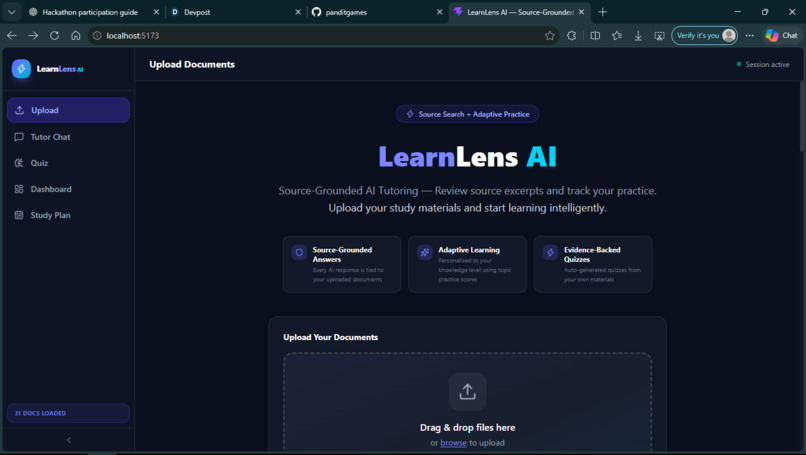
dashboard
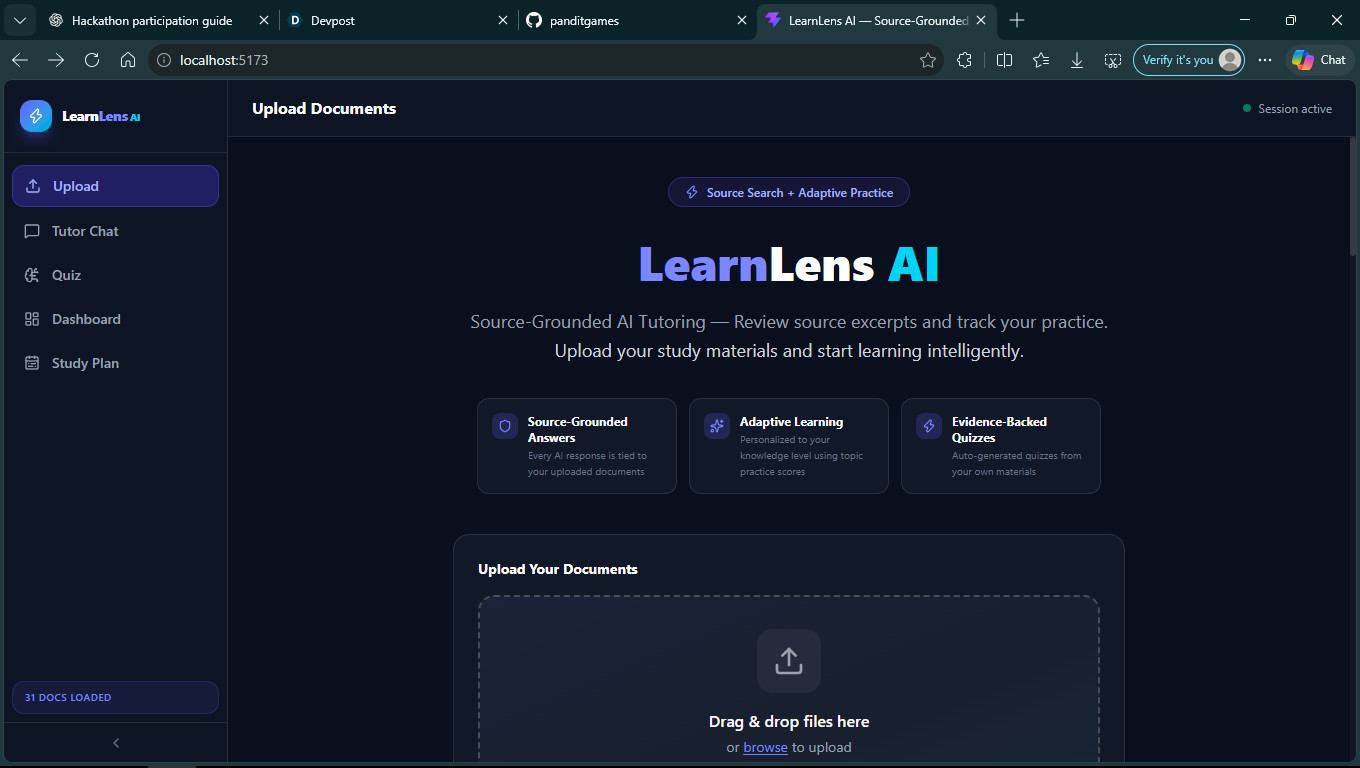
Inspiration
Students often study from multiple sources such as PDFs, slides, notes, and lecture material. General AI chatbots can sometimes answer confidently without being tied to the student's actual course content.
LearnLens AI was built to make studying more trustworthy by grounding answers and assessments in the student's own learning material and showing the exact source behind the response.
What it does
LearnLens AI is a source-grounded adaptive study companion.
Students can upload supported course material such as PDFs, slide decks, and text notes. LearnLens organizes the extracted content into searchable source units and uses them to answer questions with evidence linked back to the original material.
The system can:
- ingest course material
- retrieve relevant source passages
- answer using source-grounded evidence
- show page, slide, section, line, or timestamp references when available
- refuse or flag questions that are not supported by the uploaded material
- generate MCQ, short-answer, and numerical recall assessments
- avoid repeating questions within a learner session
- grade answers on the server
- track topic-level learner mastery
- identify weak topics
- adapt future assessments toward weaker areas
- generate personalized study recommendations
- preserve learner progress across sessions
The project also includes a built-in demo course so judges can quickly test the complete study workflow.
How we built it
The frontend is built using:
- React
- TypeScript
- Vite
- Tailwind CSS
The backend is built using:
- Python
- FastAPI
- SQLite
For retrieval, LearnLens uses a local BM25-based search system that indexes extracted course content together with source metadata.
Documents are broken into bounded source chunks while preserving information such as:
- PDF page numbers
- slide numbers
- text line references
- section identifiers
- transcript timestamps when available
The tutor searches these indexed chunks and only returns answers when enough supporting material is found.
Assessments are generated from the indexed source material and are tagged with topic, difficulty, and source information. Student performance updates the learner model, which is then used to prioritize weak areas and future study recommendations.
We also built automated backend tests, browser workflow tests, evaluation scripts, learner simulations, and security checks to validate the system.
Challenges we ran into
One of the biggest challenges was making sure the system did not invent answers or citations.
During testing, we found and fixed issues involving:
- unsupported questions
- incorrect learner mastery updates
- duplicate quiz submissions
- mismatches between frontend and backend responses
- duplicate assessment questions
- source deletion and index recovery
- invalid numerical answers
- document size limits
- citation and source-location accuracy
Another challenge was balancing ambitious multimodal features with reliability. Instead of pretending unsupported features worked, we focused on keeping the verified workflow stable and documenting remaining limitations honestly.
Accomplishments that we're proud of
We are especially proud that LearnLens can demonstrate a complete adaptive-learning loop:
- upload or load course material
- ask a question
- inspect the supporting source evidence
- test unsupported questions
- generate an assessment
- answer questions
- update topic mastery
- identify weak topics
- adapt future practice
- generate a personalized study plan
The project also passed automated backend, browser, build, lint, evaluation, learner-simulation, and security checks during development.
What we learned
This project taught us that building a useful AI learning system is not only about generating answers.
Reliable educational AI also needs:
- strong grounding
- traceable citations
- honest refusal behavior
- learner-state tracking
- assessment quality
- testing
- evaluation
- transparent limitations
We also learned the importance of validating AI-generated code instead of assuming that generated functionality is correct.
What's next for LearnLens AI
Future improvements include:
- stronger semantic retrieval
- richer lecture-video understanding
- OCR and diagram understanding
- better multilingual tutoring
- more advanced learner modeling
- larger evaluation datasets
- improved numerical problem generation
- production-ready cloud deployment
Built With
- adaptive
- ai
- bm25
- css
- fastapi
- learning
- playwright
- python
- rag
- react
- sqlite
- tailwind
- typescript
- vite


Log in or sign up for Devpost to join the conversation.