-
-
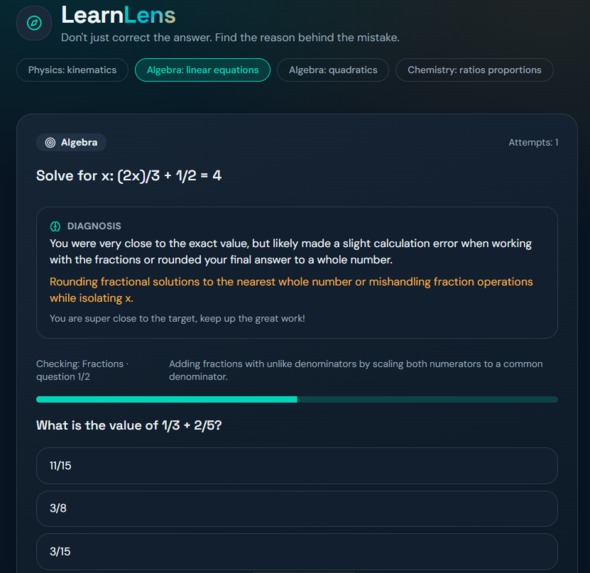
LearnLens is an educational tool that diagnoses the reasons behind learning mistakes to provide actionable mathematical insights.
-
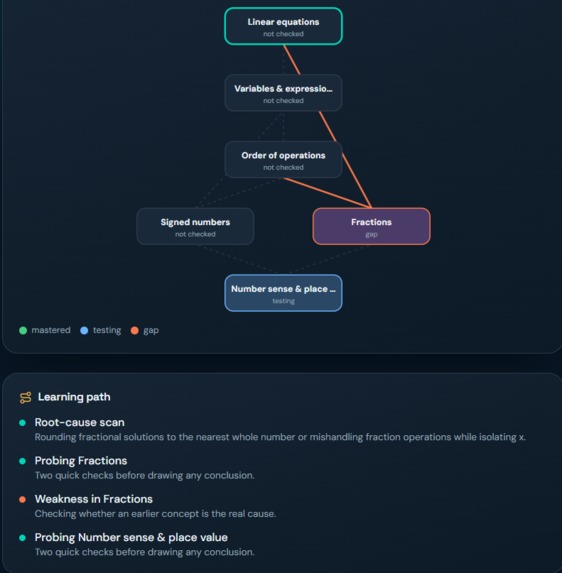
LearnLens traces mistakes back to hidden prerequisite gaps, then builds a personalized path to fix them.
-
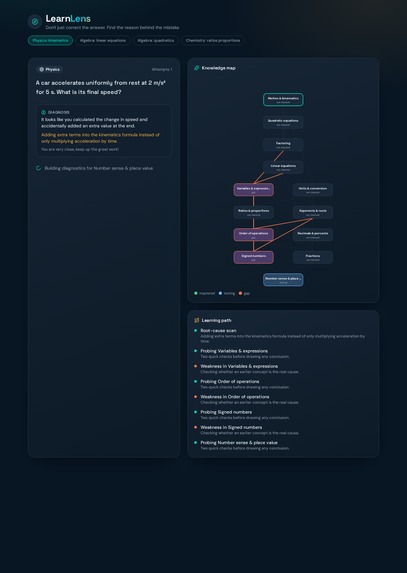
LearnLens finds the root cause behind mistakes, maps knowledge gaps, and creates personalized learning paths.
Inspiration
Every student has been there, you understand what the teacher explained in class, but when it’s time to solve a problem on your own, you just can’t figure it out.
We realized that, often the problem isn’t the lesson itself. It’s something that was missed much earlier. A student struggling with a physics equation. Eg: might actually be having trouble with basic algebra or fractions. Giving them more physics explanations won’t really help if that foundation is missing.
That’s what inspired us to build LearnLens, a way to look beyond the immediate problem, find the concepts a student is struggling with, and help them strengthen those foundations so they can learn with confidence.
What it does
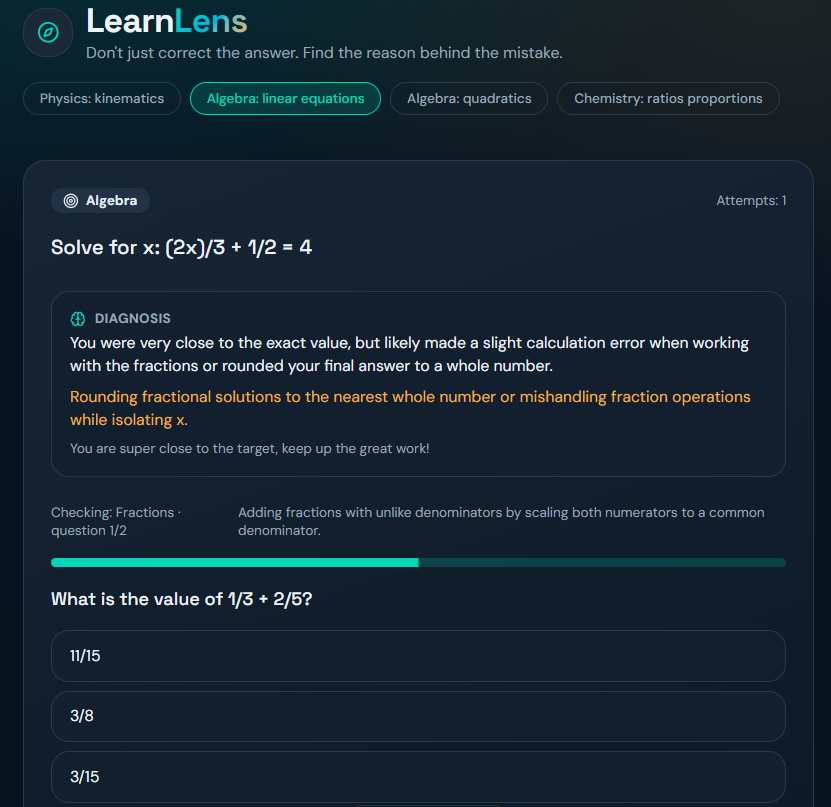
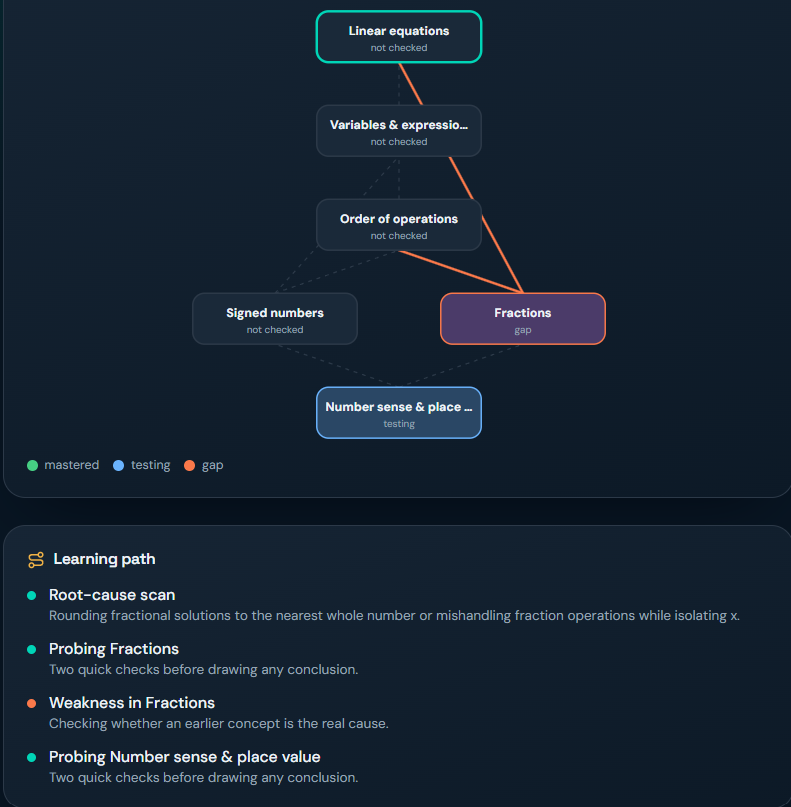
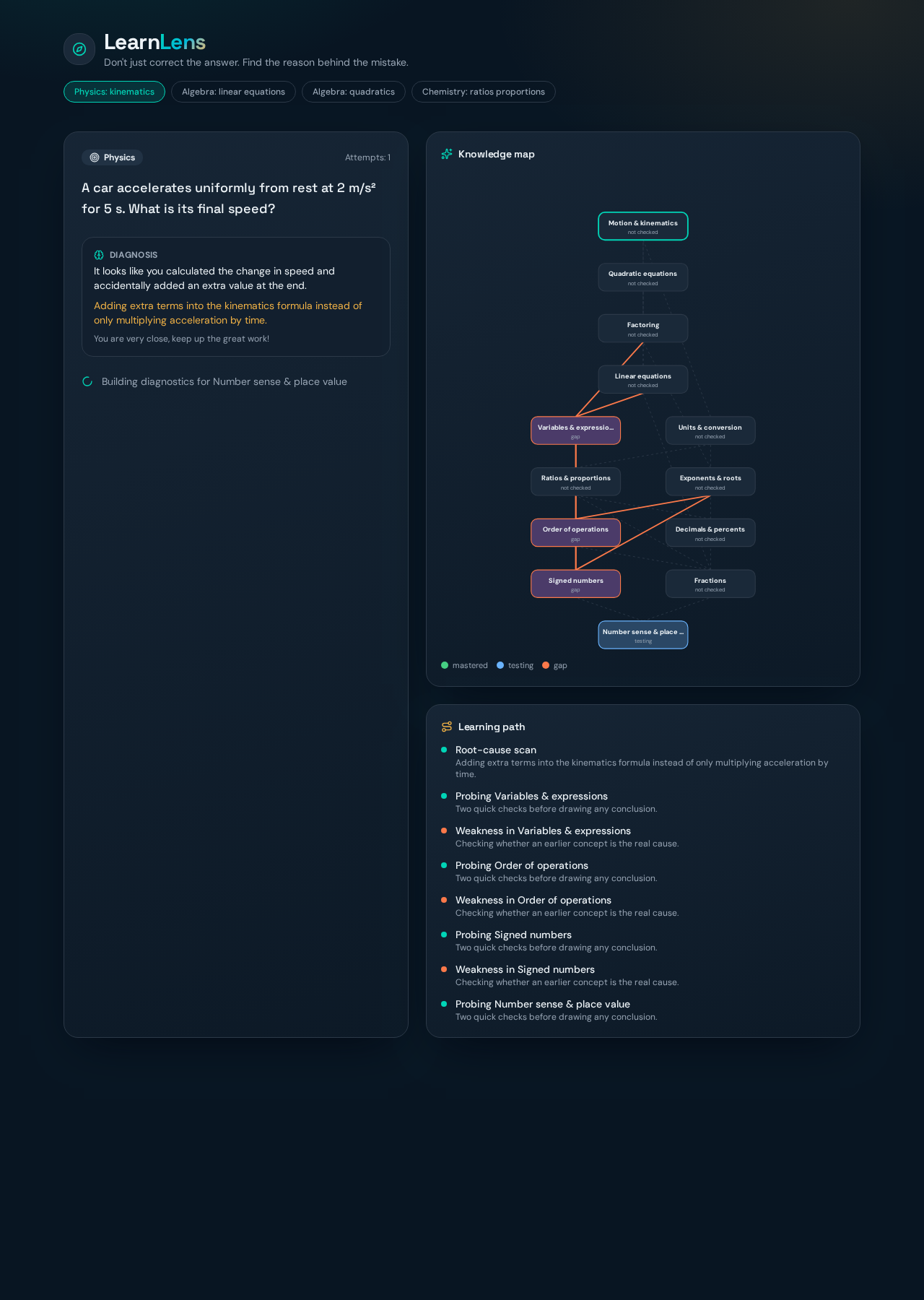
Instead of simply giving students the correct answer, LearnLens looks at their response, identifies the concept behind the question, and traces the prerequisite concepts connected to it through a knowledge graph. This helps uncover hidden gaps in foundational knowledge that may be causing the student’s difficulty.
Once a gap is identified, LearnLens creates a personalized learning path. It provides short, easy to understand explanations and diagnostic questions to help the student learn the missing concept. It then checks whether the student has actually understood it before bringing them back to the original problem.
For example:
Physics problem → Algebra → Fractions → Missing prerequisite detected
Instead of making the student sit through the same physics lesson again, LearnLens finds the real bottleneck and helps them fix it.
At the heart of LearnLens is a simple idea: Don’t just correct the answer. Find the reason behind the mistake.
How we built it
We built LearnLens by combining AI, knowledge graphs, adaptive assessment, and personalized learning.
We first mapped how mathematical concepts are connected and identified common prerequisite gaps. Then, we developed an AI system that analyzes student responses, traces mistakes back to their underlying concepts, and identifies missing foundations.
Based on these gaps, LearnLens generates personalized explanations and questions, checks the student’s understanding, and guides them back to the original problem.
We tested the prototype with different student profiles and refined the system based on the results. For our initial version, we focused on mathematics because its prerequisite relationships are easier to map and validate.
Challenges we ran into
One of our biggest challenges was distinguishing between a student who doesn't know the current concept and a student who understands the current concept but is missing an earlier prerequisite.
Another challenge was preventing AI from making assumptions based on a single incorrect answer. We therefore designed the system to use multiple diagnostic questions before identifying a potential knowledge gap.
We also had to balance personalization with simplicity. An adaptive system can become complicated very quickly, so we focused on creating a clear learning journey that students can understand without seeing the complexity happening behind the scenes.
Finally, we had to make sure that AI-generated explanations were understandable, concise, and appropriate for the learner's level rather than simply producing technically correct answers.
Accomplishments that we're proud of
We’re proud that LearnLens goes beyond being just another AI chatbot. Instead, it takes a different approach to education by focusing on why a student is struggling.
Our key achievements include building a system that can identify the root cause of mistakes, map prerequisite concepts, and create personalized learning paths. We also developed targeted micro-learning interventions and a visual knowledge map to help students understand their own learning gaps.
The platform is currently focused on mathematics, but the underlying architecture can eventually expand to subjects like science, programming, languages, and professional education.
What we learned
Building LearnLens taught us that effective AI in education is not just about giving better explanations. The bigger question is: What should the student learn next?
We learned that true personalization requires understanding a student’s overall knowledge not just the question they are currently answering. This helped us explore the importance of knowledge graphs, prerequisite relationships, adaptive assessment, explainable AI, and human-centered design.
We also learned that AI should be designed around students’ actual learning needs, rather than simply showcasing what the technology can do.
What's next for LearnLens
Our next step is to improve the diagnostic system, expand the knowledge graph, and test LearnLens with real student interactions. We also aim to expand beyond mathematics into subjects such as science, programming, and languages, while making the learning experience even more personalized and effective.
Built With
- fastapi
- knowledge-graph
- llm
- machine-learning
- next.js
- openai-api
- postgresql
- python
- react
- supabase
- tailwind-css

Log in or sign up for Devpost to join the conversation.