-
-
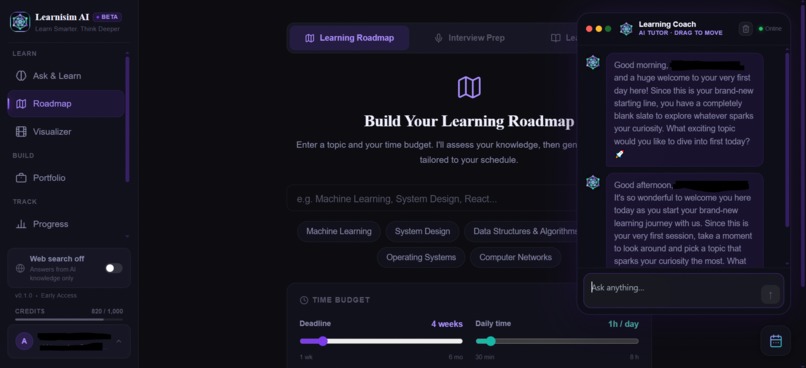
Home page
-
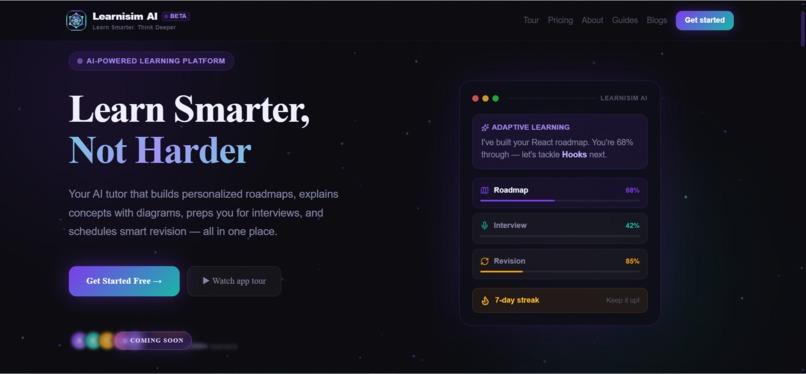
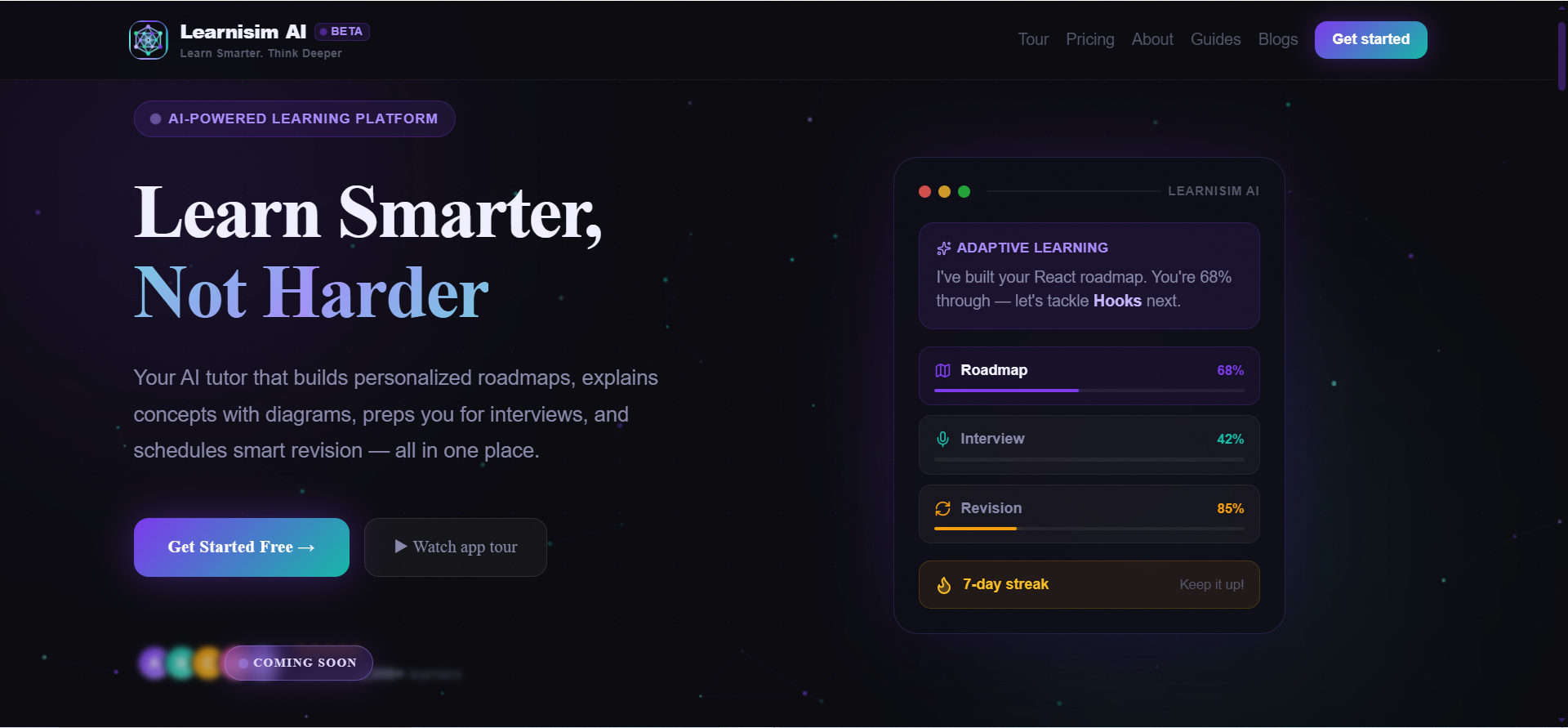
landing page
Inspiration
The inspiration for building Learnisim AI came from my own difficulty in learning complex concepts through general-purpose AI chat applications.
When I asked an AI to explain a concept, it would often present the entire solution at once. At first, this gave me the feeling that I understood the concept. But I realised that I was often only recognising the explanation rather than actually understanding it. My reasoning abilities were not being challenged, and I was not actively working through the foundational steps that build understanding.
For complex concepts, this became even more apparent. Even when the complete solution was presented in a simplified way with examples, I could still struggle to understand it. I also had to constantly scroll back and forth to connect different parts of the explanation, which was frustrating.
I realised that my understanding was incomplete because I was not being challenged on the foundational steps that build a solution progressively. I was also spending very little time actively engaging with a concept because everything was being produced instantly. As a result, I would often forget what I had learned.
This led me to a bigger realisation: general-purpose AI chat applications can make learning feel easier while potentially reducing the amount of reasoning we actually do.
So I created Learnisim AI, an app specifically designed for learning and for leveraging AI in a way that strengthens, rather than replaces, human reasoning.
Learnisim AI is an adaptive learning platform that uses diagrams at every step and 2D and 3D animations to make complex concepts easier to understand while also enhancing spatial reasoning.
I think of it as a mental gym.
In the past, when people primarily performed mechanical work, they did not need gyms to compensate for a lack of physical activity. As more jobs began requiring mental work, people started using gyms to keep their bodies fit and compensate for reduced physical activity.
Similarly, as AI becomes better and requires less human intervention to perform work, people may need a mental gym to keep their reasoning abilities intact, even when most of the work is being done by AI.
What it does
Learnisim AI is specifically designed not just to help people learn concepts, but to enhance their reasoning abilities while learning.
It is an adaptive learning platform where users can choose their skill level—from beginner and intermediate to advanced—and receive a learning experience based on that level.
The goal is to provide everything needed for learning in one place.
1. Conceptual Learning
Conceptual Learning allows users to break down complex concepts into simpler steps and learn one step at a time, supported by diagrams.
Instead of simply providing an answer, the system responds to the learner's understanding. If a response is incorrect, the concept is explained from a different angle and the learner is shown why their reasoning was incorrect at each step.
There is also a Deep Mode, where the system presents more challenging material based on the user's responses.
2. Interview Prep
Interview Prep simulates the experience of being in a real interview, including a timer.
Its purpose is to help users learn according to their specific goal of cracking an interview.
Problems are broken down into multiple steps, and the learner is asked to solve one step at a time. The system identifies incorrect assumptions and explains what the ideal interview response would be in that scenario.
3. Exam Prep
Exam Prep is designed for written theory examinations where students need to produce structured, long-form answers.
Instead of simply showing model answers, the system teaches users how to break a large response into a well-structured, multi-part answer, one step at a time.
Users receive analysis after each response as well as a final report explaining what they wrote and what they could improve.
At the end, notes and a mind map are generated so that learners can quickly revise concepts before an exam.
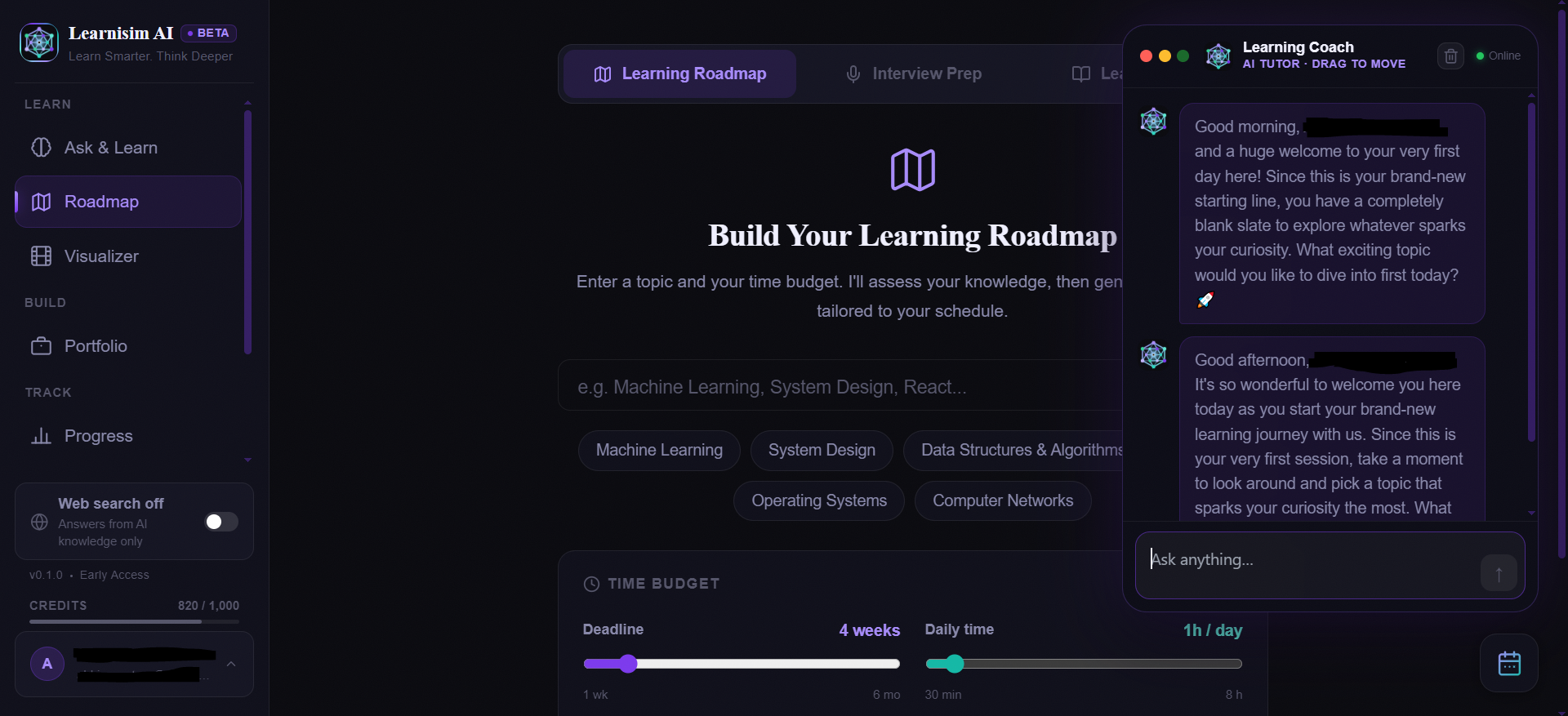
4. Roadmap
Users can create three types of learning roadmaps:
- Learning roadmaps
- Interview preparation roadmaps
- Roadmaps generated from PDFs such as notes or research papers
Roadmaps can be optimised based on the learner's skill level and the amount of time they can allocate.
For interview preparation, users can create highly targeted roadmaps based on the job requirements, their resume, and the time remaining until the interview.
Each topic in a roadmap can be opened and learned through the Conceptual Learning pathway.
Roadmaps also contain projects. When a learner starts a project, the project is divided into subtasks, requiring them to complete one subtask at a time.
After each subtask, their code can be reviewed through a GitHub repository by AI. The learner receives feedback on what they could have done better.
At the end, an analysis report is generated that can be shared as evidence of how the learner performed while working through various difficulties during the project.
5. Portfolio
For learners who want to focus specifically on hands-on learning and save time while developing highly sought-after skills, the Portfolio feature generates four industry-grade projects based on their skill level or the job they are targeting.
Each project follows the same workflow used for projects within roadmaps.
6. Concept Visualizer
The Concept Visualizer allows users to visualise complex algorithms and concepts from any domain using 2D and 3D animations.
The goal is to make concepts that are difficult to understand through text alone more interactive and spatially understandable.
7. Knowledge Graph
The Knowledge Graph allows learners to see what they have been learning and how their knowledge is connected.
8. Calendar and Spaced Revision
Users can add roadmaps to their calendar and create a schedule for learning.
After completing each topic, bite-sized revision sessions are generated based on the learner's performance and learning goal.
9. AI Mentor
The AI Mentor tracks the learner's progress and helps them complete their learning journey by identifying what they did right and where they went wrong.
How we built it
I built Learnisim AI using Next.js, with APIs from Gemini, Grok, DeepSeek, and Anthropic, along with Google/GitHub OAuth, PostgreSQL, Prisma, and many other third-party APIs.
A key part of the implementation was combining AI-generated components with deterministic components and caching techniques to improve quality while keeping costs optimised.
Challenges we ran into
The most prominent challenge was getting AI models to consistently produce higher-quality learning content while keeping the system cost-efficient.
Rather than relying entirely on AI generation, I worked on combining deterministic logic with AI-generated components and using caching techniques to optimise both quality and cost.
This balance between intelligence, consistency, and cost was one of the major challenges in building the platform.
Accomplishments that we're proud of
I am proud that I was able to take an idea that came from my own frustration with learning through AI and turn it into a working product.
The most important accomplishment for me is creating something that has the potential to help people who struggle with learning complex concepts, while also helping them become capable of facing challenging tasks and realising their potential.
Instead of building another AI tool that simply gives people answers, I wanted to build something that makes people think, reason, practise, and learn.
What we learned
Building Learnisim AI taught me a wide range of things, including prompt engineering, API integration, working with third-party applications, authentication, and taking an actual product from the ideation stage to production.
It also gave me practical experience in figuring out how different AI models and deterministic systems can work together to create a more reliable and cost-efficient product.
What's next for Learnisim AI
My long-term goal is for Learnisim AI to become a learning alternative to general-purpose AI chat applications.
I want the Conceptual Learning feature to evolve into a learning search engine—a place where anyone who wants to understand something can directly go to learn it interactively rather than simply receiving a large block of information.
I also want people to be able to use the Concept Visualizer directly to learn complex concepts through interactive visualisations.
To make the system continuously better, I want to build a feedback system where user reviews can be used to fine-tune the AI model and produce responses that are increasingly specific and effective for the Learnisim AI learning experience.
Another major area of development is the animation system. I want to further improve it to produce more accurate and better visualisations, with the help of domain experts.
Ultimately, I want Learnisim AI to become more than an AI learning tool. I want it to become a mental gym for the AI age—a place where people can continue developing their reasoning abilities even as AI takes over more of the work around them.
Built With
- gemini
- nextjs
- typescript
Log in or sign up for Devpost to join the conversation.