Inspiration
Most trackers focus only on the final destination, making the long journey feel exhausting. I wanted to build something that treats every small step as a victory. The "Learning Tracker" was born from the idea that consistent positive reinforcement—those "hurray" moments—keeps learners motivated and prevents burnout by celebrating the micro-wins that lead to major goals.
What it does
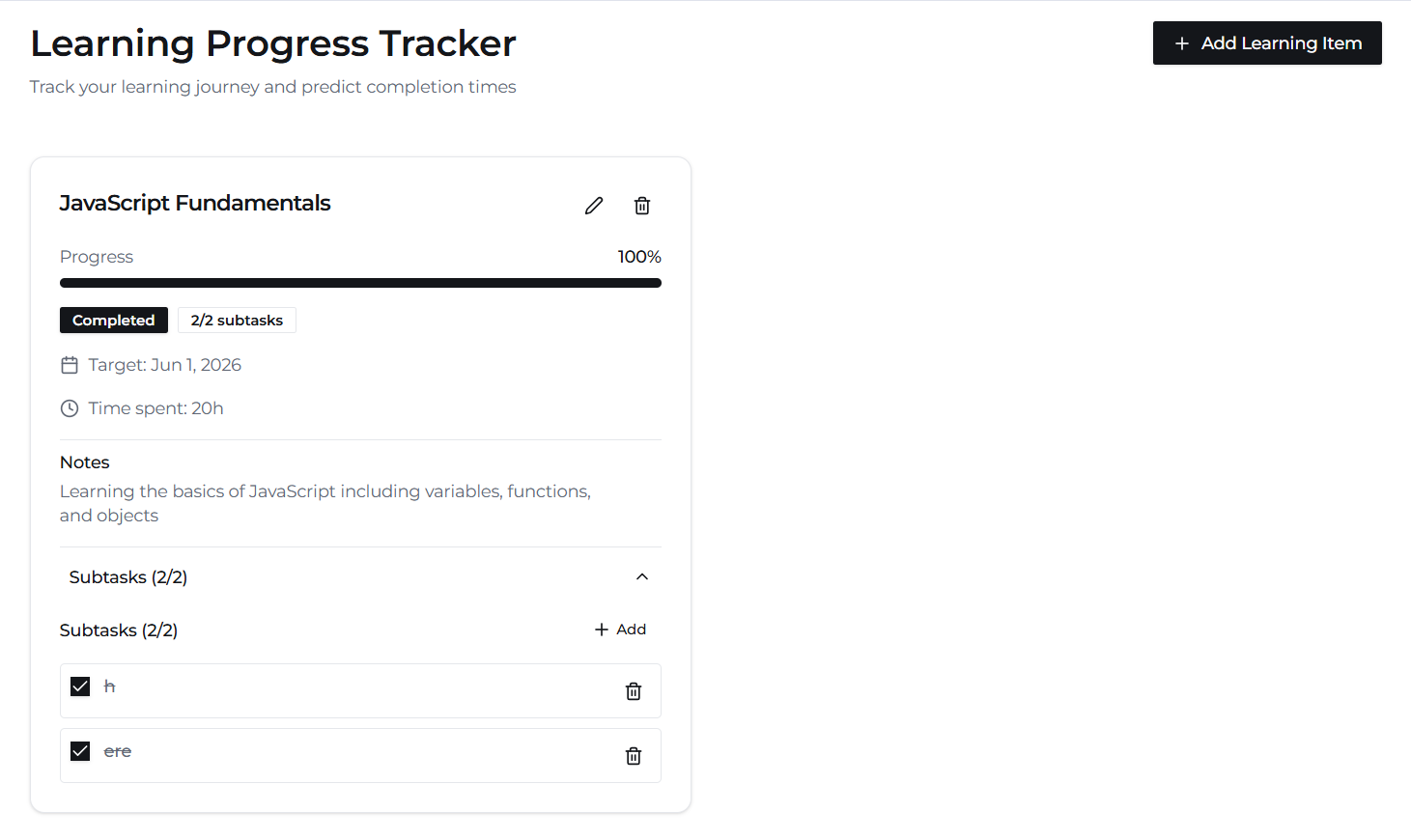
The Learning Tracker breaks down complex goals into manageable subtasks. As users complete each step, the system triggers a celebration moment. Beyond just checking boxes, it analyzes the user’s completion rate to provide dynamic progress estimates, helping users understand their actual pace rather than just seeing a static percentage.
How we built it
We built the application using a modern tech stack focused on responsiveness and real-time feedback:
- Frontend: [React/Next.js] for a smooth user interface.
- Backend: [Node.js/Firebase] to handle real-time task tracking and data persistence.
- Styling: [Tailwind CSS] to ensure the "hurray" animations felt vibrant and rewarding.
- Logic: We implemented a pace-tracking algorithm to calculate the estimated time of completion based on the formula: $$\text{Estimated Time} = \frac{\text{Remaining Subtasks}}{\text{Average Completion Rate}}$$
Challenges we ran into
One of the biggest hurdles was designing the progress estimation logic. Since everyone learns at a different speed, creating a formula that felt accurate without being discouraging was tricky. We also spent significant time optimizing the "celebration" animations to ensure they were delightful without being a distraction from the actual work.
Accomplishments that we're proud of
We are incredibly proud of the user experience. Seeing a simple subtask completion turn into a genuine moment of celebration makes the learning process feel less like a chore and more like a game. Successfully implementing the rate-based progress estimation also adds a layer of productivity insight we haven't seen in basic to-do apps.
What we learned
This project taught us a lot about Behavioral Design—how small UI/UX choices can significantly impact a user's dopamine levels and long-term habits. We also sharpened our skills in [mention a specific tech, e.g., state management or real-time database syncing].
What's next for Learning Tracker
We plan to introduce AI-powered subtask breakdown, where a user can enter a large goal, and the system automatically suggests the smaller steps needed to get there. We also want to add social features so friends can "cheer" each other on during their big learning sprints!


Log in or sign up for Devpost to join the conversation.