-
-

Here's Pip!
-
-
Inspiration
A few years ago, my son had the onset of Type 1 Diabetes. Trying to navigate through what foods to feed him, how what he ate was going to affect his glucose levels, and how to improve his diet proved to be a difficult task. I wanted to create an app that would help with that. I'm a developer, but have yet to start using AI as a tool to facilitate development. I thought this would be a great way to learn and also give my son a tool to help manage his T1D.
What it does
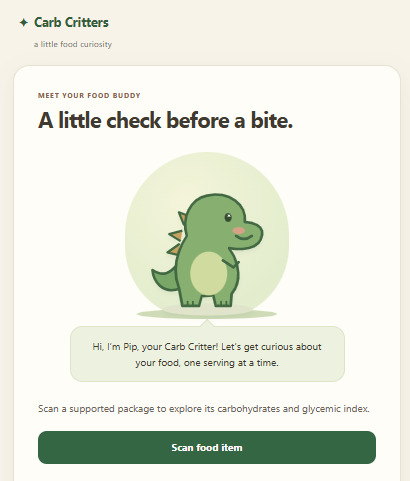
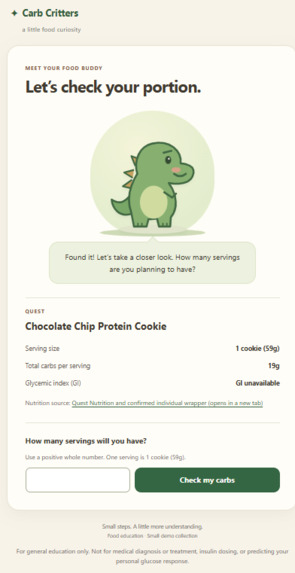
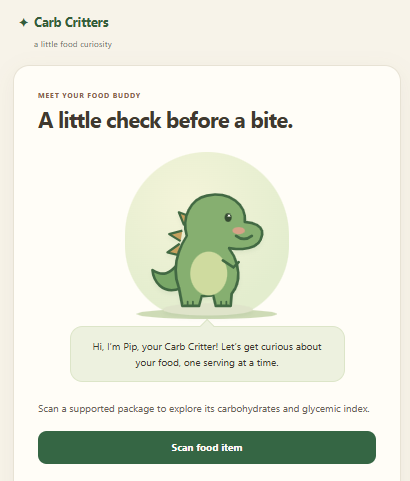
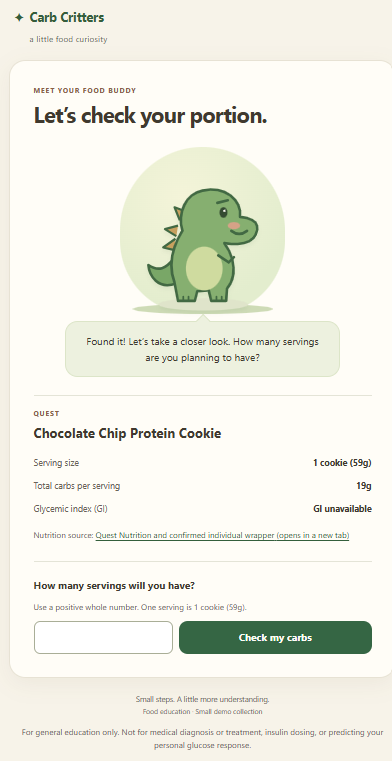
A friendly dinosaur named Pip invites you to investigate your snacks by a UPC scan or text search to give you some information on your food. After entering the number of servings, Pip totals the carb count and shows you where it lies on the Carb-O-Meter. Pip will offer some friendly feedback abut how reducing the number of servings or choosing an alternative food item could lower your carb count.
How we built it
Using the provided AI skills, we started with a broad idea for the app and narrowed it down to viable POC. It was built as a mobile-first, React and TS application to make it approachable from any platform or device.
Challenges we ran into
Getting the UPC scanner to function on my phone took a few iterations. Other than that, this was a very smooth and approachable process.
Accomplishments that we're proud of
The look and feel turned out better than I expected. The limited functions in the app work very smoothly and consistently.
What we learned
There is room for a more ambitious scope with this grounded approach. I look forward to expanding the app using an AI assistant.
What's next for Carb Critters
I'd like to expand beyond the curated collection of foods by connecting a nutrition information service and finding a consistent source for glycemic index and glycemic load information. Another feature would be to allow the user to choose and customize their Carb Critter, as well as setting some dietary goals and progress tracking.
Built With
- chatgpt
- codex
- react
- typescript
