-
-
IA University
-
🚀 LearnForge AI – Project Story
💡 Inspiration
LearnForge AI was inspired by a simple but powerful problem: students don’t just need answers — they need guidance tailored to how they learn and where they are studying.
In many countries, especially in competitive systems like university admissions, each institution (e.g., UNSA, San Marcos) has different styles, levels, and expectations. Traditional tools treat learning as generic, but in reality, education is contextual.
I wanted to build an AI that doesn’t just respond — but adapts, like a real tutor trained for your specific goal.
🧠 What I Learned
During the development of LearnForge AI, I learned:
- How to design a context-aware AI system using dynamic prompts.
- The importance of RAG (Retrieval-Augmented Generation) to inject real knowledge into responses.
How to structure a system that separates:
- General AI behavior
- Specialized academic modes
The importance of user experience (UX) in AI systems — clarity, responsiveness, and interaction matter as much as intelligence.
I also understood that intelligence is not just about answering correctly, but about: [ \text{Effective Learning} = \text{Clarity} + \text{Adaptation} + \text{Practice} ]
🏗️ How I Built It
The system was designed with a modular architecture:
🔹 Frontend
- Built with HTML, CSS, and JavaScript
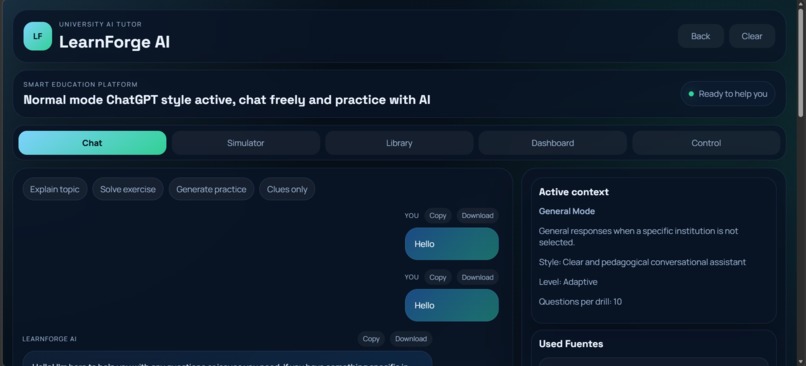
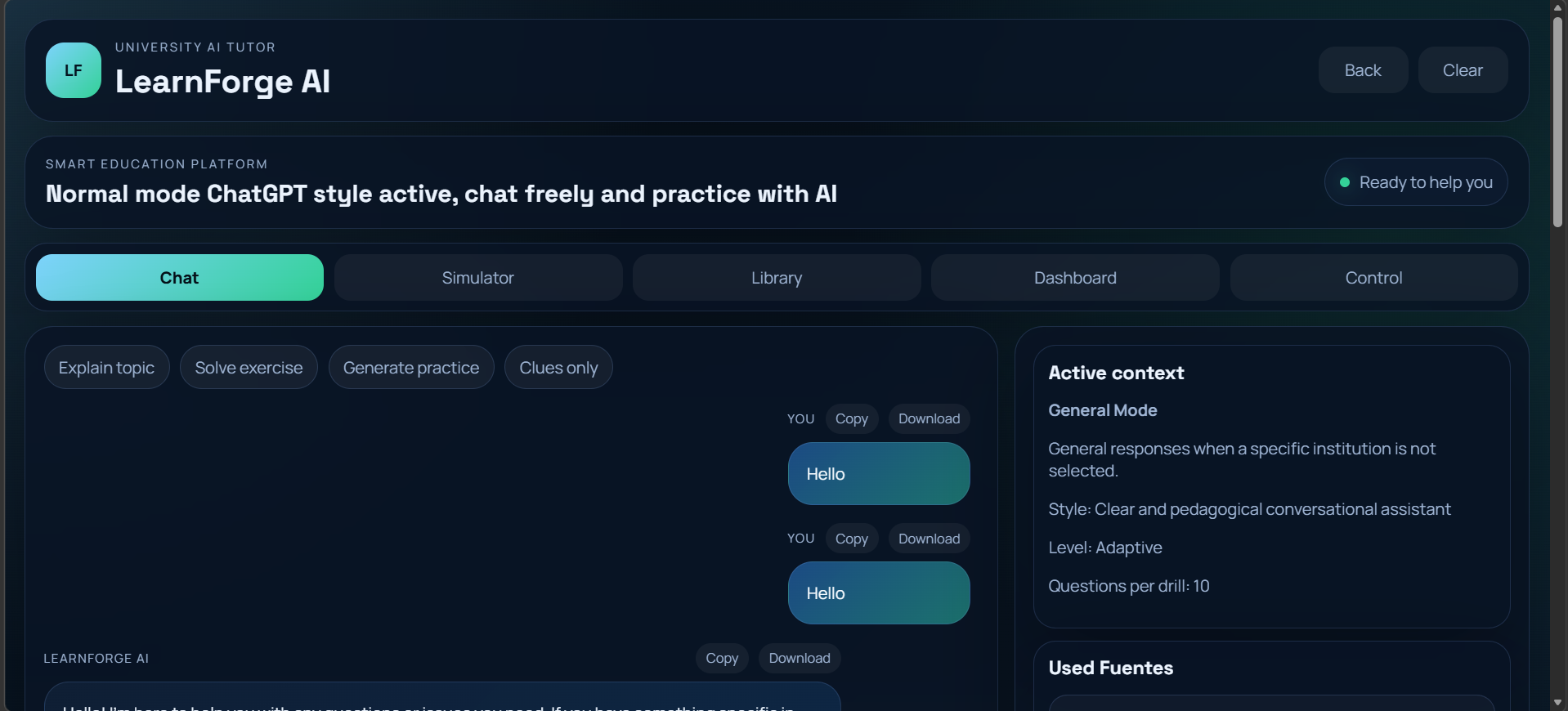
- Chat interface inspired by modern AI systems
Dynamic UI:
- Mode selection (Normal / University / Exam)
- University selector
- Real-time responses
🔹 Backend
- Node.js with Express
API endpoints:
/chat/exam/mode
Secure API key handling using environment variables
🔹 AI System
- Core chat powered by an AI API
Dynamic prompt injection based on:
- Selected university
- Mode (learning, exam, explanation)
RAG system using local data:
- University-specific content
- Study materials
🔹 Example Logic
When a user selects a university:
- The system loads contextual data
- Injects it into the prompt
- Adjusts difficulty and explanation style
📊 Smart Learning System
LearnForge AI integrates performance tracking:
Accuracy rate: [ \text{Accuracy} = \frac{\text{Correct Answers}}{\text{Total Attempts}} \times 100 ]
Progress tracking per subject
Difficulty adaptation based on performance
This transforms the AI from a chatbot into a learning system.
⚔️ Challenges I Faced
1. Context Management
Ensuring the AI doesn’t just dump information, but uses relevant context intelligently.
2. Balancing Flexibility and Control
Making the AI:
- Free in normal mode
- Strict and structured in exam mode
3. Data Simulation
Since real university data isn’t fully integrated yet, I had to:
- Design a scalable system
- Prepare it for future real data ingestion
4. UX Design
Creating a system that feels:
- Fast
- Clean
- Professional
🌍 Final Vision
LearnForge AI is not just a chatbot.
It is:
- A personalized tutor
- A university simulator
- A learning engine
The goal is to evolve it into a platform where:
- Students train for real exams
- AI adapts to their growth
- Education becomes intelligent, personal, and scalable
🔥 Closing Thought
Learning is not about memorizing answers — it’s about understanding patterns.
And with AI, we can redefine that process: [ \text{Future of Education} = \text{AI} + \text{Personalization} + \text{Real Context} ]
LearnForge AI is a step toward that future.
