-
-
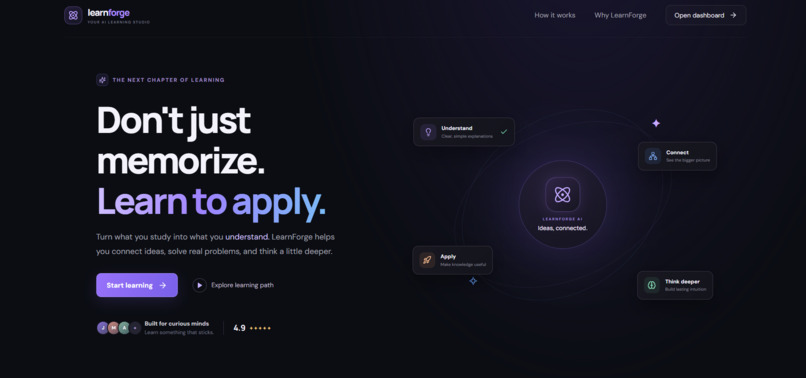
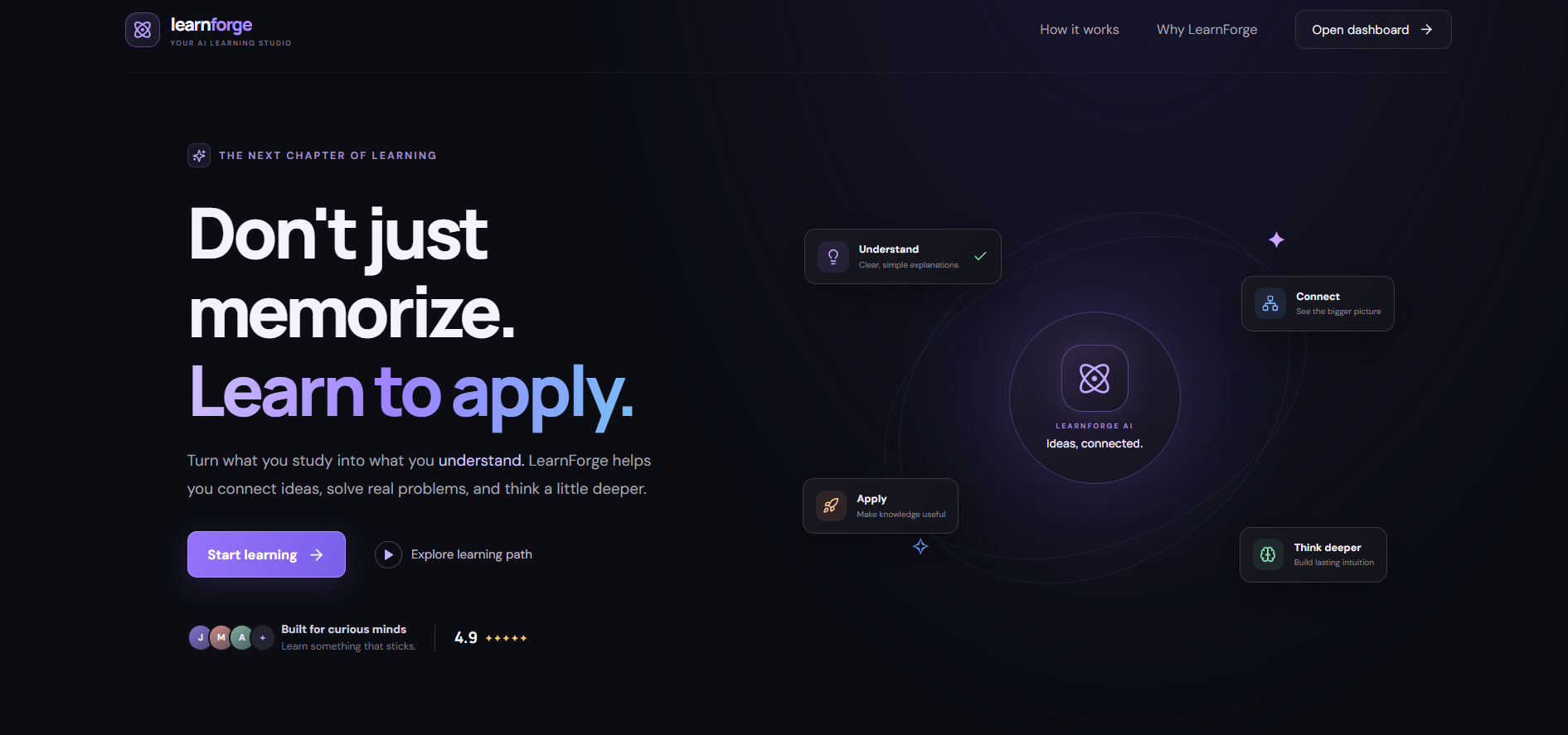
LearnForge — An AI-powered learning platform that helps learners move beyond memorization to understand, connect, apply, and think.
-
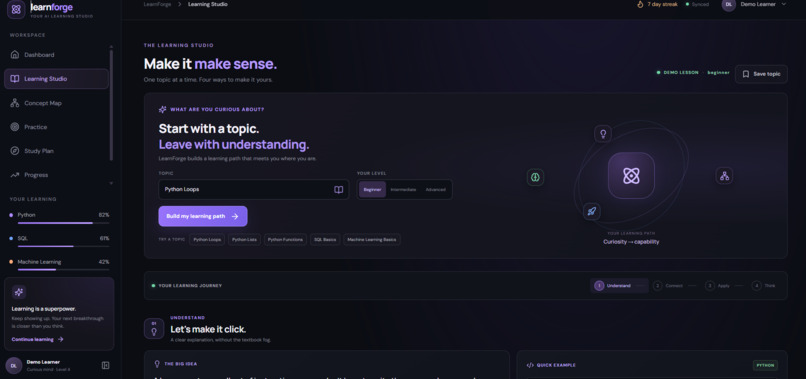
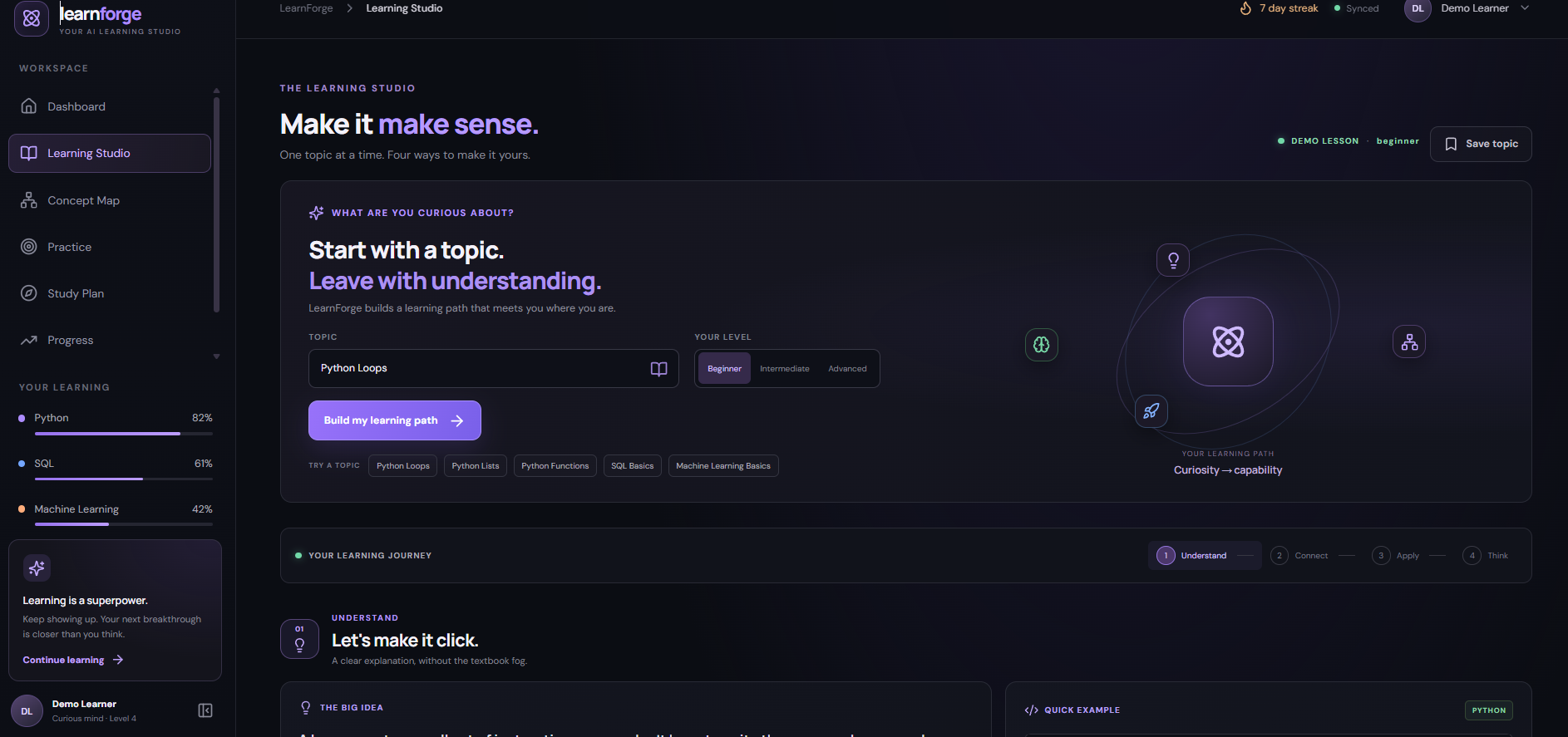
Understand concepts through clear explanations, relatable analogies, practical Python examples, and common-mistake guidance.
-
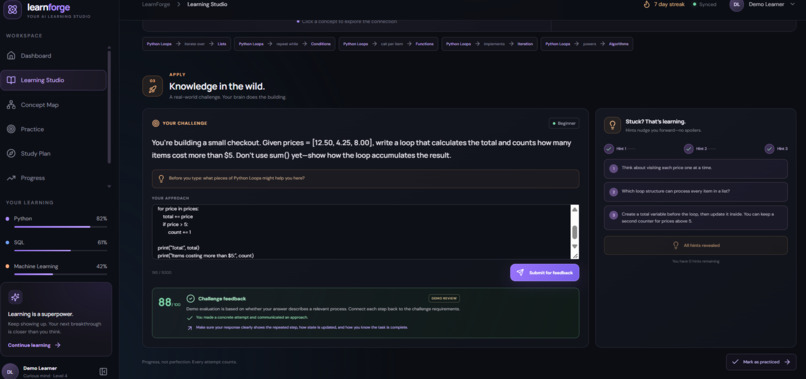
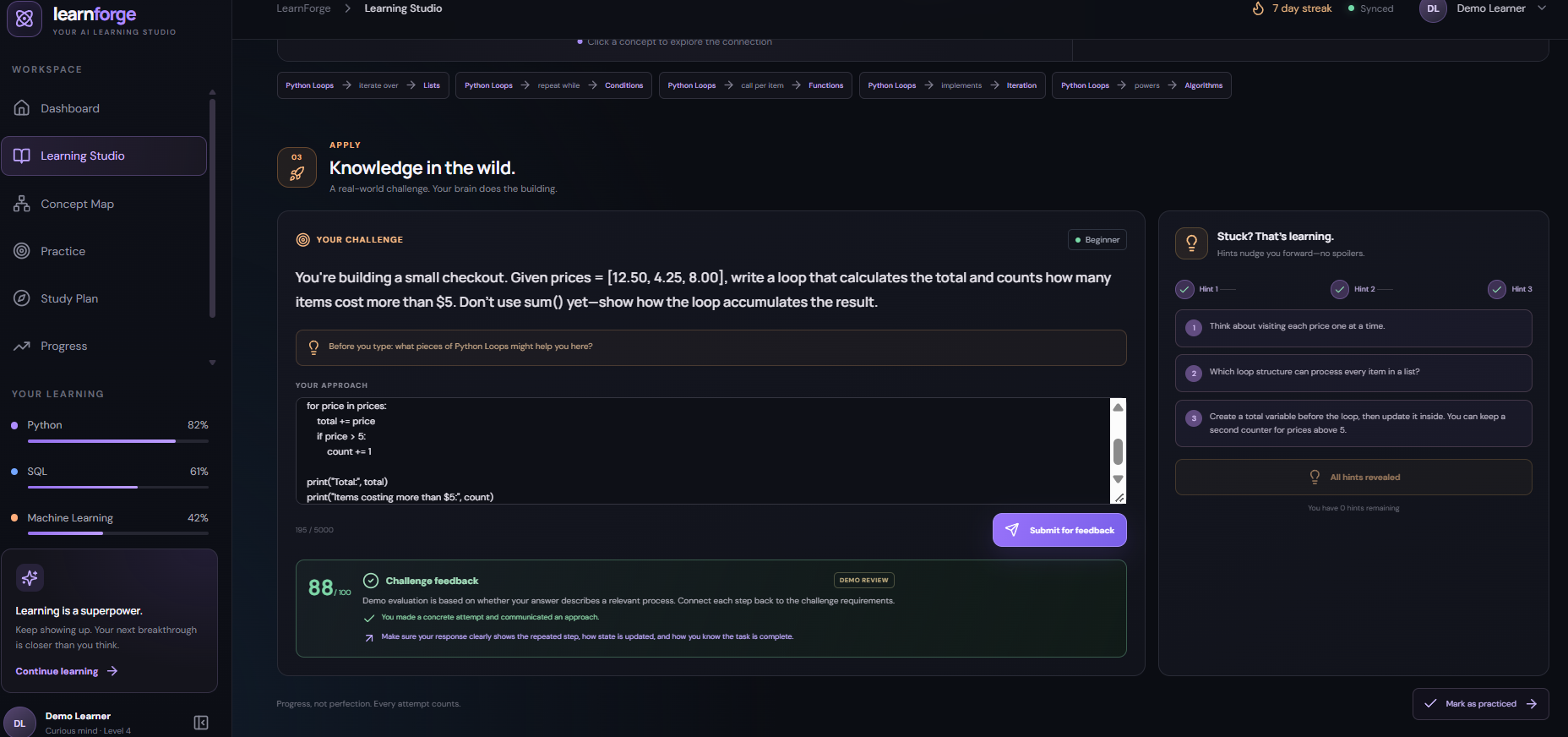
Apply knowledge to realistic challenges, reveal progressive hints, submit solutions, and receive feedback to improve problem-solving skills.
-
Go beyond memorization with reflective questions and feedback that encourage deeper reasoning and conceptual understanding.
-
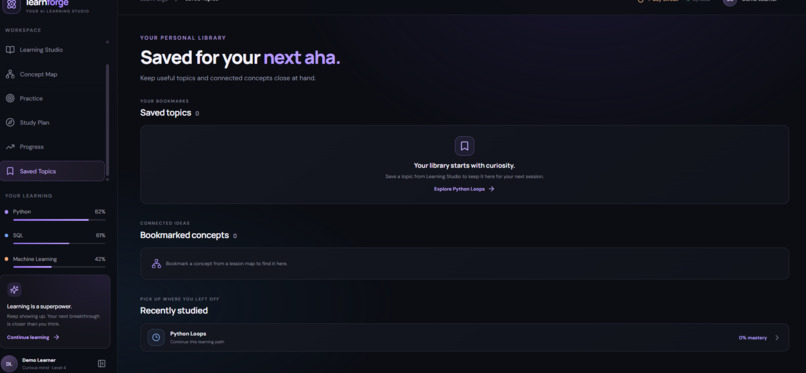
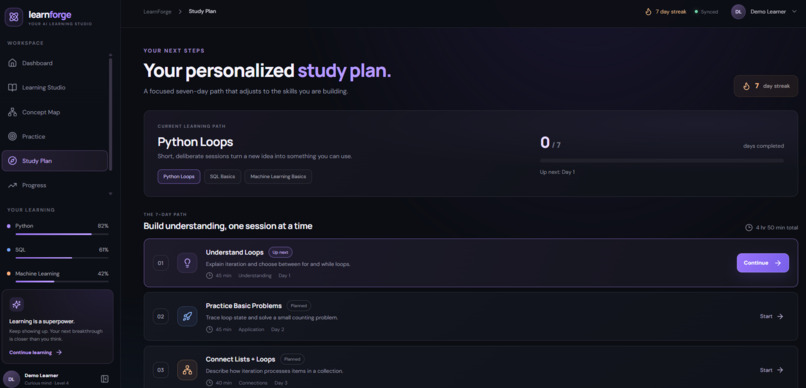
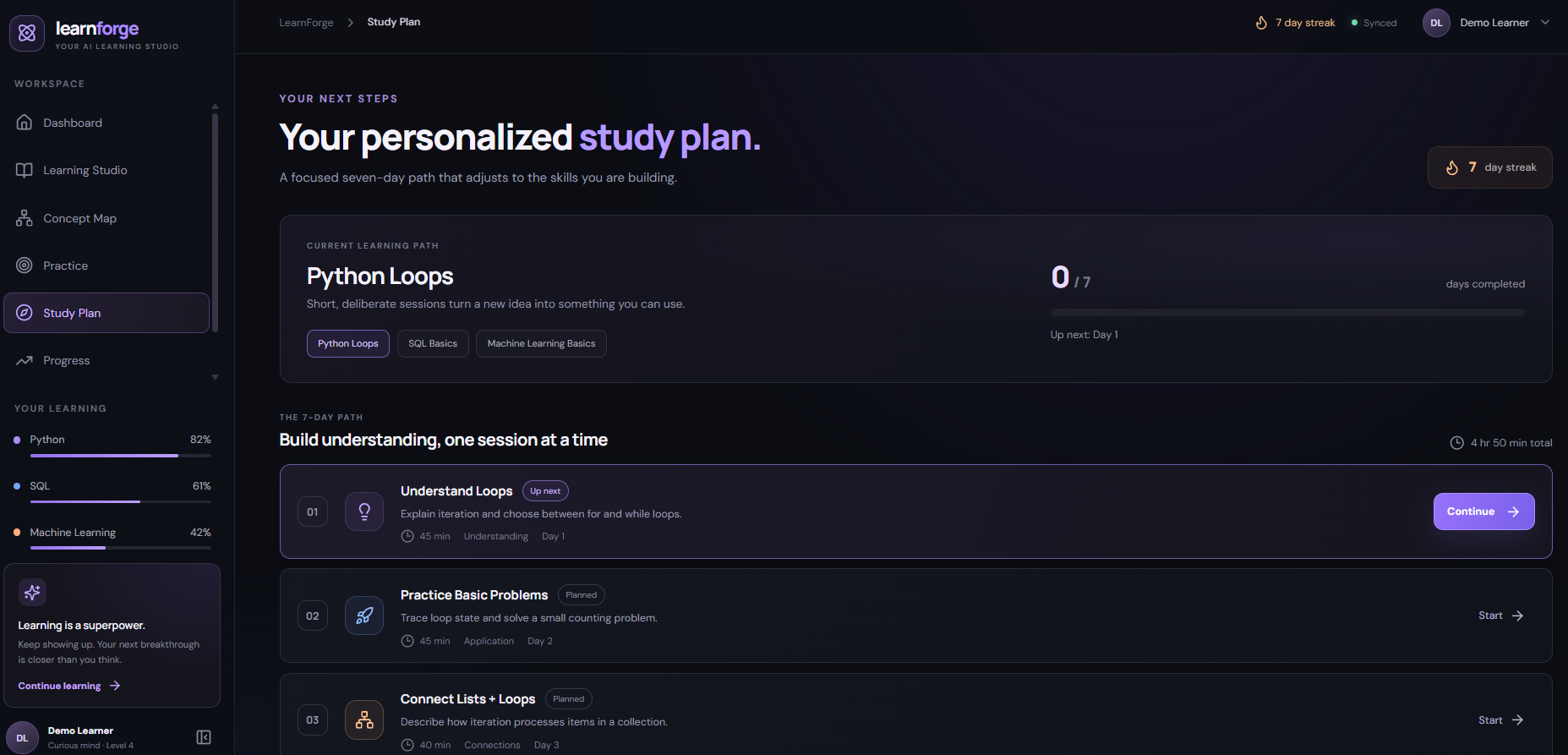
A structured seven-day study plan helps learners organize topics, practice consistently, and build knowledge step by step.
-
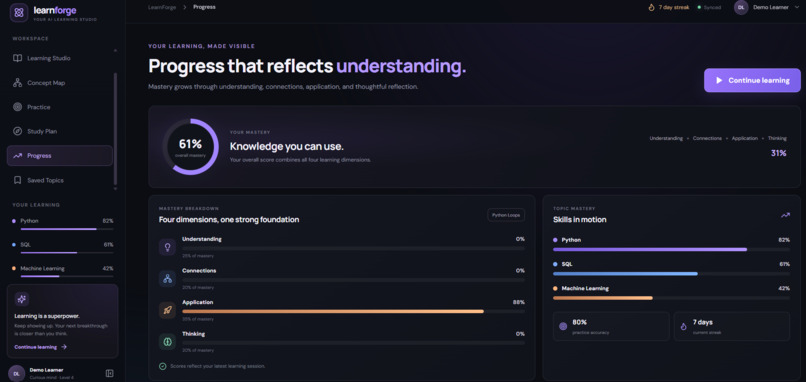
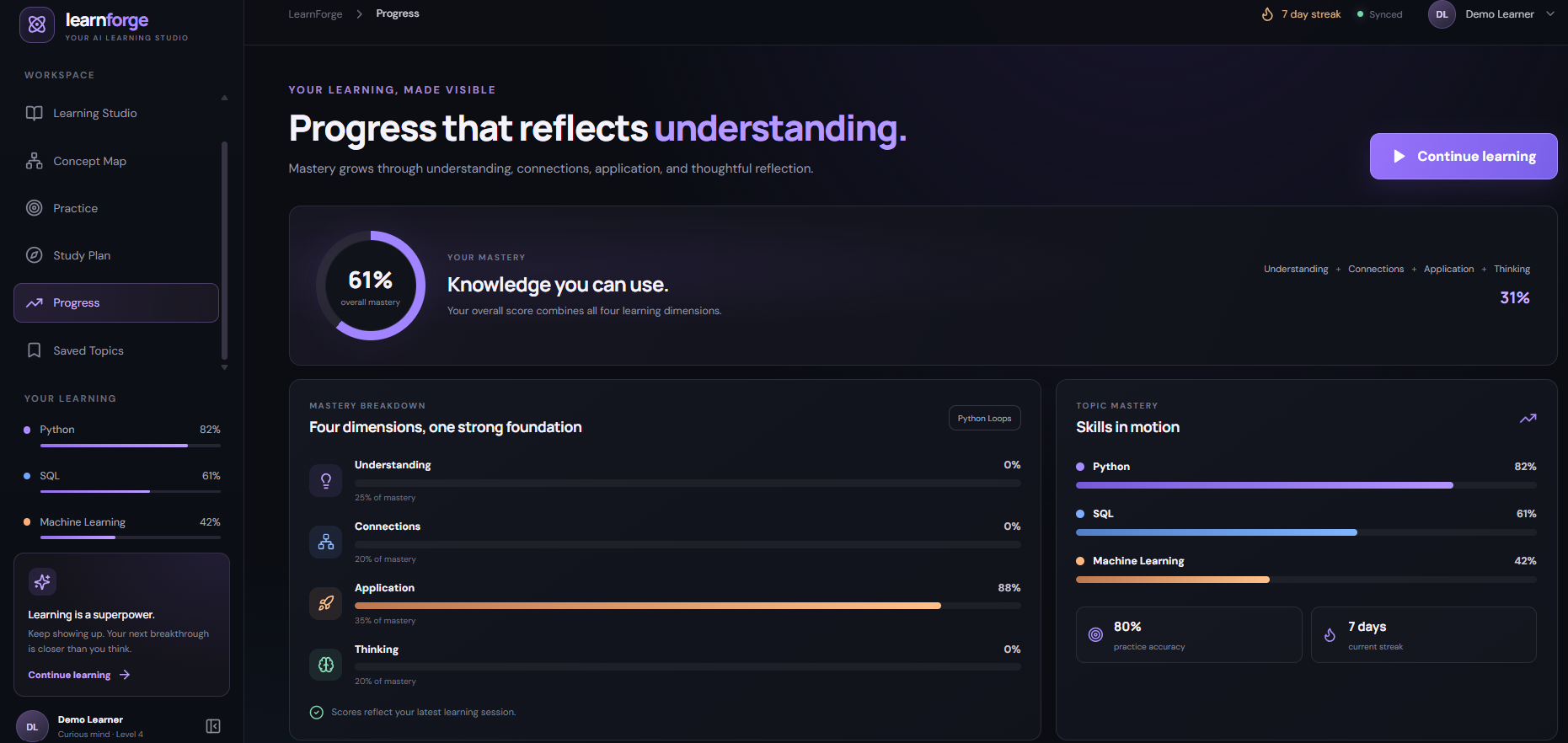
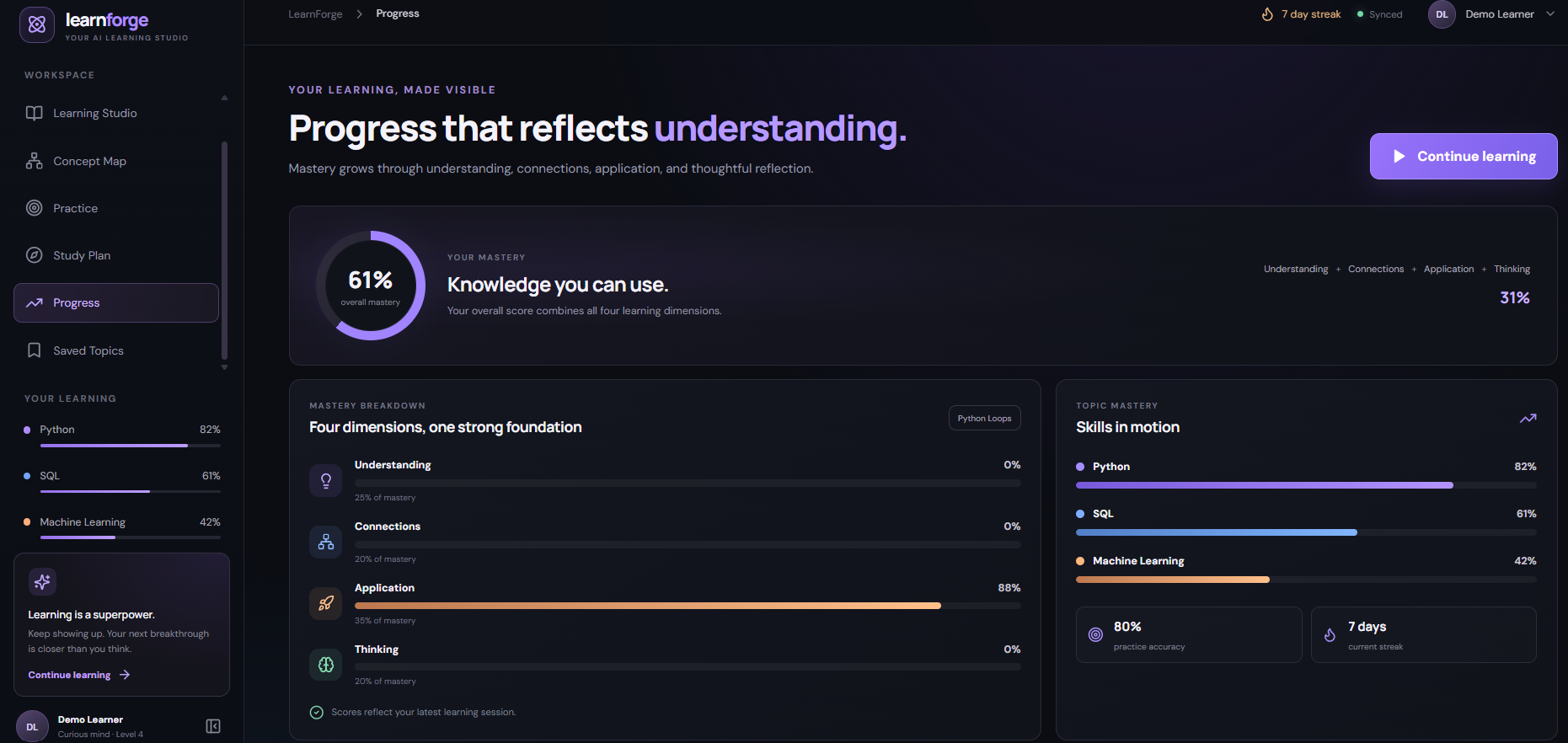
Track learning progress through mastery scores, completed activities, challenge accuracy, and skill-level indicators.
-
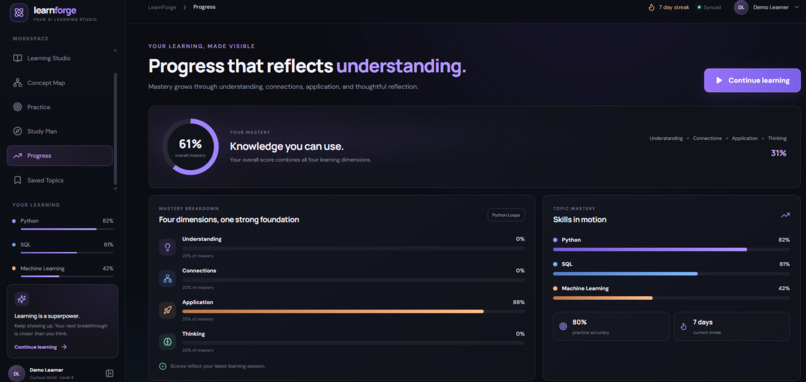
Monitor mastery scores, completed challenges, accuracy, and skill development to track your learning progress.
Inspiration
Many students can memorize concepts but struggle when they need to explain them, connect them to other concepts, or apply them to unfamiliar real-world problems.
We built LearnForge around a simple idea: AI should not just give students answers. It should help them actually understand and use what they learn.
The core learning journey is:
Understand → Connect → Apply → Think → Master
This directly addresses the AI + Education challenge of helping learners move beyond memorization toward understanding, making connections, and applying knowledge.
What it does
LearnForge is an AI-powered learning platform that turns any topic into an interactive learning journey.
A learner selects a topic such as Python Loops, SQL, or Machine Learning and chooses their level.
LearnForge then guides them through four stages:
- Understand — clear explanations, analogies, examples, code, key ideas, and common mistakes.
- Connect — an interactive concept map showing relationships between the topic and related concepts.
- Apply — realistic problems where learners must solve the problem themselves instead of immediately receiving the answer.
- Think — deeper reasoning questions that encourage reflection and conceptual understanding.
The platform also provides progressive hints, answer feedback, personalized study plans, progress tracking, mastery scores, learning streaks, saved topics, and recommendations.
Instead of measuring learning only by completion, LearnForge considers understanding, connections, application, and thinking.
How we built it
We built LearnForge as a full-stack web application with a modern React-based frontend and Python-based backend/API architecture.
The application is organized around a reusable learning architecture so the same experience can support different subjects rather than being limited to a single programming language.
The frontend provides the Learning Studio, dashboard, concept map, practice experience, study plan, progress tracking, and saved topics.
The backend manages the learning workflow, API communication, learning data, feedback flow, and AI-powered experiences.
AI is used where it provides educational value, including explanations, concept relationships, challenges, hints, answer evaluation, reasoning feedback, and adaptive learning recommendations.
We also focused heavily on creating a consistent learner state so progress in practice and learning activities can be reflected across the dashboard and mastery experience.
Challenges we ran into
One of the biggest challenges was designing an AI experience that did more than behave like a simple chatbot.
We wanted the learner to think first, attempt problems, receive progressive guidance, and only then receive meaningful feedback.
Another challenge was connecting multiple learning experiences into one coherent product. The dashboard, Learning Studio, concept map, practice challenges, reflection questions, study plan, and progress tracking needed to feel like parts of the same learning journey rather than separate pages.
We also had to balance a visually rich interface with usability and performance while keeping the application responsive and easy to navigate.
Accomplishments that we're proud of
We are proud of turning the original idea into a working end-to-end learning platform rather than just a static AI interface.
The final product includes:
- A complete LearnForge landing experience
- Interactive Learning Studio
- Understand → Connect → Apply → Think workflow
- Interactive concept relationships
- Real-world coding challenges
- Progressive hints
- Answer submission and feedback
- Deeper reasoning questions
- Personalized study planning
- Learning progress and mastery tracking
- Dashboard analytics
- Learning streaks and achievements
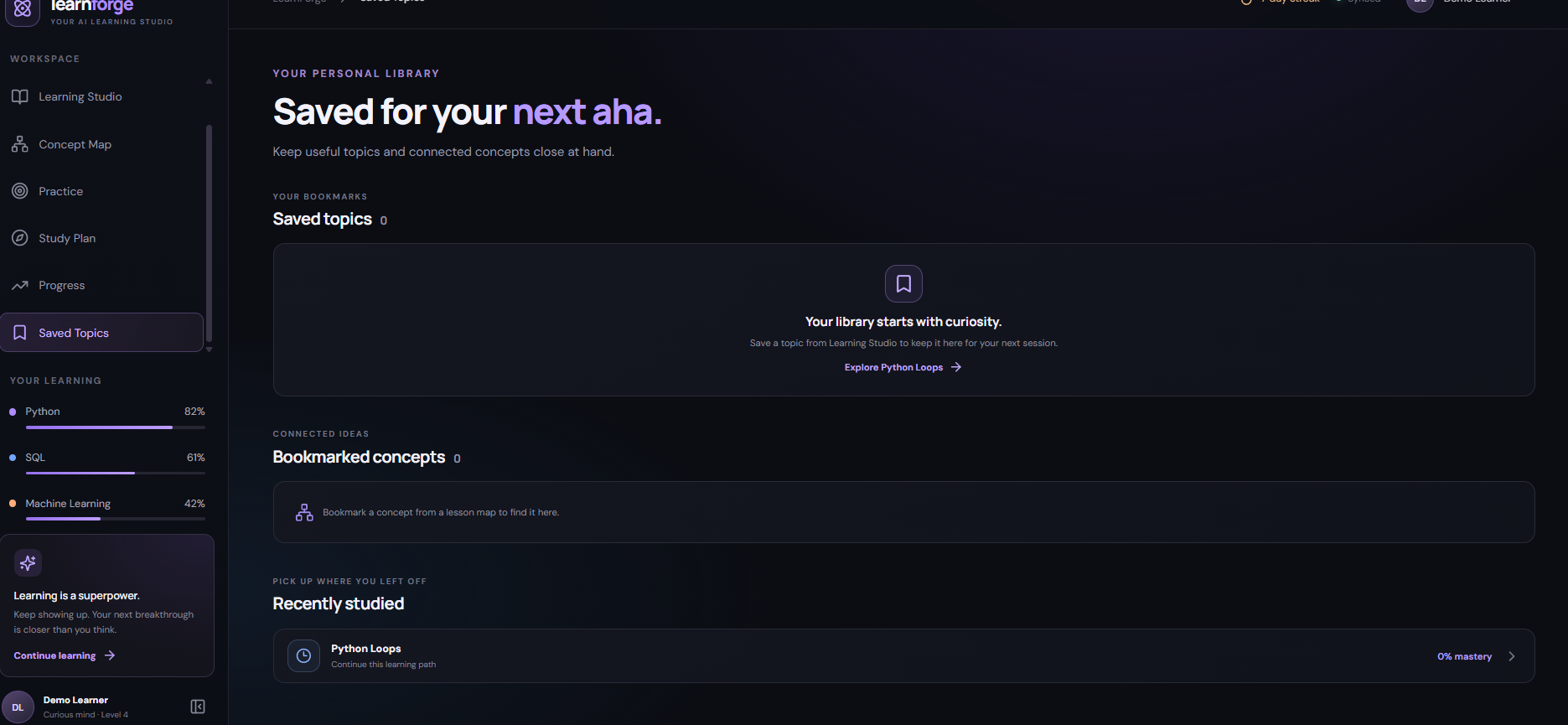
- Saved and recently studied topics
- Support for multiple learning areas including Python, SQL, and Machine Learning
Most importantly, the platform is designed around active learning rather than simply generating answers.
What we learned
We learned that building an effective AI education product is not only about generating good AI responses.
The surrounding learning experience matters just as much.
We learned how to combine AI with structured learning stages, interactive visualizations, problem-solving, progressive hints, feedback, persistence, and progress tracking.
We also learned the importance of designing AI interactions that encourage learners to reason independently instead of becoming dependent on generated solutions.
What's next for LearnForge
Our next goal is to make LearnForge increasingly adaptive to each learner.
Future versions could analyze learning patterns in greater depth, identify weak concepts, automatically adjust difficulty, generate more personalized learning paths, and provide richer mastery analytics.
We also want to expand beyond technical subjects and make LearnForge useful for mathematics, science, languages, and other areas of education.
The long-term vision is simple:
Build an AI learning mentor that helps people understand knowledge deeply enough to use it in the real world.
Built With
- al
- compose
- docker
- education
- fastapi
- framermotion
- javascript
- lucide
- machine-learning
- ollama
- pydantic
- python
- qwen
- react
- recharts
- sqlalchemy
- sqlite
- vite

Log in or sign up for Devpost to join the conversation.