-
-
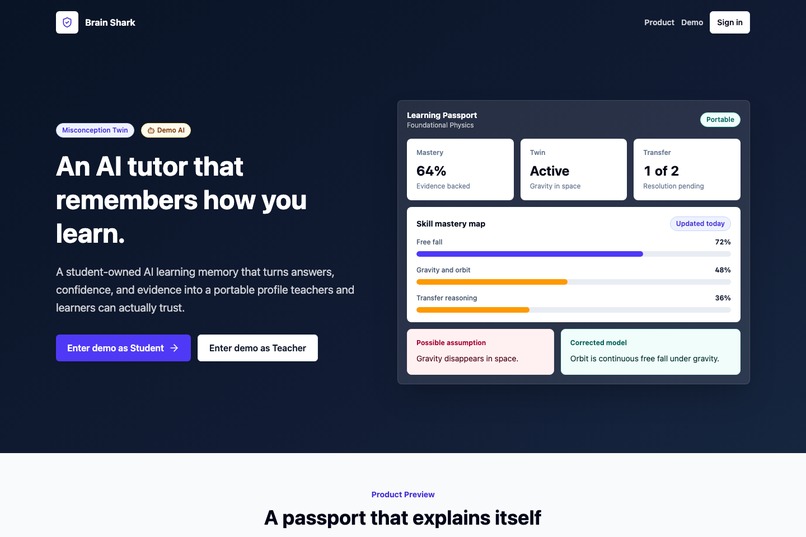
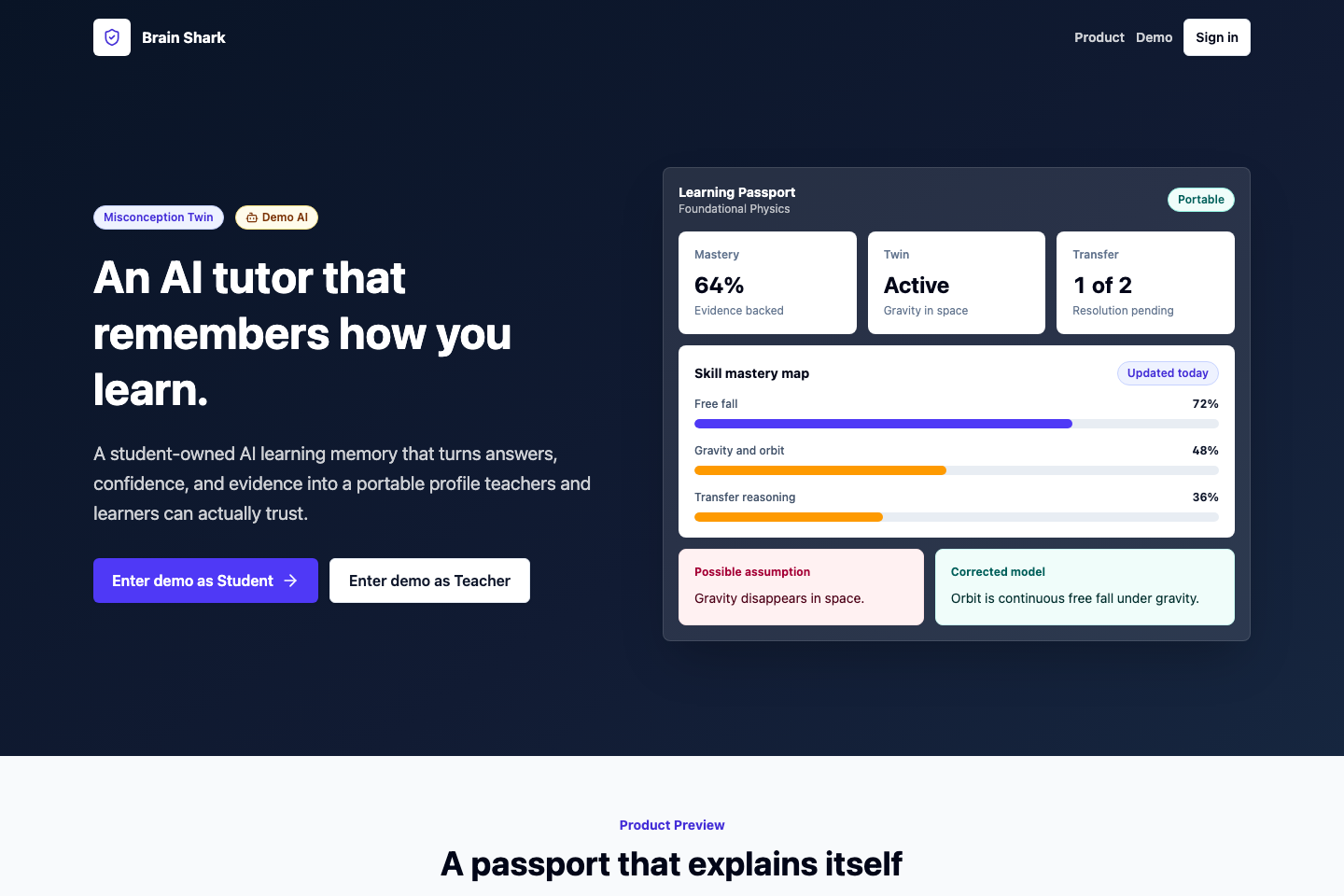
Brain Shark Home Page
-
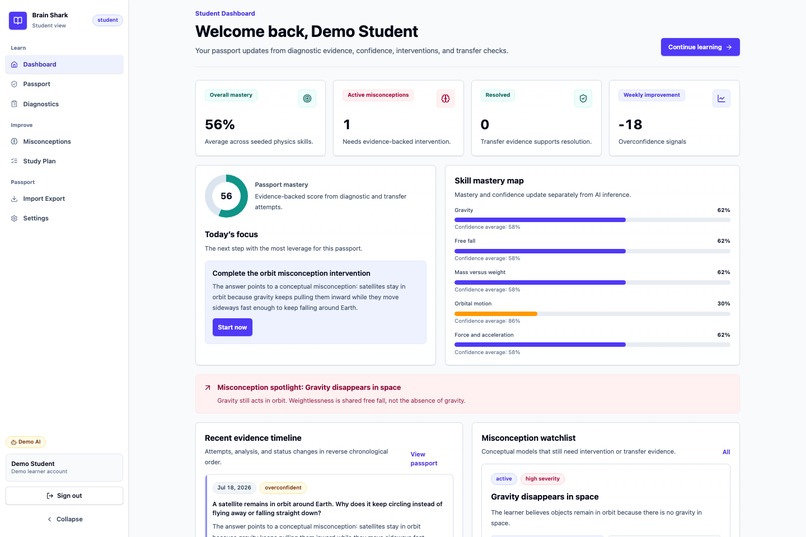
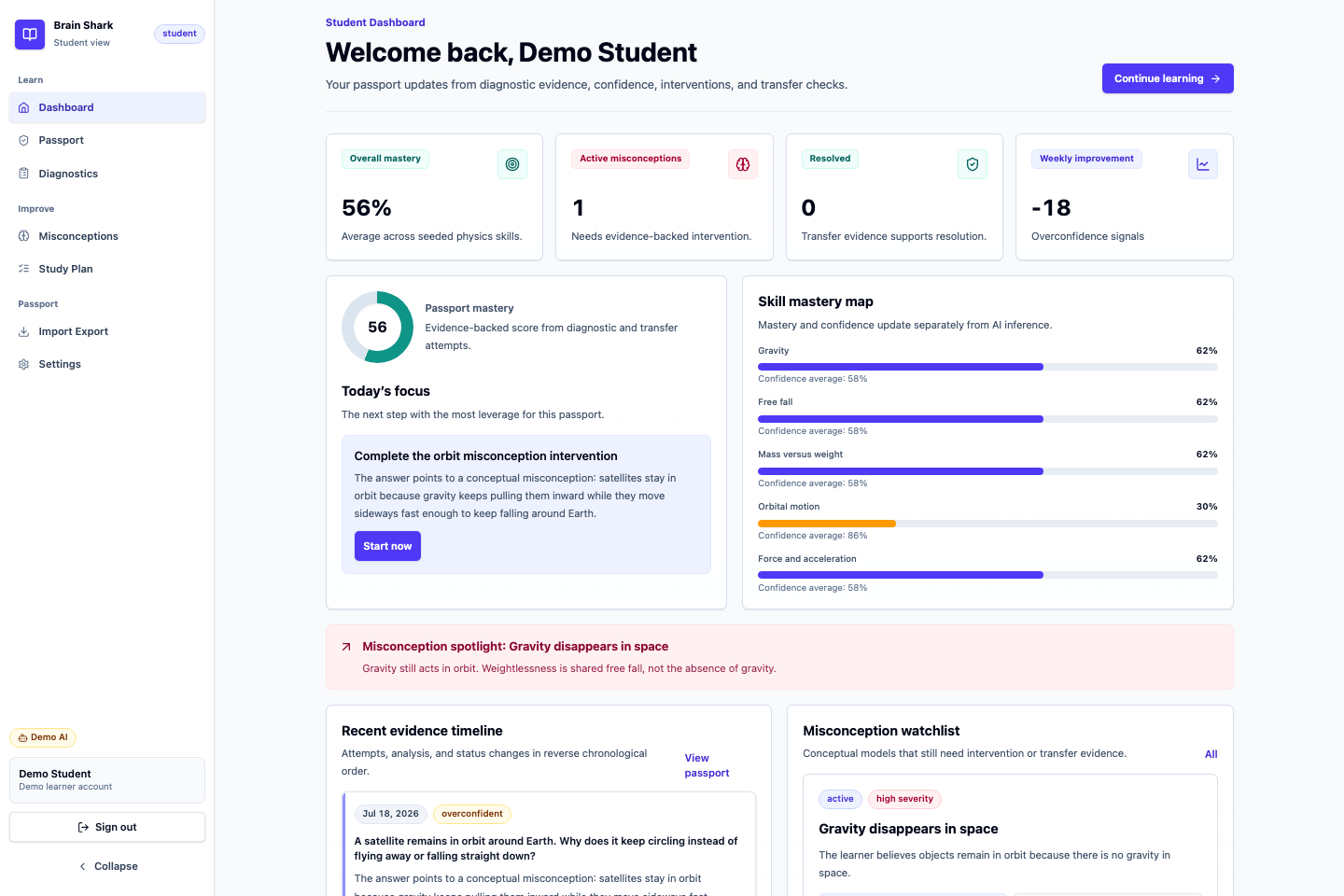
Student Dashboard
-
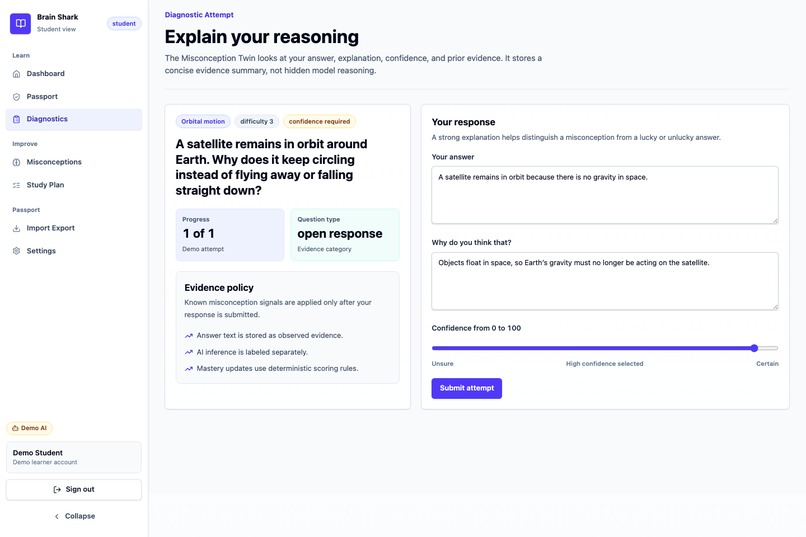
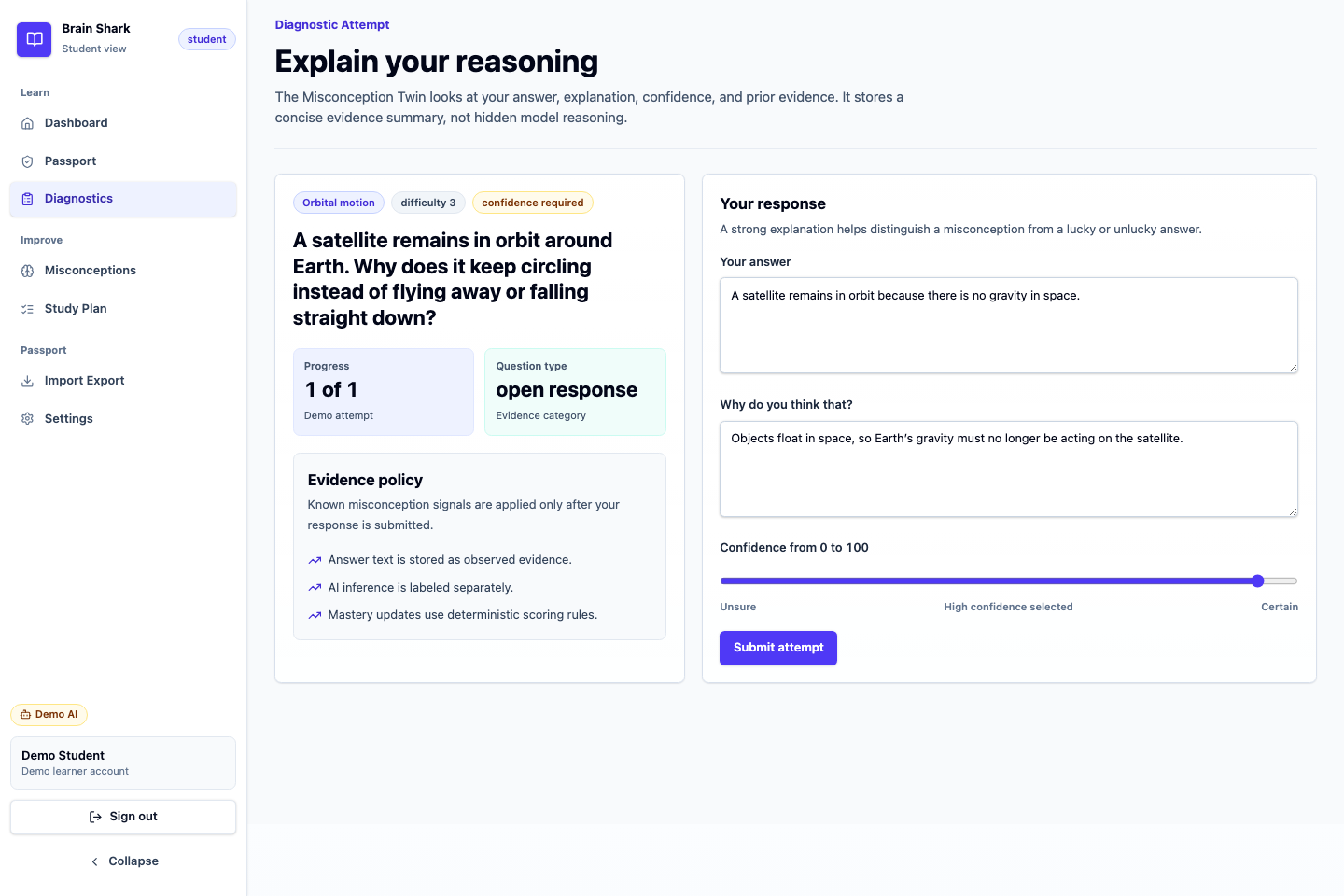
Diagnostic Question
-
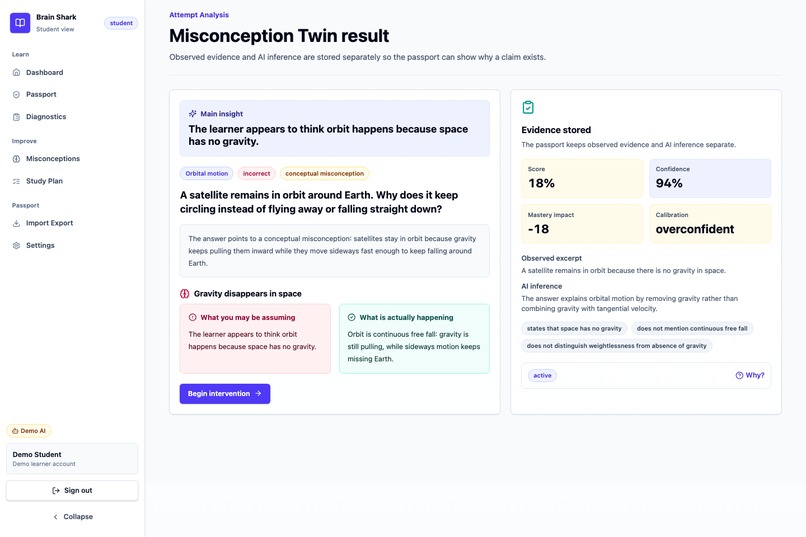
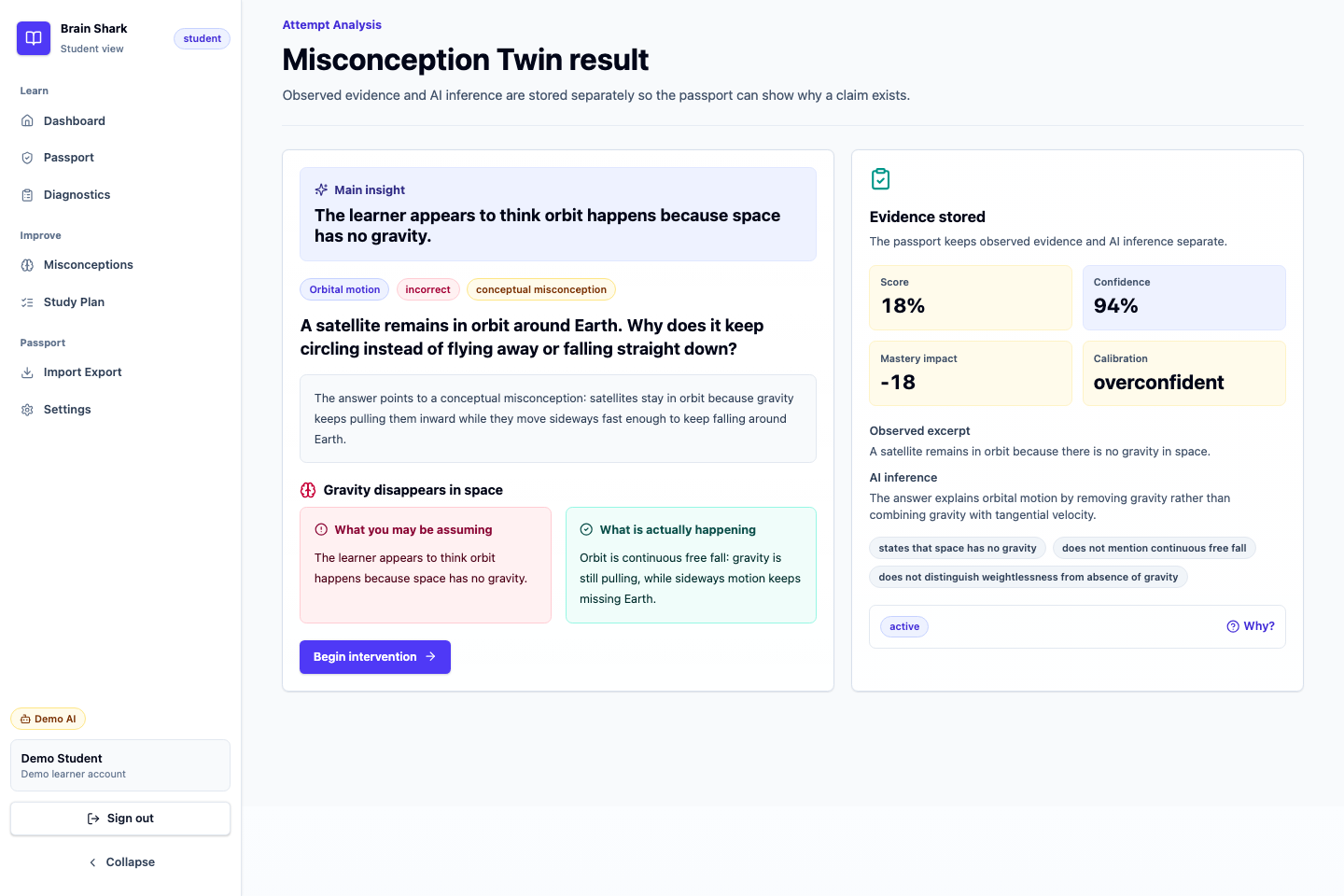
AI Misconception Analysis
-
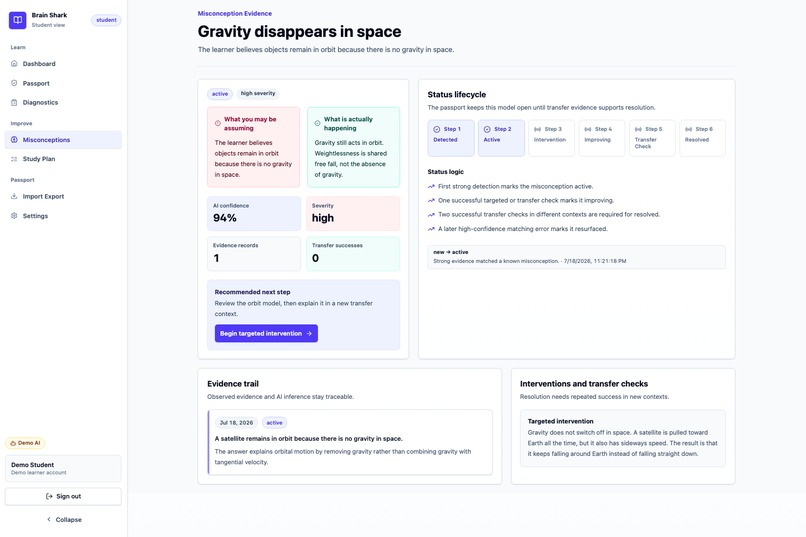
Misconception Tail
-
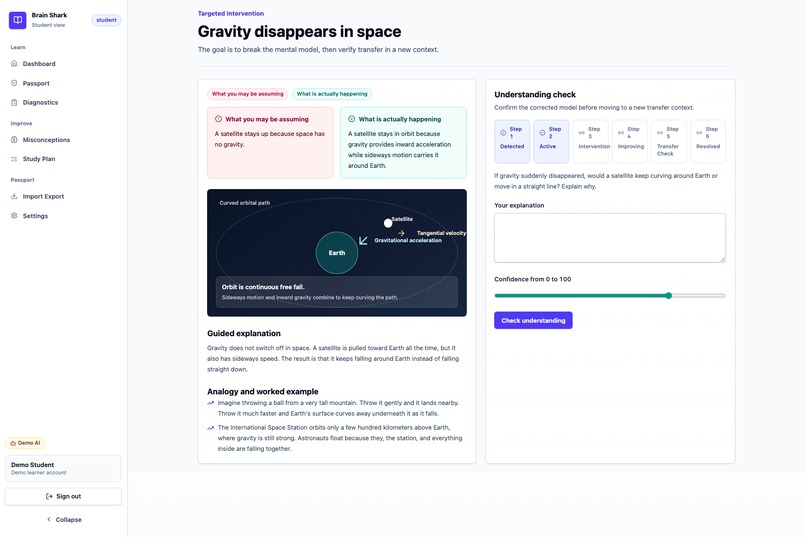
Guided Intervention
-
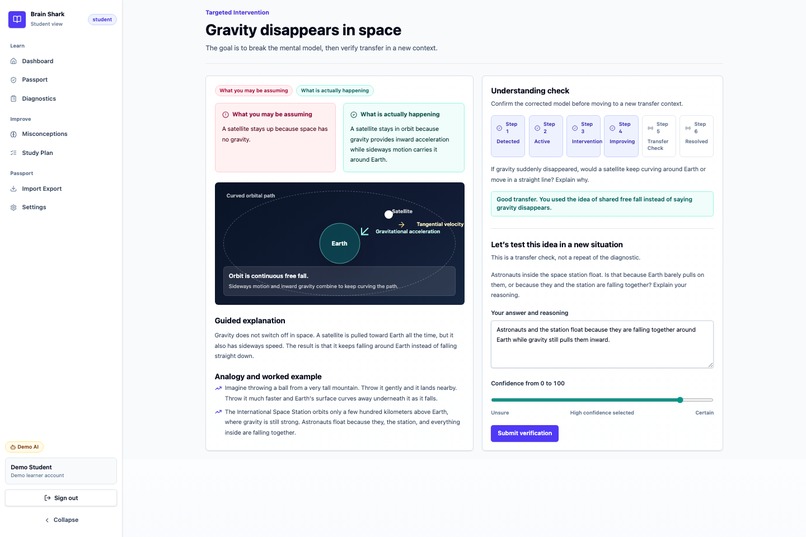
Transfer Verification
-
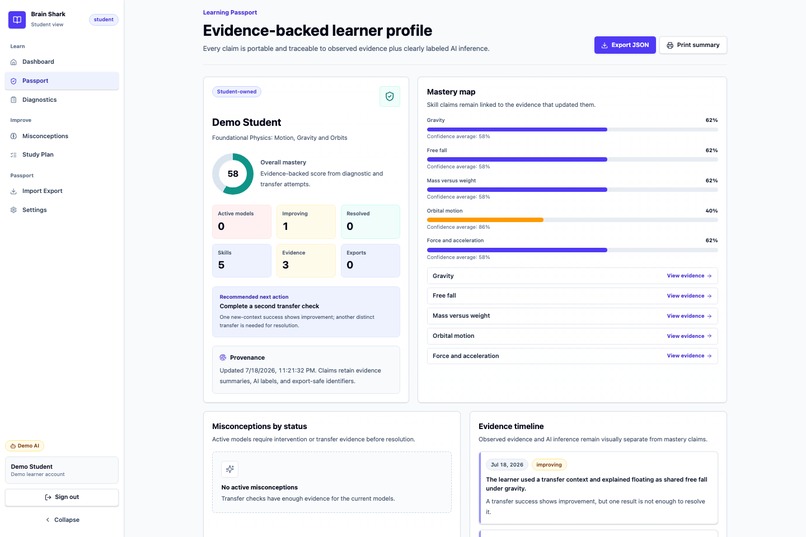
Learning Passport
-
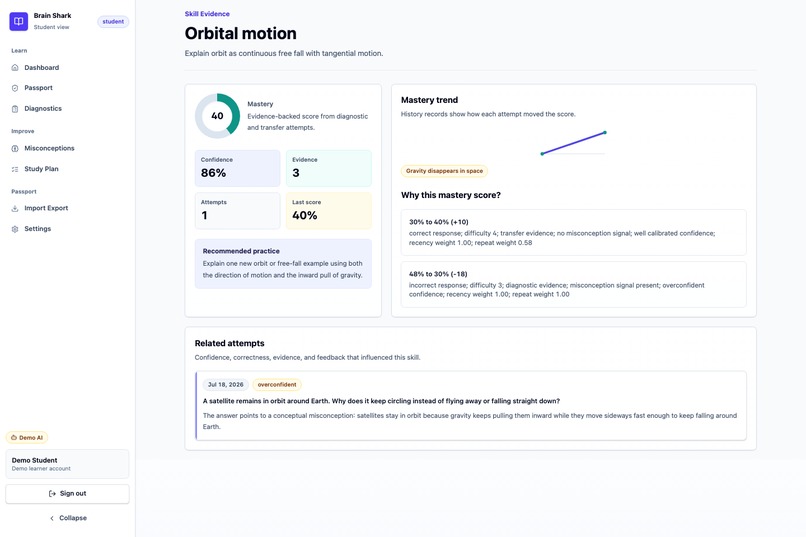
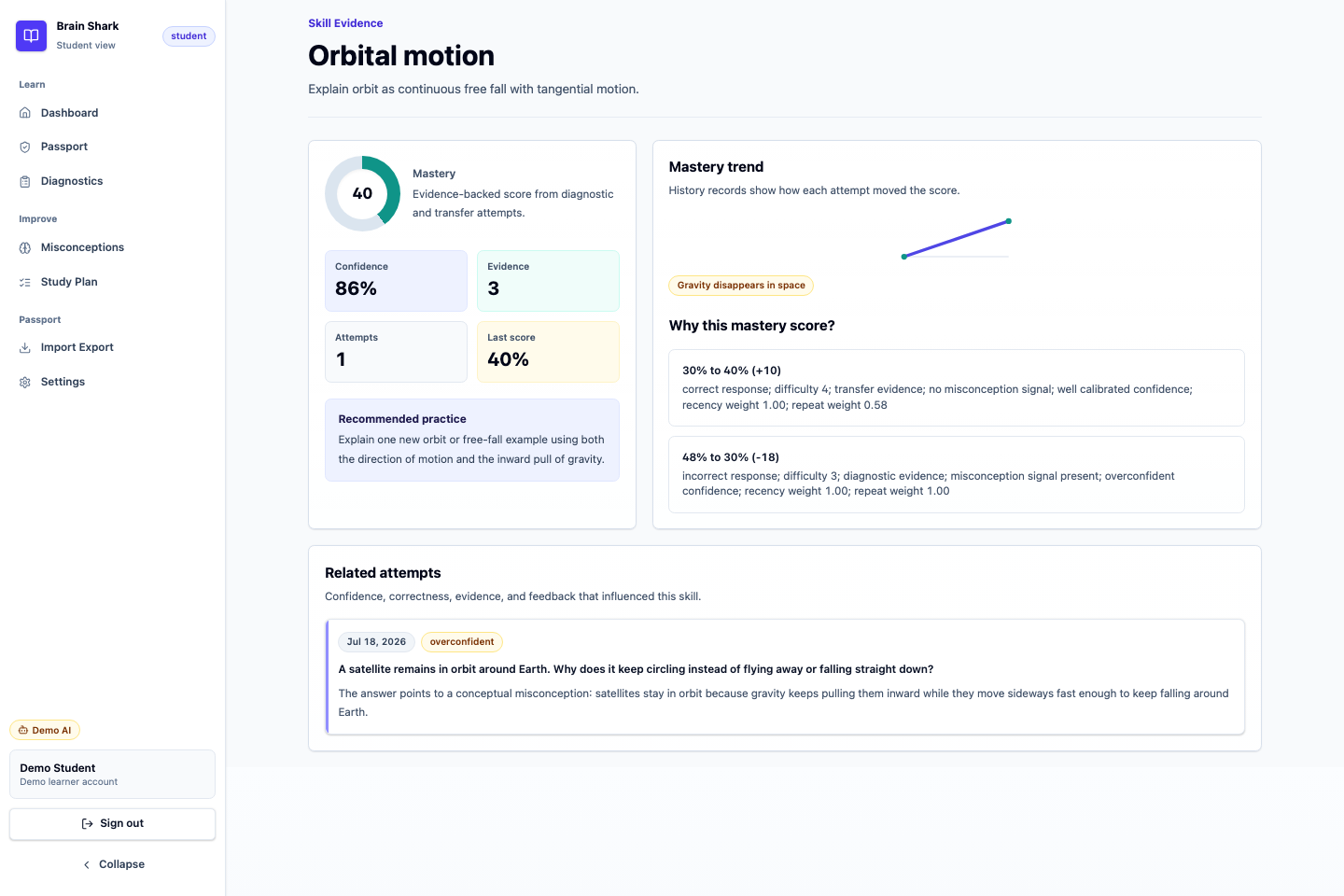
Skill Mastery
-
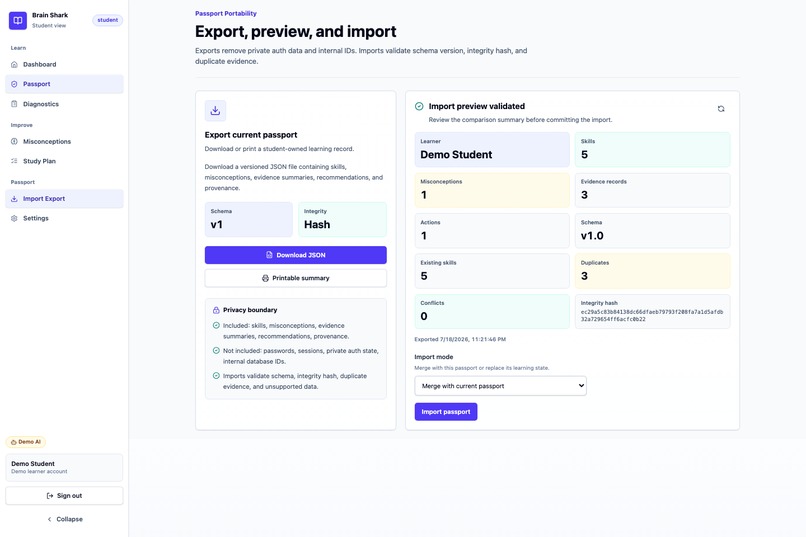
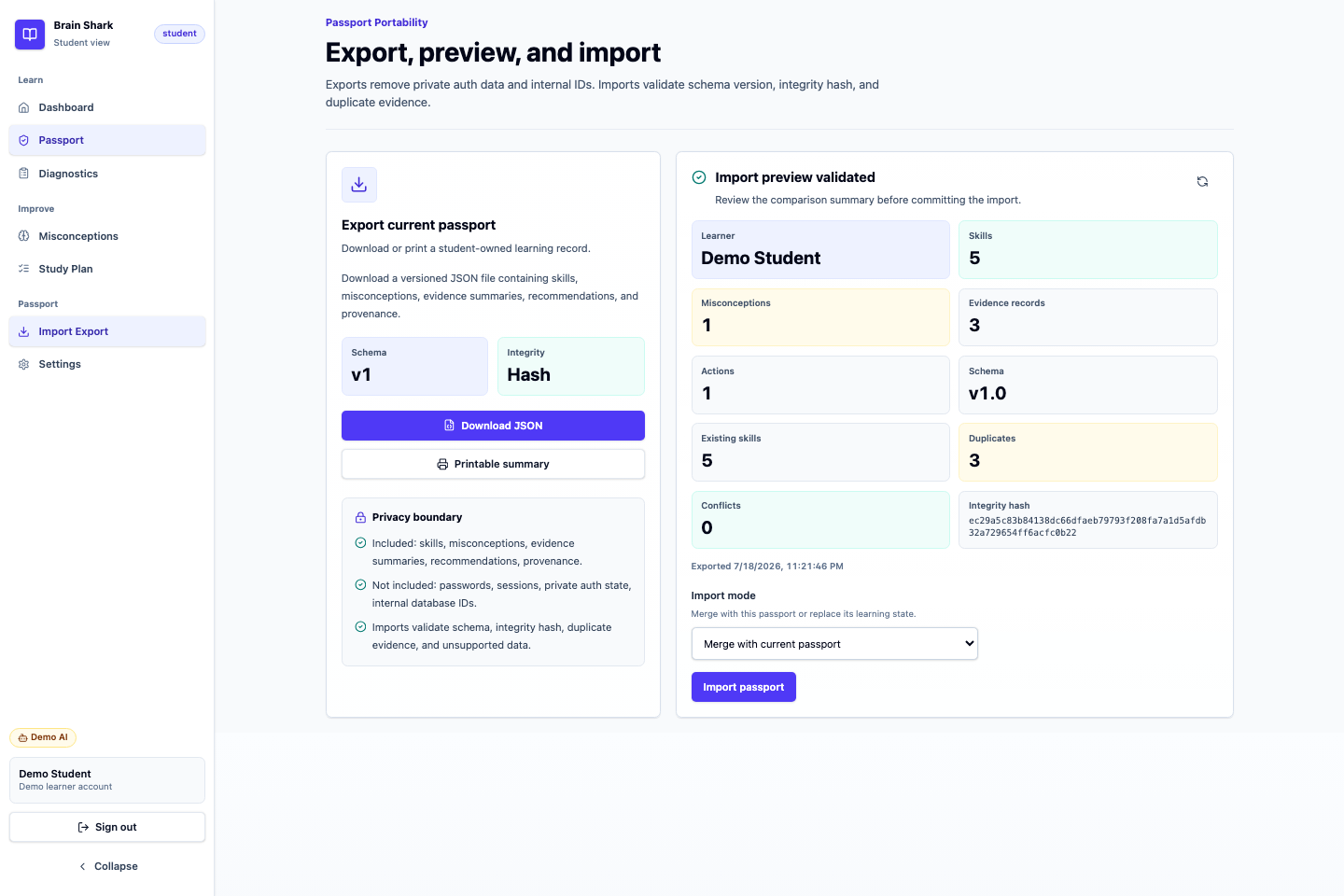
Passport Portability
-
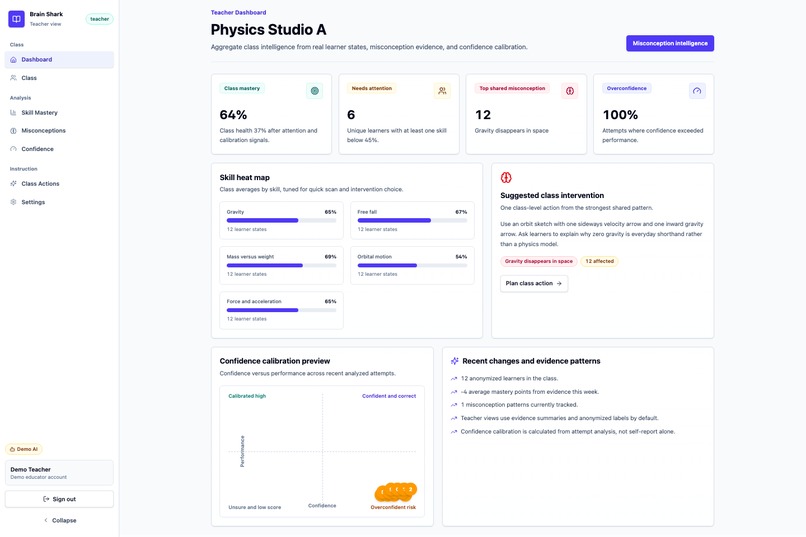
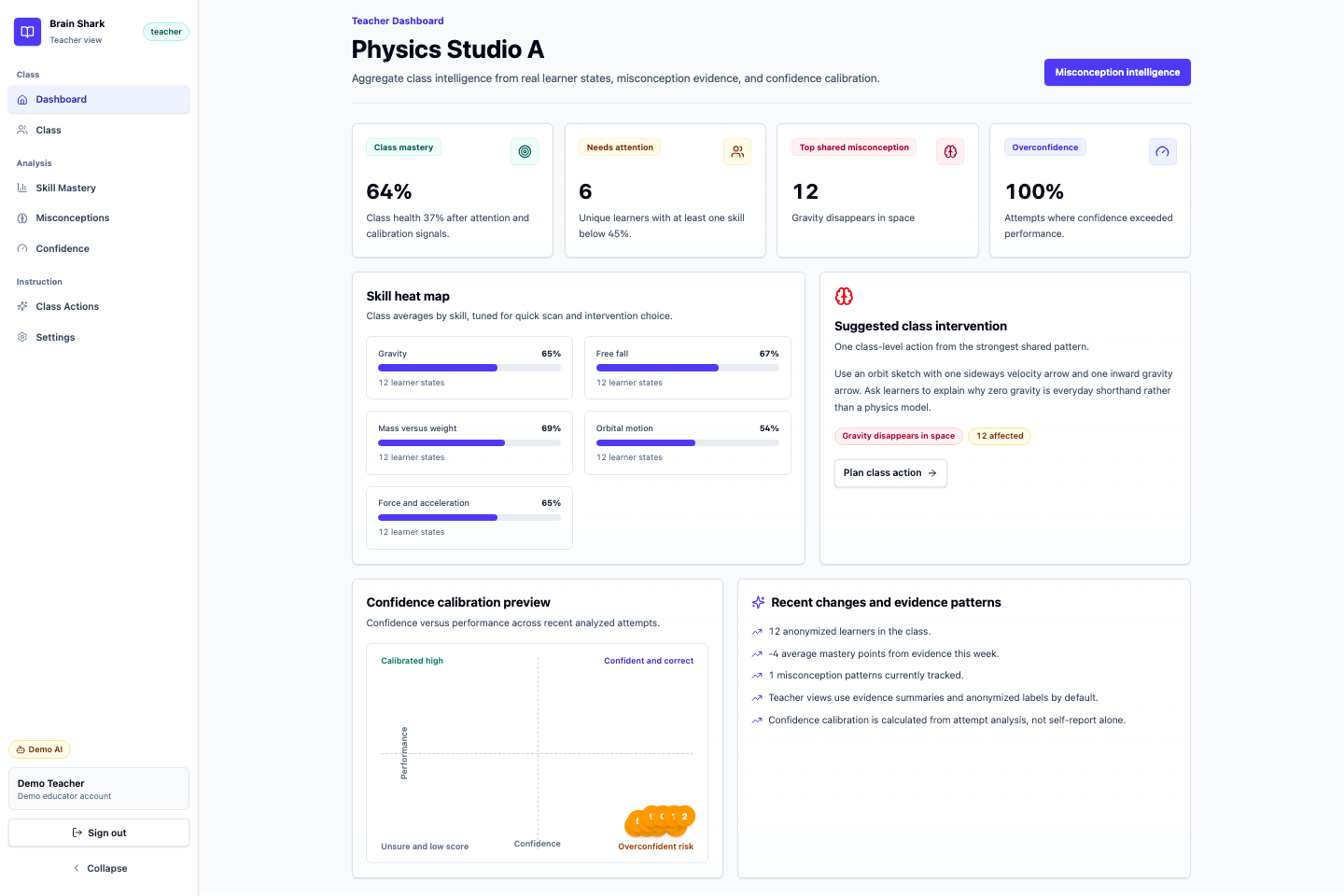
Teacher Dashboard
-
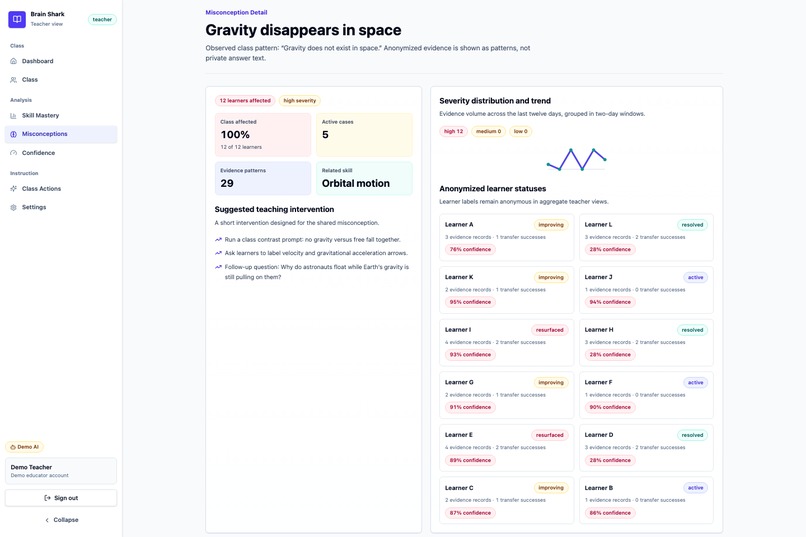
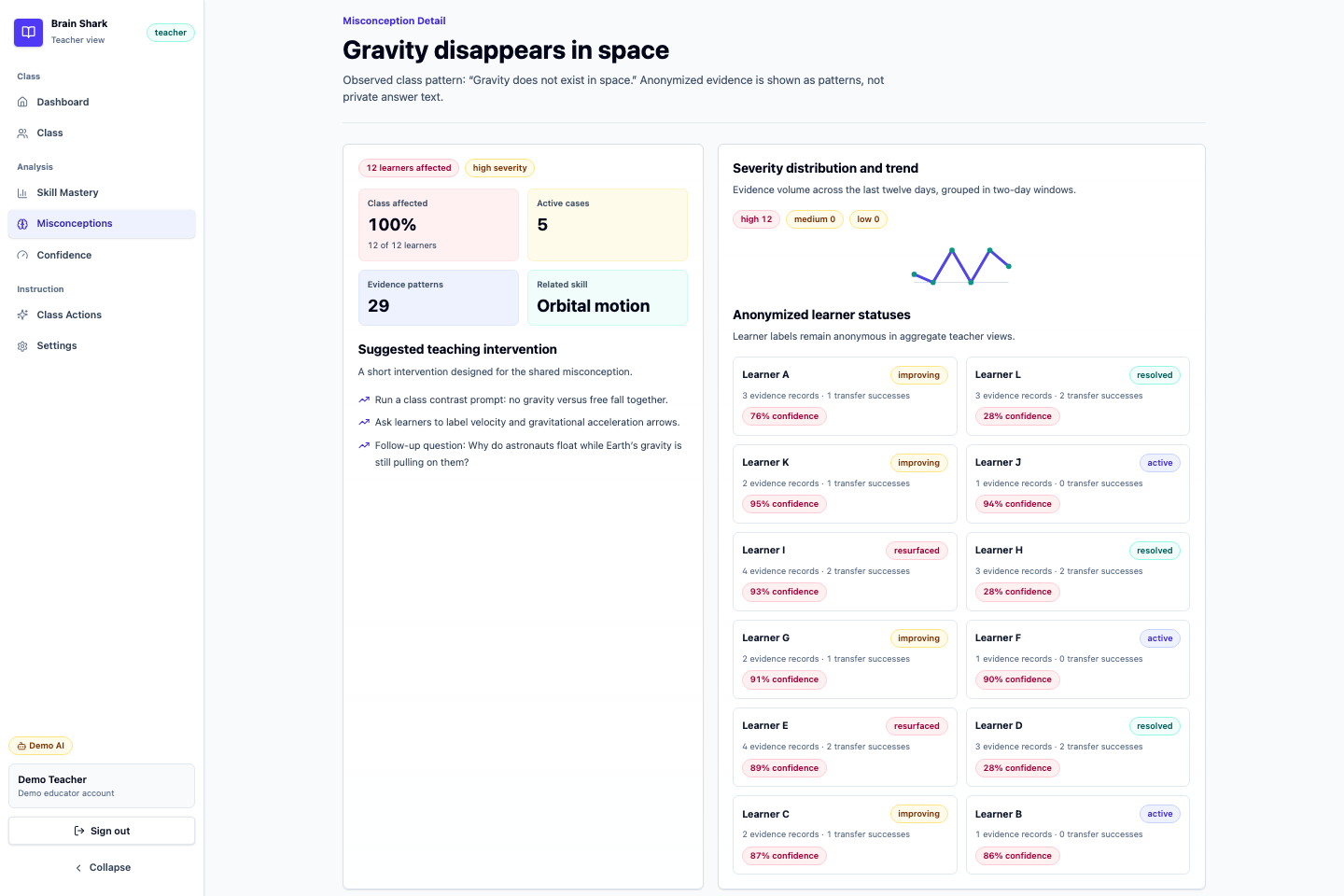
Class Misconception Intelligence
Inspiration
The student can sit for dozens of tests, repeat the same misconception many times, explain in detail his reasoning and yet every new tutoring session often starts from scratch. The tutor might remember the discussion, but they don’t have a structured, evidence-based understanding of what the learner knows, where they struggle and why they get things wrong.
We was inspired by a simple question:
What if a student could carry their learning history between tutors, courses, schools, and AI platforms?
That idea became Brain Shark: a portable AI learning memory owned by the student.
Instead of storing only scores, Brain Shark records mastery, misconceptions, confidence, interventions, verification attempts, and the evidence behind every conclusion.
We wanted to create an intelligence layer that helps any tutor understand the learner before the next lesson begins.
What Brain Shark does
Brain Shark creates a continuously updated profile of a student’s learning progress.
It tracks:
- Skill mastery
- Active and resolved misconceptions
- Confidence compared with actual performance
- Repeated mistake patterns
- Intervention history
- Verification evidence
- Recommended next learning actions
The core feature is the Misconception Twin.
When a student answers a question, the system analyses not only the final answer but also the learner’s explanation and confidence level.
For example, a student may answer:
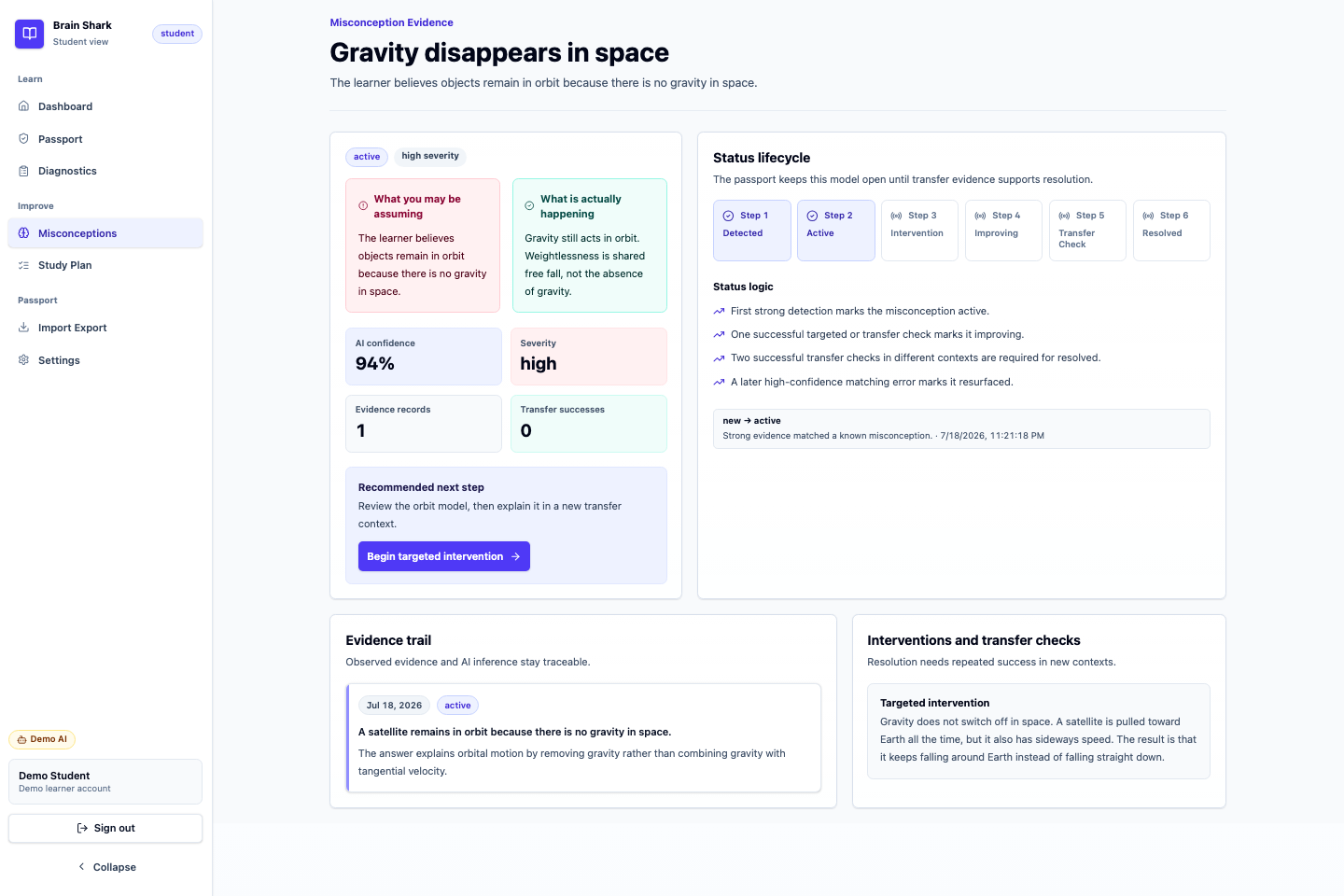
“A satellite remains in orbit because there is no gravity in space.”
A traditional assessment system marks the answer as incorrect.
Brain Shark goes further. It identifies the underlying mental model:
“Gravity disappears in space.”
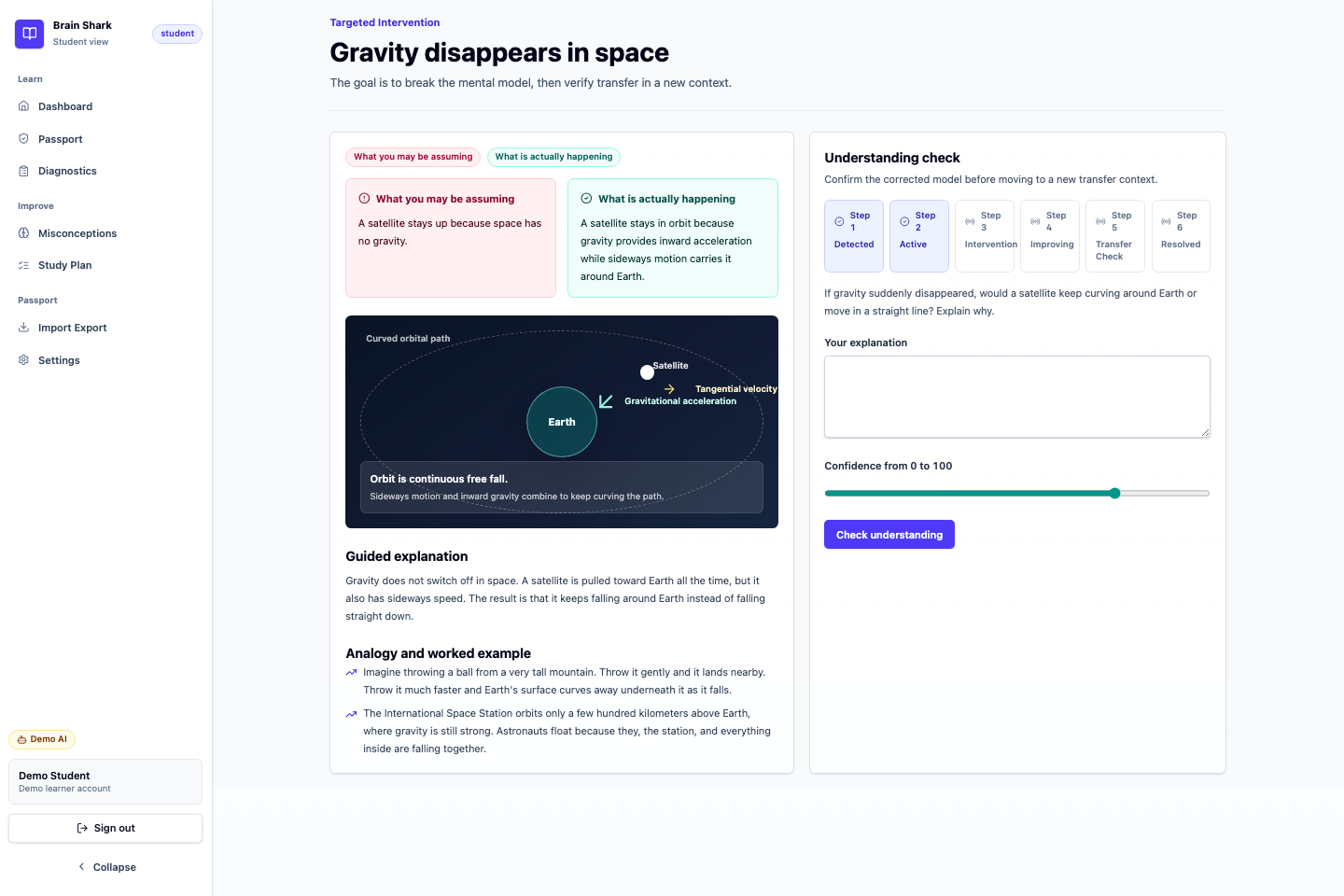
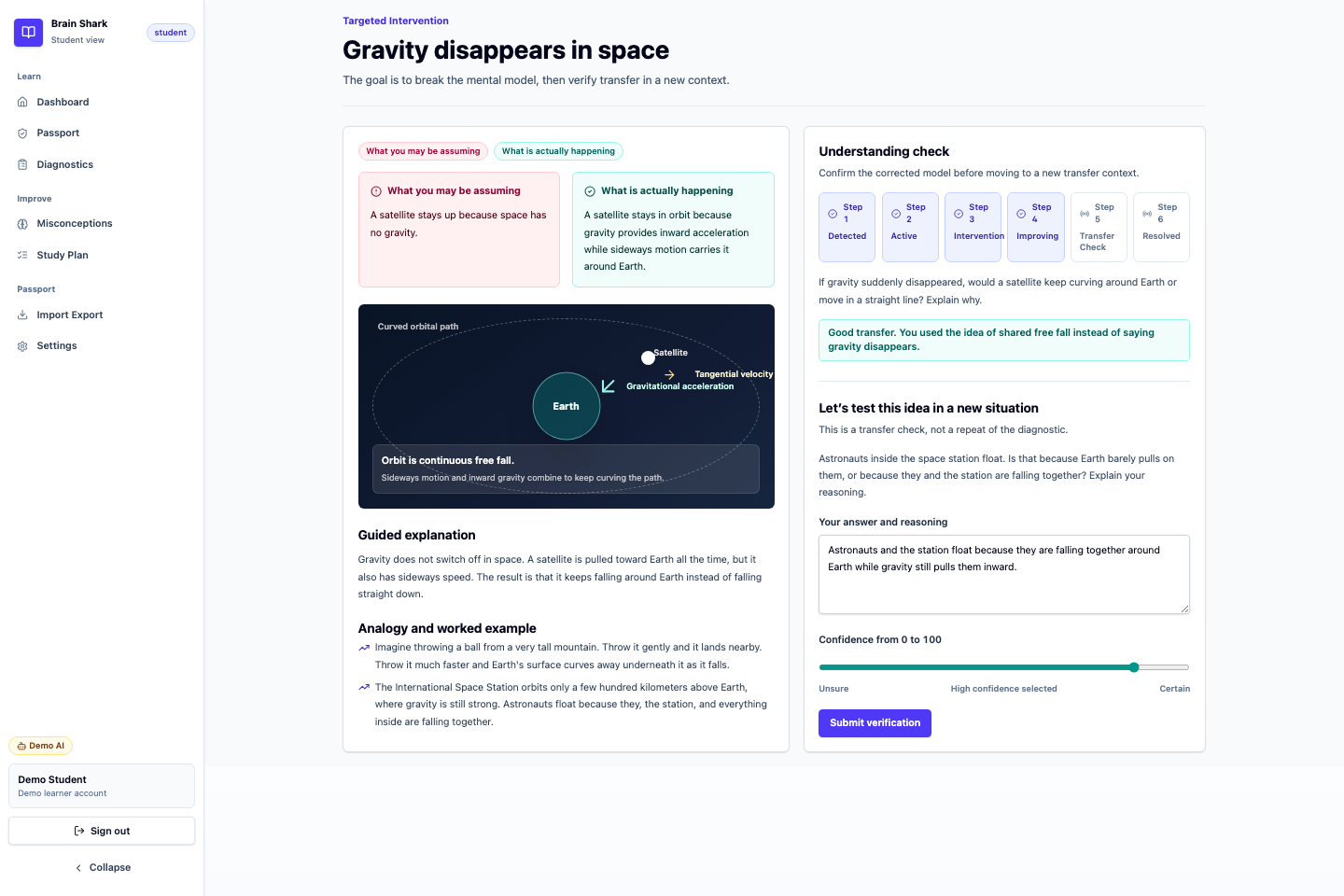
The system then provides the right concept, creates an intervention, poses another question with a different context, and checks if indeed the misconception has been addressed.
A misconception cannot be considered addressed after just one lucky guess on a multiple choice question. Evidence of learning should be shown using more than one piece of evidence, such as transfer questions.
Teachers also get anonymous information about their classes. For instance, a teacher may realize that a high proportion of the class has the misconception that heavy objects fall faster or that there is no acceleration in orbiting objects.
This makes sure that teachers address misconceptions before they become learning gaps.
How We developed it
Brain Shark was built as a full-stack education application with separate student and teacher experiences.
The application uses:
- Next.js
- React
- TypeScript
- Tailwind CSS
- shadcn/ui
- Prisma
- SQLite
- Zod
- The OpenAI Responses API
- Structured Outputs
- Codex for implementation and iteration
The AI layer is separated from the rest of the application through a provider architecture.
The main AI workflows are:
- Attempt analysis
- Intervention generation
- Verification evaluation
- Teacher insight generation
Every AI response is validated against a strict structured schema before it is saved.
The attempt-analysis workflow receives:
- The question
- The expected concept
- The student’s answer
- The student’s reasoning
- The student’s confidence
- Relevant previous learning evidence
It returns structured information such as:
- Correctness
- Mistake type
- Detected misconception
- Evidence signals
- Confidence calibration
- Mastery impact
- Recommended next action
The language model does not directly control the student’s mastery score. Instead, Brain Shark uses a deterministic scoring system around the AI analysis.
This makes mastery changes more transparent and prevents the model from assigning arbitrary scores.
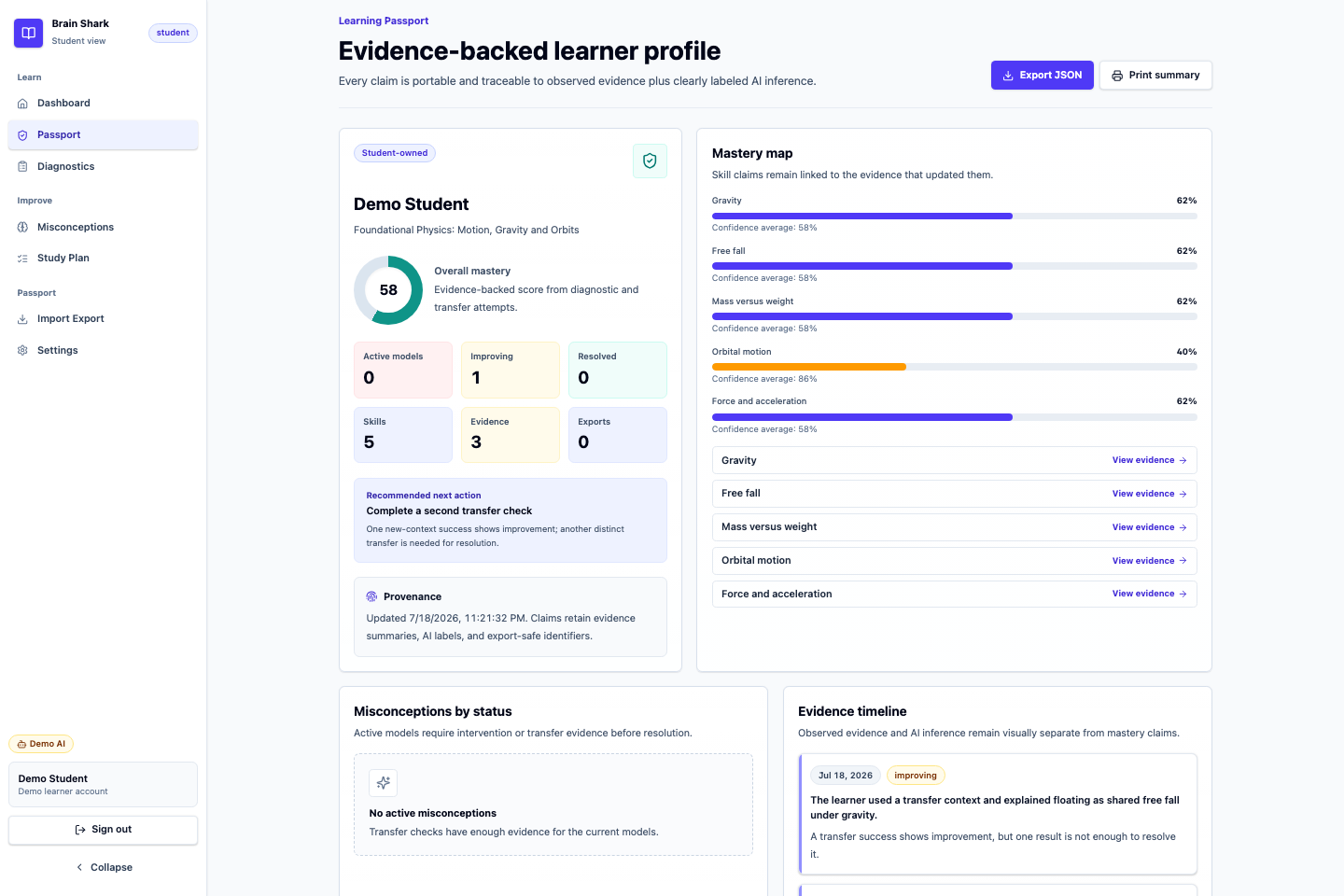
We already have developed a versioned Learning Passport JSON format. Students can export their learning profile and import it into another account or future learning system.
The exported passport includes:
- Skills
- Mastery history
- Misconceptions
- Evidence
- Recommendations
- Provenance
- Schema version
- Integrity hash
It excludes sensitive information such as passwords, sessions, private teacher data, and internal database identifiers.
Misconception lifecycle
One of the most important parts of the project was defining how a misconception changes over time.
Brain Shark uses five states:
suspectedactiveimprovingresolvedresurfaced
An initial misconception could be flagged as suspected due to inadequate evidence. With strong evidence supporting the misconception, it transitions to active.
A misconception that successfully receives a targeted intervention becomes an improving one.
The misconception only transitions into being resolved once the learner correctly answers a number of questions about its concept in different situations.
A recurrence of the same misconception elsewhere would make it resurface, not considered a totally new one.
Challenges we faced
Distinguishing mistakes from misconceptions
All mistakes do not mean a misconception.
The learner could have made a mathematical mistake, misinterpreted the question, guessed, forgotten an equation, or gave an insufficient explanation.
The issue we had to overcome is how to stop the AI from viewing all mistakes as misconceptions.
This problem was solved by giving clear definitions to mistakes and asking for evidence before classifying as a misconception.
Avoiding unsupported learner labels
The educational AI should take care when it comes to making conclusions.
Labels like slow learners, poor memories, and low intelligence were strictly avoided. Brain Shark only bases its conclusions on observable academic facts, not on any other assumptions made by AI.
Making mastery explainable
An opaque score will reduce the reliability of the product.
The updates on mastery have been designed based on deterministic criteria and an explanation is provided to students for each update in human readable form.
Verifying real learning
A correct answer does not always prove understanding.
Students may guess correctly or memorize the original explanation. I have already added transfer questions that test the same concept in a new context.
Protecting privacy in teacher analytics
Teachers need useful insights, but student reasoning can be personal.
Class-level dashboards anonymize learners by default and use aggregated data. Individual evidence is available only through authorized views.
Building a reliable live demo
APIs for AI services may not work due to key errors, rate limits, connectivity problems, or invalid structured data outputs.
For the project to remain testable, I have introduced a deterministic demo AI provider. The API shows the presence of demo mode and never provides fallback output as a real-time OpenAI response.
What we learned
We discovered that personalization is more than coming up with different explanations for each user.
Personalization includes memory, provenance, uncertainty, verification, and revision of earlier assumptions.
We have also found out that the confidence of a student matters.
The incorrect response with little confidence is treated differently from the incorrect response with high confidence; the latter could mean that there is a strong mental model that needs to be addressed.
Another key learning from our project was that AI should augment education, not substitute it.
The best combination is a language model analysis along with deterministic rules, validation, transparency for the teacher, and evidence-based state changes.
Finally, We discovered that portability might become an important part of the future of AI education. It means that students won't lose the history of their learning when they switch the tutor, the course, the school, or the platform.
What we are proud of
We are especially proud that Brain Shark is not only a dashboard or chatbot demonstration.
It supports a complete learning loop:
Attempt -> Analysis -> Misconception Detection -> Intervention -> Verification -> Passport Update
Every stage produces structured evidence that can be reviewed by the learner or used to improve future instruction.
What is next
The next version of Brain Shark could support:
- Multiple subjects and curriculum
- Institution-level integrations
- Teacher-created misconception catalogs
- LMS and assessment-platform integrations
- Parent-facing progress summaries
- Privacy-preserving cross-platform passport exchange
- Open standards for portable learner memory
- Multilingual explanations and interventions
- Long-term spaced-revision planning
- Support for competitive exams and professional certifications
My long-term vision is for every learner to have an AI tutor that does not merely remember previous messages, but genuinely understands how their knowledge is evolving.
Brain Shark: An AI tutor that remembers how you learn.
Built With
- analytics
- api
- artificial
- codex
- edtech
- education
- framer
- generative
- gpt-5.6
- intelligence
- learning
- motion
- next.js
- openai
- outputs
- personalized
- prisma
- react
- recharts
- responses
- sqlite
- student
- tutor
- typescript
- zod

Log in or sign up for Devpost to join the conversation.