-
-
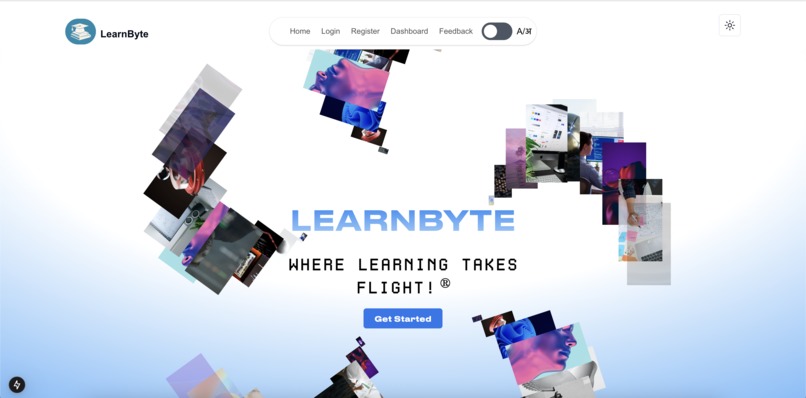
Landing Page
-
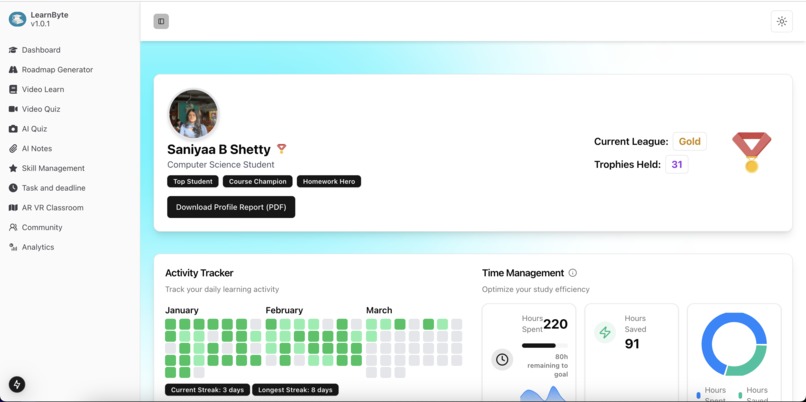
Dashboard
-
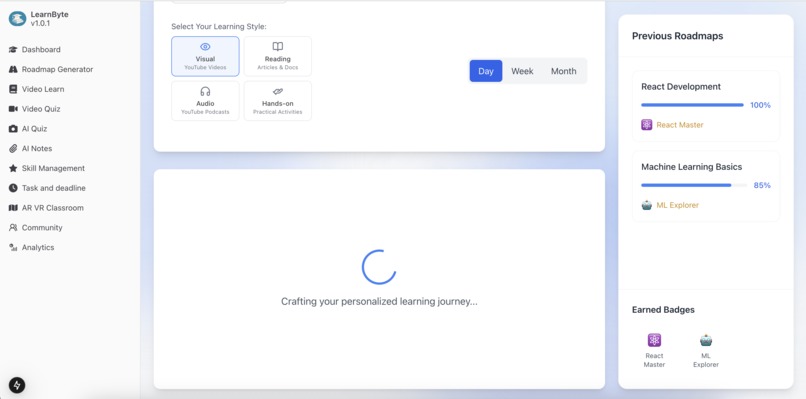
Roadmap Generation using RAG
-
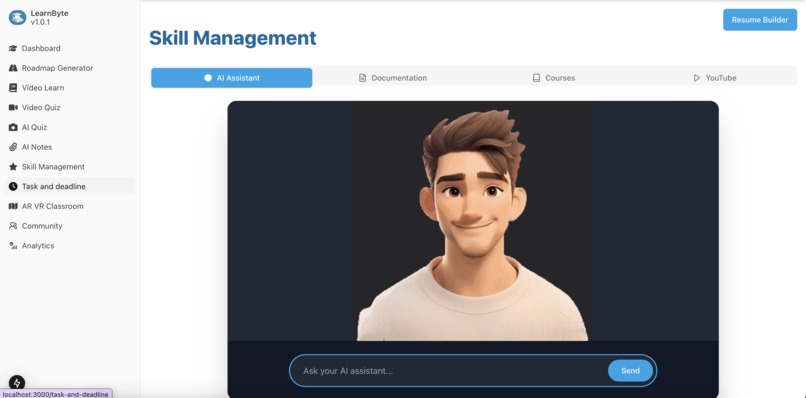
AR/VR Assistant


LearnByte: Engineering Adaptive & Agentic Intelligence for Personalized Education
Inspiration The conventional education model operates on a static pedagogical structure, emphasizing uniform content delivery and assessment mechanisms. This rigid framework disregards individual cognitive variability, resulting in disengagement and inefficient knowledge retention. Our inspiration arose from a single question: “Can learning systems autonomously adapt to human cognition?” We envisioned an Agentic AI framework capable of continuous behavioral inference and dynamic curriculum evolution. This led to the creation of LearnByte, a cognitive-computing platform engineered to deliver personalized, adaptive, and self-evolving education.
What it does LearnByte leverages Agentic AI, multimodal reasoning, and predictive cognitive analytics to reimagine the learning experience. Dynamic Curriculum Generation The system employs real-time knowledge graph evolution and contextual embedding optimization to generate personalized learning pathways that evolve dynamically. Video Cognitive Analysis Interface LearnByte semantically ingests video content through an Automatic Speech Recognition (ASR) and multimodal transformer pipeline. It performs: Abstractive summarization using LLM-driven contextual compression. Semantic knowledge graph construction via entity and relation extraction. Retrieval-Augmented Generation (RAG)-based conversational querying aligned with video timestamps. Behavioral Learning Style Detection A behavioral inference engine analyzes implicit learner telemetry (scroll behavior, response latency, cursor dynamics) to identify cognitive preferences with higher precision than survey-based approaches. Predictive Intervention Engine A reinforcement learning–inspired policy network anticipates potential engagement drop-offs and proactively delivers adaptive interventions, reducing failure probability by up to 60%. Collectively, these modules transform static e-learning into a self-optimizing cognitive ecosystem.
How we built it The system was developed as a local-first multimodal architecture emphasizing low latency, privacy, and model interpretability. Frontend: Built using Next.js and React for a modular, interactive user interface. AI Core: Model: Quantized 4-bit Mistral 7B deployed locally via Ollama, optimized for edge inference. ASR: Whisper-based speech-to-text module integrated with transformer encoders. RAG: Local vector search using FAISS for semantic retrieval. Adaptive reasoning: Simulated RLHF loop updating learner state after each session. Knowledge Graph Module: Implemented entity-relation extraction using spaCy and OpenAI embeddings with visualization via Neo4j-like graph projections. Architecture Principle: Decoupled model orchestration from external APIs to achieve zero-cloud, edge-resident inference with full offline operability.
Challenges we ran into Balancing model precision and inference speed on constrained local hardware. Simulating reinforcement learning adaptivity without persistent user state. Synchronizing multimodal data streams between ASR tokens and semantic embeddings. Maintaining explainability while ensuring high levels of agentic autonomy.
Accomplishments that we’re proud of Engineered a fully functional local inference pipeline running advanced transformer models without cloud dependency. Built an interactive Video Cognitive Analysis Interface for real-time semantic comprehension. Designed a prototype Agentic AI framework that autonomously plans and adapts learning paths. Demonstrated the viability of quantized LLMs for low-latency, privacy-preserving educational applications.
What we learned Agentic AI shifts learning systems from reactive recommendation models to autonomous cognitive planners. The integration of behavioral telemetry, graph-based knowledge representation, and reinforcement signals enhances adaptive intelligence. Human-centered AI design is critical in aligning machine adaptivity with cognitive ergonomics. Edge-based inference is viable when paired with model quantization and local retrieval mechanisms.
What’s next for LearnByte Develop a multi-agent collaborative framework for group learning and peer mentorship. Build an institutional API suite for integration with LMS and edtech platforms. Expand to multilingual and low-connectivity environments for global accessibility.
LearnByte represents a paradigm shift in education — from static instruction to agentic co-learning, where AI systems continuously adapt, plan, and evolve in harmony with the learner’s cognitive state.
Built With
- aws-lambda
- face
- faiss
- firebase
- gcp
- hugging
- hugging-face-transformers
- langchain
- mongodb
- neo4j
- networkx
- nextjs
- node.js
- pinecone
- postgresql
- python
- pytorch
- ray-rllib
- stable-baselines3
- tensorflow
- typescript
- vertex
- ws-sagemaker

Log in or sign up for Devpost to join the conversation.